
Sponsored

Unethical charging question?

waitingonanr1s

Well-Known Member
Joined
May 18, 2023
Threads
22
Messages
755
Reaction score
1,156
Location
Colorado
Vehicles
2025 Tri-Max R1S (CA Dune Edition), 2023 QM R1S (Traded in May 2025)
You obviously didn't read my first post. I charge AT HOME (Level 2) about once a week when my SOC gets below 20%. If you believe that this is adversely "deteriorating" the battery, then you are mis-informed. If I was doing this at a DCFC (Level 3) which I am not, then your assumption would be more correct.
We are getting ready to have lots of case studies in the charging to 100% at DCFC all the time thanks to all the free charging crowd that does it. Will be interesting to see how those batteries hold up. Most with free charging seem to do that - including my brother using his GV70. It's hard to even have the time argument with him since it has such a great charging curve. Of course he's not worried about it since it's a lease. ?
Sponsored


SPITmadFIRE

Well-Known Member
Joined
Jul 27, 2021
Threads
10
Messages
842
Reaction score
1,388
Location
CA
Vehicles
2024 R1S PDM Max Pack 20" AT
You obviously didn't read my first post. I charge AT HOME (Level 2) about once a week when my SOC gets below 20%. If you believe that this is adversely "deteriorating" the battery, then you are mis-informed. If I was doing this at a DCFC (Level 3) which I am not, then your assumption would be more correct.
My entire point is that it's better for your battery to charge to a lower SOC more often. You charge at home once a week; why not charge to 80% and just plug in whenever you hit 20% if you're not using the entire battery in one go? It just doesn't make sense to charge to 100% every 7 days.

Battery degradation doesn't just come from DCFCs; it also comes from high state of charge alone. Your vehicle doesn't have a default 70% limit because DCFC charging above that would cause additional wear. It's because NMC battery chemistries do not like being charged to high state of charge, at all. The longer they sit at 100% and the hotter it is while they're fully charged, the worse the degradation.
 

SwampNut

Well-Known Member
First Name
Carlos
Joined
Apr 22, 2024
Threads
50
Messages
3,386
Reaction score
3,595
Location
Peoria AZ
Vehicles
2022 R1T Launch Edition
Occupation
Geek
Clubs
 
I've never once charged to 100%. I don't understand how the hell you're all driving where you need to charge to 100%. You're just wasting your own time doing it more than anything.
LOL, what? Why the hell would you short-change yourself by leaving for a trip at less than 100%? Or do you just never take any trip where you have to charge?
 

ActionableDave

Well-Known Member
First Name
David
Joined
Sep 14, 2023
Threads
2
Messages
111
Reaction score
74
Location
Temecula, CA
Vehicles
R1S Launch Edition, LA Silver 22 Sport Bright
Occupation
Market Research Executive
There certainly IS battery degradation, but you should use the vehicle as you need to; I don't need to drive far daily these days, but when I do have a busier outbound week, I set it for 95 - 100%, and when I don't I go to 90%.

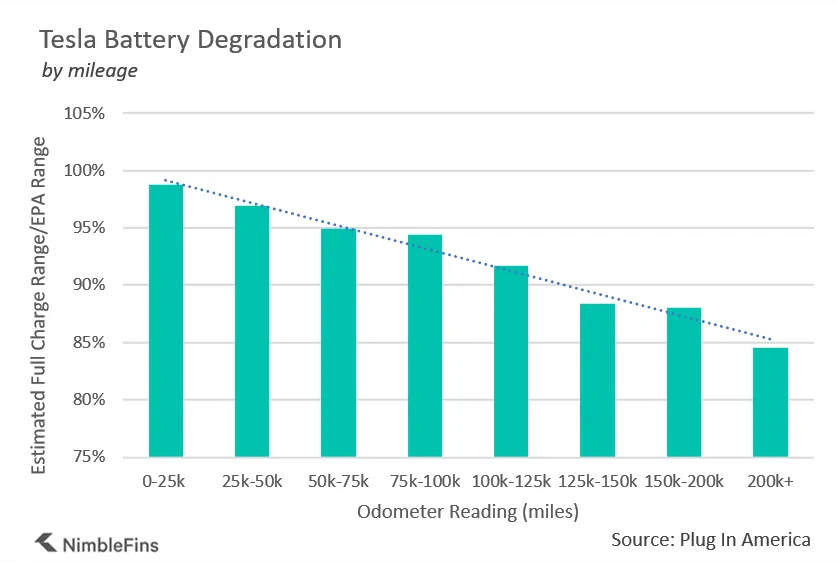
According to 9 years of data collected from Plug In America for Model S vehicles between 2013 and 2022, it shows degradation, but not dramatic degradation IMO for the first 100K - 125K miles. See the chart below:

Rivian R1T R1S Unethical charging question? 1725310128910-25


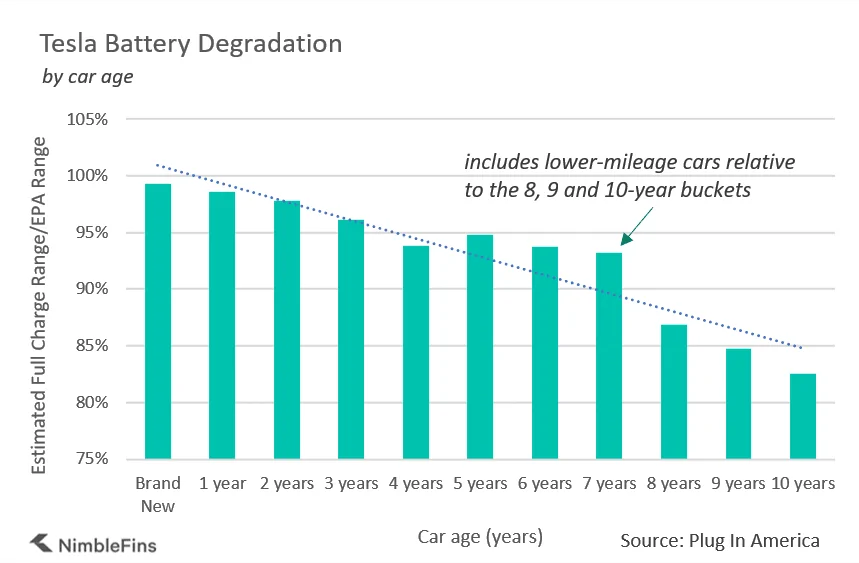
There is a similar chart for time:

Rivian R1T R1S Unethical charging question? 1725310300048-n6


Note after 3 years, there is only degradation down to 96% and at 5 years, slightly under 95%. Not zero, but certainly not significant. My recommendation is to charge the vehicle as you need to, and try to care for the battery as much as possible, because it is the right thing to do. :)
 

ActionableDave

Well-Known Member
First Name
David
Joined
Sep 14, 2023
Threads
2
Messages
111
Reaction score
74
Location
Temecula, CA
Vehicles
R1S Launch Edition, LA Silver 22 Sport Bright
Occupation
Market Research Executive
One more tidbit on charging; see this study from another reasonably reputable source:

Report: Supercharging Doesn’t Degrade Tesla Battery Life (batterytechonline.com)

The experts at Recurrent studied fast charging on more than 12,500 Tesla vehicles in the US, comparing cars that fast charge at least 90% of the time with those that fast charge less than 10% of the time. Their results showed no statistically significant difference in range degradation between the two groups of Teslas.

The Recurrent study gives further credence to Tesla’s own claims regarding battery degradation over time. In its most recent Impact Report, Tesla stated that it has more than ten years’ worth of data to draw on, and that data shows that “Even after 200,000 miles of usage, our batteries lose just 12% of their capacity on average.”
 

Sponsored

MountainPassPerformance

Well-Known Member
Site Sponsor
First Name
Sasha Anis
Joined
Jan 19, 2024
Threads
11
Messages
142
Reaction score
366
Location
Toronto, Canada
Vehicles
Rivian R1T, Tesla Model Y, Tesla Model 3
Occupation
Owners of Mountain Pass Performance
I wouldn't say you have a responsibility to the future owner of your truck, but I think taking care of the battery is a good habit that will transfer to your next vehicle!
 

SparkyR1t

Well-Known Member
Joined
Apr 5, 2023
Threads
2
Messages
380
Reaction score
388
Location
Chicago
Vehicles
R1t/Model Y
Occupation
Retired Commercial Electrician and mechanic
Charging to a high level of battery power while not ideal does not necessarily destroy the battery. I would also review the terms of your lease I doubt it addresses this issue as it is kind of a non issue over a short period of time.
 

Mathme

Well-Known Member
First Name
Matt
Joined
Jul 25, 2022
Threads
3
Messages
1,377
Reaction score
1,809
Location
Los Altos, CA
Vehicles
R1T: El Cap, OC, 20AT, Off road package
Occupation
High Tech
For daily driving, I charge when the battery gets to about 20-30% and then up to 80%. I find this is plenty of capacity for multiple days of driving. For daily driving in an EV, I think there's a mental mind shift that has to happen from driving a ICE. When in an ICE, you always fill it up to 100% as it's a special stop for just that process whereas when you're in BEV, you can charge to 70-80% and never really need to use that extra capacity for most daily driving.

When I get ready to go on a roadtrip, I will charge to 100% and I plan my L2 charging so that I get to 100% fairly close to when I'm planning to leave for said trip. If there's to be any L3 charging stops on that trip, I typically charge to 80-85% as that's typically enough to get me to the next charging stop. Going any higher than that for a charge usually isn't worth the Time involved while sitting at the charger -- with the notable exception when at a RAN with an REI having a sale next to it and we need that extra time to find a few more bargains. :rock:
 

SwampNut

Well-Known Member
First Name
Carlos
Joined
Apr 22, 2024
Threads
50
Messages
3,386
Reaction score
3,595
Location
Peoria AZ
Vehicles
2022 R1T Launch Edition
Occupation
Geek
Clubs
 
I love this thread. It made me realize that obsessing over battery care, or even giving one damn, is stupid. I will never keep the car outside of warranty. Liberating. Charge it like you stole it!

Now, my Zero, different story. Probably gonna die still riding that one.
Sponsored


Top