

ksurfier
Well-Known Member
- Thread starter
- #1
Simple efficiency reminders: Key variables that affect MPK
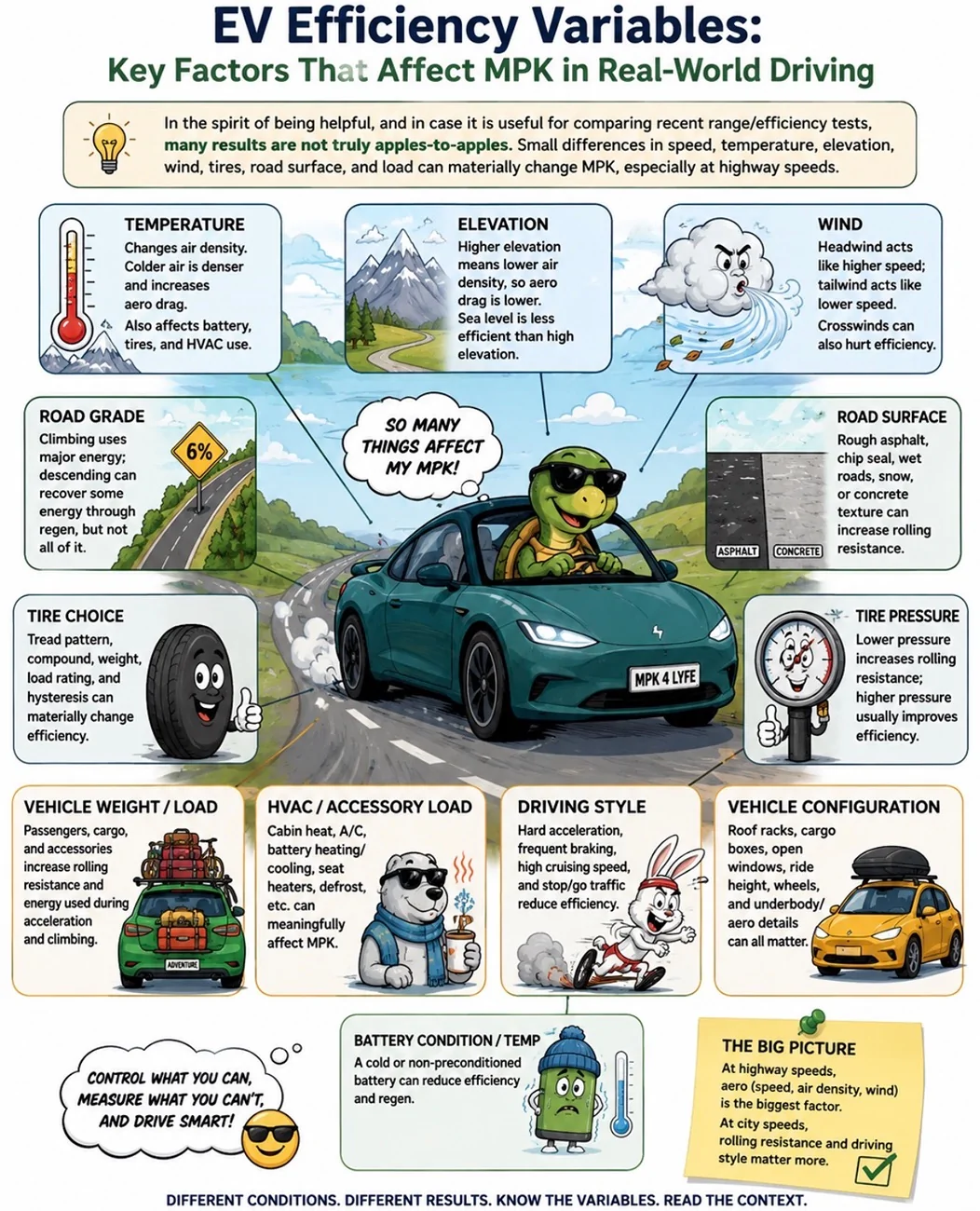
In the spirit of being helpful, and in case it is useful for comparing recent range/efficiency tests, many results are not truly apples-to-apples. Small differences in speed, temperature, elevation, wind, tires, road surface, and load can materially change MPK, especially at highway speeds.
* Speed — biggest driver; aero drag rises roughly with speed squared, and power demand rises roughly with speed cubed.
* Temperature — changes air density; colder air is denser and increases aero drag. Also affects battery, tires, and HVAC use.
* Elevation — higher elevation means lower air density, so aero drag is lower; sea level is less efficient than high elevation.
* Wind — headwind acts like higher speed; tailwind acts like lower speed. Crosswinds can also hurt efficiency.
* Road grade — climbing uses major energy; descending can recover some energy through regen, but not all of it.
* Road surface — rough asphalt, chip seal, wet roads, snow, or concrete texture can increase rolling resistance.
* Tire choice — tread pattern, compound, weight, load rating, and hysteresis can materially change efficiency.
* Tire pressure — lower pressure increases rolling resistance; higher pressure usually improves efficiency but can affect comfort/traction.
* Vehicle weight/load — passengers, cargo, and accessories increase rolling resistance and energy used during acceleration/climbing.
* HVAC/accessory load — cabin heat, A/C, battery heating/cooling, seat heaters, defrost, etc. can meaningfully affect MPK.
* Driving style — hard acceleration, frequent braking, high cruising speed, and stop/go traffic reduce efficiency.
* Vehicle configuration — roof racks, cargo boxes, open windows, ride height, wheels, and underbody/aero details can all matter.
* Battery condition/temp — a cold or non-preconditioned battery can reduce efficiency and regen.

In the spirit of being helpful, and in case it is useful for comparing recent range/efficiency tests, many results are not truly apples-to-apples. Small differences in speed, temperature, elevation, wind, tires, road surface, and load can materially change MPK, especially at highway speeds.
* Speed — biggest driver; aero drag rises roughly with speed squared, and power demand rises roughly with speed cubed.
* Temperature — changes air density; colder air is denser and increases aero drag. Also affects battery, tires, and HVAC use.
* Elevation — higher elevation means lower air density, so aero drag is lower; sea level is less efficient than high elevation.
* Wind — headwind acts like higher speed; tailwind acts like lower speed. Crosswinds can also hurt efficiency.
* Road grade — climbing uses major energy; descending can recover some energy through regen, but not all of it.
* Road surface — rough asphalt, chip seal, wet roads, snow, or concrete texture can increase rolling resistance.
* Tire choice — tread pattern, compound, weight, load rating, and hysteresis can materially change efficiency.
* Tire pressure — lower pressure increases rolling resistance; higher pressure usually improves efficiency but can affect comfort/traction.
* Vehicle weight/load — passengers, cargo, and accessories increase rolling resistance and energy used during acceleration/climbing.
* HVAC/accessory load — cabin heat, A/C, battery heating/cooling, seat heaters, defrost, etc. can meaningfully affect MPK.
* Driving style — hard acceleration, frequent braking, high cruising speed, and stop/go traffic reduce efficiency.
* Vehicle configuration — roof racks, cargo boxes, open windows, ride height, wheels, and underbody/aero details can all matter.
* Battery condition/temp — a cold or non-preconditioned battery can reduce efficiency and regen.
Sponsored
Last edited:


