Sponsored

Dark-Fx

Well-Known Member
First Name
Brian
Joined
Jul 15, 2020
Threads
148
Messages
13,583
Reaction score
27,429
Location
Michigan
Vehicles
R1T, R1S, Livewire One, Sierra EV, R1S
Occupation
Engineering
Clubs
 
Here I am, clicking this thread thinking it's about the Quad range estimates..
4x 201 kW @ 5252 RPM = 1078 HP.
Sponsored


Supratachophobia

Well-Known Member
Joined
Apr 8, 2023
Threads
9
Messages
1,781
Reaction score
2,122
Location
Ohio
Vehicles
S
Clubs
 
Rivian will be out of business or acquired by 2030 at this rate. Their product won’t sell in Europe, elsewhere without 800v. And in the US, they’ll continue to face strong competition from incumbent OEMs.

BMW’s new EV platform coming out across their entire line up has 800V, up to 400kw charging, and great range.

At some point, even US consumers will start comparing and make their choices. It doesn’t matter whether one “needs” 400v. It’ll be like a horsepower contest, where all else equal, consumers will choose the one with the higher horsepower.

800v isn't going to sink or swim anyone. You think any more than 5% of EV owners can even recall what voltage their EV is??

If it makes you feel better, the max pack is over 450v and the EV9 is something line 650v. Those are "claimed" to be 400v and 800v respectively.

 

CharonPDX

Well-Known Member
First Name
Charon
Joined
Jul 12, 2021
Threads
31
Messages
2,508
Reaction score
4,187
Location
Cascadia
Vehicles
'22 R1T LE, '16 Model S, '19 Arcimoto FUV
Occupation
InfoSec Geek
Clubs
 
Why does the Quad Max on 22" T weigh less than S; but on 20" T weighs more? Are they using different 20" wheels on the T than the S?
 

jaredm

Well-Known Member
First Name
Jared
Joined
Jan 30, 2025
Threads
4
Messages
50
Reaction score
119
Location
PNW
Vehicles
2024 R1T
The 20"s imply the AT package, which is not the same between the T and the S. The extra spare is heavy, and I'm guessing the underbody protection is also larger.
 

DuoRivians

Well-Known Member
Joined
Dec 30, 2022
Threads
258
Messages
3,814
Reaction score
9,091
Location
California
Vehicles
R1T, R1S
800v isn't going to sink or swim anyone. You think any more than 5% of EV owners can even recall what voltage their EV is??

If it makes you feel better, the max pack is over 450v and the EV9 is something line 650v. Those are "claimed" to be 400v and 800v respectively.
It’s about charging speed. While one can wait longer at DCFCs, no one wants to be forced to. 350kw is certainly faster than 200kw.

Yeah, no one “cares” about the voltage. But they do care about how fast they can charge and go. Especially for larger vehicles.

If Rivian miraculously introduced 800v/350kw charging tomorrow, half of us would be complaining about how their cars are now obsolete and half of us would be busy upgrading. Very few of us will be saying, “I’m totally content with 400v.”
 
Last edited:

Sponsored

Kaiju

Well-Known Member
Joined
Aug 18, 2024
Threads
2
Messages
136
Reaction score
254
Location
Texas
Vehicles
R1T
BMW iX3, launching this year 2025, will have 800v, 400kw charging with 400 mile EPA range. Also with zonal and software defined architecture.

https://www.autoblog.com/news/bmw-ix3-the-electric-suv-ready-to-shake-up-the-ev-world

How is Rivian supposed to compete with this with their R2? 400V, 200kw, 300 mile EPA range.

The R1 is Rivian’s “flagship” product, so I would think Rivian can splurge on it a bit, to figure out the battery tech and eventually pass it onto the R2 and other vehicles. And the R1 quad max is the highest priced vehicle. So, I was a bit disappointed that Rivian didn’t take the opportunity to try it out.

Hypothetically, if the R1 quad max were 800v yet cost $15k more over R1 tri max, I think consumers would still buy the quad max for the 800v.
The simple fact is the BWM costs a lot more, at least as far as projected sticker prices go. Even Kia has admitted that its E-GMP platform costs more than a 400V equivalent despite the fact it's not on super expensive cars, which is one reason they actually redesigned a bunch of stuff to revert to 400V on their low end. The new E4 is something like 38k to the R2's 45k. Is someone going to pay $15k more to get that BWM just for 6 or 7 minutes faster on DCFC?

You're probably right in that the R1 will start to look like it's missing something if all the competition in its price range can do 350kW charging, which may be a fair point at the 100k range. The real question though is how much it would actually cost. Personally I don't think they could do it just for one part of the R1 line simply because it would involve an entirely different set of parts for the drive train that weren't interchangeable with any of the other R1 models and it'd be a mess for production. You'd have to sink all the R&D expenses in a fairly tiny number of vehicles, which has an outsized impact on their cost. So it stands to reason you'd make the change for all the R1s and use the same set of 800V battery packs, inverters, harnesses and motors across them along with the extra hardware to be backwards compatible with 400V stations.

Given the Gen 2 refresh with a large number of production changes just happened, I'm a little curious why there was no movement there because I'm sure they must have weighed changing from 400V. So the question is if every R1 cost 5k more, or even 3k more with 350kW charging, would people already complaining about the Gen 2 prices be enticed to buy it? It's pretty easy to hide that in a 120k quad max, but it's a bit of a hard sell on basically any model that wasn't already maxed out as basically anyone that's not buying top trim would have to give something else up for it.

 

Dark-Fx

Well-Known Member
First Name
Brian
Joined
Jul 15, 2020
Threads
148
Messages
13,583
Reaction score
27,429
Location
Michigan
Vehicles
R1T, R1S, Livewire One, Sierra EV, R1S
Occupation
Engineering
Clubs
 
Given the Gen 2 refresh with a large number of production changes just happened, I'm a little curious why there was no movement there because I'm sure they must have weighed changing from 400V. So the question is if every R1 cost 5k more, or even 3k more with 350kW charging, would people already complaining about the Gen 2 prices be enticed to buy it? It's pretty easy to hide that in a 120k quad max, but it's a bit of a hard sell on basically any model that wasn't already maxed out as basically anyone that's not buying top trim would have to give something else up for it.
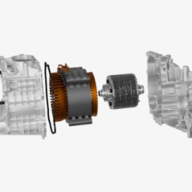
Rivian has the technology to split the pack like GM is doing. Everything runs on 400V but it can get reconfigured to series for 800V charging. They just aren't putting it into their vehicles. I have to imagine they could make it optional for those who want it and at a price that would still justify having engineered it. But maybe the beancounters disagree with me.
 

Donald Stanfield

Well-Known Member
First Name
Donald
Joined
Jul 31, 2022
Threads
59
Messages
8,309
Reaction score
16,657
Location
USA
Vehicles
2025 R1S Tri Ascend, 2024 i4 M50
Occupation
Stuff and things
Could be, but people tend to hyperfixite on one or two metrics, not 12. So “HP” (only), or “HP and Torque” or “HP and Range” not “HP, Charging speed, and Range”.

Look at the gas car world, people talk about HP like that is everything. Or occasionally 0-60 times. Or sometimes torque.

I’m not saying charge speed isn’t important, but getting people to focus on it is an uphill battle. It could end up being one of the items some people look at (like some people are “I need a 3 row SUV”), but getting to the point that everyone wants it? Not happening soon at any rate.

(and yes, I think if all the DC fast chargers support 800V being able to double the charge speed is almost as good as doubling the range and generally less expensive, but getting the average first time EV buyer to look at that? Not easy!)
I agree with this. I have had a Rivian since '22 and have taken many road trips, but I still couldn't give you an accurate time for charge stops on fast charges. Most of the people who have an EV charge at home, and the amount of fast charging we do isn't enough to centralize our buying decision on. Besides, when I stop somewhere on a road trip I'm more concerned with using the bathroom or getting something to eat or walking around to stretch my legs than I am whether or not I am spending an extra 5 min charging than I could be.

From my perspective, the Rivian is usually done charging about the time my family and I are done with using the bathroom and eating a snack, give or take a few minutes. A couple min quicker here or there isn't going to move that needle for me, but I can tell you the exact HP, 0-60 and 1/4 mile time of my trimax.
 

DuoRivians

Well-Known Member
Joined
Dec 30, 2022
Threads
258
Messages
3,814
Reaction score
9,091
Location
California
Vehicles
R1T, R1S
Rivian has the technology to split the pack like GM is doing. Everything runs on 400V but it can get reconfigured to series for 800V charging. They just aren't putting it into their vehicles. I have to imagine they could make it optional for those who want it and at a price that would still justify having engineered it. But maybe the beancounters disagree with me.
RJ seems to be quite opposed to 800V too
 

mkhuffman

Well-Known Member
First Name
Mike
Joined
Nov 9, 2020
Threads
14
Messages
2,868
Reaction score
3,217
Location
Virginia
Vehicles
2025 R1T Tri-Max, Jeep GC-L, VW Jetta
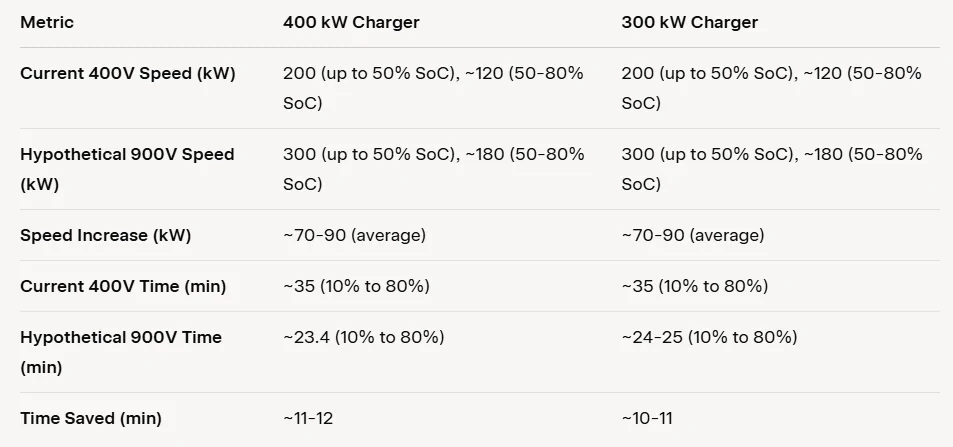
So I had Grok do a theoretical analysis with the following instructions:

1. Rivian converts to 900V in the R1 platform.
2. The new charging profile matches the best ever tested (by OOS) in the US: Lucid Gravity.
3. Analyze the improvement if charged on a 300 kW RAN charger, or a 400 kW charger.
4. Assume the current Gen2 fast charging performance (on 2025.18) can maintain 200 kW from 0 to 50%. I think testing shows it is pretty close to doing this.

I have to say, it isn't a huge difference, even though the parameters are probably best case for what we would see. Others have been saying this, but I wanted to put numbers on it.

It is pretty obvious why Rivian has not jumped into 800V (or 450 x 2 = 900V) yet: the improvement in the real world is not that big. And can they maintain the current performance on a 400V charger after they switch to 900V? The Lucid Air takes a massive hit on 400V chargers.

The Gravity uses motor inverters to convert the voltage, so it can maintain a good speed on 400V charges. Certainly it will cost more to make a 900V R1 if they do what they did in Gravity. To save 11 minutes?

Rivian R1T R1S 2026 Quad Max EPA Certification w/ specs (range, capacity, etc.) 1750197600843-a


Notes:
  • Speeds are averages across the 10% to 80% range, with the 900V model peaking at 400 kW and sustaining higher rates (e.g., 300 kW up to 50% SoC) based on the Lucid Gravity’s 1000V performance.
  • Time estimates assume optimal conditions and a 98.7 kWh charge (70% of 141 kWh), with the 300 kW charger slightly affecting early 900V performance.
  • Actual results may vary depending on charger compatibility and thermal management.
Sponsored


Top