
Sponsored
OP
OP
ksurfier

ksurfier

Well-Known Member
First Name
Ken
Joined
Aug 23, 2022
Threads
51
Messages
1,167
Reaction score
1,117
Location
CA
Vehicles
R1S, Tesla
Occupation
Fake Science Lead
Clubs
 
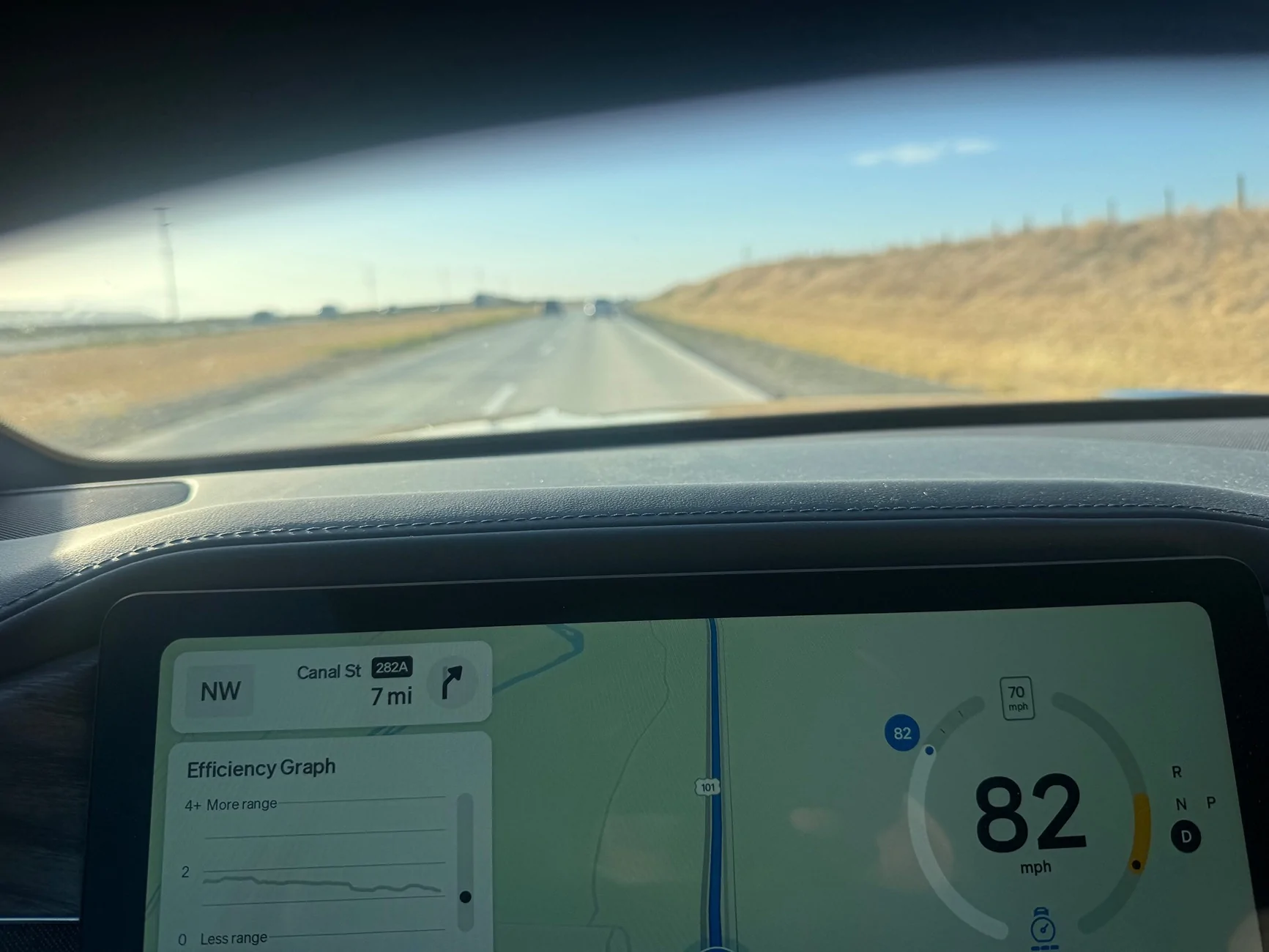
Ironically, I spent a great deal of time today along the central coast at 80 mph and even into a headwind (got 1.3 MPK - that was a first!). So I wouldn’t say it’s all that unusual…I’d say going less than 75 is extremely rare.

Edit: I pulled up to a sheriff going 80 (me) and was side by side, my wife suggested I slow down and I think it was a fair request…he dropped to 65 and created a 20-30 car pile up all going 65, then after 5-10 minutes pulled someone over for what was likely a cell phone…

Rivian R1T R1S R2 Highway Efficiency Test: 80 MPH vs 70 MPH Changed Everything IMG_7674
Sponsored

 
Last edited:

Indy avocado

Well-Known Member
First Name
Greg
Joined
Dec 17, 2022
Threads
3
Messages
225
Reaction score
314
Location
Indiana
Vehicles
'22 R1T, '17 Macan S, '11 Mustang GT
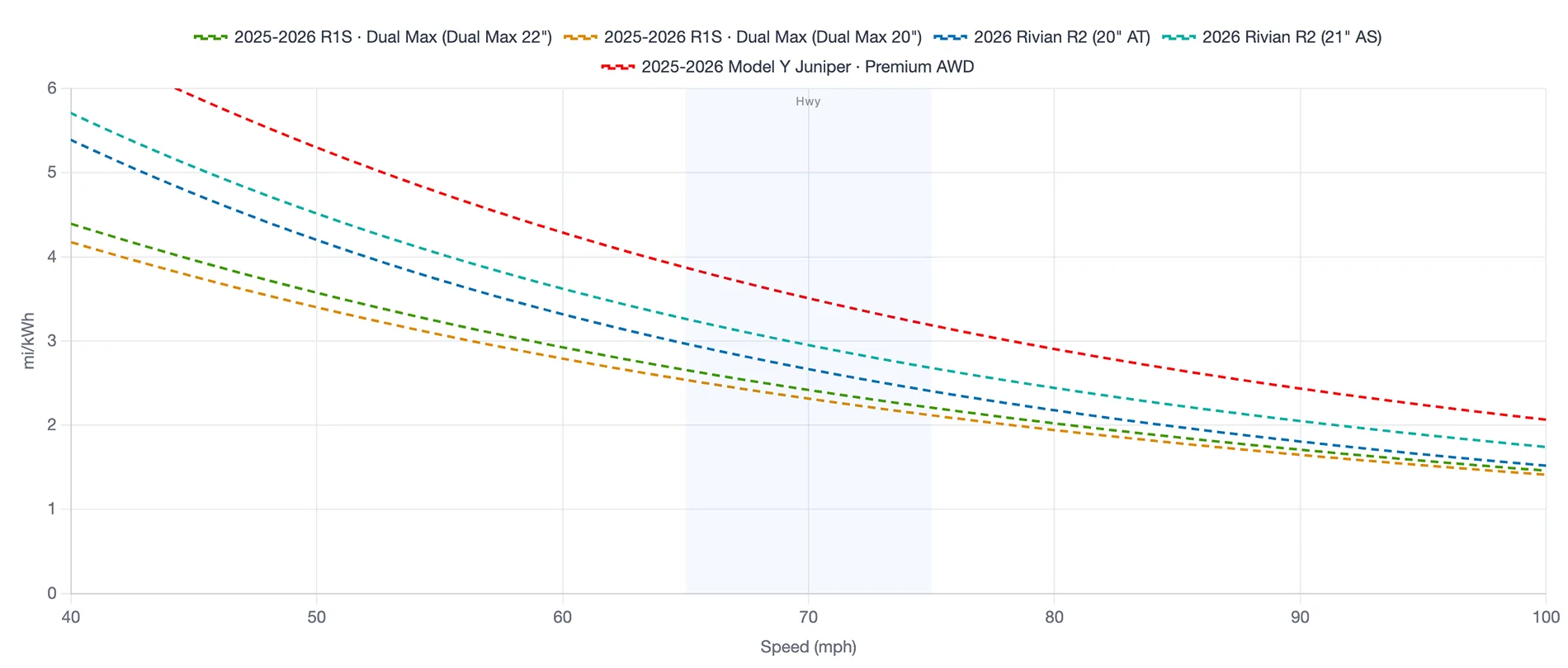
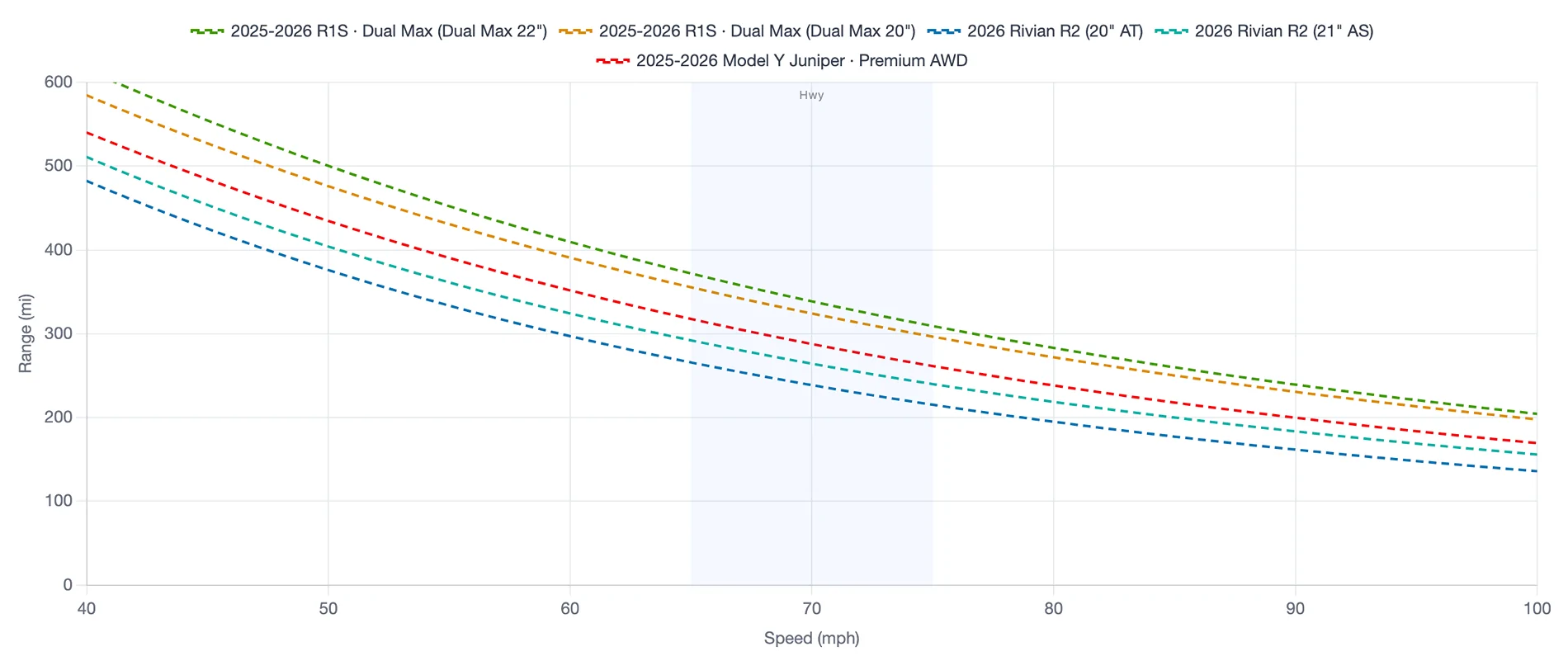
EPA has dynomometer values that tend to very accurately predict "nice day highway" efficiency and range.

Below plots assume *very* light HVAC load.

Some summary

Efficiency:
Rivian R1T R1S R2 Highway Efficiency Test: 80 MPH vs 70 MPH Changed Everything 1784357008617-hz


Range:
Rivian R1T R1S R2 Highway Efficiency Test: 80 MPH vs 70 MPH Changed Everything 1784356870538-hc


My range model was forecasting this at 229 (+/-) at 80. If your data holds over longer distances, the model may be very optimistic.
I think your Model Y numbers are slightly pessimistic, possibly optimistic on R2, but very close to a perfect day range test. I am thinking 265mi (vs your 271) at sea level for the 21" Performance. The Model Y should be 285-295mi.


1. Direct testing: InsideEVs measured about 2.97 mi/kWh under favorable Colorado conditions.
2. Physics: The R2’s estimated CdA predicts approximately 2.5–2.7 mi/kWh at sea level.
3. Vehicle comparison: The R2 falls exactly between the Model Y and R1, where its estimated CdA places it.
4. Battery capacity: Multiplying 2.5–2.9 mi/kWh × 88 kWh gives approximately 220–255 miles usable, depending on conditions, with favorable conditions approaching 260 miles.
This all checks out.

My calculator finds 2.94mi/kWh @ 70mph and 5000ft elevation (20" AT). Sounds like it's spot-on with InsideEVs.
Adjusting back to sea level (above screenshots) and we get 2.67mi/kWh, just as #2


No, just kicked them...everyone was looking at me funny...:bandit:

But ABRP shows the following (only a ~5% difference betweem 20" and 21")
R2 at 80 mph can travel ~190 miles (2.16 MPK)
R2 at 75 mph can travel ~200 miles (2.3 MPK)
R2 at 70 mph can travel ~213 miles (2.45 MPK)
R2 at 66 mph can travel ~225 miles (2.6 MPK)
R2 at 58 mph can travel ~250 miles (2.85 MPK)
These all seem to be pessimistic, as they should be for a route planning tool, but perhaps unnecessarily so?


Did some crude gpt calculations on incorporating charge times and distance traveled to see if charging more at 80 mph is worth it at any distance.
As a thought exercise I was curious to calculate the time efficiency of the R2 over long distance.
...
Bottom line, driving fast and charging more is faster on a long road trip than slower with less frequent charging sessions.
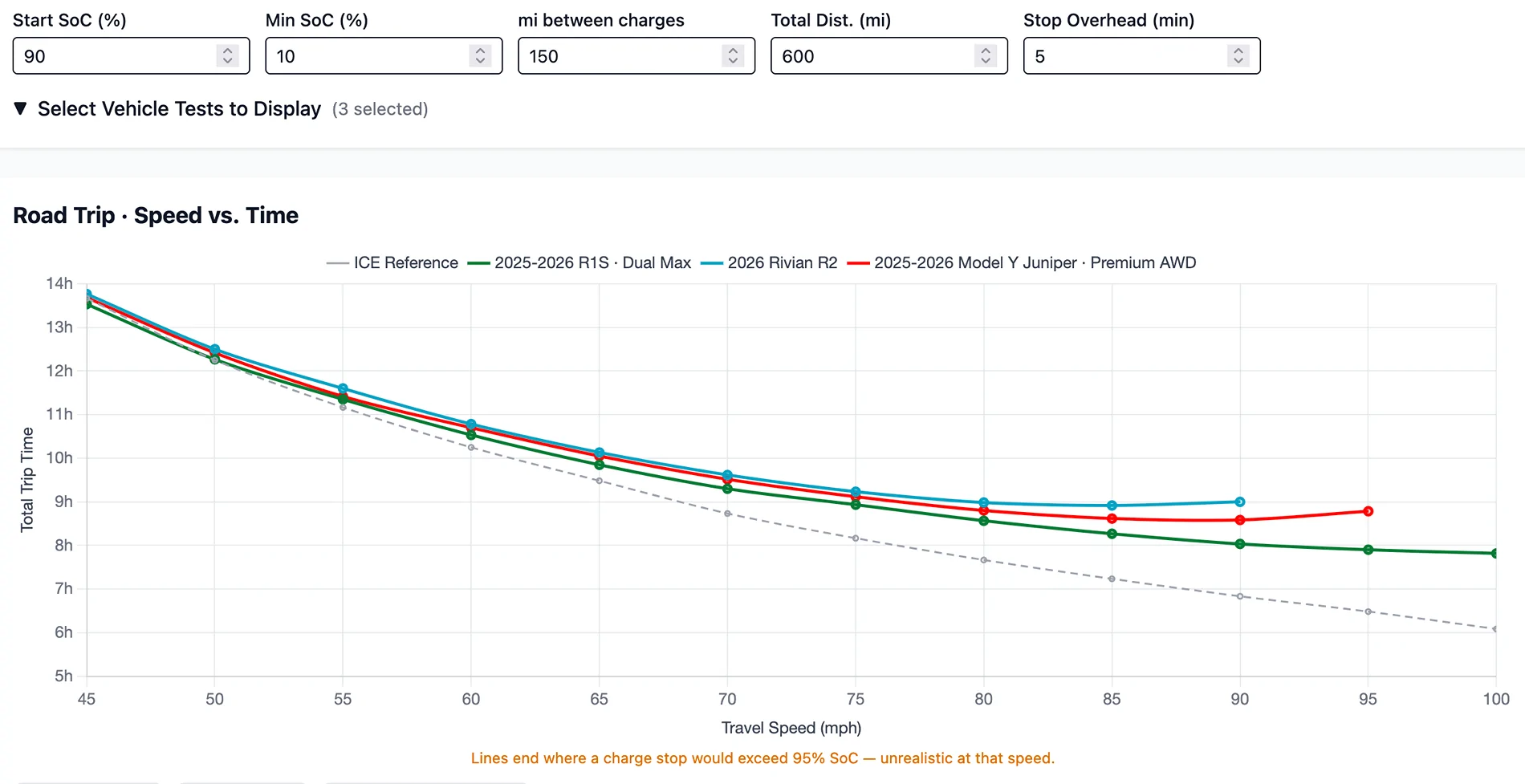
Lets compare with my calculator (uses discrete stops, estimates time from measured charging curves & 70mph range tests):
70 vs 80mph over 600mi, R2 saves ~38 minutes at 80mph.

Optimal travel speed is right around 85mph, but certainly diminishing returns over 75.

Rivian R1T R1S R2 Highway Efficiency Test: 80 MPH vs 70 MPH Changed Everything 1784357681348-w3
 

3dogfl

Member
First Name
Rob
Joined
Jun 19, 2026
Threads
1
Messages
20
Reaction score
26
Location
Jupiter
Vehicles
Tundra
I imagine heavier-traffic on highway driving would have a significant positive impact on range. Coming from cycling passion where drafting is huge, even at our much lower speeds, and you don't have to be that close to feel the impact. When a vehicle passes you on the road, you can feel that boost for several seconds.
 

Budman

Well-Known Member
First Name
Rick
Joined
Oct 22, 2021
Threads
60
Messages
856
Reaction score
2,943
Location
Minnesota
Vehicles
Honda CRV
Clubs
 
Air at 32F is also 15% more dense than air at 70F for the same elevation. The difference between 70F and 100F is 5% lower density at 100F.
This is an under appreciated fact. A good chunk of the loss of range in cold weather is just due to the air being much more dense in colder weather.
 

Indy avocado

Well-Known Member
First Name
Greg
Joined
Dec 17, 2022
Threads
3
Messages
225
Reaction score
314
Location
Indiana
Vehicles
'22 R1T, '17 Macan S, '11 Mustang GT
I imagine heavier-traffic on highway driving would have a significant positive impact on range. Coming from cycling passion where drafting is huge, even at our much lower speeds, and you don't have to be that close to feel the impact. When a vehicle passes you on the road, you can feel that boost for several seconds.
Definitely my experience in my R1T that alternating 50-80miles an hour in heavy traffic around Chicago is more efficient than holding 65-70 steady on a rural road.
 

ohmman

Well-Known Member
First Name
Mark
Joined
Aug 22, 2020
Threads
4
Messages
111
Reaction score
323
Location
Sonoma, California
Vehicles
2022 Model Y, 2024 Model Y, 2022 Model 3
Honestly, if that's the case that's really really bad. My Lyriq gets about 250ish going 80 in Texas. Anything less than that in a 2027 vehicle is a poor showing.

Tom's video from state of charge I think is a better example. If it gets 260 going 70 than 240 is probably more accurate going 80 with the 20 inch wheels.

I still dont understand how in 2026 we are still releasing cars at 300 miles of range. Although I'm still getting the R2 average speed limits in Texas highways are between 70-85. Most are 75 and some all the way to 85. You need at minimum a 350 - 400 miles range car coming out today for proper highway driving. Hence why I'm opting for the 20 inch wheels with aftermarket all season tires. This is coming from someone that does monthly long drives in our Lyriq.

I love EV's but there's a reason it's still not appealing to the masses because of this. Not sure why they didnt put at least a 100-110 kwh battery like the IX3 with the efficiency numbers would have been somewhere between 350-380 of range.
Perhaps at least as an option. Personally, I don’t love the idea of a bunch of raw materials I’ll rarely use sitting in my vehicle and/or being hauled around. A 300 mile range vehicle is plenty for me - I’ve driven EVs since 2014 and have covered a lot of ground on road trips, including towing a camper.

Most of my use is back and forth between the North Bay and Tahoe, and with my MY LR, I typically stop for 5-10 minutes to top up in the foothills for a pee break and maybe to grab a couple of things at Raley’s. My other driving is north up to Bend, OR and south as far as San Diego depending on what trip I want to take. Even for those trips, that range is fine for me.

But I get some people like the peace of mind or maybe they just drive really long stretches on a regular basis. Being able to pay another $10k for an “ultra long range” variant makes some sense from the consumer perspective, if not from the manufacturer.

BMW iX3 will ship with a lot more miles for those who want something like that.
Sponsored


Top