Sponsored

Rivian torque curves

Luxus

Well-Known Member
First Name
Walter
Joined
Jan 5, 2026
Threads
12
Messages
167
Reaction score
283
Location
Niles, IL.
Vehicles
2026 Rivian R1T tri; 1973 Buick Century Gran Sport; 1974 Buick Lesabre conv
Occupation
Mechanical Engineer
I was curious if Rivian has published torque curves for their motors? I was not able to find anything in an internet search.

It's my understanding that electric motors start to spin at max torque and as the rpm goes up, the torque linearly decreases with increasing rpm. I understand Rivian (and others) electronically limit the max torque of their motors such that the torque curve is dead flat until the rpm reaches the actual limitations of the motor. After which the torque produced will drop. I'm curious at what rpm that happens.
Sponsored

 

mkg3

Well-Known Member
Joined
Nov 19, 2021
Threads
90
Messages
2,787
Reaction score
3,701
Location
SoCal
Vehicles
R1S, Model 3, Outback, Artura
Clubs
 
Torque is directly proportional to the current in the DC motor, and is considered constant.

Since power is a function of toque x RPM, the only way the torque can go down is if the power is held constant. The power in each motor is controlled by the amount of voltage its fed from the battery.

In most cases, power is controlled by keeping the current constant and varying the voltage (i.e., power = voltage x current)
 
OP
OP
Luxus

Luxus

Well-Known Member
First Name
Walter
Joined
Jan 5, 2026
Threads
12
Messages
167
Reaction score
283
Location
Niles, IL.
Vehicles
2026 Rivian R1T tri; 1973 Buick Century Gran Sport; 1974 Buick Lesabre conv
Occupation
Mechanical Engineer
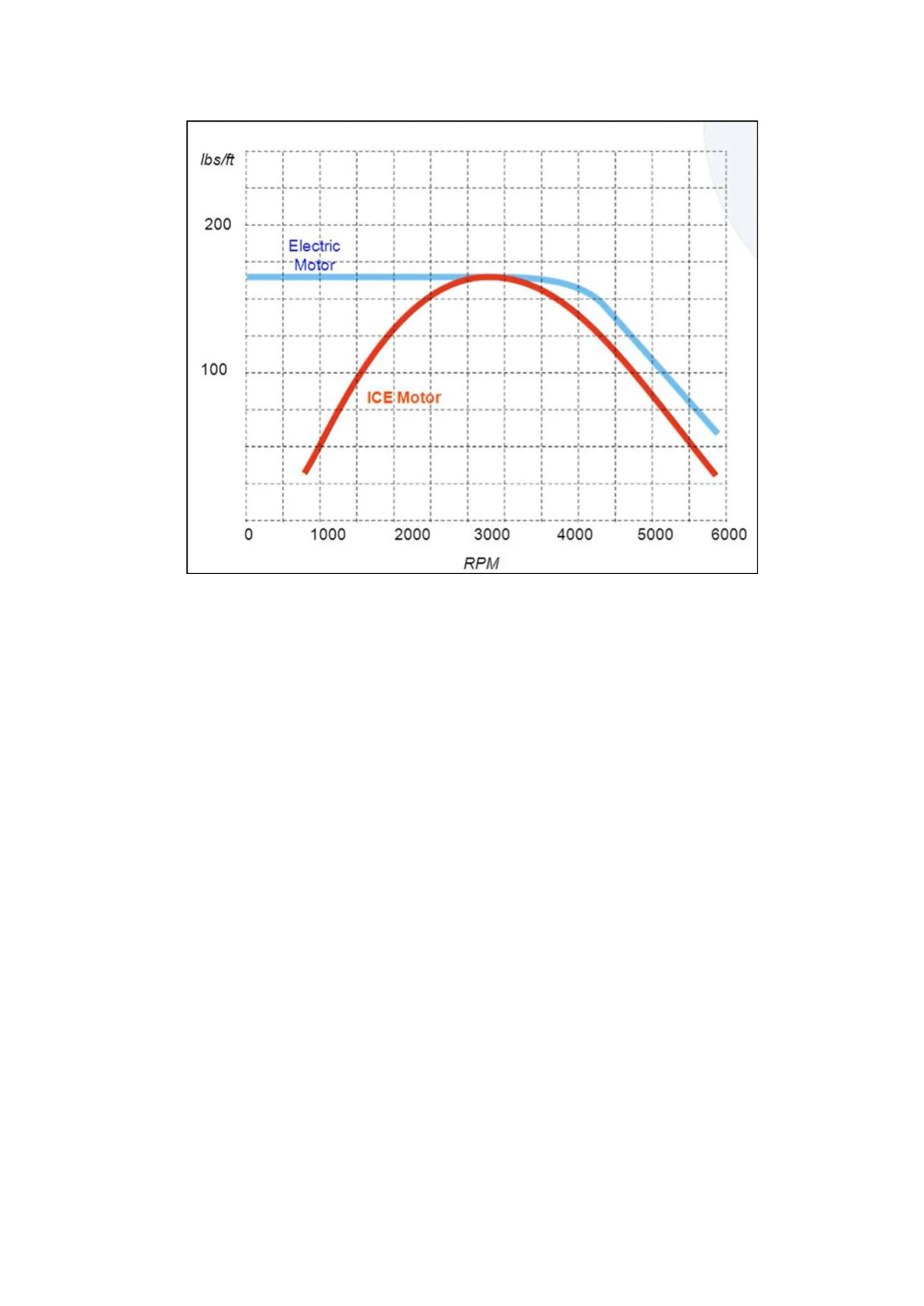
I am curious about this because I am engineer. But my expertise is mechanical and not so much electrical. So what I'm looking for is similar to the below image. Just curious at around what rpm the Rivian motors start to lose torque.
Rivian R1T R1S Rivian torque curves Torque-Curves-of-Electric-Motor-and-Internal-Combustion-Engine-2-The-electric-motors-can-1568
 
Last edited:

mkg3

Well-Known Member
Joined
Nov 19, 2021
Threads
90
Messages
2,787
Reaction score
3,701
Location
SoCal
Vehicles
R1S, Model 3, Outback, Artura
Clubs
 
I see. You want Rivian specific performance data. Unfortunately its not published and as you might expect, the motor design probably is tailored for higher performance below 80mph since most people drive thereabouts or lower.

While no scientific data, you can assume the performance tapering off after 80mph or so until it reaches the speed imiter. Many reviews have shown how this happens on the quarter mile tracks.

So you can probably assume that whatever the motor RPM is at around 80mph, the torque starts to fall off. I don't think the data you are seeking is available to the public.
 
OP
OP
Luxus

Luxus

Well-Known Member
First Name
Walter
Joined
Jan 5, 2026
Threads
12
Messages
167
Reaction score
283
Location
Niles, IL.
Vehicles
2026 Rivian R1T tri; 1973 Buick Century Gran Sport; 1974 Buick Lesabre conv
Occupation
Mechanical Engineer
That's fair enough if the data hasn't been published. I was just curious.

So how do you know 80 mph is when the torque starts to fall off? Not saying you are wrong BTW. I also don't think that happening is a bad thing. As you say, 80 is pretty close to the top end of where people drive. Also happens to ICE too so not a new thing.
 

Sponsored

portdirect

Well-Known Member
Joined
Jun 15, 2023
Threads
16
Messages
928
Reaction score
1,372
Location
Missouri
Vehicles
R1T (2023 QM - RIP, 2025 Tri Max), R1S (2024 DM Large)
Occupation
Blinkenlight Hearder
Torque is directly proportional to the current in the DC motor, and is considered constant.

Since power is a function of toque x RPM, the only way the torque can go down is if the power is held constant. The power in each motor is controlled by the amount of voltage its fed from the battery.

In most cases, power is controlled by keeping the current constant and varying the voltage (i.e., power = voltage x current)
Rivian isn’t using a DC motor. It’s a permanent magnet AC motor driven by an inverter.

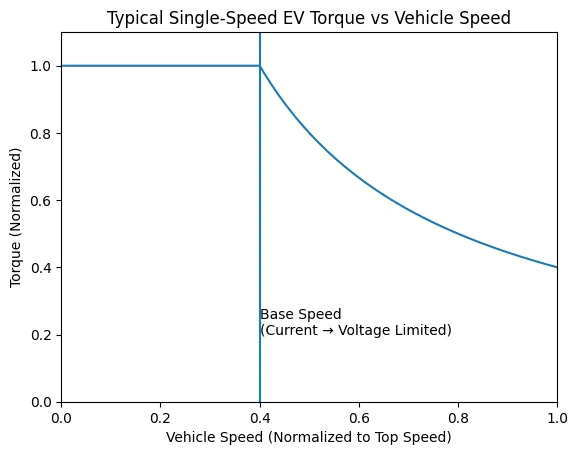
You’re right that torque is proportional to current. At low RPM the system is current-limited, so torque is essentially flat. However as RPM rises, back-EMF rises. Once that approaches the available DC bus voltage, the inverter becomes voltage-limited and has to enter field weakening. That reduces available torque - and why to get good 0-60 times you need a battery at high voltage.

So torque doesn’t drop because the system is “holding power constant.” It drops because the inverter runs out of voltage headroom and can’t maintain the same current. The constant-power region is just the natural result of that.

Exactly where that transition happens depends on motor constants, pack voltage, gearing, and tire size. Without Rivian data we can’t know for sure. That said, I'd expect in most EVs the base-speed transition often lands somewhere around 30–50% of top speed:


Rivian R1T R1S Rivian torque curves 1771885688908-b0


(This opens up the question as to what is the top *uncorked* straight line speed Rivian designed for - seems to be north of 130mph in the gen2 Tri and Quad... though at 130 my tri feels like theres not much more to go :D )
 
Last edited:

mkg3

Well-Known Member
Joined
Nov 19, 2021
Threads
90
Messages
2,787
Reaction score
3,701
Location
SoCal
Vehicles
R1S, Model 3, Outback, Artura
Clubs
 
That's fair enough if the data hasn't been published. I was just curious.

So how do you know 80 mph is when the torque starts to fall off? Not saying you are wrong BTW....
I don't know for sure it does or not. I may be wrong. Just a speculation on my part as the performance of the vehicle drops, Rivian probably have the SW driven controller to manage the motor behavior.
 

mkg3

Well-Known Member
Joined
Nov 19, 2021
Threads
90
Messages
2,787
Reaction score
3,701
Location
SoCal
Vehicles
R1S, Model 3, Outback, Artura
Clubs
 
Rivian isn’t using a DC motor. It’s a permanent magnet AC motor driven by an inverter.

You’re right that torque is proportional to current...

...So torque doesn’t drop because the system is “holding power constant.” It drops because the inverter runs out of voltage headroom and can’t maintain the same current. The constant-power region is just the natural result of that.
Thanks for that correction on the motor.

I was referring to the equation and that the only way torque drops for any given RPM is if the power drops. Wasn't going further out to where the back EMF rises towards the limit. Was just in the context of flat torque curve before the fall RPM.
 

Time2Roll

Well-Known Member
Joined
Jul 10, 2025
Threads
2
Messages
770
Reaction score
659
Location
SoCal
Vehicles
2026 R1S Quad - 2001 F150
(This opens up the question as to what is the top *uncorked* straight line speed Rivian designed for - seems to be north of 130mph in the gen2 Tri and Quad... though at 130 my tri feels like theres not much more to go :D )
I would assume the Rivian runs out of RPM before any theoretical top speed is reached.
By the description of quarter mile testing it seems the RI throttles back to ease into the speed limiter. So this may make it feel like the vehicle is topped out by wind resistance when with different drive ratio it could go higher.

To really know top speed would need a second gear. Most I have read on general EVs the motors turn 10K to 15K rpm max.
 

portdirect

Well-Known Member
Joined
Jun 15, 2023
Threads
16
Messages
928
Reaction score
1,372
Location
Missouri
Vehicles
R1T (2023 QM - RIP, 2025 Tri Max), R1S (2024 DM Large)
Occupation
Blinkenlight Hearder
I would assume the Rivian runs out of RPM before any theoretical top speed is reached.
By the description of quarter mile testing it seems the RI throttles back to ease into the speed limiter. So this may make it feel like the vehicle is topped out by wind resistance when with different drive ratio it could go higher.

To really know top speed would need a second gear. Most I have read on general EVs the motors turn 10K to 15K rpm max.
I suppose what I meant was: at what RPM does the motor’s back-EMF rise to the point that it matches the battery voltage, so the inverter can’t push any more meaningful torque-producing current into it (ie what it puts in is matched by drag)? That equilibrium point would effectively define the drivetrain’s maximum theoretical speed.
 

Sponsored

Time2Roll

Well-Known Member
Joined
Jul 10, 2025
Threads
2
Messages
770
Reaction score
659
Location
SoCal
Vehicles
2026 R1S Quad - 2001 F150
I suppose what I meant was: at what RPM does the motor’s back-EMF rise to the point that it matches the battery voltage, so the inverter can’t push any more meaningful torque-producing current into it (ie what it puts in is matched by drag)? That equilibrium point would effectively define the drivetrain’s maximum theoretical speed.
I believe it is more of a mechanical limit before the armature comes apart.
Strength of materials.

I believe Tesla wraps the plaid motors with carbon fiber to get close to 18,000 rpm.
 

portdirect

Well-Known Member
Joined
Jun 15, 2023
Threads
16
Messages
928
Reaction score
1,372
Location
Missouri
Vehicles
R1T (2023 QM - RIP, 2025 Tri Max), R1S (2024 DM Large)
Occupation
Blinkenlight Hearder
I believe it is more of a mechanical limit before the armature comes apart.
Strength of materials.

I believe Tesla wraps the plaid motors with carbon fiber to get close to 18,000 rpm.
You are probably right - however we should pool some money and find out what gives up 1st! :D

Rivian R1T R1S Rivian torque curves 1771895900979-yc
 

strykerwsu

Well-Known Member
Joined
Dec 21, 2022
Threads
6
Messages
966
Reaction score
1,188
Location
Kansas
Vehicles
Chevy SS, Ford Bronco, Ram Rebel, Ford Flex, G8
It doesnt show RPM but Charger EV in sport mode shows torque. Interesting to see how little torque is required after getting to speed for us non engineers.
 

madhat

Well-Known Member
Joined
Feb 27, 2024
Threads
10
Messages
332
Reaction score
376
Location
Arizona
Vehicles
22 R1T
Another thing to consider is Rivian's power curve isn't necessarily peak power available. We know AP mode pulls harder at higher speeds than Sport does, even though sport gives way more off the line (at least for G1 Quads). Maybe Launch Mode or Rad Tuner allows max output?
Apparently we can't just stick a Rivian on a dyno due to all the sensors recognizing you're not moving.
 

Yota2R1T

Well-Known Member
First Name
Rich
Joined
Nov 21, 2022
Threads
7
Messages
209
Reaction score
246
Location
Calgary, Canada
Vehicles
Blue 2024 R1T, Large-DM, 21", OC int.
Occupation
Solar PV professional
Clubs
 
Rivian isn’t using a DC motor. It’s a permanent magnet AC motor driven by an inverter.

You’re right that torque is proportional to current. At low RPM the system is current-limited, so torque is essentially flat. However as RPM rises, back-EMF rises. Once that approaches the available DC bus voltage, the inverter becomes voltage-limited and has to enter field weakening. That reduces available torque - and why to get good 0-60 times you need a battery at high voltage.

So torque doesn’t drop because the system is “holding power constant.” It drops because the inverter runs out of voltage headroom and can’t maintain the same current. The constant-power region is just the natural result of that.

Exactly where that transition happens depends on motor constants, pack voltage, gearing, and tire size. Without Rivian data we can’t know for sure. That said, I'd expect in most EVs the base-speed transition often lands somewhere around 30–50% of top speed:


1771885688908-b0.webp


(This opens up the question as to what is the top *uncorked* straight line speed Rivian designed for - seems to be north of 130mph in the gen2 Tri and Quad... though at 130 my tri feels like theres not much more to go :D )
Thanks for this!
Sponsored


Top