Sponsored

Probably overreacting but... Losing capacity fast?

smashweights

Well-Known Member
Joined
Oct 28, 2025
Threads
22
Messages
136
Reaction score
129
Location
USA
Vehicles
2022 Rivian R1T Launch Edition
So I bought my Rivian with about 40k on it. First checked Rivian roamer after the winter while reasonably warm and was sitting around 128.4kWh capacity, pretty good only losing about 3kWh (2%) over 4 years and 40k miles. It was around 128kWh last week, took my first big charge round trip of around 250mi in an area without any charging infrastructure. Charged to 95% and drove it down to 7% by the time I got home. Since recharging it's consistently showing about 127.1kWh capacity with similar temps. Can I really expect to permanently lose nearly 1kWh of capacity with such a cycle? Seems rather excessive...
Sponsored

 

Rivian Roamer

Well-Known Member
Joined
Jul 18, 2024
Threads
2
Messages
473
Reaction score
661
Location
Seattle, WA
Website
rivianroamer.com
Vehicles
2024 R1S Quad Large, 2025 R1T Tri Max
Occupation
Adventurer
So I bought my Rivian with about 40k on it. First checked Rivian roamer after the winter while reasonably warm and was sitting around 128.4kWh capacity, pretty good only losing about 3kWh (2%) over 4 years and 40k miles. It was around 128kWh last week, took my first big charge round trip of around 250mi in an area without any charging infrastructure. Charged to 95% and drove it down to 7% by the time I got home. Since recharging it's consistently showing about 127.1kWh capacity with similar temps. Can I really expect to permanently lose nearly 1kWh of capacity with such a cycle? Seems rather excessive...
Battery capacity measurement is fickle.

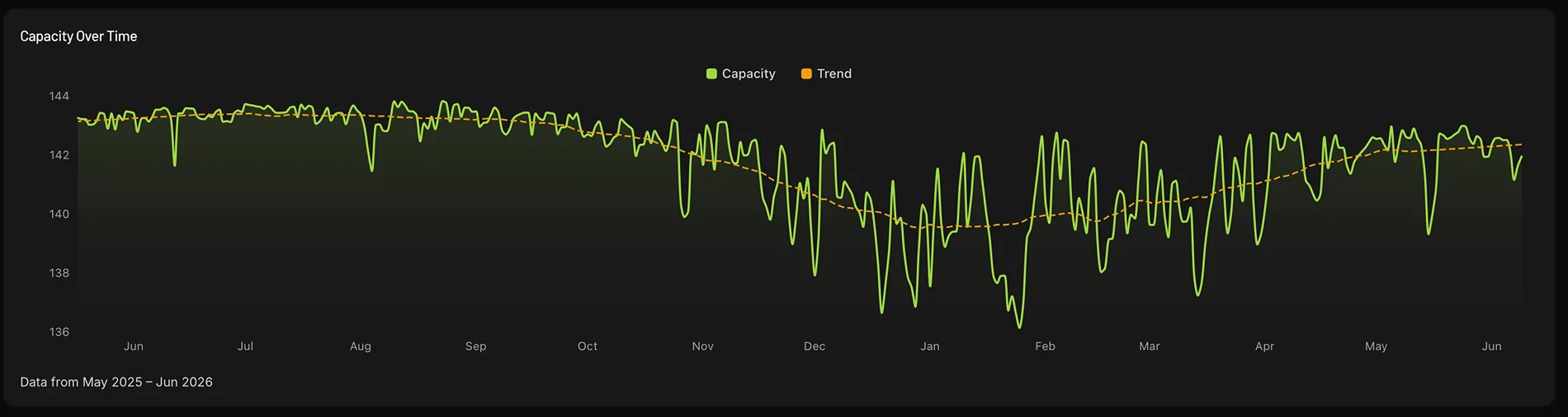
Both of the measurements are probably off as they are often just estimates. On top of that, Rivian doesn't expose gross capacity but instead, net. There is some funny things Rivian does with capacity.

Here's my R1T.

Rivian R1T R1S Probably overreacting but... Losing capacity fast? Screenshot 2026-06-09 at 6.02.53 PM
 
OP
OP
smashweights

smashweights

Well-Known Member
Joined
Oct 28, 2025
Threads
22
Messages
136
Reaction score
129
Location
USA
Vehicles
2022 Rivian R1T Launch Edition
Battery capacity measurement is fickle.

Both of the measurements are probably off as they are often just estimates. On top of that, Rivian doesn't expose gross capacity but instead, net. There is some funny things Rivian does with capacity.

Here's my R1T.

Screenshot 2026-06-09 at 6.02.53 PM.webp
Well that makes me feel better. I wasn't sure how much to read into those values. Made me worried I was gonna trash my battery in a few trips.

I know the Large pack NCA chemistry doesn't need large charges to calibrate like LFP but wonder if the earlier was more incorrect since I've never gone outside of about 30-70% SOC for nearly 6 months of ownership.
 

jrmbadger

Well-Known Member
Joined
Jul 16, 2025
Threads
8
Messages
163
Reaction score
263
Location
USA
Vehicles
R1S (Gen 1)
Nothing really to worry about.

Degradation can be caused by many factors, but, as I understand it, the biggest factor is cell aging. Cell aging degradation happens on a non-linear basis with the highest amount seen in the first year and decreasing amounts every year after that.

Charging to 100% does stress the battery some, but occasionally doing it isn't really a big deal. Its best to try and plan the battery to be at 100% just before you leave.

The amount of charge in a battery is notoriously difficult to measure and varies wildly with temperature, ambient conditions, state of charge, etc.... A couple of KWH variance in measurement is probably within the margin of error. (As @Rivian Roamer pointed out)

My advice: Drive it and dont worry. But, if you REALLY REALLY REALLY care about minimizing degradation, go to the Tesla Motor Club forum and search for a user named AAKE. But, it's a big rabbit hole and probably not worth the inconveniences to save a couple percent range.
 

UnsungZero_OldTimeAdMan

Well-Known Member
First Name
Barnum
Joined
Mar 20, 2023
Threads
67
Messages
8,610
Reaction score
11,816
Location
SoCal
Vehicles
'23 GW Quad-Large R1T "Ghost"
Occupation
Advertising Circus
Nothing really to worry about.

Degradation can be caused by many factors, but, as I understand it, the biggest factor is cell aging. Cell aging degradation happens on a non-linear basis with the highest amount seen in the first year and decreasing amounts every year after that.

Charging to 100% does stress the battery some, but occasionally doing it isn't really a big deal. Its best to try and plan the battery to be at 100% just before you leave.

The amount of charge in a battery is notoriously difficult to measure and varies wildly with temperature, ambient conditions, state of charge, etc.... A couple of KWH variance in measurement is probably within the margin of error. (As @Rivian Roamer pointed out)

My advice: Drive it and dont worry. But, if you REALLY REALLY REALLY care about minimizing degradation, go to the Tesla Motor Club forum and search for a user named AAKE. But, it's a big rabbit hole and probably not worth the inconveniences to save a couple percent range.
So does running it down to 7%. General consensus is to play between 20-80% as much as possible isn’t it? Not that going over or below would instantly cause irreparable harm. Just that larger charge deltas, frequently, add up to full cycles sooner? Engineering Explained videos on NMC and LFP do’s and don’ts explain it much better.
 

Sponsored

OP
OP
smashweights

smashweights

Well-Known Member
Joined
Oct 28, 2025
Threads
22
Messages
136
Reaction score
129
Location
USA
Vehicles
2022 Rivian R1T Launch Edition
So does running it down to 7%. General consensus is to play between 20-80% as much as possible isn’t it? Not that going over or below would instantly cause irreparable harm. Just that larger charge deltas, frequently, add up to full cycles sooner? Engineering Explained videos on NMC and LFP do’s and don’ts explain it much better.
Yep, I've watched those. But when you're driving 250mi round trip into the boonies sometimes you gotta push that limit
 

Roads76

Active Member
First Name
Jeremy
Joined
Oct 10, 2024
Threads
0
Messages
27
Reaction score
17
Location
Monrovia, MD
Vehicles
Rivian R1T, Tesla Model 3
Occupation
Vascular medical
Clubs
 
I picked up my 2023 R1T two years ago, it had 21k miles and charged to 203 miles at 70%. I'm now at 52k miles and now it posts 205 miles at 70% in the morning. I've had it on many long road trips. I don't worry about the battery at all at this point, I'm pretty confident the degradation is absolutely minimal.
 

Hereforthesnacks

Well-Known Member
Joined
Jun 6, 2024
Threads
3
Messages
1,247
Reaction score
1,469
Location
West Coast
Vehicles
Ford Bronco
Just that larger charge deltas, frequently, add up to full cycles sooner?
How do larger charge deltas lead to full cycles sooner? If you are putting in and taking out the same amount of energy, the number of charge cycles is the same if you go from 0-100 once or 60-70 ten times.

The best advice is keep it from 20-80, fast charge only when needed, and then don’t worry about the rest of it.
 

jrmbadger

Well-Known Member
Joined
Jul 16, 2025
Threads
8
Messages
163
Reaction score
263
Location
USA
Vehicles
R1S (Gen 1)
So does running it down to 7%. General consensus is to play between 20-80% as much as possible isn’t it? Not that going over or below would instantly cause irreparable harm. Just that larger charge deltas, frequently, add up to full cycles sooner? Engineering Explained videos on NMC and LFP do’s and don’ts explain it much better.
I've generally tried to follow the advice of Jeff Dahn, he's a battery researcher that works with Tesla. He has a whole video on maximizing the lifespan of EV batteries.
Jeff Dahm Video
He recommends:
1.) if you are going to store the car for a long time, store it at around 30%
2.) Charge more frequently - lower depth of discharge is better for battery longevity. Rather than charging to 80% and then driving for several days to reach 20%, charge each day to maintain a low DOD.
3.) Charge to no more than 75% regularly. Occasional 100% is fine.

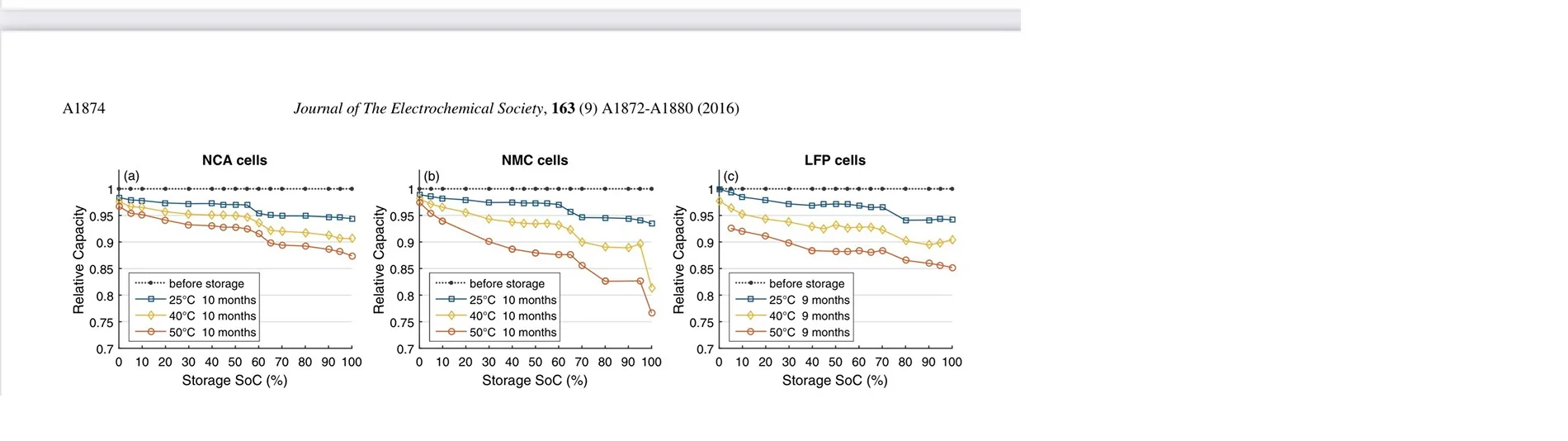
The Tesla Motor Club forums have taken that to extremes. The advice one well received member gives is to keep it to 50-55% unless you need more. They cite the below graphic where range starts to drop off at 60% SOC. The reason they use 50-55% is because of the internal buffer the car has. So when the car says you have 50% you have more - how much is unknown. This is a bit extreme, although I do keep my R1S at 50% in the summer and 55% in the winter because I generally don't need more than around 10% a day in range. My Model Y, which is driven more gets charged to 65% daily.

Rivian R1T R1S Probably overreacting but... Losing capacity fast? cell aging


For most people though, its not really something to worry about - just use the car and keep it below 75%
 

Rivian Roamer

Well-Known Member
Joined
Jul 18, 2024
Threads
2
Messages
473
Reaction score
661
Location
Seattle, WA
Website
rivianroamer.com
Vehicles
2024 R1S Quad Large, 2025 R1T Tri Max
Occupation
Adventurer
How do larger charge deltas lead to full cycles sooner? If you are putting in and taking out the same amount of energy, the number of charge cycles is the same if you go from 0-100 once or 60-70 ten times.

The best advice is keep it from 20-80, fast charge only when needed, and then don’t worry about the rest of it.
There is increasing evidence that fast charging doesn't have the impact we thought it once had. More so the heat and extreme SOCs.

This is hand-wavy but something like ABS(50 - SOC) * TEMP is a way to think about impact for battery degradation impact.
 

Sponsored

Rivian Roamer

Well-Known Member
Joined
Jul 18, 2024
Threads
2
Messages
473
Reaction score
661
Location
Seattle, WA
Website
rivianroamer.com
Vehicles
2024 R1S Quad Large, 2025 R1T Tri Max
Occupation
Adventurer
Tesla's recent batteries have much less cobalt and have seen higher degradation even with careful battery charge and temperature management. It seems Rivian's batteries are more resilient to this.
 

Hereforthesnacks

Well-Known Member
Joined
Jun 6, 2024
Threads
3
Messages
1,247
Reaction score
1,469
Location
West Coast
Vehicles
Ford Bronco
There is increasing evidence that fast charging doesn't have the impact we thought it once had. More so the heat and extreme SOCs.

This is hand-wavy but something like ABS(50 - SOC) * TEMP is a way to think about impact for battery degradation impact.
Interesting. Though fast charging does increase battery temp quite a bit…
 

jrmbadger

Well-Known Member
Joined
Jul 16, 2025
Threads
8
Messages
163
Reaction score
263
Location
USA
Vehicles
R1S (Gen 1)
Tesla's recent batteries have much less cobalt and have seen higher degradation even with careful battery charge and temperature management. It seems Rivian's batteries are more resilient to this.
Yeah, there is a long thread on TMC about that and we've experienced a bit more degradation in our model Y even keeping it under 65% and rarely fast charging. At new it was around 330 and just less than 3 years later we have about 294 miles when fully charged. That's like 11%.
 

UnsungZero_OldTimeAdMan

Well-Known Member
First Name
Barnum
Joined
Mar 20, 2023
Threads
67
Messages
8,610
Reaction score
11,816
Location
SoCal
Vehicles
'23 GW Quad-Large R1T "Ghost"
Occupation
Advertising Circus
I've generally tried to follow the advice of Jeff Dahn, he's a battery researcher that works with Tesla. He has a whole video on maximizing the lifespan of EV batteries.
Jeff Dahm Video
He recommends:
1.) if you are going to store the car for a long time, store it at around 30%
2.) Charge more frequently - lower depth of discharge is better for battery longevity. Rather than charging to 80% and then driving for several days to reach 20%, charge each day to maintain a low DOD.
3.) Charge to no more than 75% regularly. Occasional 100% is fine.

The Tesla Motor Club forums have taken that to extremes. The advice one well received member gives is to keep it to 50-55% unless you need more. They cite the below graphic where range starts to drop off at 60% SOC. The reason they use 50-55% is because of the internal buffer the car has. So when the car says you have 50% you have more - how much is unknown. This is a bit extreme, although I do keep my R1S at 50% in the summer and 55% in the winter because I generally don't need more than around 10% a day in range. My Model Y, which is driven more gets charged to 65% daily.

cell aging.webp


For most people though, its not really something to worry about - just use the car and keep it below 75%

Good advice. However, not everyone can charge at home or get by daily/weekly with 50~60% SOC. So I think the matter of "best practices" is more nuanced than any one single rule/practice. In that context, I think it's easier to advise EV owners on what they mustn't do and leave the rest to individual needs. The OEMs have also gotten much better with their BMS. Current day packs are not as "fragile" as they once were.
Sponsored

 
Last edited:


Top