Administrator
Administrator
- Joined
- Nov 26, 2018
- Threads
- 360
- Messages
- 1,368
- Reaction score
- 4,620
- Location
- Rivianforums.com
- Vehicles
- Rivian
- Thread starter
- #1
NEW STUDY FINDS GREATER GREENHOUSE GAS REDUCTIONS FOR PICKUP TRUCK ELECTRIFICATION THAN FOR OTHER LIGHT-DUTY VEHICLES

Press Release Source: https://media.ford.com/content/ford...greenhouse-gas-reductions-for-pickup-tru.html
But what does pickup truck electrification mean for the decarbonization of the transportation industry?
University of Michigan and Ford Motor Company researchers addressed this question in a new study and evaluated the savings in greenhouse gas emissions relative to gasoline-powered pickup trucks.
Researchers found that light-duty, battery-electric vehicles have approximately 64% lower cradle-to-grave life cycle greenhouse gas emissions than internal-combustion-engine vehicles on average across the United States.
“This is an important study to inform and encourage climate action. Our research clearly shows substantial greenhouse gas emission reductions that can be achieved from transitioning to electrified powertrains across all vehicle classes,” said study senior author Greg Keoleian, a professor at the U-M School for Environment and Sustainability and director of the U-M Center for Sustainable Systems.
“This study can help us to understand the potential impact of electrification from an emissions-reduction perspective, particularly as we introduce new electric vehicles, and how we can continue to accelerate our progress towards carbon neutrality. We’re proud to partner with U-M in this critical work,” said Cynthia Williams, global director of sustainability, homologation and compliance at Ford.
In the study, researchers conducted a cradle-to-grave life cycle assessment of pickup trucks and compared the implications of pickup truck electrification to those of sedan and SUV electrification.
With a focus on evaluating greenhouse gas emissions, researchers looked at three different model year 2020 powertrain options—internal-combustion-engine vehicles, hybrid-electric vehicles, and battery-electric vehicles—for midsize sedans, midsize SUVs, and full-size pickup trucks, accounting for differences in fuel economy, annual mileage, vehicle production, and vehicle lifetime across vehicle classes.
“This study expands upon previous studies that have focused on comparing battery-electric vehicle sedans to their internal-combustion-engine or hybrid counterparts,” said Keoleian. “We report emissions for vehicle production, use, and end-of-life stages on a per-mile basis and over the total vehicle lifetime. In addition, we analyzed the regional variation in emissions considering differences in electricity grid mixes and ambient temperatures, and we also explored the effects of the rate of grid decarbonization on emission reduction.”
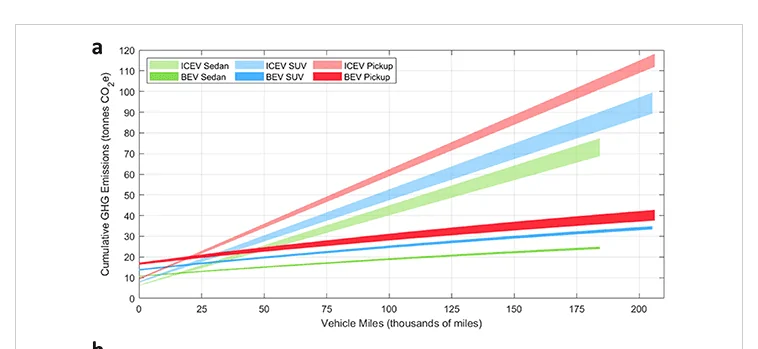
The study offers key findings. Researchers, for instance, found that switching an internal-combustion-engine vehicle to a battery-electric vehicle results in greater total tonnage of emissions reductions as the vehicle size increases, due to the greater fuel consumption of larger vehicles. “Though the percentage savings is approximately the same across vehicle classes, on average replacing an internal-combustion-engine sedan with a battery-electric sedan saves 45 metric tons of carbon dioxide equivalent, replacing an internal-combustion-engine SUV with a battery-electric SUV saves 56 metric tons of carbon dioxide equivalent, and replacing an internal-combustion-engine pickup with a battery-electric pickup saves 74 metric tons carbon dioxide equivalent over the lifetime of the vehicles,” said study first author and Center for Sustainable Systems Research Specialist Max Woody.
The researchers also found that battery-electric vehicles have larger greenhouse gas emissions in their manufacturing than internal-combustion-engine vehicles, due to battery production, but this impact is offset by savings in their operation. For battery-electric vehicles and internal-combustion-engine vehicles, the breakeven time is 1.2 to 1.3 years for sedans, 1.4 to 1.6 years for SUVs, and 1.3 years for pickup trucks, based on the average U.S. grid and vehicle miles traveled.
Vehicle emissions vary across the country, as different temperatures and different drive cycles affect a vehicle’s fuel economy. For electric vehicles, the emissions intensity of the local electricity grid is also an important factor. The study developed maps to show the lifetime grams of carbon dioxide equivalent/mile for each powertrain (internal-combustion-engine vehicles, hybrid vehicles, and battery-electric vehicles) and vehicle type (sedan, SUV, and pickup truck) by county across the United States. Researchers found that concerns about battery-electric vehicles having higher emissions than internal-combustion-engine vehicles or hybrids are largely unfounded, as battery-electric vehicles outperform hybrids in 95% to 96% of counties, while battery-electric vehicles outperform internal-combustion-engine vehicles in 98% to 99% of counties, even assuming only modest progress towards grid decarbonization.
Charging strategies can further reduce battery-electric vehicle greenhouse gas emissions. The study found that charging during the hours of the day with the lowest grid emissions intensity can reduce emissions by 11% on average. “Deployment of electric vehicles and expansion of renewable energy resources like solar and wind should be done at the same time; the benefit of each is increased by the development of the other,” said Woody.
The study, “The role of pickup truck electrification in the decarbonization of light-duty vehicles,” was published online March 1 in the journal Environmental Research Letters.
The other authors of the study are Parth Vaishnav of the U-M School for Environment and Sustainability and Center for Sustainable Systems and Robert De Kleine, Hyung Chul Kim, James E. Anderson, and Timothy J. Wallington of Ford Motor Company’s Research and Innovation Center.
This study was supported by Ford Motor Company through a Ford-University of Michigan Alliance Project Award.

Press Release Source: https://media.ford.com/content/ford...greenhouse-gas-reductions-for-pickup-tru.html
- A University of Michigan and Ford Motor Company study evaluates the reductions in greenhouse gas emissions relative to gasoline-powered pickup trucks as part of the decarbonization of the transportation industry.
- Sedan, SUV, and pickup truck battery-electric vehicles have approximately 64% lower cradle-to-grave life cycle greenhouse gas emissions than internal-combustion-engine vehicles on average across the United States.
- Replacing an internal-combustion-engine pickup with a battery-electric pickup results in a reduction of 74 metric tons of carbon dioxide equivalent over the lifetime of the vehicle on average.
- While battery-electric vehicles currently have larger greenhouse gas emissions in their manufacturing than internal-combustion-engine vehicles, due to battery production, this impact is offset by savings in their operation.
But what does pickup truck electrification mean for the decarbonization of the transportation industry?
University of Michigan and Ford Motor Company researchers addressed this question in a new study and evaluated the savings in greenhouse gas emissions relative to gasoline-powered pickup trucks.
Researchers found that light-duty, battery-electric vehicles have approximately 64% lower cradle-to-grave life cycle greenhouse gas emissions than internal-combustion-engine vehicles on average across the United States.
“This is an important study to inform and encourage climate action. Our research clearly shows substantial greenhouse gas emission reductions that can be achieved from transitioning to electrified powertrains across all vehicle classes,” said study senior author Greg Keoleian, a professor at the U-M School for Environment and Sustainability and director of the U-M Center for Sustainable Systems.
“This study can help us to understand the potential impact of electrification from an emissions-reduction perspective, particularly as we introduce new electric vehicles, and how we can continue to accelerate our progress towards carbon neutrality. We’re proud to partner with U-M in this critical work,” said Cynthia Williams, global director of sustainability, homologation and compliance at Ford.
In the study, researchers conducted a cradle-to-grave life cycle assessment of pickup trucks and compared the implications of pickup truck electrification to those of sedan and SUV electrification.
With a focus on evaluating greenhouse gas emissions, researchers looked at three different model year 2020 powertrain options—internal-combustion-engine vehicles, hybrid-electric vehicles, and battery-electric vehicles—for midsize sedans, midsize SUVs, and full-size pickup trucks, accounting for differences in fuel economy, annual mileage, vehicle production, and vehicle lifetime across vehicle classes.
“This study expands upon previous studies that have focused on comparing battery-electric vehicle sedans to their internal-combustion-engine or hybrid counterparts,” said Keoleian. “We report emissions for vehicle production, use, and end-of-life stages on a per-mile basis and over the total vehicle lifetime. In addition, we analyzed the regional variation in emissions considering differences in electricity grid mixes and ambient temperatures, and we also explored the effects of the rate of grid decarbonization on emission reduction.”
The study offers key findings. Researchers, for instance, found that switching an internal-combustion-engine vehicle to a battery-electric vehicle results in greater total tonnage of emissions reductions as the vehicle size increases, due to the greater fuel consumption of larger vehicles. “Though the percentage savings is approximately the same across vehicle classes, on average replacing an internal-combustion-engine sedan with a battery-electric sedan saves 45 metric tons of carbon dioxide equivalent, replacing an internal-combustion-engine SUV with a battery-electric SUV saves 56 metric tons of carbon dioxide equivalent, and replacing an internal-combustion-engine pickup with a battery-electric pickup saves 74 metric tons carbon dioxide equivalent over the lifetime of the vehicles,” said study first author and Center for Sustainable Systems Research Specialist Max Woody.
The researchers also found that battery-electric vehicles have larger greenhouse gas emissions in their manufacturing than internal-combustion-engine vehicles, due to battery production, but this impact is offset by savings in their operation. For battery-electric vehicles and internal-combustion-engine vehicles, the breakeven time is 1.2 to 1.3 years for sedans, 1.4 to 1.6 years for SUVs, and 1.3 years for pickup trucks, based on the average U.S. grid and vehicle miles traveled.
Vehicle emissions vary across the country, as different temperatures and different drive cycles affect a vehicle’s fuel economy. For electric vehicles, the emissions intensity of the local electricity grid is also an important factor. The study developed maps to show the lifetime grams of carbon dioxide equivalent/mile for each powertrain (internal-combustion-engine vehicles, hybrid vehicles, and battery-electric vehicles) and vehicle type (sedan, SUV, and pickup truck) by county across the United States. Researchers found that concerns about battery-electric vehicles having higher emissions than internal-combustion-engine vehicles or hybrids are largely unfounded, as battery-electric vehicles outperform hybrids in 95% to 96% of counties, while battery-electric vehicles outperform internal-combustion-engine vehicles in 98% to 99% of counties, even assuming only modest progress towards grid decarbonization.
Charging strategies can further reduce battery-electric vehicle greenhouse gas emissions. The study found that charging during the hours of the day with the lowest grid emissions intensity can reduce emissions by 11% on average. “Deployment of electric vehicles and expansion of renewable energy resources like solar and wind should be done at the same time; the benefit of each is increased by the development of the other,” said Woody.
The study, “The role of pickup truck electrification in the decarbonization of light-duty vehicles,” was published online March 1 in the journal Environmental Research Letters.
The other authors of the study are Parth Vaishnav of the U-M School for Environment and Sustainability and Center for Sustainable Systems and Robert De Kleine, Hyung Chul Kim, James E. Anderson, and Timothy J. Wallington of Ford Motor Company’s Research and Innovation Center.
This study was supported by Ford Motor Company through a Ford-University of Michigan Alliance Project Award.
Sponsored