- Thread starter
- Banned
- #1
So the myth goes.
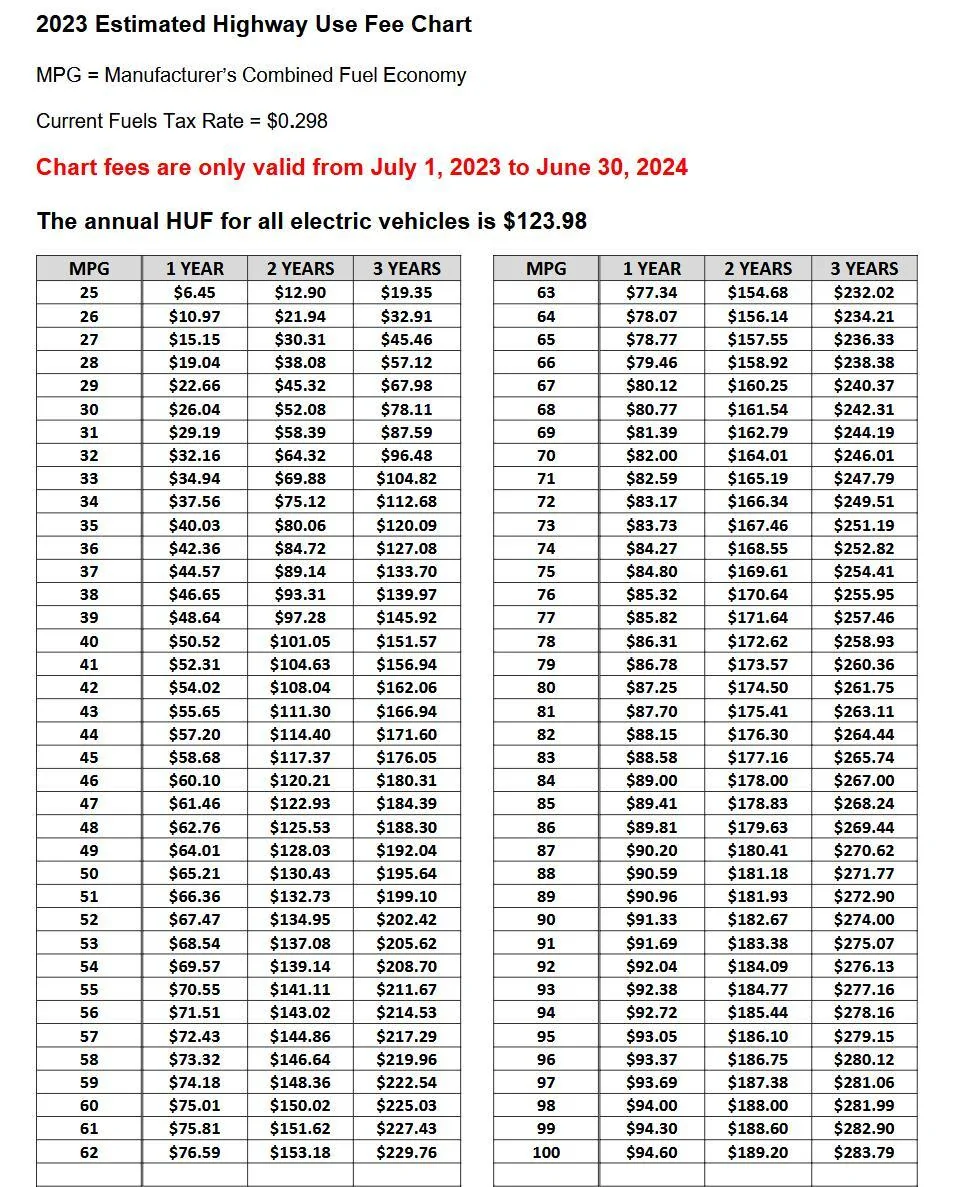
While EVs do not pay gasoline taxes, states do make sure that EVs still pay a so-called fair share through much higher annual registration fees levied on EVs only.
Comparing auto registration costs for my R1S to those for a typical ICE SUV, and eliminating commonalities, e.g., weight, it costs $225 more to register my R1S.
Looking at gasoline excise taxes in the area, the $225 additional EV registration tax would buy you 500 gallons of gasoline.
From the nerdy point of view, this means I would have had to charge north of 16,700 kWh on my Rivian to "break even"; I actually charged 3,400 kWh in 2024.
From the mileage point of view, overall consumption on my R1S for 2024 was 1.8 mi/kWh. That is 60 MPGe, which means that I would have to drive 30k miles in a given year to once again "break even"; I actually drove 6,300 miles in 2024.
And should I not drive my R1S at all; and it will be in winter storage for at least 6 months, I still pay the same for registration. No prorating. The same will go for my other two EVs. By comparison, ICE does not drive=ICE does not purchase gas=ICE does not pay taxes. Fair.
Registration fees on EVs seem capricious and arbitrary at best and can never begin to address the much-needed fairness. We all must pay our fair share for road usage. I am thinking ditch the excise tax on gasoline and make everybody pay annual registration according to mileage driven and throw in vehicle weight tax for good measure also. That would be very fair.
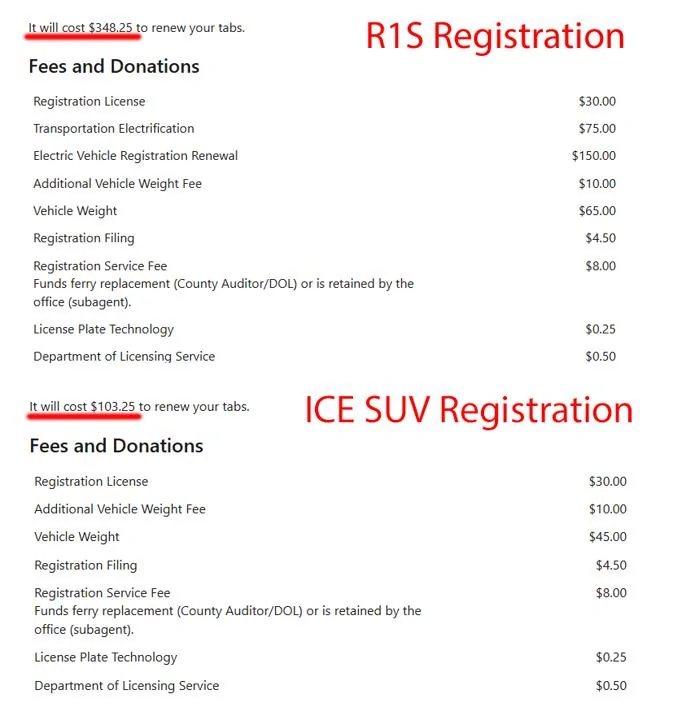
A side-by-side comparison on the R1S registration and an ICE SUV registration. The $75.00 EV tax "funds electric vehicle infrastructure." There is no such similar thing for the ICE SUV registration. In my days of driving ICE, I do not recall ever paying a tax for gasoline vehicle infrastructure, either.
Just a reality check.

While EVs do not pay gasoline taxes, states do make sure that EVs still pay a so-called fair share through much higher annual registration fees levied on EVs only.
Comparing auto registration costs for my R1S to those for a typical ICE SUV, and eliminating commonalities, e.g., weight, it costs $225 more to register my R1S.
Looking at gasoline excise taxes in the area, the $225 additional EV registration tax would buy you 500 gallons of gasoline.
From the nerdy point of view, this means I would have had to charge north of 16,700 kWh on my Rivian to "break even"; I actually charged 3,400 kWh in 2024.
From the mileage point of view, overall consumption on my R1S for 2024 was 1.8 mi/kWh. That is 60 MPGe, which means that I would have to drive 30k miles in a given year to once again "break even"; I actually drove 6,300 miles in 2024.
And should I not drive my R1S at all; and it will be in winter storage for at least 6 months, I still pay the same for registration. No prorating. The same will go for my other two EVs. By comparison, ICE does not drive=ICE does not purchase gas=ICE does not pay taxes. Fair.
Registration fees on EVs seem capricious and arbitrary at best and can never begin to address the much-needed fairness. We all must pay our fair share for road usage. I am thinking ditch the excise tax on gasoline and make everybody pay annual registration according to mileage driven and throw in vehicle weight tax for good measure also. That would be very fair.
A side-by-side comparison on the R1S registration and an ICE SUV registration. The $75.00 EV tax "funds electric vehicle infrastructure." There is no such similar thing for the ICE SUV registration. In my days of driving ICE, I do not recall ever paying a tax for gasoline vehicle infrastructure, either.
Just a reality check.
Sponsored
Last edited: