- Banned
- #16
Oh, no. Quite the contrary.Doesn’t this only work if your average load is less than 1.5 kW? Topping up the battery while you are drawing will extend coverage but if the flow out is faster than the flow in eventually you run out.
I purchased the Ecoflow Delta Pro Ultra Whole Home 18 kWh Power Solution; A/C inverter + 3 batteries. The maximum A/C inverter power output is 7.2 kW.
Circuit breaker panel powering my home critical loads has a NEMA L14-30P, your typical gas generator hookup. Maximum input power to breaker panel is also 7.2 kW, safety derated to 4.2 kW.
During an outage, my home power consumption is typically under 1 kWh the vast majority of the time; temporary 4 kWh spikes every now and then when some items in my home turn on.
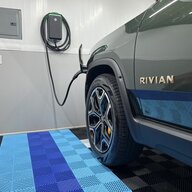
The point being that most of the time, my home power consumption is much lower than the input charging power provided by my R1S, which makes my R1S the ideal solution for charging and keeping my battery solution fully charged forever with the R1S massive pack.
In the very unlikely event that I got close to depleting the R1S battery, I can always DCFC my R1S nearby; my home solution battery will have more than enough power storage to keep juicing up my home uninterrupted.
The only thing I had to do to allow my R1S to charge my home solution was to use an extension cord that floats ground, i.e., connection to my battery solution is H and N only through a dongle that removes ground pin/prong. Conversely, to charge either of my EVs, i just use another dongle plugged into the backup unit inverter outlet that fakes out ground. I then plug into it either the Rivian or Tesla mobile charger, voila!
It is awesome!
Sponsored
Last edited: