skyguyscott
Well-Known Member
- First Name
- Scott
- Joined
- Jul 29, 2025
- Threads
- 11
- Messages
- 339
- Reaction score
- 557
- Location
- whereverIroam
- Vehicles
- 2026 R1T
- Thread starter
- #1
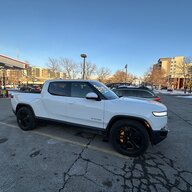
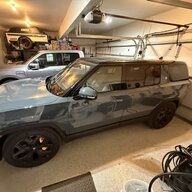
Thought I'd put down some pros and cons of EVs in general, and my R1T in particular for whatever help or insight it might provide to those considering making the plunge. Please feel free to add or correct, or ask questions and I'll try to answer based on my limited perspective.
So, perhaps the biggest remaining concerns folks have about EVs in general are: Range, charging, cost, batteries, and practicality.
Unless you are driving hundreds of miles a day in steep terrain, in cold weather, or towing across the country, range isn't really a concern anymore. My 2026 R1T dual motor max pack has a rated range of 420 miles when fully charged. That range will vary somewhat depending on your driving stye, steep hills, cold weather, how much you use the HVAC, high winds, if you're towing, and so on. It will vary to a greater degree than mileage/range on an ICE (Internal Combustion Engine) vehicles, but not so much greater. In practice, it has never been an issue for me in real life; I have yet needed to charge anywhere but at home.
What about that charging? Others have stated that range anxiety isn't so much about range as it is about charging speeds and convenience. It is true that currently, there are not as many charging stations out in the wild as there are gas stations, and in general, it takes longer to "fill up" an EV than a gas tank. But it is also true that the number of places you can charge an EV are continuing to increase, and battery technology is now growing at a rapid pace -- so rapid in fact that an EV you purchase today may be quickly out-classed in charging speed within a few years, not unlike how quickly smart phones evolved in their first decade. But in practice, I have not yet been inconvenienced in any way regarding charging, and in fact, charging at home is incredibly convenient. My 2026 R1T max pack is hardly the winner in a charging race; there are other EVs out there that will charge faster -- and yet, in practice, it does not have any impact because I simply plug it in at night at home, and in the morning, it's done charging from a lowly level 2 charger and whether it finishes charging at 2am or 6am is inconsequential. On the road there are level 4 chargers your EV will show you and route you to that will charge from 20% to 80% in about 20 minutes, depending. It will take longer to charge from 80% to 100% than it is worth waiting for.
What is consequential is the cost of that charging. I have not yet calculated my savings, but you can take the cost of your electricity per kilowatt hour, and the efficiency of your EV (My R1T is averaging 2.9 miles/kHr - hardly the most efficient EV out there, it is a work truck) and compare it to the mileage and cost per gallon of gas to calculate your own potential savings. I do know that I'm paying way less per mile of travel than I was driving an ICE, because I am charging at home where my rate is roughly nine cents/kHr, vs $.60/kHr at L4 chargers. Also, no oil changes, no maintenance charges so far (it's still new) -- EVs have far fewer movings parts than ICE so your total cost of ownership is going to be significantly lower than that of an ICE vehicle, with the probable exception of tires. Because of the increased weight of the batteries and curb weight of an EV, plus their remarkable acceleration, you are likely going to chew through your tires faster than a comparable ICE vehicle, but still the overall cost of ownership will be less.
There's some misinformation out there regarding battery life and the cost of replacing them. The truth is that current batteries are likely going to outlive your ownership of the vehicle in the same way your engine is going to last the time of ownership. EV batteries are expected to retain 80% or better of their capacity after 10 years of regular use. And there is also a growing industry of battery reuse and recycling. And newer battery technology is improving at a remarkable rate.
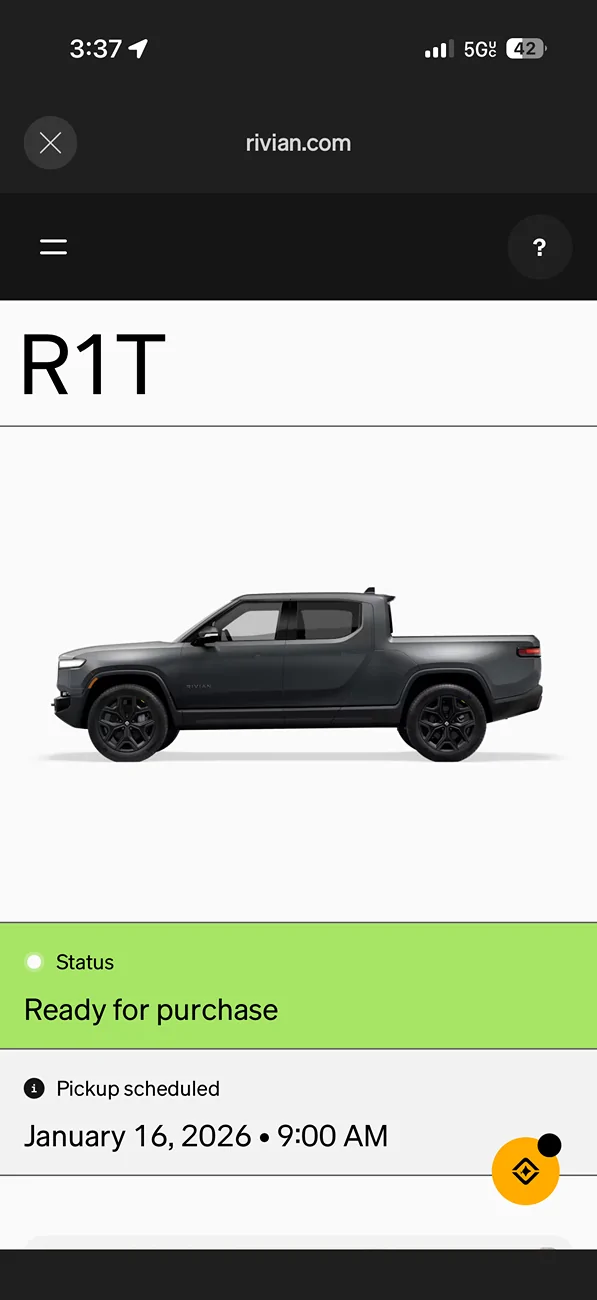
My R1T is simply the most practical vehicle I have yet owned. Ownership is easy, convienent, not all that expensive even with the higher upfront cost compared to an equivalent ICE truck, and yes, fun to drive. I'll leave it to others to relate how much fun these trucks are. My R1T is hardly perfect, there are quirks and design decisions I am not a fan of, and areas I think could be improved, especially at its price point, but those are relative quibbles. If you are considering getting an EV or Rivian in particular, ask away.
So, perhaps the biggest remaining concerns folks have about EVs in general are: Range, charging, cost, batteries, and practicality.
Unless you are driving hundreds of miles a day in steep terrain, in cold weather, or towing across the country, range isn't really a concern anymore. My 2026 R1T dual motor max pack has a rated range of 420 miles when fully charged. That range will vary somewhat depending on your driving stye, steep hills, cold weather, how much you use the HVAC, high winds, if you're towing, and so on. It will vary to a greater degree than mileage/range on an ICE (Internal Combustion Engine) vehicles, but not so much greater. In practice, it has never been an issue for me in real life; I have yet needed to charge anywhere but at home.
What about that charging? Others have stated that range anxiety isn't so much about range as it is about charging speeds and convenience. It is true that currently, there are not as many charging stations out in the wild as there are gas stations, and in general, it takes longer to "fill up" an EV than a gas tank. But it is also true that the number of places you can charge an EV are continuing to increase, and battery technology is now growing at a rapid pace -- so rapid in fact that an EV you purchase today may be quickly out-classed in charging speed within a few years, not unlike how quickly smart phones evolved in their first decade. But in practice, I have not yet been inconvenienced in any way regarding charging, and in fact, charging at home is incredibly convenient. My 2026 R1T max pack is hardly the winner in a charging race; there are other EVs out there that will charge faster -- and yet, in practice, it does not have any impact because I simply plug it in at night at home, and in the morning, it's done charging from a lowly level 2 charger and whether it finishes charging at 2am or 6am is inconsequential. On the road there are level 4 chargers your EV will show you and route you to that will charge from 20% to 80% in about 20 minutes, depending. It will take longer to charge from 80% to 100% than it is worth waiting for.
What is consequential is the cost of that charging. I have not yet calculated my savings, but you can take the cost of your electricity per kilowatt hour, and the efficiency of your EV (My R1T is averaging 2.9 miles/kHr - hardly the most efficient EV out there, it is a work truck) and compare it to the mileage and cost per gallon of gas to calculate your own potential savings. I do know that I'm paying way less per mile of travel than I was driving an ICE, because I am charging at home where my rate is roughly nine cents/kHr, vs $.60/kHr at L4 chargers. Also, no oil changes, no maintenance charges so far (it's still new) -- EVs have far fewer movings parts than ICE so your total cost of ownership is going to be significantly lower than that of an ICE vehicle, with the probable exception of tires. Because of the increased weight of the batteries and curb weight of an EV, plus their remarkable acceleration, you are likely going to chew through your tires faster than a comparable ICE vehicle, but still the overall cost of ownership will be less.
There's some misinformation out there regarding battery life and the cost of replacing them. The truth is that current batteries are likely going to outlive your ownership of the vehicle in the same way your engine is going to last the time of ownership. EV batteries are expected to retain 80% or better of their capacity after 10 years of regular use. And there is also a growing industry of battery reuse and recycling. And newer battery technology is improving at a remarkable rate.
My R1T is simply the most practical vehicle I have yet owned. Ownership is easy, convienent, not all that expensive even with the higher upfront cost compared to an equivalent ICE truck, and yes, fun to drive. I'll leave it to others to relate how much fun these trucks are. My R1T is hardly perfect, there are quirks and design decisions I am not a fan of, and areas I think could be improved, especially at its price point, but those are relative quibbles. If you are considering getting an EV or Rivian in particular, ask away.
Sponsored
Last edited: