
Sponsored

SeaGeo

Well-Known Member
First Name
Brice
Joined
Jan 12, 2021
Threads
50
Messages
5,673
Reaction score
10,212
Location
Seattle
Vehicles
Xc60 T8
Occupation
Engineer
That’s not an accurate conclusion. The smaller the battery the less average kw it should theoretically take in. The Rivian has a huge battery so it should be able to change faster for longer. C rate is what matters. The Rivian has less than 1C whereas the EV6 averages over 2C in the same window. @ajdelange can offer a way more scientific explanation.
Jumping in for @ajdelange a bit. You're right, but the two E-gmp cars have an absolutely bonkers charging curve relative to battery size.

But there are plenty of large battery cars that charge from 10% to 80% in ~30 minutes. Just looks at the EQS with a 400v pack. Most cars released in the last ~2 years that I can think of have a X to 80% charge spec of about 30 to 35 minutes. The Lucid, Taycan, E-tron GT, and e-gmp cars (kia/hyundai) have an advantage with using 800v class systems, and have also opted to push the batteries harder in some cases. It's going to be really interesting to see how the e-gmp cars hold up.
Sponsored

 

Scoiatael

Well-Known Member
Joined
Sep 20, 2021
Threads
49
Messages
1,162
Reaction score
1,816
Location
Southern CA
Vehicles
2025 R1S, 2024 Mach E
Just a point of clarification on the phrase "EA throttles." I haven't seen evidence that EA intentionally throttles their 350kw stations as a whole in any way. More that some of their hardware throttles to 150kw for whatever reason, so our new member showed with his Tesla.

I don't think there is a way to get to 250kW for the R1T using the CCS standard unless they have a way to mimic an 800v system. At the battery's safety cutoff of 459v and the max CCS current of 500 amps that would be ~230 kw. But in reality the limit is a bit less than that, hence the 210 kW max listed in the EPA docs.
I've seen a road trip video for an EV, forget which one, where they were getting only 150 kw at an EA station, they called EA and EA actually said they throttle stations that aren't used as often. The EA customer service was able to reboot the charger and then it was pumping out full speed.
 

SeaGeo

Well-Known Member
First Name
Brice
Joined
Jan 12, 2021
Threads
50
Messages
5,673
Reaction score
10,212
Location
Seattle
Vehicles
Xc60 T8
Occupation
Engineer
I've seen a road trip video for an EV, forget which one, where they were getting only 150 kw at an EA station, they called EA and EA actually said they throttle stations that aren't used as often. The EA customer service was able to reboot the charger and then it was pumping out full speed.
Huh. Hadn't heard that one before. That actually makes sense as a way to manage demand fees on their end. It'd be nice if they'd say that on the charger or something though.
 

Dirtman16

Well-Known Member
First Name
Allen
Joined
Dec 9, 2020
Threads
3
Messages
83
Reaction score
144
Location
Alabama
Vehicles
Tesla Model 3, Tesla Model Y
Occupation
Engineer
Ultimately, this test goes to show that more inefficient vehicles are going to need to be on an 800V architecture sooner or later, Rivians included. You aren't always going to have optimal conditions (temps, charger capability, etc.), so you need to support, on the vehicle side, the maximum possible from existing and future charging infrastructure.

I've got an R1S or order, but this does make me a bit leery about it's suitability for multi-charge-stop, long-distance trips. It's going to really start adding significant time to the trips. The Korean manufacturers, GM, and Porsche may have a leg up on all the other brands for a while, Tesla included.
 

jjwolf120

Well-Known Member
First Name
John
Joined
Feb 25, 2020
Threads
1
Messages
791
Reaction score
1,133
Location
Arcadia
Vehicles
Rivian R1S
Occupation
TPA
Ultimately, this test goes to show that more inefficient vehicles are going to need to be on an 800V architecture sooner or later, Rivians included.
This test shows nothing, other than this test. A single data point is insufficient to draw any conclusions.
 

Sponsored

branden

Well-Known Member
First Name
Branden
Joined
Jan 21, 2022
Threads
15
Messages
147
Reaction score
348
Location
Charlotte, NC
Vehicles
Rivian R1T - many EVs in past
Occupation
EV charging deployment
I suspect @rhuber is spot on - both Model S Plaid and R1T use a peak 450V pack and would be around 430V at 50% hitting ~150kW as both demonstrated with a 350A limit. Trying another station is key here. Hopefully you can make that happen, @TFLtommy. Also, if you test again, I think doing 5% or 10% as your starting point would be useful. 20% is leaving a huge buffer with longer range EVs.

I have some useful colo(u)r to add here, as I just drove a Model S Plaid 4000 miles using only Electrify America and a CCS adapter...

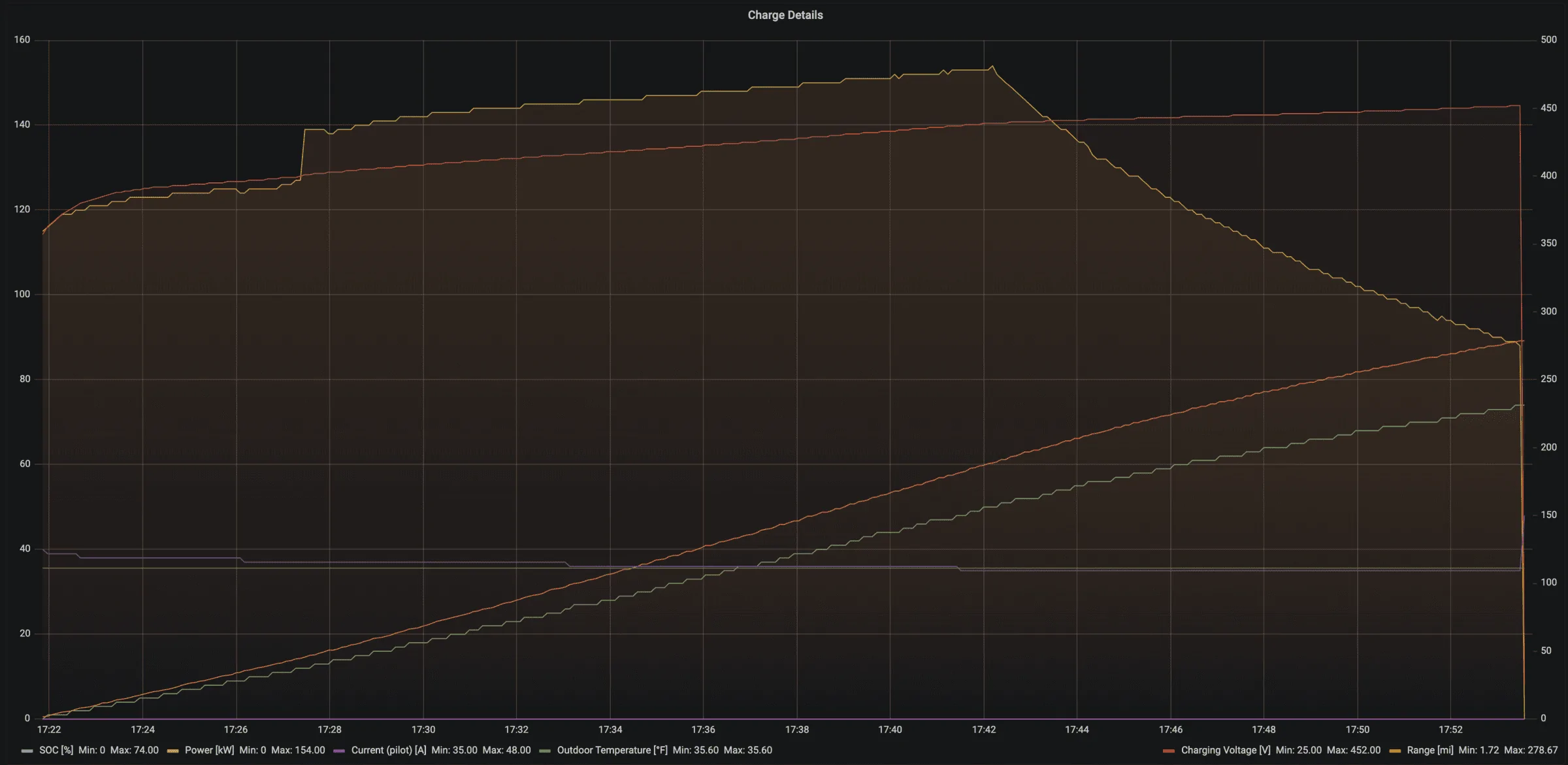
tldr: With the Plaid I ran into some EA stations (mostly the ABB units iirc) on I-80, which peaked at 350 amps instead of the CCS spec limit of 500 amps. In those cases, my maximum charge rate also peaked near 150kW. I know TFL (/cc @TFLtommy) has limited time, but I'd look for a Signet or other manufacturer unit to test on, as this may be an ABB+400V architecture quirk, and one I definitely experienced myself.

EDIT: @TFLtommy if you have time, I would try this EVgo station with Signet units, which is the closest one I can find to the EA station where you did the test: https://www.plugshare.com/location/343002

The plaid has a very similar voltage profile to the Rivian, both of which are reported to peak around 460V at 100% SoC. When the car hit 500A, my charging profile had me hitting a peak of 218kW at approx 39% SoC, which is the point where voltage and amperage converge at optimal.

On my trip, I ran across a few stations that were unwilling to provide more than 350A, and they were definitely capping me at 150kW instead of the much better rates I was able to hit at other EA stops. I can share a lot of data on this, as I logged everything, but here is a short writeup with a bit of info:


In fact, here is a screenshot of my charge curve from 0% (reported) SoC up to 74%, at one of the stations that would only give me 350A, instead of 500A. It looks VERY similar to the curve TFL saw until 70-ish%, after which, rivian seems to throttle more aggressively. We even both hit the same peak of around 150kW right at 50% SoC.
Screen Shot 2022-01-21 at 9.46.44 AM.webp
 

Dirtman16

Well-Known Member
First Name
Allen
Joined
Dec 9, 2020
Threads
3
Messages
83
Reaction score
144
Location
Alabama
Vehicles
Tesla Model 3, Tesla Model Y
Occupation
Engineer
This test shows nothing, other than this test. A single data point is insufficient to draw any conclusions.
At very best, the R1T and R1S could charge at a peak of 220kW (440V x 500A). Even if could sustain an average of 175 kw from 10-80, that's still 30 minutes to get 210-220 miles of range.

My point is, on an 800V architecture, you could peak at 350kW (theoretically) and likely average something more like 270kw from 10-80. Now you're down under 20 minutes. That's a BIG difference if you have to do it 2-3 times along a journey. And it's more in line with what drivers of modern Teslas and Hyundais are used to (due to efficiency and charging speed, respectively).

You'll just never be able to get reasonable range replenishment in under 30 minutes on the 400V architecture, not in a vehicle getting 2-2.5 miles/kW-hr.
 

Scoiatael

Well-Known Member
Joined
Sep 20, 2021
Threads
49
Messages
1,162
Reaction score
1,816
Location
Southern CA
Vehicles
2025 R1S, 2024 Mach E
I suspect @rhuber is spot on - both Model S Plaid and R1T use a peak 450V pack and would be around 430V at 50% hitting ~150kW as both demonstrated with a 350A limit. Trying another station is key here. Hopefully you can make that happen, @TFLtommy. Also, if you test again, I think doing 5% or 10% as your starting point would be useful. 20% is leaving a huge buffer with longer range EVs.
I disagree with leaving less than 20% buffer. If a charger is broken you need enough range to make it to the next one.
 

branden

Well-Known Member
First Name
Branden
Joined
Jan 21, 2022
Threads
15
Messages
147
Reaction score
348
Location
Charlotte, NC
Vehicles
Rivian R1T - many EVs in past
Occupation
EV charging deployment
I disagree with leaving less than 20% buffer. If a charger is broken you need enough range to make it to the next one.
I guess that would be the prudent thing to do, but it's very unlikely an entire EA station would be down. I've roadtripped my VW ID.4 around the country and never had an issue charging.
 

paariv

Well-Known Member
Joined
Mar 10, 2019
Threads
8
Messages
669
Reaction score
1,625
Location
Cali
Vehicles
Died of old age during the wait
I understand the disappointment here. But this does not strike me as a significant issue, given how little it will impact day to day life for almost all of us.

Most of us will charge at home almost all of the time, so this won’t affect day to day commuting: no charging stops are necessary then. And on what are for most of us very infrequent road trips, long charging stops are required no matter what, even for cars with superior charging performance. Is 40 minutes a long time to wait? Yes. But a 30 minute charge is a long break as well - and we couldn’t realistically have expected reliable real world charging faster than that.

the marginal 10 minutes isn’t nothing, and of course I’d rather not spend that time waiting. But for virtually all of us, long road trips are very infrequent, and the marginal impact of a slower charge is not that big.
 

Sponsored

COdogman

Well-Known Member
First Name
Brian
Joined
Jan 21, 2022
Threads
33
Messages
11,641
Reaction score
34,494
Location
CO
Vehicles
2023 R1T
Occupation
Cyber defender
Clubs
 
It will be interesting to see what the results are once Rivian gets their own charging network up and running. With the charger and truck software optimized will most achieve the 140 miles/ 20 minutes figure? It would be nice if Rivian released a little more aggregate data about charging from all the time they tested it out and about, but I certainly understand why they don’t. People will see what they want to see in it, good and bad.
 

graemebshaw

Well-Known Member
First Name
Graeme
Joined
Jan 21, 2022
Threads
2
Messages
50
Reaction score
58
Location
Brooklyn
Vehicles
Rubicon 392
Occupation
Consultant and investor
Something is not quite right here. From what I can tell in the data, it took 20 minutes to go from 20% to 50% SOC (a 30% increment) at a reasonably constant charge rate close to 150 kW/hr. Then it took almost exactly the same duration (21 mins) to go from 50% SOC to 80% SOC, which also an increment of 30%. However the charge rate was much lower. How is that possible? Given the lower charge rate, it should have taken much longer to go from 50% to 80% SOC than it did to go from 20% to 50% SOC. @TFLtommy, do you have any idea what might be going on? My suspicion is the car is giving erroneous SOC % readings...

Edit: I quickly summed the kWh delivered according to @TFLtommy's numbers and I am right: the R1T is giving erroneous SOC data. See the table here:
Rivian R1T R1S Rivian R1T charging curve test 20-80% [by TFL] 1642801912310


This simple calc shows that it really goes from 20% to 50% in only 16 minutes (not 20). And also notice that this calc gives the correct cumulative kWh delivered (same as on the charging station screen). Something is wrong with the R1T data...
 
Last edited:

SeaGeo

Well-Known Member
First Name
Brice
Joined
Jan 12, 2021
Threads
50
Messages
5,673
Reaction score
10,212
Location
Seattle
Vehicles
Xc60 T8
Occupation
Engineer
I guess that would be the prudent thing to do, but it's very unlikely an entire EA station would be down. I've roadtripped my VW ID.4 around the country and never had an issue charging.
For all the bitching I do about the software in our ID.4s (and that it doesn't precondition for charging), they do a damn good job charging reliably overall with EA.
 

branden

Well-Known Member
First Name
Branden
Joined
Jan 21, 2022
Threads
15
Messages
147
Reaction score
348
Location
Charlotte, NC
Vehicles
Rivian R1T - many EVs in past
Occupation
EV charging deployment
For all the bitching I do about the software in our ID.4s (and that it doesn't precondition for charging), they do a damn good job charging reliably overall with EA.
There seem to be a lot less issues with low(ish) power charging. We could charge on a 350A limited station and we wouldn't even know in an ID.4
 

kanundrum

Well-Known Member
Joined
May 2, 2020
Threads
273
Messages
4,685
Reaction score
13,661
Location
Washington, DC
Vehicles
Giulia QV, R1S (Sept 22 Delivery)
Occupation
IT
Clubs
 
For all the bitching I do about the software in our ID.4s (and that it doesn't precondition for charging), they do a damn good job charging reliably overall with EA.

Same with my Ioniq, whats crazy is my peak speed is 64kw which is a LOT for a 28kwh battery pack. In 2020 they reduced the speed for better battery health to 50kw and increased pack size to 35kwh.
Sponsored


Top