
Sponsored

Are There Alternatives to Rivian Level2 Charger?

MaskedRacerX

Well-Known Member
First Name
DT
Joined
Nov 27, 2022
Threads
3
Messages
405
Reaction score
675
Location
Vilano Beach, FL
Vehicles
'24 BMW iX50 / '24 Jeep Wrangler 4xe
Occupation
Software Dev / Architect / Product Designer
Does the specific charger software control setting charge level caps like not going above 80% day to day or is that controlled by the vehicle? I've never owned an electric vehicle of any kind so this is maybe an easy answer for anyone with more knowledge than me.
That's all negotiated by the vehicle, for example we have a 40 amp charger on a 50 amp circuit and if I plug in to the Wrangler it has a maximum charging capacity of 32 amps it just charges at 32 amps where the BMW IX charges at the full 40 amps.

Also EV chargers run at continuous load so they charge at 80% of the circuit spec, so a 50a circuit allows for 40a, a 30a circuit (like a dryer plug, which you can also use) runs at 24a.

Most vehicles have all sorts of scheduling and whatnot as well, So after having had a smart charger, I'm back to preferring a simple "dumb" charger.

And for some additional really esoteric EV info :D

That box that hangs on the wall in your garage is technically not a charger it's called an EVSE. It's basically a smart switch from your AC power. The charger is on board the vehicle and rated at a specific amperage. The EV batteries are expecting to get DC power so the charger on board the car converts the AC from your EVSE (aka "charger"), to DC at a specified rate.

Commercial chargers are actually DC power (DCFC), so they bypass the onboard AC to DC charger and go directly into the batteries at a much higher rate.
Sponsored

 
Last edited:
JeepEVer

Well-Known Member
First Name
Jim
Joined
Mar 10, 2024
Threads
2
Messages
100
Reaction score
89
Location
San Francisco
Website
www.pocketpigskin.com
Vehicles
Tesla Performance Model 3, Jeep Grand Cherokee 4x4
Occupation
Cyber Security
Clubs
 
The "mobile" chargers are half the wall charger price, and don't need installation if you already have a NEMA 14-50 outlet. The downside tends to be amperage (32 for mobile, 50 for wall). 32 amps provides over 20 miles per hour of charging, which is plenty when you have all night.

For example, I could use my Tesla mobile charger on the Rivian. But since that Tesla charger will probably be part of the Tesla vehicle sale, I will just replace it with the $400 Rivian NACS charger. There are probably plenty of Tesla chargers for sale online, both new and used.
 

VSG

Well-Known Member
Joined
Oct 3, 2022
Threads
4
Messages
3,205
Reaction score
5,992
Location
WA
Vehicles
R1T LE/RB/OC/20
What are your feelings. Should I use a Rivian charger, or is it safe to go with another? In either case, the charger and 50A 240V line from my circuit panel will be installed by me.
With all due respect, if you are not able to make that judgement yourself, you shouldn't be doing the electrical work yourself. Get a professional and get a permit.

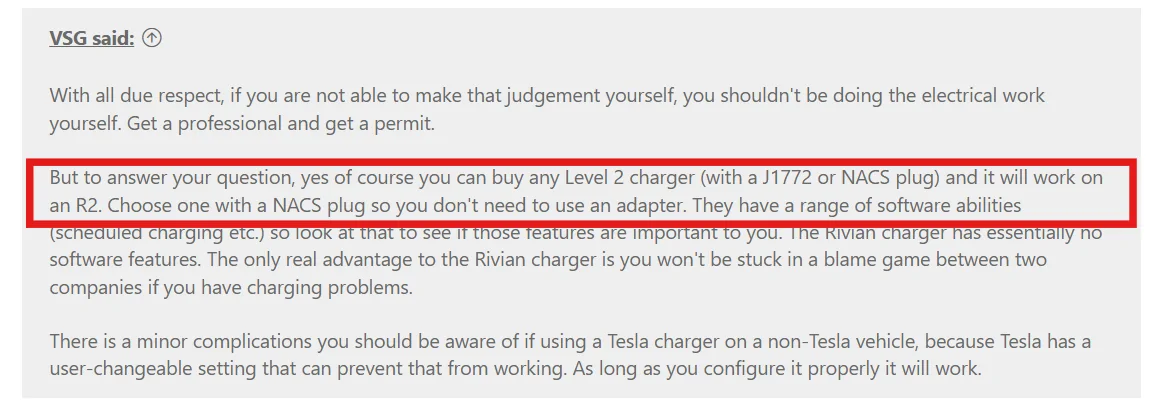
But to answer your question, yes of course you can buy any Level 2 charger (with a J1772 or NACS plug) and it will work on an R2. Choose one with a NACS plug so you don't need to use an adapter. They have a range of software abilities (scheduled charging etc.) so look at that to see if those features are important to you. The Rivian charger has essentially no software features. The only real advantage to the Rivian charger is you won't be stuck in a blame game between two companies if you have charging problems.

There is a minor complications you should be aware of if using a Tesla charger on a non-Tesla vehicle, because Tesla has a user-changeable setting that can prevent that from working. As long as you configure it properly it will work.
 

horseback

Member
First Name
Kent
Joined
Mar 27, 2025
Threads
0
Messages
7
Reaction score
2
Location
Flyover country
Vehicles
Lexus NX 450h+
I paid less than $600 for a ChargePoint Home Flex charger in my garage some years ago and it has been absolutely rock solid. Plugs right into a 40 amp outlet, so I can take it with me if I move. Great little gadget.
 

VSG

Well-Known Member
Joined
Oct 3, 2022
Threads
4
Messages
3,205
Reaction score
5,992
Location
WA
Vehicles
R1T LE/RB/OC/20
Check with your utility company, county, or even city for rebates on EVSE’s.
This is a really important point. This sort of rebate is very common. My charger was paid for by my power company, and I got to choose which one to install (although there was a list of qualified chargers, and I had to choose one of them). Some power companies will give you a charger.

Regardless, L2 chargers are somewhat of a commodity item, so if you can get one for free or a greatly reduced cost, that's going to be your best deal. The power company will almost certainly require a professional installation as a condition for the rebate ...
 

Sponsored

MaskedRacerX

Well-Known Member
First Name
DT
Joined
Nov 27, 2022
Threads
3
Messages
405
Reaction score
675
Location
Vilano Beach, FL
Vehicles
'24 BMW iX50 / '24 Jeep Wrangler 4xe
Occupation
Software Dev / Architect / Product Designer
The "mobile" chargers are half the wall charger price, and don't need installation if you already have a NEMA 14-50 outlet. The downside tends to be amperage (32 for mobile, 50 for wall). 32 amps provides over 20 miles per hour of charging, which is plenty when you have all night.
The installation / wire-up doesn't really denote mobile or not, I had a Grizzl-E that was not in any way "mobile", but it used an outlet.

@reodds

What he's talking about is there is two ways to power an EVSE / charger, You can either have an outlet / receptacle installed so it plugs in, Or you can choose to hardwire it where there is a straight wiring run from the power source directly into the charger.

The max spec for receptacle is 50 amps, If you hardwire your charger, and obviously if your vehicle supports it, you can go over 50 amps. For example, a 60a hardwired circuit that would allow for 48a charging (charging rate of ~12kW).

There's kind of a general understanding that constantly plugging and unplugging from an outlet can actually wear the outlet out, and that different grades of outlets make a big difference, so some people shy away from a receptacle based install. Personally I like the ability to swap out the EVSE without getting involved in a rewire, and at least one time that was incredibly handy for us.

There's two (common) specifications for 50 amp outlets, an N6-50 (aka "welder outlet") and an N14-50 (commonly used in RV parks). The latter is a good bit more common, though we actually have the N6-50. They each have specification specific plugs which isn't much different than your dryer outlet or your oven outlet.
 

Luxus

Well-Known Member
First Name
Walter
Joined
Jan 5, 2026
Threads
12
Messages
167
Reaction score
283
Location
Niles, IL.
Vehicles
2026 Rivian R1T tri; 1973 Buick Century Gran Sport; 1974 Buick Lesabre conv
Occupation
Mechanical Engineer
Does the specific charger software control setting charge level caps like not going above 80% day to day or is that controlled by the vehicle? I've never owned an electric vehicle of any kind so this is maybe an easy answer for anyone with more knowledge than me.
To add to MaskedRacerX's reply, the fancypants (read more expensive) EVSEs can control the level to which the vehicle is charged. But given that the vehicle does that, I feel that is an unnecessary expensive feature to pay for. Personally, I got the base Grizzle-E and works great in addition to being a lower cost unit.
 

MaskedRacerX

Well-Known Member
First Name
DT
Joined
Nov 27, 2022
Threads
3
Messages
405
Reaction score
675
Location
Vilano Beach, FL
Vehicles
'24 BMW iX50 / '24 Jeep Wrangler 4xe
Occupation
Software Dev / Architect / Product Designer
There is no better deal than $450 for Tesla's wall connector. I shy away from mobile chargers for home use as they are less safe than hard wired connectors for frequent use.
Plug in chargers are not necessarily "mobile" see my post above. And I've been using plug-in style EVSEs for going on 6 years now, on two EVs, without a single issue. :)
 

rbdavis808

Well-Known Member
First Name
Roger
Joined
Mar 12, 2026
Threads
0
Messages
78
Reaction score
126
Location
Honolulu
Vehicles
'22 Ioniq5
This Tom Moloughney at State of Charge has lots of information and testing of EV chargers. Might be worth looking at his testing.
This. Ignore all other advice. ;)

There are many good home L2 EVSE out there, and many cheaper than the Rivian. Get anything recommended by Tom that seems to fit your needs.
 

Sponsored

SANZC02

Well-Known Member
First Name
Bob
Joined
Feb 11, 2021
Threads
50
Messages
7,400
Reaction score
12,683
Location
California
Vehicles
Tesla Model S, LE - R1S
Occupation
Retired
With all due respect, if you are not able to make that judgement yourself, you shouldn't be doing the electrical work yourself. Get a professional and get a permit.

But to answer your question, yes of course you can buy any Level 2 charger (with a J1772 or NACS plug) and it will work on an R2. Choose one with a NACS plug so you don't need to use an adapter. They have a range of software abilities (scheduled charging etc.) so look at that to see if those features are important to you. The Rivian charger has essentially no software features. The only real advantage to the Rivian charger is you won't be stuck in a blame game between two companies if you have charging problems.

There is a minor complications you should be aware of if using a Tesla charger on a non-Tesla vehicle, because Tesla has a user-changeable setting that can prevent that from working. As long as you configure it properly it will work.
The R2 has the J3400 (NACS) plug. He will need the J3400 if he does not want to use an adapter.
 

SANZC02

Well-Known Member
First Name
Bob
Joined
Feb 11, 2021
Threads
50
Messages
7,400
Reaction score
12,683
Location
California
Vehicles
Tesla Model S, LE - R1S
Occupation
Retired

Jeremy3292

Well-Known Member
First Name
Jeremy
Joined
Apr 27, 2026
Threads
1
Messages
293
Reaction score
343
Location
South Carolina
Vehicles
R2
Plug in chargers are not necessarily "mobile" see my post above. And I've been using plug-in style EVSEs for going on 6 years now, on two EVs, without a single issue. :)
Yes, I understand but I do not recommend them as they require a NEMA outlet of some sort. I cannot account for the quality of NEMA outlet or the electrician used by the person who is need of recommendations on this or any other forum. So I always recommend permanently hard wired connectors vs. anything with a plug for home use.

There are countless, numerous, never ending stories of improper outlet installs that result in fires and burned up outlets. I have yet to see any posts in my 7 years on these EV forums of a botched hard wired connector job.

When done properly with a industrial grade Hubbell outlet, proper wiring, stripping, and lug attaching, a NEMA plug in charger is perfectly safe. Unfortunately they are so often not done safely and are done cheaply. The cost of a properly done one is more than a Tesla wall connector anyways.
Sponsored


Top