
TexasBob
Well-Known Member
Would it matter to you if you learned that the regulation is sensible and life-saving?I was pointing out that the regulation is stupid and unnecessary. We can't make vehicles pedestrian proof. If you get hit by a 4,000 lbs vehicle, it is going to be bad. Should the government mandate foam on the front of all vehicles? Maybe they can put air bags on the front instead. Stupid. Accidents happen. We don't need to regulate everything.
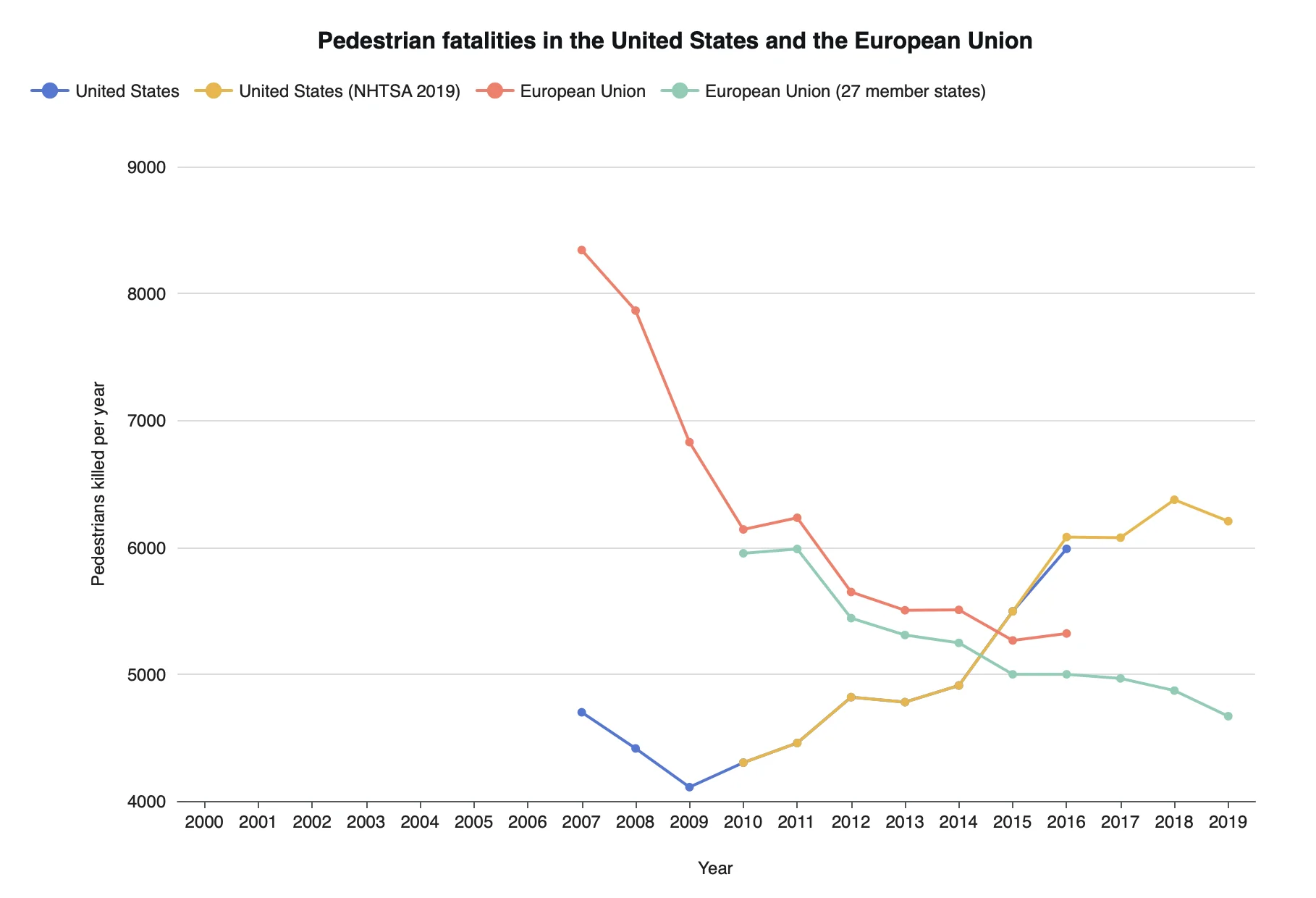
TLDR these and similar "stupid" regulations saved around 20,000 lives over the past 10 years. In the US, we could prevent around 3,000 deaths a year if we adopted similar strategies and if we adopted safer vehicle styles.
Here is some data just in case it might be of interest:
The Buehler & Pucher study in Transport Reviews (Vol. 41 No. 1, 2021) is the canonical source for per-km comparisons. Key numbers:
- 1990–2018: US pedestrian fatalities per capita fell 23%. UK/Germany/Netherlands/Denmark fell 66–80%.
- In 2018, US pedestrian fatalities per km were 5–10× higher than in those four countries.
- 2010–2018 alone: US per-km pedestrian fatality rate rose 17% while EU peer rates fell or held flat.
- Streetsblog summary of the same study: 11.2 US pedestrian deaths per 100 million km walked (2016–2018), versus roughly 1 in the Netherlands.
IIHS injury risk curves (2024, Monfort et al.):
- Pedestrian struck at 20 mph: ~1% fatality risk.
- At 35 mph: ~19% fatality risk.
- At 50 mph: >80% fatality risk.
IIHS 2023 study (n ≈ 18,000 pedestrian crashes):
- Vehicles with hood height >40 inches are 45% more likely to kill a struck pedestrian than vehicles with hoods ≤30 inches and a sloping profile.
- For hoods between 30–40 inches, blunt/vertical front ends raise risk further.
- Flat hoods (≤15° angle) carry a 25% higher fatality risk regardless of height.
- Same impact speed produces worse injuries in the US than in Germany, and the gap is fully explained by US fleet composition (taller pickups/SUVs).
- Vehicle weight is not the dominant factor — "any vehicle, even a small car, vastly outweighs a person" (IIHS). Front-end height and shape are what determine where the body is struck and whether it goes under the wheels.
Journal of Safety Research (2022): children are 8× more likely to be killed when struck by an SUV or light truck than by a passenger car.
Sponsored