
-
👉 R2 Reservations List: Add Your R2 Reservation 📊
Sponsored
Search results
-

Charging at 19.2kW?
For about a year, the first releases of the Model X had a single on-board charger that could do 72A. For home use, I think the R1's current (pun intended) charger is fine. -
Bi-Directional Charging
You shouldn't need a transformer to get a Neutral. Just bond a Neutral to the existing Ground. If you're doing V2H, it would be bonded, anyway at the main panel. -
Issues with key card after update
Same here. The two keycards are registered but I've never had them unlock or start since I got it, last month. -
Poll - Do you plan to place R2 Reservation for $100?
Will be selling my Model S and Volt for a Polestar 2, here soon. That will be the "second" car until the R2 arrives.- Chris TX
- Post #98
- Forum: Rivian R2 Forum
-
Unpopular opinion: Rivian shouldn’t be running ads
I'd love a referral program. When Tesla had it, I referred dozens and dozens, earning me two Powerwalls, two sets of Arachnid wheels, two Radio Flyer kid's cars, and all the luggage and swag. I'm an owner and investor. Sign me up!- Chris TX
- Post #10
- Forum: RIVN Stock Investors / Rivian Company
-
Bait and Switch?
That would be super cool if you get that configuration for legacy pricing. -
Does the R2 actually kill Rivian?
As a "legacy" Model S owner (pre-Model X,3,Y) there didn't seem to be many people that chose to not get a Model S/X to get a Model 3/Y. I did see some people trade in their Model S to get a Model Y, but the demographics are usually different enough to where there isn't much cannibalization. If...- Chris TX
- Post #48
- Forum: Rivian General Topics -- Sponsored by Atomic Wheels
-
Bi-Directional Charging
For this device, the biggest hurdle to having V2G/V2H is the Vehicle manufacturer allowing the HV contactors to close, exposing that massive DC voltage to the charge port, when it's not charging. There needs to be bidirectional communication establishing trust. As someone noted, that's for a... -
-
-
Is there really no way R2 can be produced earlier in Normal?
"losing $43k/vehicle" is a falsehood, plain and simple. That $43k is being dumped into building the GA plant and other innovations.- Chris TX
- Post #27
- Forum: Rivian R2 Forum
-
Is there really no way R2 can be produced earlier in Normal?
R2 will need a completely different line for machine/tooling and assembly. The cost of expanding Normal just for a 3rd line would be very short-sighted, limiting future production of all three models. If any expansion happens in Normal, it should be for R1 and EDV. Considering the price point...- Chris TX
- Post #24
- Forum: Rivian R2 Forum
-
Video: Charging Two Rivians on 200A Service
The 3rd Gen Tesla Wall Connectors won't pull more than 48A. 48+48=96A of full kW charging. It's okay to oversubscribe your main panel, as well. -
RealWheels EV Stainless Steel Running Boards
How do they mount (pics would be neat) and does this interfere with the jack points? -
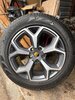
Texas 21” OEM spares or set PRICE DROP to $600 down from $800
How much for the $200 wheel and all four caps?- Chris TX
- Post #2
- Forum: Wheels, Tires, Suspension
-
RV outlet adapter?
This is the best answer. Get one that specifically says it's for Teslas or EVs and dial down the amps to 24 tops. Most RV sites don't have good maintenance with their gear so it might be good to take it down to 16A. -
R1S not charging from a dryer plug
10-30 has two hots and a neutral, not a ground. Sure, the neutral might be bonded to ground at the panel but you're rolling the dice. When the charge cord (EVSE) first boots up, it does a GFCI test to see if there is a certain amount of voltage between one of the hots and what should be ground... -
Are Rivians being built with NACS plugs yet? Any NACS adapter plug recommendations?
I got this one yesterday so I can use my 48A Tesla Wall Connector. It works great at full amps. https://www.amazon.com/dp/B0CP264NH6