
Sponsored
SeaGeo
Well-Known Member
The math is the same. @jjswan33 was looking up air resistance as power. Which is a function of v^3. Whereas the force (and energy used/mile) is a function of v^2.https://www.engineeringtoolbox.com/wind-power-d_1214.html
talking about power harnessed by wind, not necessarily drag on a car.
Instantaneously, the power answer is right, but as a function of distance, then energy consumed is a function if velocity squared. Let's see how well I can do this on my phone...
(1) Power = force× distance/time (ie force×velocity) (kw)
(2) Energy = power × time (kwh)
When we report kwh/mi the third velocity component cancels itself out.
For example, let's solve for energy/ mile...
Energy/distance = power × time/distance = force × distance/time × time /distance
OR combining 1 and 2...
Energy/distance = force/time×time
If you work you way through the math, the total energy consumed per mile is still a function of velocity squared, but the if you look at it from the standpoint of energy required per unit of time it folds back to a cube of the velocity.
OP
OP
jjswan33
Well-Known Member
- Thread starter
- #18
I agree of course, your math is correct. I meant I didn't look at what you were saying was v^2.The math is the same. @jjswan33 was looking up air resistance as power. Which is a function of v^3. Whereas the force (and energy used/mile) is a function of v^2.
Instantaneously, the power answer is right, but as a function of distance, then energy consumed is a function if velocity squared. Let's see how well I can do this on my phone...
(1) Power = force× distance/time (ie force×velocity) (kw)
(2) Energy = power × time (kwh)
When we report kwh/mi the third velocity component cancels itself out.
For example, let's solve for energy/ mile...
Energy/distance = power × time/distance = force × distance/time × time /distance
OR combining 1 and 2...
Energy/distance = force/time×time
If you work you way through the math, the total energy consumed per mile is still a function of velocity squared, but the if you look at it from the standpoint of energy required per unit of time it folds back to a cube of the velocity.
I would look at the math slightly different to come to my same initial conclusion
Energy = Force * Distance
From your initial equation:
F = cd×A×v^2 = cd * A * d^2/t^2
E = cd * A * d^2/t^2 *d = cd * A * d^3 / t^2 for Air Resistance
Then rolling resistance becomes
F * d = cr * m * g * d
So energy from air resistance is proportional to the third power of distance traveled while rolling resistance is proportional to distance.
Put another way:
For 100 miles traveled:
Rolling resistance will be a constant * mass * 100
Air resistance will be a constant * surface area * 1,000,000
Not exactly sure where those constants come out... I suspect a small trailer that can mostly draft an R1T/R1S wouldn't have as a significant effect on range as we have seen from some of these tests.
Finally... Thanks for pulling me down the rabbit hole ?
SeaGeo
Well-Known Member
Right.E = cd * A * d^2/t^2 *d = cd * A * d^3 / t^2 for Air Resistance
I was being lazy and dropped density and the scaler of /2 in my original equation. Which is probably why you're not sure where to get the constants. Cd is obviously the one we cant easily come up with without some empirical testing.Not exactly sure where those constants come out...
The big question ends up being cd*A. Since that little trailer shouldn't add area to the truck, it's basically a question of how much its going to screw up the drag coefficient. ?
Also, tonight I learned the carrot doesnt exist on my phone keyboard when split across screens. ?
OP
OP
jjswan33
Well-Known Member
- Thread starter
- #20
It's ok I was trained as a Physicist so a factor of 2 is within the rounding errorRight.
I was being lazy and dropped density and the scaler of /2 in my original equation. Which is probably why you're not sure where to get the constants. Cd is obviously the one we cant easily come up with without some empirical testing.
The big question ends up being cd*A. Since that little trailer shouldn't add area to the truck, it's basically a question of how much its going to screw up the drag coefficient. ?
Also, tonight I learned the carrot doesnt exist on my phone keyboard when split across screens. ?

Sponsored
SeaGeo
Well-Known Member
That sounds like an engineer, not a physicist...It's ok I was trained as a Physicist so a factor of 2 is within the rounding error
kylealden
Well-Known Member
I'm extremely impressed that it hit the target consumption across this drive. I do this stretch often in my Model Y and the climb is still lossy even after the descent. Very encouraging.
Singletracker
Well-Known Member
Blah, blah, blah, blah, blah ? Bottom line, and all that matters, it looks like about 275+/- miles per full charge. Not bad, but would like a bit more. Clearly the climb hurt. But, what goes up must come down - well, some times ?

Budman
Well-Known Member
Force is proportional to velocity squared. However, power is equal to Force*velocity so the power required is proportional to velocity cubed!Now you have me thinking I'm missing something. Velocity squared not cubed right?
Fd = cd×A×v^2. Right?
Sponsored

SASSquatch
Well-Known Member
- Joined
- Feb 3, 2022
- Threads
- 36
- Messages
- 2,303
- Reaction score
- 4,471
- Location
- Washington DC
- Vehicles
- BMW i3s Ford C-Max Hybrid
- Occupation
- Semi-Autonomous Yeti
I came here expecting to see pretty pictures and maybe some spirited layman discussion on efficiency and instead I find a thicket of math.
Bait and switch!
Bait and switch!
whyasky
Well-Known Member
- First Name
- Yury
- Joined
- Jul 15, 2020
- Threads
- 6
- Messages
- 247
- Reaction score
- 447
- Location
- Mid-Atlantic
- Vehicles
- R1T, ID.4
No need to be sorry. He just hasn't learned yet to take the good with the math. ?Sorry about that.. That was a bit off topic anyway.
And thanks for for the write-up. Insightful and confidence inspiring.
SASSquatch
Well-Known Member
- Joined
- Feb 3, 2022
- Threads
- 36
- Messages
- 2,303
- Reaction score
- 4,471
- Location
- Washington DC
- Vehicles
- BMW i3s Ford C-Max Hybrid
- Occupation
- Semi-Autonomous Yeti
Nothing to apologize for. I was just unprepared for the indiscriminate math carnage.Sorry about that.. That was a bit off topic anyway.
Then again, I'm a neuroscientist by training so I avoid math wherever and whenever I can...
wicked2112
Well-Known Member
- First Name
- Kenny
- Joined
- Jun 5, 2021
- Threads
- 4
- Messages
- 431
- Reaction score
- 478
- Location
- Salem Oregon
- Vehicles
- Subaru Outback & CrossTrek
- Occupation
- Warranty & Product Integrity Manager - Yakima Racks.
CONGRATS!!!!!So I was bored after dinner so naturally I wanted to take the R1T for a drive.
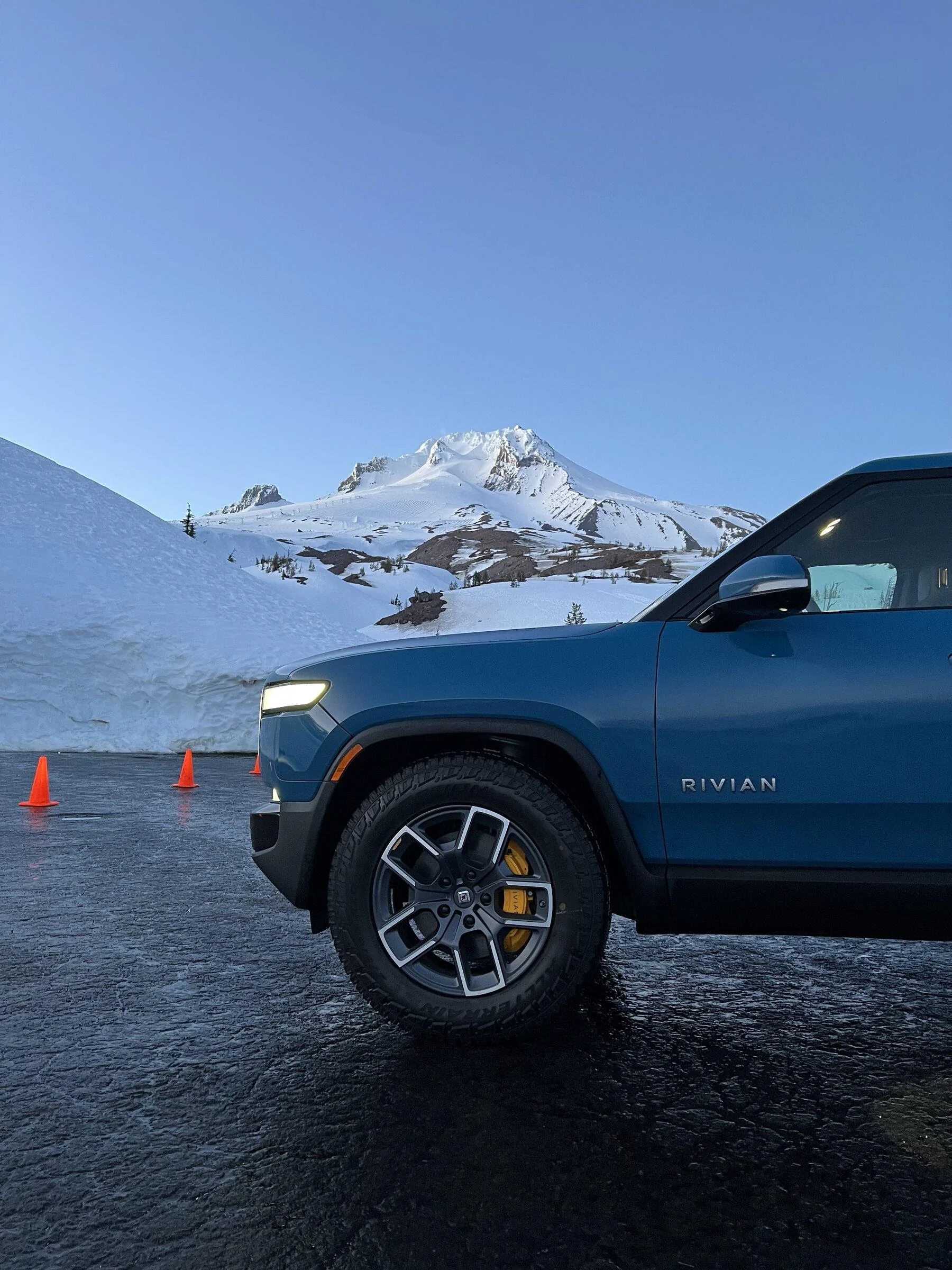
So I decided to drive from my home in Sandy, OR (~800 ft above sea level) to Timberline Lodge (~5800 ft above sea level) over a total distance of 35-36 miles. Temperature was low 50s F in Sandy and mid 30s F at Timberline.
I drove with auto climate control on at 69 and heated drivers seat at level 1. 20” AT tires installed.
For the first flatter part of the drive between Sandy.and Rhododendron (and reverse) truck was in conserve in standard ride height
For the steepest part of the climb between Rhododendron and Timberline and back I used all purpose in standard ride height
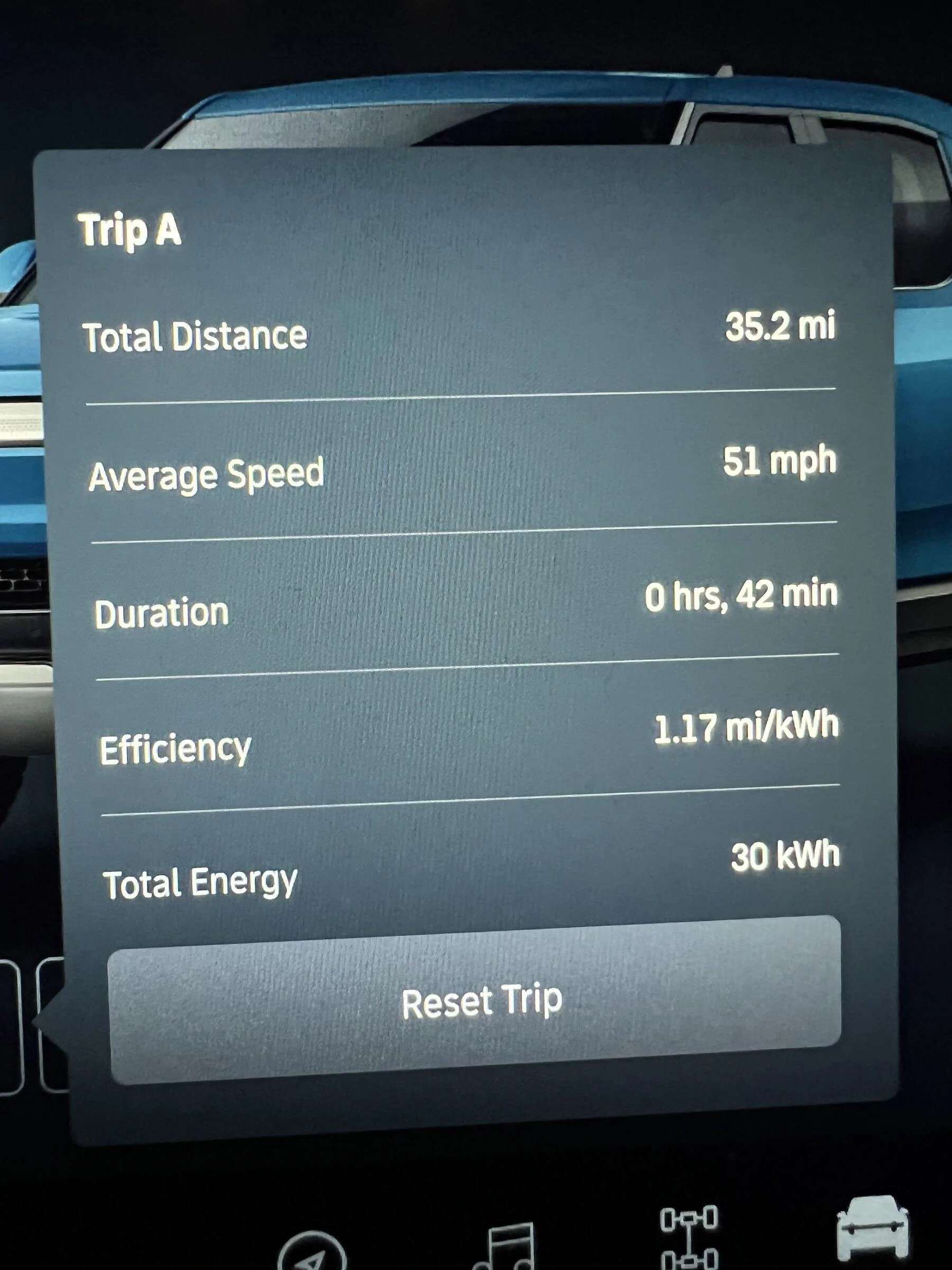
Leg 1 (to trip) - Started at 66% SOC and arrived at 40% SOC
35.2 miles
1.17 mi/kWh
30 kWh used
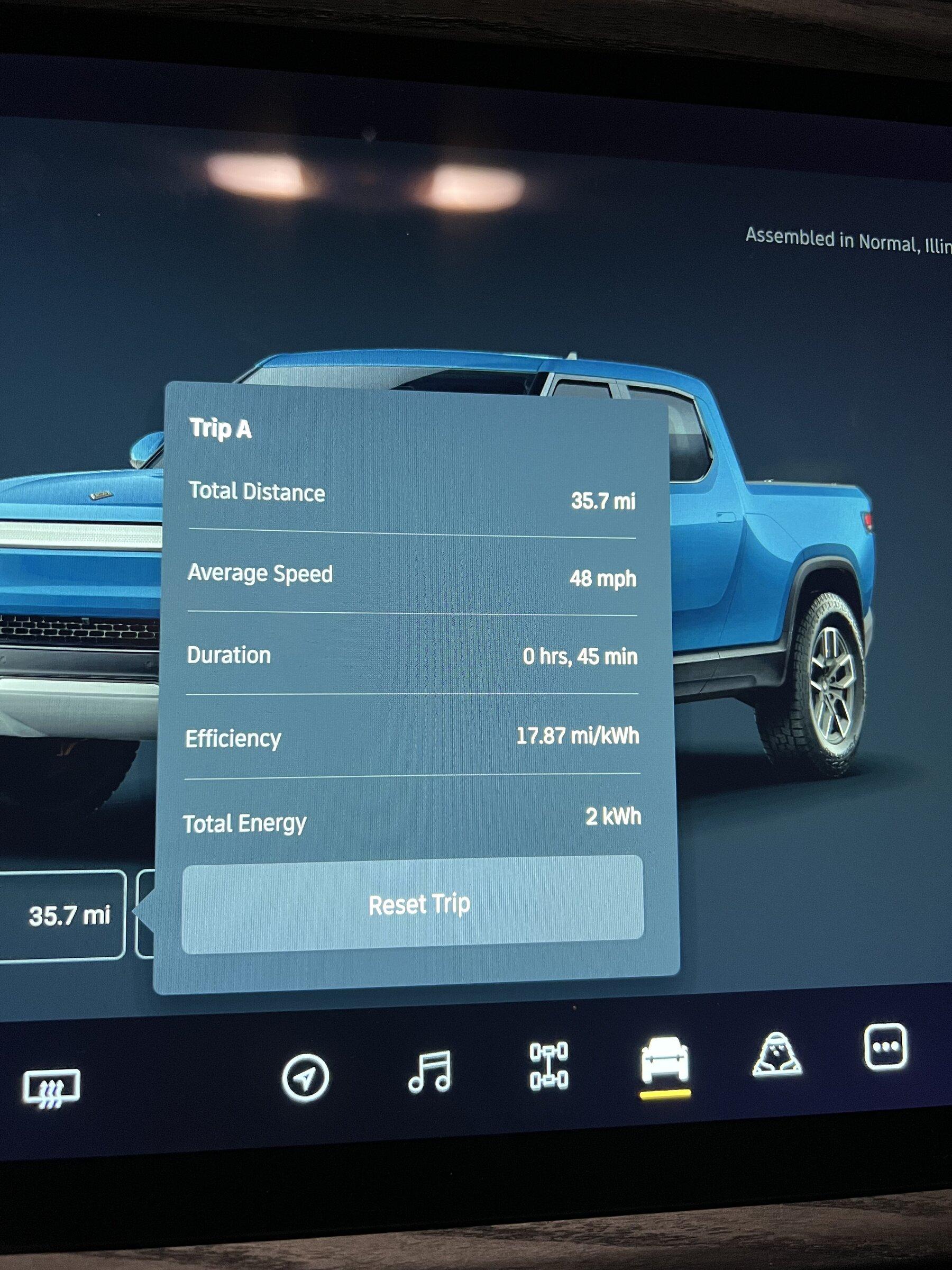
leg 2 (return trip) started at 40% SOC (got up to 42% SOC) and arrived home at 37% SOC
35.7 miles
17.87 mi/kWh
2 kWh used
Overall 2.23 mi/kWh
A couple of observations in general I noticed on the trip:
The trip meter doesn’t give correct information when you have gained energy via regen. I watched the trip meter go from 2kWh used to 1kWh used to 0kWh used then back up to 1kWh and 2kWh used. The trip meter didn’t appear to understand that wasn’t consumed but gained energy.
Auto High Beams work pretty well, turn off a bit closer then some other drivers may appreciate. I also blinded someone That passed my on a 4 lane part of the highway. They didn’t turn off until he had completely passed me and the car could see the other cars taillights. I suppose this could be fixed by adding some logic to turn them off when someone drives into your blindspot.

Sponsored
Similar threads


- Replies
- 18
- Views
- 1,331


- Replies
- 15
- Views
- 3,313
