Sponsored

R2 has bidirectional V2L / V2H (vehicle-to-home) specification article

M3_R2

Well-Known Member
Joined
Mar 30, 2024
Threads
0
Messages
124
Reaction score
152
Location
Canada
Vehicles
'18 M3 RWD, '23 M3 LR AWD, R2 reserved. Scout Terra cancelled 2/26
Clubs
 
In my area you are only allowed to have 10 kW of grid connected generation. My PW3 inverter had to be delimited to this. So V2H could only be used if the power was out. Which is fine but I'll have to consider the costs. I'm not sure I'd want to do load displacement with an EV that has an NMC battery sitting in my garage but I would with LFP. Regardless, great news that Rivian is following through on this promise. I'd only be able to use it during a power outage so would depend on the costs vs adding another DC Expansion pack. The plan to retire an EV solely for load displacement purposes is interesting if you have space for that. Almost makes me wonder if a used R1T with LFP might be a better solution for me.
Sponsored
 

scottf200

Well-Known Member
First Name
Scott
Joined
Nov 25, 2019
Threads
6
Messages
433
Reaction score
297
Location
WNC
Vehicles
Past Ford Exped; curr TMX 100D; future BEV truck/SUV
Occupation
sw engineer
I investigated this. I found that, for now, the external inverter needed in the home for the R1 is pretty costly. In fact, it costs about the same than installing rooftop solar with storage, although the Tesla Powerwall does not have the capacity of a max battery pack. With the R2's built in inverter, the home would only need a smarter L2 charger and a remote isolation switch at the meter.
Going through this with a new house build. You have to consider the times when you are not at home (eg. shopping, gone for weekend, etc) or you have a multiday event (eg. need to run to supercharger, etc to refill). Thus a small (10-15 kWh) home battery with 0-10ish ms switch over (handy for many things link not rebooting router) is an important piece in my equation.
 

DogPound

New Member
Joined
Oct 28, 2022
Threads
0
Messages
4
Reaction score
3
Location
Long Island, NY
Vehicles
R1T
Occupation
FAA
I am hoping there will be some agreement in the way forward so we dont have manufacturer specific systems. I currently have two PW3 that I added to existing Sunpower 15KW solar. I would love to be able to one day take advantage of V2L as CyberDumpster can do. But our R1's are DC output not AC like it sounds the future vehicles will be. Would be crazy to have a set up that only works with for, or Mercedes, Or Chevy. Not to mention each manufacturer of cars, who can barely keep up with UI improvements in vehicle, having to develop home power systems.
 

M3_R2

Well-Known Member
Joined
Mar 30, 2024
Threads
0
Messages
124
Reaction score
152
Location
Canada
Vehicles
'18 M3 RWD, '23 M3 LR AWD, R2 reserved. Scout Terra cancelled 2/26
Clubs
 
This is why, while I'm not a fan of Elon (always have to preface that), I went with a PW3 and 1 expansion pack. Installers have good familiarity, approvals were seamless and the ecosystem is well developed and in continuous improvement. I don't trust the MFG's will adopt a standardized/universal V2H solution. At least not for some time. Using that as one's primary whole home backup, you are only left with ensuring it is fed during a long blackout. Choices are solar, gas generator, V2H and V2L.

I looked at the costs of installing BMW's wallbox pro for V2H in consideration of a 2026 iX3 and for a bit less I could probably install another DC Expansion Pack which would then provide me 40.5 kW of total battery and I'm not sure I would ever need more with solar on the roof. But V2H would be the icing on the cake.

A recent Telsa update has provided real-time weather to the mix so the system is now even more finely tuned. If they ever get around to enabling V2H on more of their vehicles, they might have a chance of keeping me but more likely I'd then get an LFP Model Y for my wife and an R2 or iX3 for myself. Starting to weed Scout out of the equation. I'd also consider a used LFP R1T if I could trickle charge the PW3 batteries with it.
 

llninja

Member
Joined
Jun 18, 2025
Threads
0
Messages
15
Reaction score
9
Location
Illinois
Vehicles
Borealis R1S Gen 2 TriMotor
I for one don’t see the need for this except for emergencies when power is out for extended periods of time. My Gen2 R1S is a huge consumer of energy in my household (mostly grid but I have 5200w of solar so far and 52.8 kWh of batteries not including the Rivian‘S batteries. In a dire emergency I can power up to 1500w from the R1S, but I have yet to use it
 

Sponsored

scottf200

Well-Known Member
First Name
Scott
Joined
Nov 25, 2019
Threads
6
Messages
433
Reaction score
297
Location
WNC
Vehicles
Past Ford Exped; curr TMX 100D; future BEV truck/SUV
Occupation
sw engineer
I am hoping there will be some agreement in the way forward so we dont have manufacturer specific systems. I currently have two PW3 that I added to existing Sunpower 15KW solar. I would love to be able to one day take advantage of V2L as CyberDumpster can do. But our R1's are DC output not AC like it sounds the future vehicles will be. Would be crazy to have a set up that only works with for, or Mercedes, Or Chevy. Not to mention each manufacturer of cars, who can barely keep up with UI improvements in vehicle, having to develop home power systems.
This is why, while I'm not a fan of Elon (always have to preface that), I went with a PW3 and 1 expansion pack. Installers have good familiarity, approvals were seamless and the ecosystem is well developed and in continuous improvement. I don't trust the MFG's will adopt a standardized/universal V2H solution. At least not for some time. Using that as one's primary whole home backup, you are only left with ensuring it is fed during a long blackout. Choices are solar, gas generator, V2H and V2L.

I looked at the costs of installing BMW's wallbox pro for V2H in consideration of a 2026 iX3 and for a bit less I could probably install another DC Expansion Pack which would then provide me 40.5 kW of total battery and I'm not sure I would ever need more with solar on the roof. But V2H would be the icing on the cake.

A recent Telsa update has provided real-time weather to the mix so the system is now even more finely tuned. If they ever get around to enabling V2H on more of their vehicles, they might have a chance of keeping me but more likely I'd then get an LFP Model Y for my wife and an R2 or iX3 for myself. Starting to weed Scout out of the equation. I'd also consider a used LFP R1T if I could trickle charge the PW3 batteries with it.

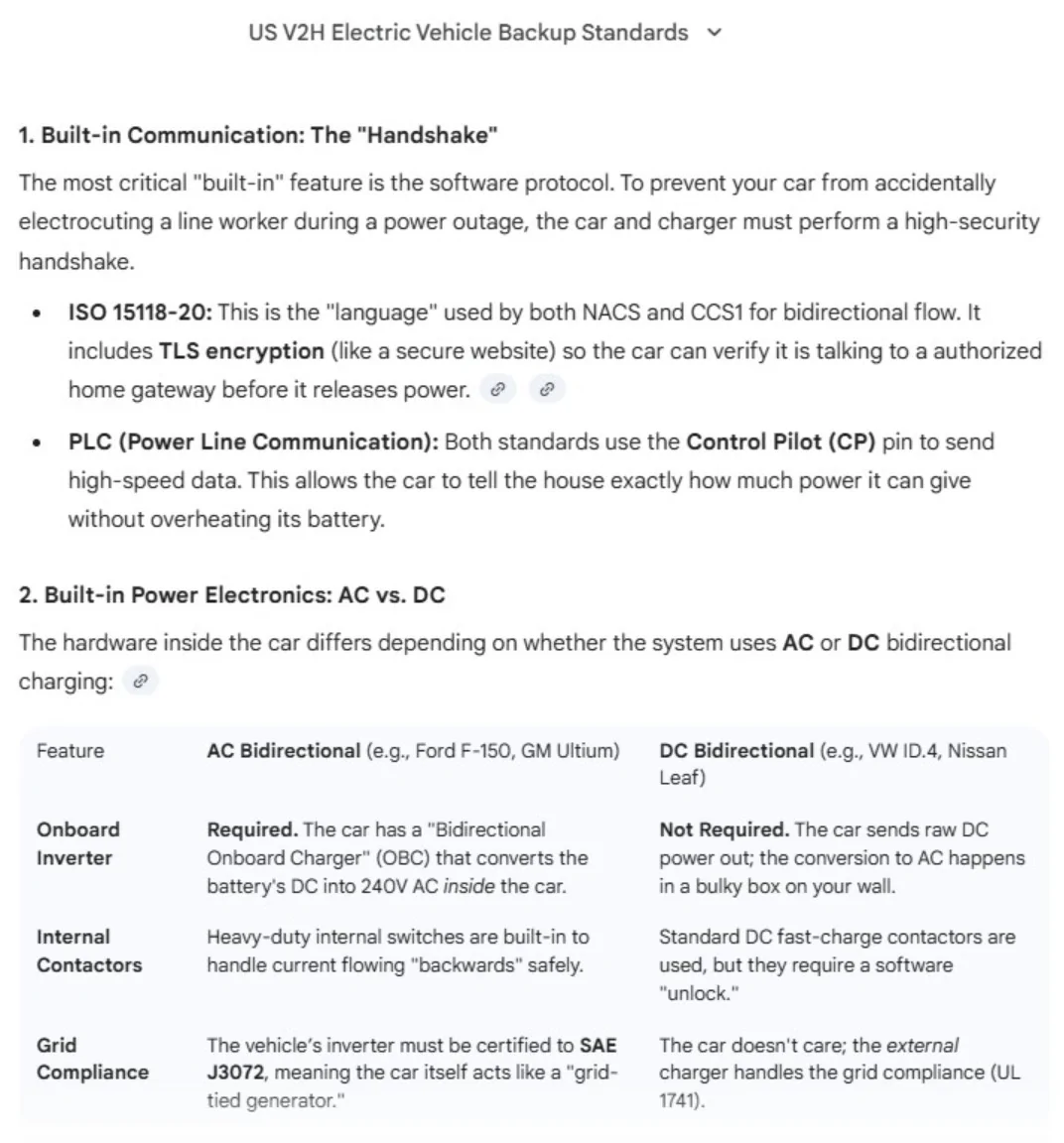
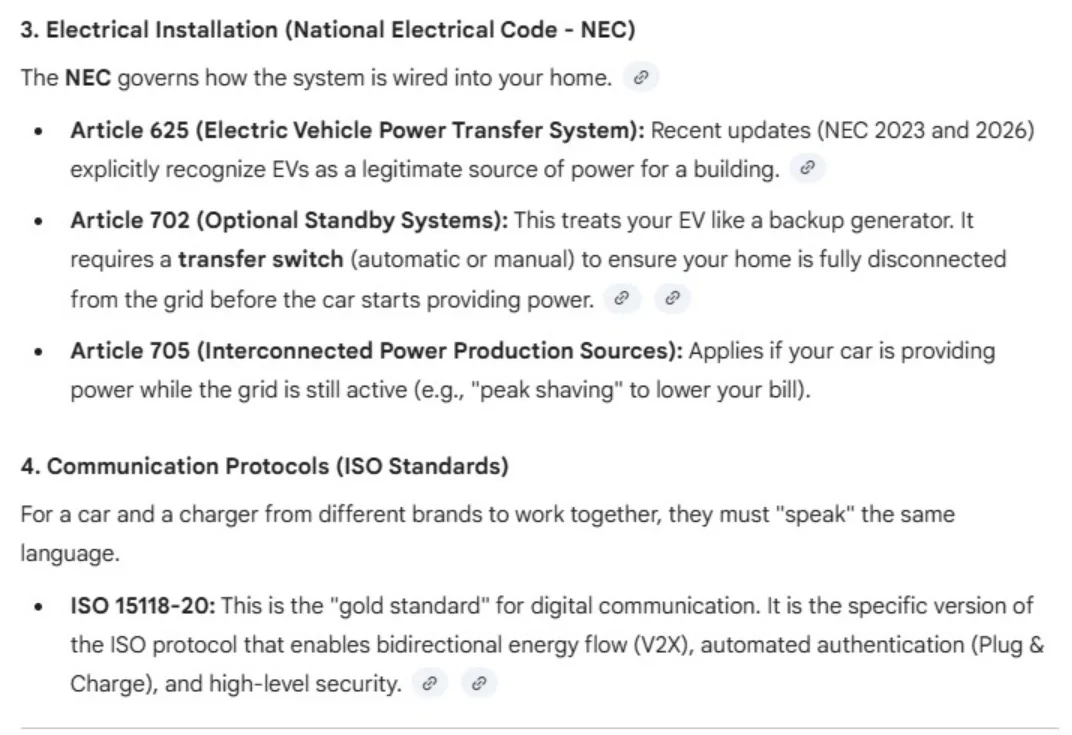
Below is what I found in a quick look as I thought there were some standards. This came up with the NACS became a standard.

1) NECs and ISO standards
2) CCS1 and NACS standards
  • DC V2H (UL 1741 inherently)
  • AC V2H (SAE J3072)

V2H V2X codes and standards
Rivian R1T R1S R2 has bidirectional V2L / V2H (vehicle-to-home) specification article 2025-12-17 V2H V2X codes and standards - Google Gemini


2025-12-17 V2H V2X CCS1 and NACS features
Rivian R1T R1S R2 has bidirectional V2L / V2H (vehicle-to-home) specification article 2025-12-17 V2H V2X CCS1 and NACS features - Google Gemini
 

BrianB

Well-Known Member
First Name
Brian
Joined
Jun 9, 2024
Threads
14
Messages
189
Reaction score
294
Location
Conroe, TX
Vehicles
2025 R1S
Clubs
 
I for one don’t see the need for this except for emergencies when power is out for extended periods of time. My Gen2 R1S is a huge consumer of energy in my household (mostly grid but I have 5200w of solar so far and 52.8 kWh of batteries not including the Rivian‘S batteries. In a dire emergency I can power up to 1500w from the R1S, but I have yet to use it
If you don’t mind, what did that setup cost? I’m interested, but need lots of storage capacity and the high cost of batteries makes V2H seem like a good solution.
 

scottf200

Well-Known Member
First Name
Scott
Joined
Nov 25, 2019
Threads
6
Messages
433
Reaction score
297
Location
WNC
Vehicles
Past Ford Exped; curr TMX 100D; future BEV truck/SUV
Occupation
sw engineer
I'm *really* hoping that the R2 V2H works natively with the SigEnergy products (formerly in the USA as PointGuard Energy).

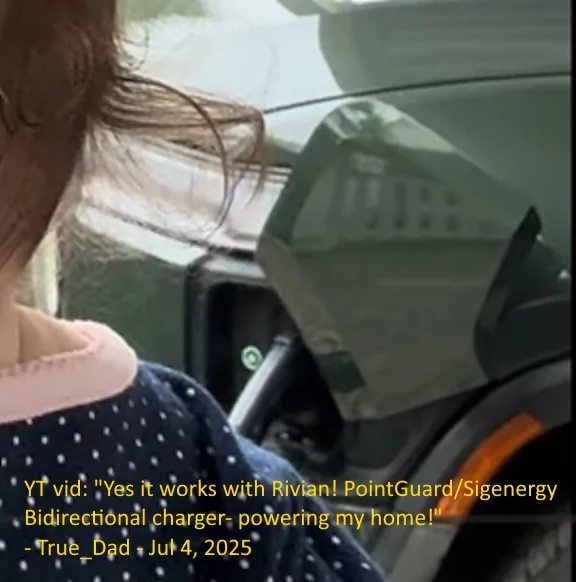
I know there is a YT video of SigEnergy/Pointguard working with a R1T or R1S but I don't think that is an official supported thing but may have worked because Rivian designed to the CCS1 standars (eg. ISO 15118-20 in my post just above).

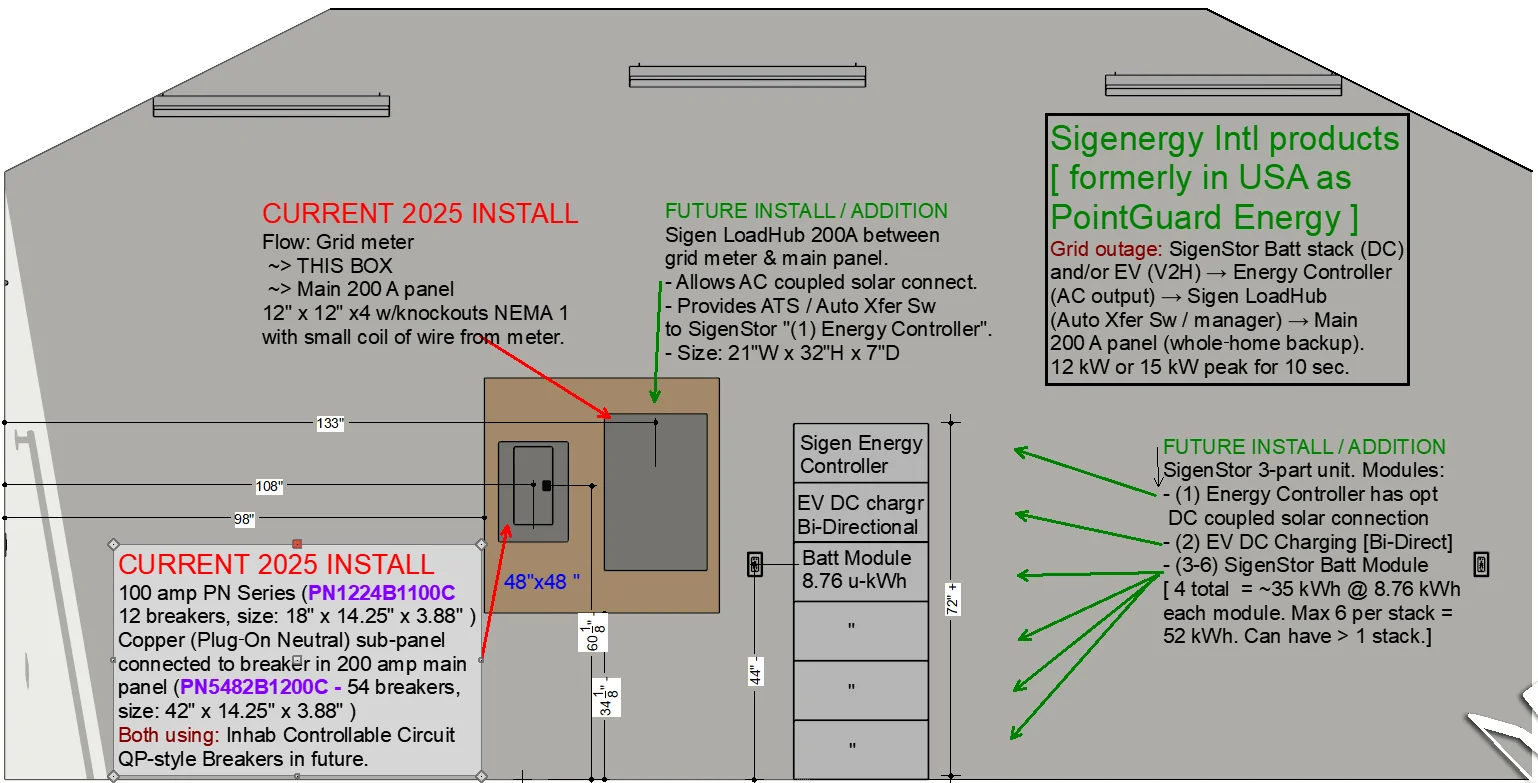
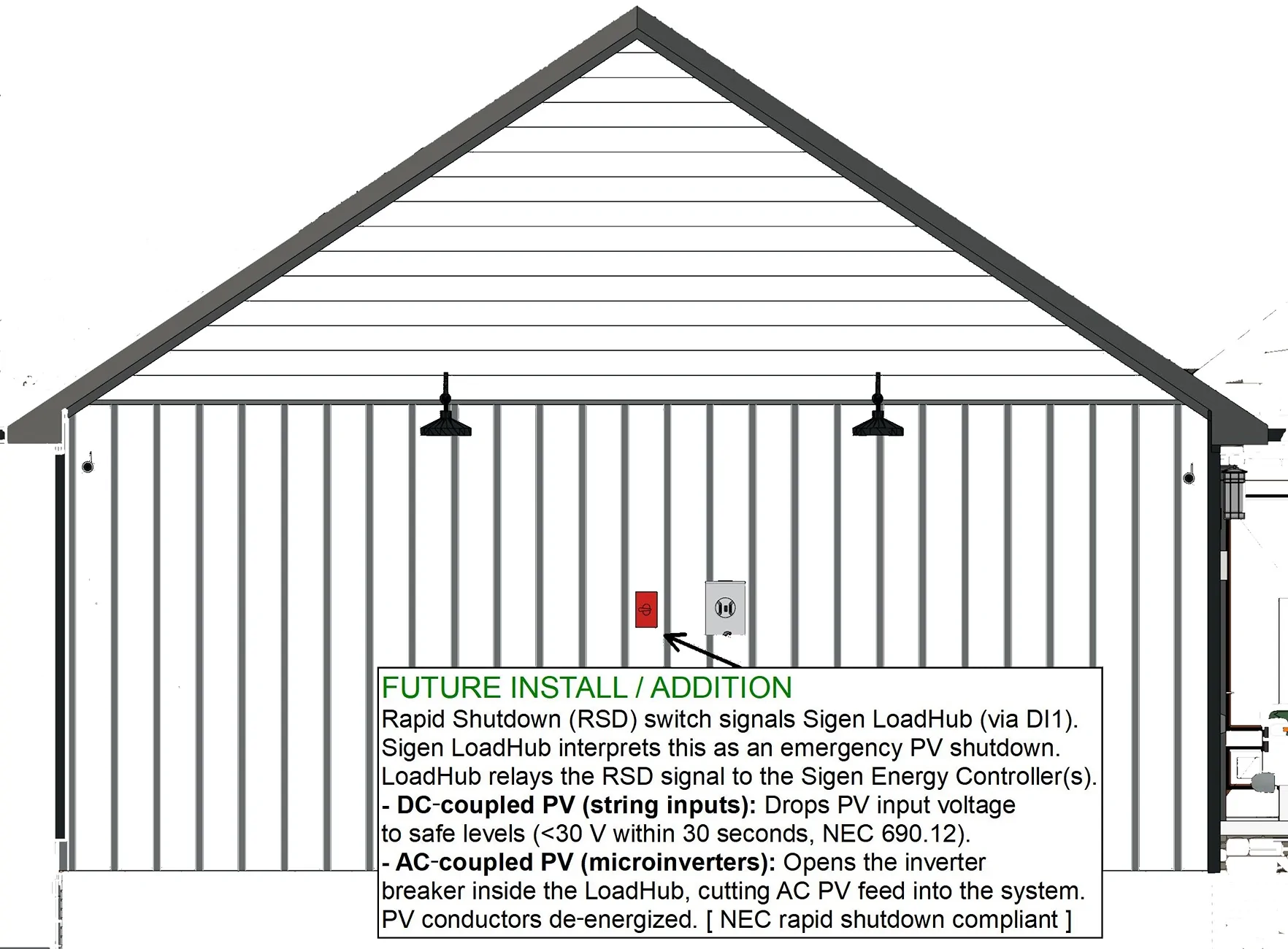
Here is the setup that I'm hoping to use in our new build.

Rivian R1T R1S R2 has bidirectional V2L / V2H (vehicle-to-home) specification article 2025-12-19z - Elev Garage West gable wall area - 100 amp subpanel


Rivian R1T R1S R2 has bidirectional V2L / V2H (vehicle-to-home) specification article Garage Elev - Grid backup - Sigenergy formerally USA PointGuard Energy 2of2 B
 

tpepper

Member
Joined
Jun 2, 2024
Threads
1
Messages
24
Reaction score
21
Location
Oregon
Vehicles
R1T
Clubs
 
I know there is a YT video of SigEnergy/Pointguard working with a R1T or R1S but I don't think that is an official supported thing but may have worked because Rivian designed to the CCS1 standars (eg. ISO 15118-20 in my post just above).
I’m not sure how much it is really a “CCS1” thing versus an ISO standard. The YT video you’re talking about is a NACS R1. I too have the SigEnergy/Pointguard setup and my DC fast charger is NACS while my ’23 R1 is CCS. The beauty of a good standard is it just works.

As best I can tell SigEnergy and Rivian are trying to figure out “support” in terms of making a good UI/UX and perhaps bounding their potential warranty risks in an early tech roll out.

Either way it does work. Today.

I easily run my whole house off the R1’s battery during the 5-9pm expensive electricity time of day and it automatically fills back to the Riv’s set charging limit at 9pm with the almost free electricity.

I get that many don’t have solar and don’t want to add $10k of gear in their garage, but DC solar, DC batteries, DC chargers is so much more sensible architecture and infrastructure investment than making the cars output high amperage AC.
 

scottf200

Well-Known Member
First Name
Scott
Joined
Nov 25, 2019
Threads
6
Messages
433
Reaction score
297
Location
WNC
Vehicles
Past Ford Exped; curr TMX 100D; future BEV truck/SUV
Occupation
sw engineer
I’m not sure how much it is really a “CCS1” thing versus an ISO standard. The YT video you’re talking about is a NACS R1. I too have the SigEnergy/Pointguard setup and my DC fast charger is NACS while my ’23 R1 is CCS. The beauty of a good standard is it just works.

As best I can tell SigEnergy and Rivian are trying to figure out “support” in terms of making a good UI/UX and perhaps bounding their potential warranty risks in an early tech roll out.

Either way it does work. Today.

I easily run my whole house off the R1’s battery during the 5-9pm expensive electricity time of day and it automatically fills back to the Riv’s set charging limit at 9pm with the almost free electricity.

I get that many don’t have solar and don’t want to add $10k of gear in their garage, but DC solar, DC batteries, DC chargers is so much more sensible architecture and infrastructure investment than making the cars output high amperage AC.
Great information. Thanks for sharing your usage.

I think you're right on the ISO 15118-20 standard as my prev graphic mentioned NACS and CCS1 using it. (cut-n-past of that section below)

Regarding the video, I was referring to this one and it appeared to be a CCS1 plug to me.

YT video: "Yes it works with Rivian! PointGuard/Sigenergy Bidirectional charger- powering my home!" - True_Dad - Jul 4, 2025


Rivian R1T R1S R2 has bidirectional V2L / V2H (vehicle-to-home) specification article Yes it works with Rivian! PointGuard - Sigenergy Bidirectional charger - powering my home! Tr


Rivian R1T R1S R2 has bidirectional V2L / V2H (vehicle-to-home) specification article jMlRwPX


Sponsored

M3_R2

Well-Known Member
Joined
Mar 30, 2024
Threads
0
Messages
124
Reaction score
152
Location
Canada
Vehicles
'18 M3 RWD, '23 M3 LR AWD, R2 reserved. Scout Terra cancelled 2/26
Clubs
 
If you don’t mind, what did that setup cost? I’m interested, but need lots of storage capacity and the high cost of batteries makes V2H seem like a good solution.
If you have a Rivian, V2H is a great way to go. I don't and with tariffs in place, likely never will. But it depends on what your needs and goals are. Powerwalls are intended for daily cycling and backup and usually in conjunction with solar. V2H is intended primarily for emergency backup. So define your needs and tailor the solution to meet them.

Setup was in Ontario, Canada so difficult to compare. It was quite expensive but there were incentives so I went for it after looking at solar for about a decade. There was always something that didn't suit me but this time, everything kind of aligned so I proceeded and also got 27 kWh of storage in the form of a Powerwall 3 and a DC Expansion pack. I wanted backup power but otherwise would have had a much quicker ROI if I had just went Solar and did Net Metering. We can only do one or the other. It's a lifestyle decision more so than an ROI one.

Meanwhile, the past 2 years, I've been saying my next vehicle will do V2H. Almost went for an R1T last December but I was only 1 year into my M3 so didn't proceed and then tariffs came in so no R2 for me, it would appear.

Had Tesla enabled it on my M3, I might have gone that route instead. But I do like having a dedicated home system and could always still add V2H as the icing. But it would have to be very cheap as now I could just add another DC Expansion pack and at 40 kWh I can't imagine how V2H would then get me any further. In the summer, I'll already be off the grid pretty much all the time with 12kW of solar and 27 kWh of battery. Our energy needs aren't very high and our natural disasters are very low. Wildfires are the greatest danger followed by once every 10 year ice storms that take power out for a few days. But I will have shorter 30-90min outages with some frequency and so this covers me for those quite easily.

Also, my overnight electricity rate is only $0.039 / kWh so in the winter, I top up the batteries and then I'm good from 7a-11pm. My raw electricity costs, including charging my vehicle are $33 for the past 30 days and most have been cloudy and/or snowing with a number of days with snow covered panels.

I'm currently in the throes of deciding between a MYP and a BMW iX3. The MYP is hinted to be supporting V2H next year and with a bidirectional charger and a firmware update to my Tesla Gateway, that would be a very nice, tightly integrated system for very little cost. But the more I use what I have, the more I realize I probably don't even need V2H now. I certainly wouldn't pay a lot for it. Even V2L could help me shed some loads like the garage freezer in the event of a long blackout and preserve my powerwalls to run longer.

What I have now, is seamless peace of mind. Cutover is imperceptible. It just works and it's intuitive, reacting to daily changes in weather. It's LFP and I retrofitted my under porch cold cellar to accommodate it.

Most people don't need lots of storage capacity but if you truly do, home battery solutions are going to be expensive and if for emergency backup only, V2H would be far cheaper. It's getting better and there are solutions out there that would have been almost 1/2 my cost but I didn't want to be the electricity approvals guinnea pig. Regardless what you do, you'll need approval from your Electrical Authority.

V2H is predictably gaining traction and it's great to see so many solutions coming out now.
 

BrianB

Well-Known Member
First Name
Brian
Joined
Jun 9, 2024
Threads
14
Messages
189
Reaction score
294
Location
Conroe, TX
Vehicles
2025 R1S
Clubs
 
If you have a Rivian, V2H is a great way to go. I don't and with tariffs in place, likely never will. But it depends on what your needs and goals are. Powerwalls are intended for daily cycling and backup and usually in conjunction with solar. V2H is intended primarily for emergency backup. So define your needs and tailor the solution to meet them.

Setup was in Ontario, Canada so difficult to compare. It was quite expensive but there were incentives so I went for it after looking at solar for about a decade. There was always something that didn't suit me but this time, everything kind of aligned so I proceeded and also got 27 kWh of storage in the form of a Powerwall 3 and a DC Expansion pack. I wanted backup power but otherwise would have had a much quicker ROI if I had just went Solar and did Net Metering. We can only do one or the other. It's a lifestyle decision more so than an ROI one.

Meanwhile, the past 2 years, I've been saying my next vehicle will do V2H. Almost went for an R1T last December but I was only 1 year into my M3 so didn't proceed and then tariffs came in so no R2 for me, it would appear.

Had Tesla enabled it on my M3, I might have gone that route instead. But I do like having a dedicated home system and could always still add V2H as the icing. But it would have to be very cheap as now I could just add another DC Expansion pack and at 40 kWh I can't imagine how V2H would then get me any further. In the summer, I'll already be off the grid pretty much all the time with 12kW of solar and 27 kWh of battery. Our energy needs aren't very high and our natural disasters are very low. Wildfires are the greatest danger followed by once every 10 year ice storms that take power out for a few days. But I will have shorter 30-90min outages with some frequency and so this covers me for those quite easily.

Also, my overnight electricity rate is only $0.039 / kWh so in the winter, I top up the batteries and then I'm good from 7a-11pm. My raw electricity costs, including charging my vehicle are $33 for the past 30 days and most have been cloudy and/or snowing with a number of days with snow covered panels.

I'm currently in the throes of deciding between a MYP and a BMW iX3. The MYP is hinted to be supporting V2H next year and with a bidirectional charger and a firmware update to my Tesla Gateway, that would be a very nice, tightly integrated system for very little cost. But the more I use what I have, the more I realize I probably don't even need V2H now. I certainly wouldn't pay a lot for it. Even V2L could help me shed some loads like the garage freezer in the event of a long blackout and preserve my powerwalls to run longer.

What I have now, is seamless peace of mind. Cutover is imperceptible. It just works and it's intuitive, reacting to daily changes in weather. It's LFP and I retrofitted my under porch cold cellar to accommodate it.

Most people don't need lots of storage capacity but if you truly do, home battery solutions are going to be expensive and if for emergency backup only, V2H would be far cheaper. It's getting better and there are solutions out there that would have been almost 1/2 my cost but I didn't want to be the electricity approvals guinnea pig. Regardless what you do, you'll need approval from your Electrical Authority.

V2H is predictably gaining traction and it's great to see so many solutions coming out now.
Thanks. I’m the backup use case. On the Texas Gulf coast. So I need lots more power than a Canadian for the air conditioning load. ~100 + kw of battery backup was prohibitively expensive last time I priced it. If I could do 20-40 kw, and another hundred of refillable on top via my Rivian, that seems ideal.

I really don’t want to buy an antiquated propane generator when I’ve got 100 kw sitting in my garage.
 

scottf200

Well-Known Member
First Name
Scott
Joined
Nov 25, 2019
Threads
6
Messages
433
Reaction score
297
Location
WNC
Vehicles
Past Ford Exped; curr TMX 100D; future BEV truck/SUV
Occupation
sw engineer
Thanks. I’m the backup use case. On the Texas Gulf coast. So I need lots more power than a Canadian for the air conditioning load. ~100 + kw of battery backup was prohibitively expensive last time I priced it. If I could do 20-40 kw, and another hundred of refillable on top via my Rivian, that seems ideal.

I really don’t want to buy an antiquated propane generator when I’ve got 100 kw sitting in my garage.
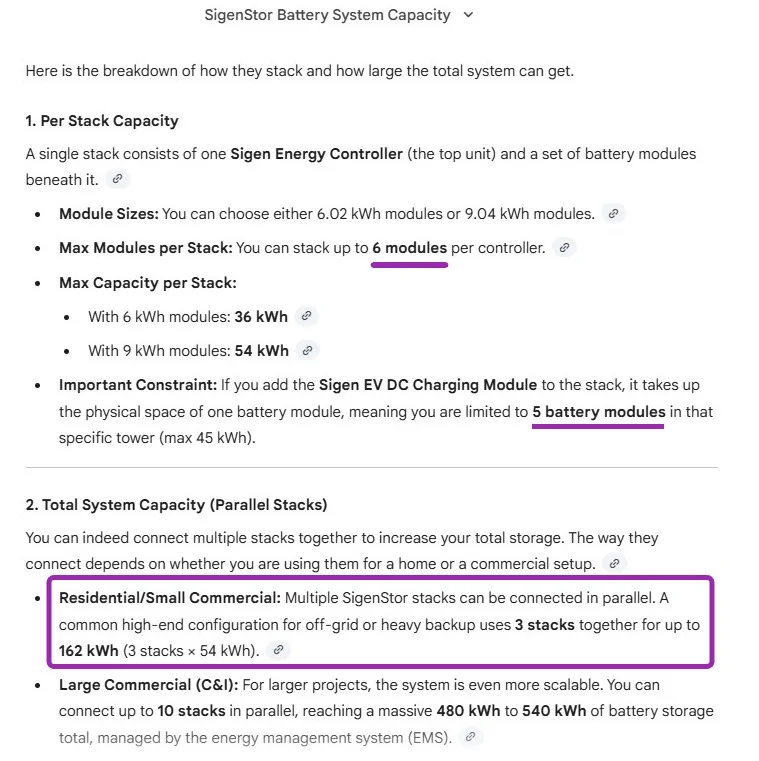
I've spent a lot of time looking at the SigEnergy battery products and how to utilize the kWh battery storage. Check out their details: https://www.sigenergy.com/us/products/sigenstor

AI LLM overview.
Rivian R1T R1S R2 has bidirectional V2L / V2H (vehicle-to-home) specification article SigenStor capacity
 

M3_R2

Well-Known Member
Joined
Mar 30, 2024
Threads
0
Messages
124
Reaction score
152
Location
Canada
Vehicles
'18 M3 RWD, '23 M3 LR AWD, R2 reserved. Scout Terra cancelled 2/26
Clubs
 
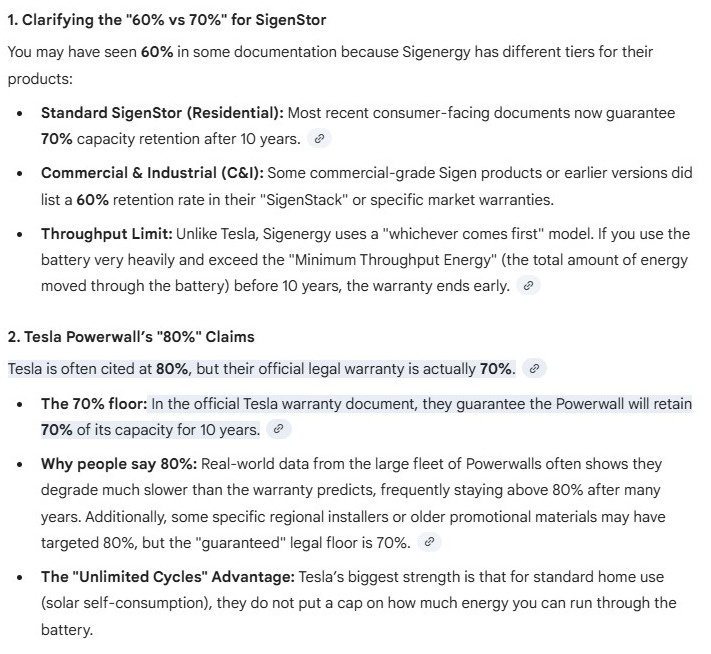
I saw some warranty figures for the Sigenstor showing only 60% battery capacity after 10 years whereas the Powerwalls are 80% after 10 years. That's quite a difference if correct. ESP for my cold climate. I didn't dive very deep on it but I wouldn't want to buy 100 kWh and it only be capable of 60 kWh after 10 years if those numbers are accurate.

The nice thing about high AC needs is that's in line with peak solar production. So if you were able to generate a lot of solar to feed those hungry AC units, your battery requirements wouldn't be so high.

I was interested in EG4 products when I did mine but Ontario electrical approvals are the most stringent in North America and didn't want to risk getting into some elongated process for that.

Sigenstor looks very promising and are probably more robust if used outdoors.

If you are capable of utilizing solar, I would first investigate how much you could expect to generate and factor that in to the equation as you might then find you don't need as much battery storage.
 

scottf200

Well-Known Member
First Name
Scott
Joined
Nov 25, 2019
Threads
6
Messages
433
Reaction score
297
Location
WNC
Vehicles
Past Ford Exped; curr TMX 100D; future BEV truck/SUV
Occupation
sw engineer
I saw some warranty figures for the Sigenstor showing only 60% battery capacity after 10 years whereas the Powerwalls are 80% after 10 years. That's quite a difference if correct. ESP for my cold climate. I didn't dive very deep on it but I wouldn't want to buy 100 kWh and it only be capable of 60 kWh after 10 years if those numbers are accurate.
FYI, You may be confusing commercial products vs residential products. I asked a couple of LLMs about your comments. Here is Gemini's. CoPilot ended up being similar.

Rivian R1T R1S R2 has bidirectional V2L / V2H (vehicle-to-home) specification article 4wmbmxJ
Sponsored


Top