Sponsored

RPG

Active Member
First Name
Bob
Joined
Jul 22, 2025
Threads
5
Messages
28
Reaction score
49
Location
Northern Utah
Vehicles
R1T, Tesla Model Y
Occupation
Retired
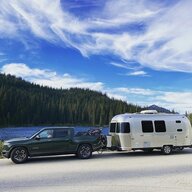
I recently completed a 2,000 mile trip in my Gen 2 Rivian R1T towing an Airstream Globetrotter 27FB (GVWR of 7,600 lbs). I use a BW Continuum weight distribution hitch. The trip was from northern Utah to northern Idaho to the Bellingham Washington area, and then looping back to Utah. Daytime temperatures were mostly in the upper 90s.

The towing experience was great, with plenty of power to climb long hills, smooth operation, and little noise. My general practice is to limit my speed to 65 mph when towing, but when traffic conditions demand, I will go up to the legal speed limit of 70 or 80 mph.

I am disappointed by how expensive on-the-road charging is. My total charging expense on this trip was $514.95. With my previous tow vehicle, a GMC Canyon diesel, this trip would have taken about $540 for fuel. The electric was a little cheaper than diesel, but only because I did about 40% of the charging for free, at RV parks.

When towing, I have averaged 1.17 miles/kWh. At an average on-the-road electricity cost of $0.50/kWh, the electric towing cost is $0.425 per mile. This compares poorly with a diesel towing fuel cost of $0.267 per mile. Of course, when I charge the Rivian at home, the cost goes way down to $0.080 per mile.

On this trip, on-the-road charging costs ranged from a low of $0.39/kWh (at a 50 kW ChargePoint) to a high of $0.56/kWh (at Electrify America). I charged at eleven fast chargers: seven Tesla Superchargers, one Rivian Adventure Network, two Electrify America, and one ChargePoint. I was able to keep the trailer connected at six chargers. Three of the chargers had a special space designed for trailers. At others there was enough space where I could maneuver into an end charger without blocking the other chargers or traffic lanes. But at five chargers I had to find a nearby space to drop the trailer, and then charge like any other car.

Our travel is leisurely. Most driving days on this trip were between 150 and 250 miles long. We stopped in the middle of the day for an hour to charge and have lunch. The longest day was 322 miles, with two charging stops of about an hour each, taking 7 hours and 5 minutes elapsed time.

The longest leg on this trip was 144.7 miles, with a net elevation drop of 2527 feet. I started with the battery at 100%, and got to the charger with 15%. The lowest battery level was 9%, at the end of a 117.9 mile drive with 946 feet of net climb. I found the on-board nav system to be fairly accurate at predicting the battery level for arrival at the next charge stop. The prediction would usually only change by a few percent during the drive. I would watch it to make sure I could reach the next charge stop.

During charging, the nav system would tell me when I had enough charge to continue. However, when I had to disconnect the trailer to charge, it would make this prediction without the trailer. I had to determine the correct charge limit myself.

Towing a travel trailer with the Rivian is a bit of an adventure. The driving experience is smooth and pleasant. You get to take nice relaxing breaks every hour or two. Finding charging stations where you need them can be a challenge. There are no noxious combustion fumes or engine noise.
Rivian R1T R1S Rivian / Airstream Towing Experience IMG_4266
Sponsored


KootenayEV

Well-Known Member
First Name
Andrew
Joined
Sep 22, 2021
Threads
28
Messages
614
Reaction score
589
Location
Nelson, BC
Vehicles
R1T, Tesla Model 3
Occupation
Environmental Engineer
I recognize that RAN! It was the first one I ever used - happened during on our BC->UT-AZ->BC trip this spring. Foolishly I pulled in on the left side of the charger and scratched my head as to why I couldn't reach my charging port... (I find it a bit odd how they set up the RAN units. Maybe the new ones make more sense.)
 

twieland

Well-Known Member
First Name
Tim
Joined
Jun 7, 2022
Threads
1
Messages
49
Reaction score
100
Location
Omaha
Vehicles
2023 R1T - Limestone, Ocean Coast, 21's
Occupation
Tech
Averaging 1.17 miles/kWh is pretty good. We tow a 25' Airstream Globetrotter (have over 20,000 towing miles thus far) with a 1st Gen R1T and are averaging more like 1.1 keeping speeds at 60'ish. Looks like you have the range wheels and more efficient tires than we do so probably accounts for some of that difference.
 

BrandonC

Member
First Name
Brandon
Joined
Mar 25, 2025
Threads
1
Messages
9
Reaction score
45
Location
Kansas
Vehicles
2022 Rivian R1T
I really enjoy seeing threads like this where people are using their trucks like they would any other truck and then reporting back on the experience. I've only towed mildly with mine but these are interesting nonetheless.
 
OP
OP
RPG

RPG

Active Member
First Name
Bob
Joined
Jul 22, 2025
Threads
5
Messages
28
Reaction score
49
Location
Northern Utah
Vehicles
R1T, Tesla Model Y
Occupation
Retired
I recognize that RAN! It was the first one I ever used - happened during on our BC->UT-AZ->BC trip this spring. Foolishly I pulled in on the left side of the charger and scratched my head as to why I couldn't reach my charging port... (I find it a bit odd how they set up the RAN units. Maybe the new ones make more sense.)
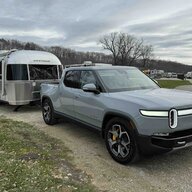
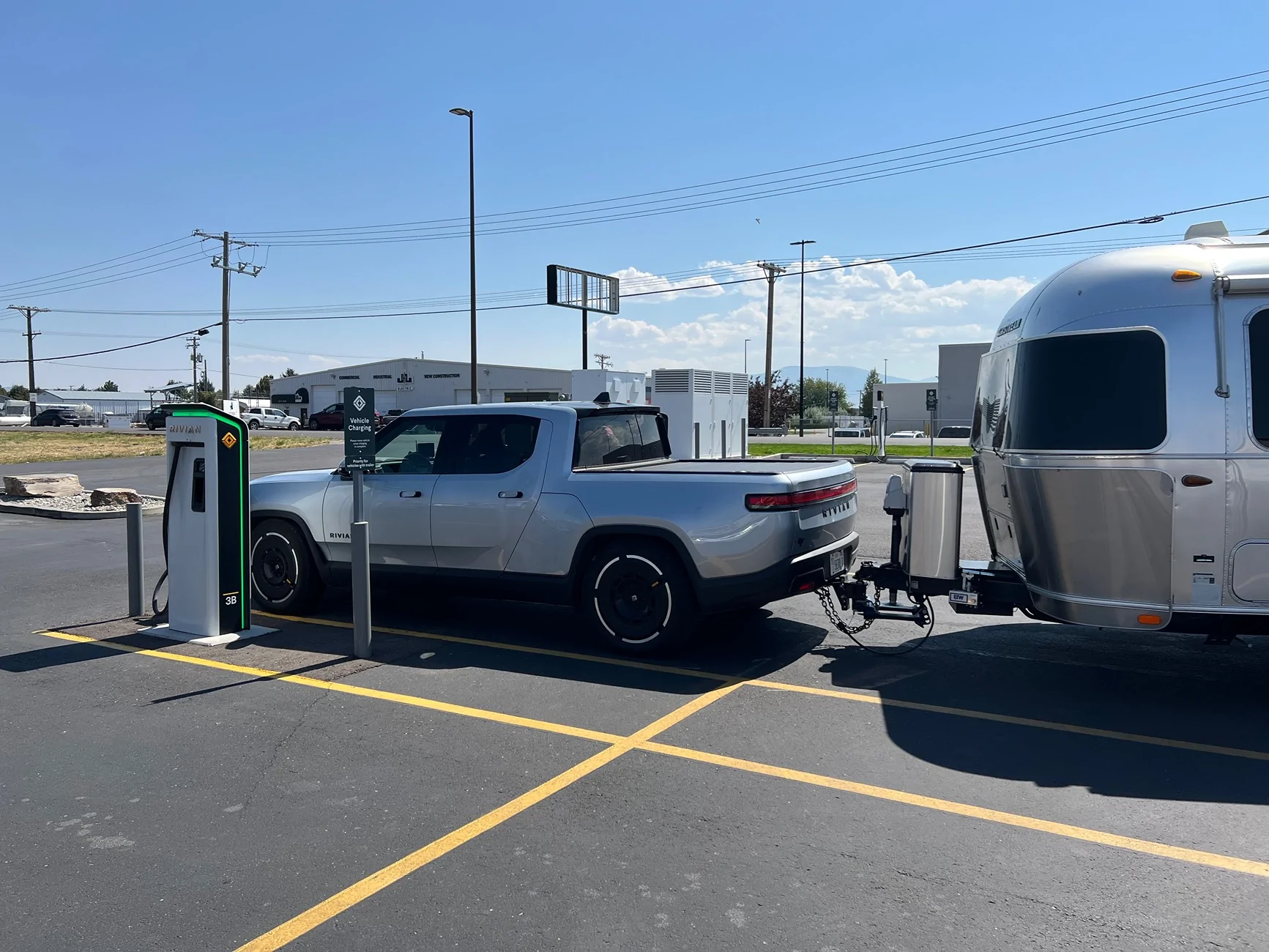
My photo is at the RAN in Burley, Idaho. It's the first one I've used. I thought it was very nicely arranged for trailers. It was fairly busy. While I was there, four or five other Rivians charged at the regular stalls. Fortunately no other trailers came.
 

Sponsored

OP
OP
RPG

RPG

Active Member
First Name
Bob
Joined
Jul 22, 2025
Threads
5
Messages
28
Reaction score
49
Location
Northern Utah
Vehicles
R1T, Tesla Model Y
Occupation
Retired
Averaging 1.17 miles/kWh is pretty good. We tow a 25' Airstream Globetrotter (have over 20,000 towing miles thus far) with a 1st Gen R1T and are averaging more like 1.1 keeping speeds at 60'ish. Looks like you have the range wheels and more efficient tires than we do so probably accounts for some of that difference.
Yes, I have the range wheels, dual motor, max pack. Your 25' Globetrotter would only be a few hundred pounds lighter than my 27', with very similar aerodynamics, so performance should be similar.

With all those miles, how's your experience been finding trailer-friendly chargers?
 

twieland

Well-Known Member
First Name
Tim
Joined
Jun 7, 2022
Threads
1
Messages
49
Reaction score
100
Location
Omaha
Vehicles
2023 R1T - Limestone, Ocean Coast, 21's
Occupation
Tech
Yes, I have the range wheels, dual motor, max pack. Your 25' Globetrotter would only be a few hundred pounds lighter than my 27', with very similar aerodynamics, so performance should be similar.

With all those miles, how's your experience been finding trailer-friendly chargers?
When we first started towing (2 1/2 years ago) we were having to drop the trailer more often to charge, but with Tesla chargers opening up and more locations coming online it's becoming much less frequent. We've gotten familiar with charging stops on routes we've already traveled so know which locations are more trailer friendly. We've also gotten more comfortable parking unconventionally to be able to access a charger without blocking traffic. We're probably now only having to unhitch maybe 10% of the time, but of course it's still necessary sometimes.
 

mblist

Active Member
First Name
michael
Joined
Aug 31, 2024
Threads
3
Messages
27
Reaction score
126
Location
North Bend WA
Vehicles
R1T
Thank you for a great post about your experience. I have a Gen 1 quad and I used to tow a 27’ Airstream and got almost exactly the miles/ kwhr that you are getting. In January I downsized to a 20’ Airstream Basecamp. With that I am getting about 1.4 miles/kwhr.

Like you I take it easy and enjoy the breaks. My old dogs need the break even more than I do.😁

I agree with your pricing comments. On a recent trip from Seattle to Yellowstone and back, I was bush camping or camping in state and national parks with no power available so really had to pay through the nose. That said, I would rather pay extra for all the advantages of electric than go back to diesel again.

On that trip I never had to disconnect as I used mostly RAN or Tesla and was able to stay out of everyone’s way.

The one scary experience was a section that was up hill with strong headwinds. I really played havoc with the range. I made it with 7%.
 

HaveBlue

Well-Known Member
Joined
Nov 22, 2022
Threads
41
Messages
2,926
Reaction score
2,234
Location
91107
Vehicles
R1S DMP Max, Lifted GX470, APR Audi A7, BMW 325Ci
Clubs
 
Quite a torture test. Electricity is expensive compared to gas and diesel. It's only the fact that it can be used efficiently that is the benefit and that is tough towing something big. The fact that you came out even is amazing and all the non towing miles charging at home will net a savings. I've resigned that sometimes it's more expensive but usually less.

I like the color match!
 

JamuJoe

Well-Known Member
First Name
Joseph
Joined
Nov 19, 2020
Threads
20
Messages
207
Reaction score
494
Location
Hesperus, CO
Vehicles
RAM 2500, Polestar 2, R1T Max Pack Performance
Occupation
Retired Petroleum Engineer
Good summary!
We also just returned from a 3200 mile trip towing our 28’ Airstream with our R1T PDM. We covered much of the same country, with our route from Durango thru NM and NV to San Francisco, up coast to Astoria, then thru WA, OR, ID, and UT. Hit temps of 109 deg. in NV. With 17 fast charger stops, I never had to unhitch. EA at Walmart locations is generally the most challenging, RAN the easiest. I also charged overnight at campgrounds, a real convenience and money saver. This was our fourth long trip, a cumulative 12K miles of towing this combination.

My RAM 2500 Cummins HD stayed home in my driveway, the R1T is a better tow vehicle in every regard.

I recently completed a 2,000 mile trip in my Gen 2 Rivian R1T towing an Airstream Globetrotter 27FB (GVWR of 7,600 lbs). I use a BW Continuum weight distribution hitch. The trip was from northern Utah to northern Idaho to the Bellingham Washington area, and then looping back to Utah. Daytime temperatures were mostly in the upper 90s.

The towing experience was great, with plenty of power to climb long hills, smooth operation, and little noise. My general practice is to limit my speed to 65 mph when towing, but when traffic conditions demand, I will go up to the legal speed limit of 70 or 80 mph.

I am disappointed by how expensive on-the-road charging is. My total charging expense on this trip was $514.95. With my previous tow vehicle, a GMC Canyon diesel, this trip would have taken about $540 for fuel. The electric was a little cheaper than diesel, but only because I did about 40% of the charging for free, at RV parks.

When towing, I have averaged 1.17 miles/kWh. At an average on-the-road electricity cost of $0.50/kWh, the electric towing cost is $0.425 per mile. This compares poorly with a diesel towing fuel cost of $0.267 per mile. Of course, when I charge the Rivian at home, the cost goes way down to $0.080 per mile.

On this trip, on-the-road charging costs ranged from a low of $0.39/kWh (at a 50 kW ChargePoint) to a high of $0.56/kWh (at Electrify America). I charged at eleven fast chargers: seven Tesla Superchargers, one Rivian Adventure Network, two Electrify America, and one ChargePoint. I was able to keep the trailer connected at six chargers. Three of the chargers had a special space designed for trailers. At others there was enough space where I could maneuver into an end charger without blocking the other chargers or traffic lanes. But at five chargers I had to find a nearby space to drop the trailer, and then charge like any other car.

Our travel is leisurely. Most driving days on this trip were between 150 and 250 miles long. We stopped in the middle of the day for an hour to charge and have lunch. The longest day was 322 miles, with two charging stops of about an hour each, taking 7 hours and 5 minutes elapsed time.

The longest leg on this trip was 144.7 miles, with a net elevation drop of 2527 feet. I started with the battery at 100%, and got to the charger with 15%. The lowest battery level was 9%, at the end of a 117.9 mile drive with 946 feet of net climb. I found the on-board nav system to be fairly accurate at predicting the battery level for arrival at the next charge stop. The prediction would usually only change by a few percent during the drive. I would watch it to make sure I could reach the next charge stop.

During charging, the nav system would tell me when I had enough charge to continue. However, when I had to disconnect the trailer to charge, it would make this prediction without the trailer. I had to determine the correct charge limit myself.

Towing a travel trailer with the Rivian is a bit of an adventure. The driving experience is smooth and pleasant. You get to take nice relaxing breaks every hour or two. Finding charging stations where you need them can be a challenge. There are no noxious combustion fumes or engine noise.
IMG_4266.jpeg
 

Sponsored

JamuJoe

Well-Known Member
First Name
Joseph
Joined
Nov 19, 2020
Threads
20
Messages
207
Reaction score
494
Location
Hesperus, CO
Vehicles
RAM 2500, Polestar 2, R1T Max Pack Performance
Occupation
Retired Petroleum Engineer
On this trip, I avoided interstates as much as possible, enjoyed the ’Blue Highways’ , and generally kept my speed at 60 mph. I do have the 21” wheels (no covers) wheels with Michelin LTX tires.
Rivian R1T R1S Rivian / Airstream Towing Experience IMG_0835
 

ArchBuck

New Member
First Name
Buck
Joined
Oct 17, 2025
Threads
0
Messages
1
Reaction score
0
Location
Willmar, MN
Vehicles
Tesla model y and Tundra (2021)
Occupation
Retired
I really appreciate this post. We have a 25' airstream which we haul all over the place. Looking to go full-time in about a year. Currently we pull with our 2021 Tundra and I have zero complaints, but we love our Tesla and the electric experience. I really love the Rivian, both as a company and as a vehicle. Although it was out of our price range back when we bought the Airstream, I would love to re-examine it again in another year or so. That is, if the possibility of legitimately hauling a heavy RV is an option for EV trucks. Real-world posts like this are perfect to read on other's experience.
Sponsored


Top