Sponsored

sparked

Well-Known Member
Joined
Dec 16, 2025
Threads
13
Messages
274
Reaction score
462
Location
USA
Vehicles
R2 Deposit
I mostly just worry that in 2 years it will feel a bit like a dinosaur when the rest of the market starts moving to actually good batteries.
In 2 to 3 years, R2 will probably get updated for faster charging and bigger battery. I think it just came down to priority for Rivian where Autonomy was higher on the list than 800v. Of course if companies like Tesla don't update anytime soon, then there isn't even any competitive pressure at that price point.
Sponsored


Zathras

Well-Known Member
First Name
Eric
Joined
Apr 29, 2026
Threads
0
Messages
296
Reaction score
303
Location
Carlsbad, CA
Vehicles
Subaru Crosstrek Plug-in Hybrid
Occupation
Retired
So what about 600 amp 400v charging. If we could hook up to systems capable of 600 amps, what difference would that make? The R2 seems pretty capable for a 400v vehicle?
 

Jeremy3292

Well-Known Member
First Name
Jeremy
Joined
Apr 27, 2026
Threads
5
Messages
682
Reaction score
1,090
Location
South Carolina
Vehicles
R2
So what about 600 amp 400v charging. If we could hook up to systems capable of 600 amps, what difference would that make? The R2 seems pretty capable for a 400v vehicle?
Yes and yes. R2 is very capable for a 400v vehicle, the best or almost the best in the USA today. IONNA and Rivian sites both will provide 600 amps natively on NACS. Walmart stations will too if thy are Alpitronic stations and not ABB. Tesla superchargers will only allow 500 amps to non-Tesla vehicles.
 

Indy avocado

Well-Known Member
First Name
Greg
Joined
Dec 17, 2022
Threads
3
Messages
223
Reaction score
310
Location
Indiana
Vehicles
'22 R1T, '17 Macan S, '11 Mustang GT
In 2 to 3 years, R2 will probably get updated for faster charging and bigger battery. I think it just came down to priority for Rivian where Autonomy was higher on the list than 800v. Of course if companies like Tesla don't update anytime soon, then there isn't even any competitive pressure at that price point.
This is my hope. A "Gen2" R2X with a ~100-120kWh battery and 800V charging (as an option, most people won't need it). They'll need to find some much higher performance cells to get there though. Perhaps Donut labs can help them out (hahahahahhahahahahha )

I just hope it happens before I am ready to buy a new vehicle. Because as of right now, the R2 is "too much" for our around town vehicle and sub-optimal for road trips and wholly unsuitable long distance towing. The iX3 and iX5 have my attention even though I much prefer the styling (in and out) of R2.


So what about 600 amp 400v charging. If we could hook up to systems capable of 600 amps, what difference would that make? The R2 seems pretty capable for a 400v vehicle?
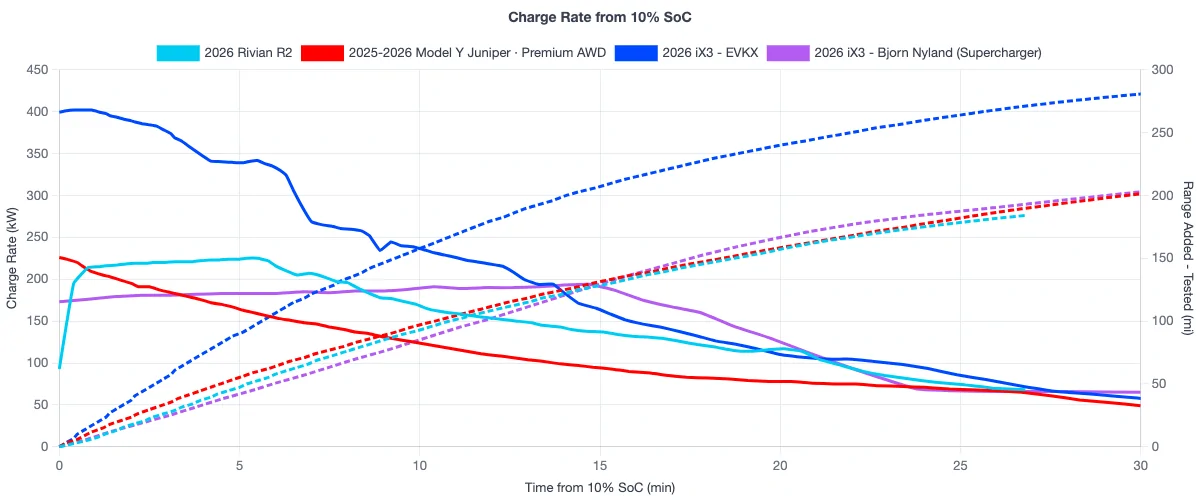
This charging test was on a 600A capable charger.

As @Jeremy3292 has noted a few places, the R2 is fantastic for a 400V vehicle - probably the best native 400V.

The Model Y is practically competitive, as it makes up for worse charging performance with better efficiency.
Besides the Y, you need to spend big money on an EV9, XC90, iX3, Gravity, Macan, Cayenne, etc. to match or beat the performance in the SUV segment - all 800V.

But it still could be better above 40% (and they may tweak the software as they did on R1 - but never buy based on expectations!).
You leave 1-3 minutes "on the table" using 500A equipment (Tesla, EVgo, Electrify America, etc.), as it needs 600A to hit maximum charging speeds. The impact isn't *that* big, and it is truly negligible if you plug in above 20%. It should still be capable of <30 minutes 10-80% unless the supercharger handle overheats.

The way to road trip an R2 will be similar to R1. Plan on "deep" charges - 20-30 minutes and leave at 70-75%. You don't need to do the Tesla 8-15 minute charges every 90-120mi.
 

Sponsored

Jeremy3292

Well-Known Member
First Name
Jeremy
Joined
Apr 27, 2026
Threads
5
Messages
682
Reaction score
1,090
Location
South Carolina
Vehicles
R2
This is my hope. A "Gen2" R2X with a ~100-120kWh battery and 800V charging (as an option, most people won't need it). They'll need to find some much higher performance cells to get there though. Perhaps Donut labs can help them out (hahahahahhahahahahha )

I just hope it happens before I am ready to buy a new vehicle. Because as of right now, the R2 is "too much" for our around town vehicle and sub-optimal for road trips and wholly unsuitable long distance towing. The iX3 and iX5 have my attention even though I much prefer the styling (in and out) of R2.


This charging test was on a 600A capable charger.

As @Jeremy3292 has noted a few places, the R2 is fantastic for a 400V vehicle - probably the best native 400V.

The Model Y is practically competitive, as it makes up for worse charging performance with better efficiency.
Besides the Y, you need to spend big money on an EV9, XC90, iX3, Gravity, Macan, Cayenne, etc. to match or beat the performance in the SUV segment - all 800V.

But it still could be better above 40% (and they may tweak the software as they did on R1 - but never buy based on expectations!).
You leave 1-3 minutes "on the table" using 500A equipment (Tesla, EVgo, Electrify America, etc.), as it needs 600A to hit maximum charging speeds. The impact isn't *that* big, and it is truly negligible if you plug in above 20%. It should still be capable of <30 minutes 10-80% unless the supercharger handle overheats.

The way to road trip an R2 will be similar to R1. Plan on "deep" charges - 20-30 minutes and leave at 70-75%. You don't need to do the Tesla 8-15 minute charges every 90-120mi.
Yep exactly. 10% to 70% in 20 minutes on 600 amp capable charger or 10% to 70% in 21-22 minutes on 500 amp limited chargers, like Tesla superchargers.

Based on Tom's video, holding on til 73% is likely the perfectly ideal SoC to stop at if we want to get very technical. That last 7% to 80% is 5-6 minutes and not worth it. Also of course starting your charge below 10% is even better, but most of us can't time it perfectly to arrive at 3% or 5% and plug in.

Fun fact: I gave Gemini Tom's video to analyze and came back with just under 29 minutes 10% to 80% on 500 amp limited chargers, which is what Rivian is advertising. I suspect that is on purpose on their part.
 

RivianXpress

Well-Known Member
Joined
Nov 17, 2020
Threads
91
Messages
823
Reaction score
1,474
Location
West Coast
Vehicles
R1T, Sprinter, KTM 250 XC-W, R1250GSA, Husky 501, 890R, KTM 350 EXC-F, IBEX 450
Occupation
Retired Engineer
How about a comparison with R1, R1 (gen 2) and R2.

Is the R2 faster to charge than my R1T LE which seems to be very slow on road trips. Range seems similar to my LE but contemplating replacing my R1T with the R2 although I love my LE.
 

Jeremy3292

Well-Known Member
First Name
Jeremy
Joined
Apr 27, 2026
Threads
5
Messages
682
Reaction score
1,090
Location
South Carolina
Vehicles
R2
How about a comparison with R1, R1 (gen 2) and R2.

Is the R2 faster to charge than my R1T LE which seems to be very slow on road trips. Range seems similar to my LE but contemplating replacing my R1T with the R2 although I love my LE.
Yes, R2 is much faster. Better thermals and cooling, as well as being a smaller battery pack that can actually accept more amps than R1. R1 is heavily penalized for having a large battery and still being 400v, on top of not having good thermals.
 

savethemanual

Well-Known Member
Joined
May 18, 2024
Threads
17
Messages
974
Reaction score
1,684
Location
Earth
Vehicles
Future R2
Yes, R2 is much faster. Better thermals and cooling, as well as being a smaller battery pack that can actually accept more amps than R1. R1 is heavily penalized for having a large battery and still being 400v, on top of not having good thermals.
Looking forward to seeing what they put in their next generation R1 some day, pretty sure Rivian is aware they need to upgrade the DCFC experience with that line ;).
 

Sponsored

llninja

Member
Joined
Jun 18, 2025
Threads
0
Messages
20
Reaction score
15
Location
Illinois
Vehicles
Borealis R1S Gen 2 TriMotor
R1 charging is considerable slower than R2 is, but I agree with your thoughts as 20 minutes or less is ideal for me. I'll be splashing and dashing in the 10% to 71%ish range.
I think it depends on how you look at it. 10-70% on an R1 is a whole lot more kWh than 10-70% on an R2. It’s like saying my crossover SUV fills its tank much faster my brother;s crew cab dually - how big are the tanks? The R1 and R2 are fundamentally different cars that look simlar
 

llninja

Member
Joined
Jun 18, 2025
Threads
0
Messages
20
Reaction score
15
Location
Illinois
Vehicles
Borealis R1S Gen 2 TriMotor
Looking forward to seeing what they put in their next generation R1 some day, pretty sure Rivian is aware they need to upgrade the DCFC experience with that line ;).
I’d rather see Rivian focus on R3, R4, R5, and R6 and not make major changes to gen2 R1. Sales will drop just like the Model S and X dropped when the lower cost Models 3 and Y appeared. But there will still be people who want a truck or a 3 row SUV. I hope Rivian at least does a gen3 facelift where the drivetrain and innards have incremental small improvements but R1T and R1S get new Fresh sheet metal someday. At this point it would be great to introduce a longbed and a Subyukonade (longer - 3 row with even more cargo in the back) SUV.

I personally would like for Rivian to make an exotic looking 2 seater, but lifted and AWD, like the Porsche Dakar or Lamborghini Sterrato. Not that I’m in the market to buy one, but as a car enthusiast, that would be an awesome and rare vehicle to dream about.
 

Jeremy3292

Well-Known Member
First Name
Jeremy
Joined
Apr 27, 2026
Threads
5
Messages
682
Reaction score
1,090
Location
South Carolina
Vehicles
R2
I think it depends on how you look at it. 10-70% on an R1 is a whole lot more kWh than 10-70% on an R2. It’s like saying my crossover SUV fills its tank much faster my brother;s crew cab dually - how big are the tanks? The R1 and R2 are fundamentally different cars that look simlar
Avg C rate on R1 is worse than R2, so yeah it’s still not better. By this metric you are proposing, any big battery vehicle is better than any smaller battery vehicle automatically bc it adds more kWh on 10 to 70 or 10 to 80. So big truck with big gas tank better than a small sedan always. Doesn’t make sense logically to say that.
 

Kaiju

Well-Known Member
Joined
Aug 18, 2024
Threads
2
Messages
145
Reaction score
258
Location
Texas
Vehicles
R1T
This is lovely data. I would have much rathered find this earlier. The napkin math wasn't actually too far off on the time over 300kW.

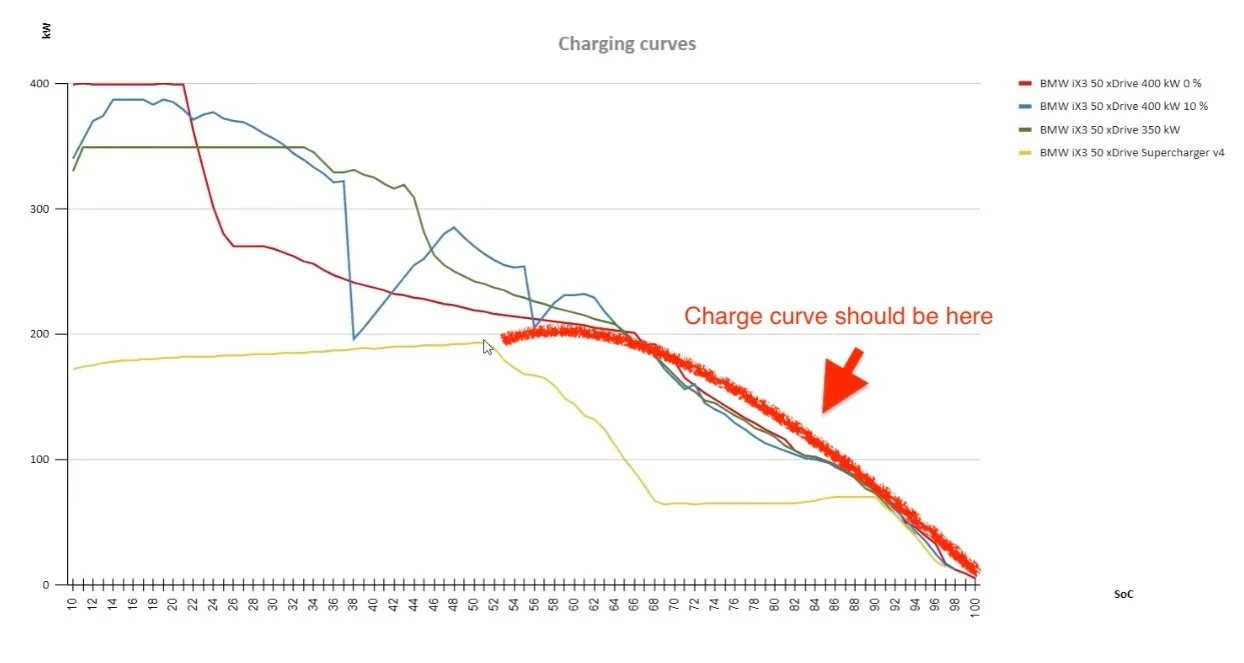
As far as the dropoff on the v4 supercharger, it looks to coincide with a 500A amperage limit at 400V and I presume that's the amp limit on the car for 400kW. The curve looks like something's hitting a temperature max after with the sharp dropoff and plateau suggesting a subsequent bottleneck in active cooling. But both of those things would imply it's not actually charging at 800V. That may actually be correct rather than a glitch.

I found a little niggling thing when looking at the supercharger specs and that's that not everything with a v4 post has a v4 cabinet. The ones with a v4 post but a v3 cabinet still only do 500V. They make 325kW doing 650 amps at 500 volts, which the BMW can't actually fully utilize, so 200kW at 400V would seem to make sense if that's what it was tested with. Since it doesn't peg out at 500A for more than a few minutes on 800V it might make sense that it just can't handle it for very long.

This also means one needs to be somewhat careful judging chargers by their kW ratings alone. Another layer of nuance that will doubtlessly confuse people especially since that info is not easy to find.

All that being said, I think there's more going on under the hood than charge speed when we're talking 800V systems. The fact it costs more aside, it's possible 800V could add some obstacles to getting the power out. The added complexity of having to step up/down from 800V and potential bottlenecks in the solid state switching for charging could have performance impacts as well. It might not simply be an issue of throwing money at the problem.

If you happen to know where to find the iX3 drive motor specs that would be very telling.

It's actually better. R2 has much better designed cooling and thermals.

R2: 137kW/88kWh = 1.56C
R1: 157kW/140kWh = 1.12C
The difference here may be semantics, but the point being made wasn't about the C rate. It was that a bigger battery pack could still suck down more kilowatts for longer on account of its size alone. The C rate trends down as battery pack size increases in general so yeah, no surprises there. If I remember the gigantic one on the Silverado EV has a C value of around 1 despite its 800V charging. I would hope Rivian is incrementally doing better, but I think we'd need to see a post-R2 battery pack design for the R1.
 

Indy avocado

Well-Known Member
First Name
Greg
Joined
Dec 17, 2022
Threads
3
Messages
223
Reaction score
310
Location
Indiana
Vehicles
'22 R1T, '17 Macan S, '11 Mustang GT
As far as the dropoff on the v4 supercharger, it looks to coincide with a 500A amperage limit at 400V and I presume that's the amp limit on the car for 400kW. The curve looks like something's hitting a temperature max after with the sharp dropoff and plateau suggesting a subsequent bottleneck in active cooling. But both of those things would imply it's not actually charging at 800V. That may actually be correct rather than a glitch.
Yeah, the timing is too suspicious... I think there's a software limit based on input current. Could bea limitation of the wiring at the charging port?

To add on to your supercharger comment - All (but 14) current "V4" superchargers are V3 cabinets with V4 posts. They *should* be able to easily handle 500A+ continuous, and demonstrate boosting to 900A for Cybertruck (to hit 325kW). However, in the US they are limited to 500A for non-Tesla vehicles. iX3 is probably limited (internally or externally) by the 500A limit when charging on 400V - the same limit R2 hits. "325kW" is true, but only the Cybertruck can hit it.
For all other vehicles, they are 150-225kW chargers (depending on battery voltage).

The C rate trends down as battery pack size increases in general so yeah, no surprises there. If I remember the gigantic one on the Silverado EV has a C value of around 1 despite its 800V charging. I would hope Rivian is incrementally doing better, but I think we'd need to see a post-R2 battery pack design for the R1.
C-rate (short duration) is primarily a function of the battery chemistry and is therefore independent of pack size. For longer duration, cooling comes into play which *IS* impacted by pack size (but a good chemistry with strong coulombic efficiency can reduce heat load).

And yes, the C-rate of the Ultium stuff is piss-poor. But they have *so* much battery that it doesn't matter. Brute force. And it works. Perfect for a big ass truck.

But when they scale that pack down to fit in the CUVs (or when the trucks with the medium sized battery split-pack on a supercharger), the voltage is like 270V or so. They charge *extremely* poorly. ~130-150kW.[/QUOTE]
Sponsored


Top