OP
OP

ksurfier
Well-Known Member
- Thread starter
- #46
Just see what's painfully obvious, that's all:I am so confused. Did you fail to read all my previous posts? I provided scientific studies of wheel efficiency.
You are trying to tie one variable, weight, to efficiency. Nobody who studies wheel efficiency does that.
Provide a study from a reputable source that does. And explain why tire manufacturers don't prioritize weight when designing an efficient tire. And explain why Rivian and Tesla are using heavy wheels on their most efficient vehicles.
You know the EPA game. If they could simply get better range with lighter wheels they would do it. But they don't. Because tire design (tread and rubber compound) and aerodynamics matter more. So they don't prioritize lightweight wheels. At all.
But you are smarter than all the engineers who work for Rivian and Tesla?
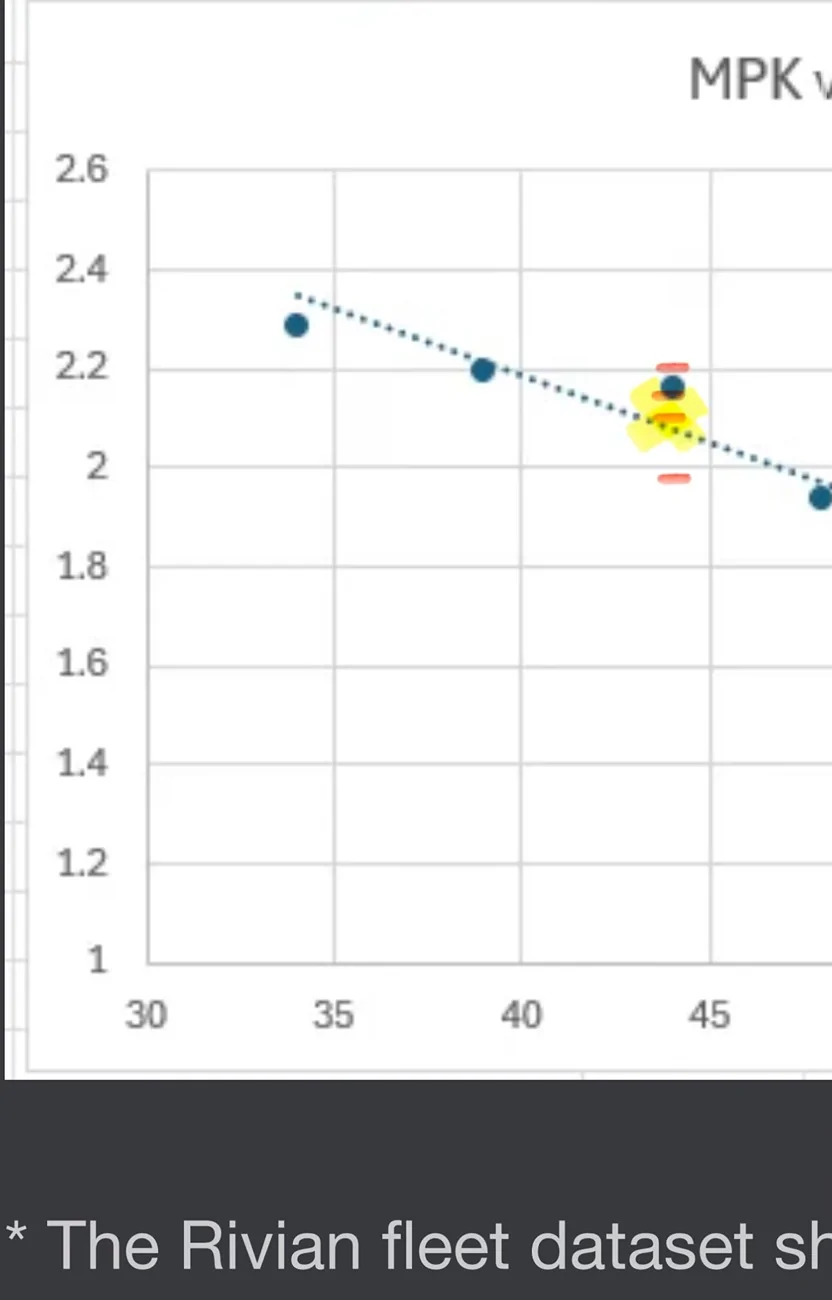
The available Rivian fleet data provided by RivianTrackr offer compelling evidence that tire weight is a major predictor of vehicle efficiency. Weight alone appears to explain most of the observed variability in MPK, despite the presence of numerous uncontrolled variables. While tire weight is not the sole determinant of efficiency, the analysis strongly supports the hypothesis that increasing tire mass is associated with a substantial reduction in MPK over the weight range evaluated. The observed relationship is consistent with established mechanical principles governing tire rolling resistance, particularly increased viscoelastic hysteresis associated with greater deforming rubber volume.
Key observations
- Trend direction: Strong inverse (negative) relationship.
- Regression equation:
MPK=−0.0271(Weight)+3.271 - Interpretation: Every additional 10 lb of tire weight is associated with an average reduction of approximately 0.27 MPK.
- Across the dataset (34 → 66 lb):
- Weight increases by 32 lb
- MPK decreases from approximately 2.29 to 1.47
- Total reduction ≈ 0.82 MPK (~36% decrease).
Although the exact statistics require computation from the raw data, the scatterplot suggests:
- Correlation (r): approximately -0.9 to -0.95
- Coefficient of determination (R²): approximately 0.80–0.90
This would indicate that 80–90% of the observed variation in MPK is explained by tire weight alone, which is exceptionally strong for field data where many other factors (compound, tread pattern, inflation pressure, temperature, alignment, driving style, etc.) also influence efficiency.
Based on the dataset shown, there is strong empirical evidence of a negative relationship between tire weight and Rivian efficiency (MPK). While the sample is relatively small (11 tire models), the trend is remarkably consistent across nearly the full weight range (34–66 lb), and it aligns well with the underlying physics of rolling resistance, viscoelastic hysteresis, and rotational inertia.
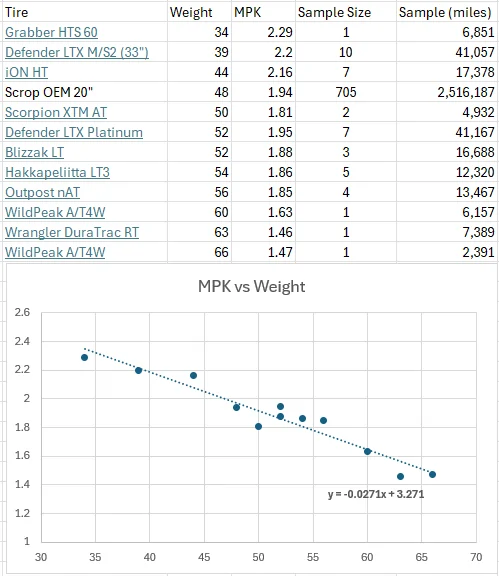
* The Rivian fleet dataset shows a strong inverse relationship between tire weight and efficiency (MPK), with approximately 80–90% of the observed variation explained by tire weight alone (R² ≈ 0.8–0.9).
* On average, every additional 10 lb of tire weight is associated with an approximately 0.27 MPK reduction, representing a substantial range penalty.
* This relationship is consistent with tire engineering principles. Heavier tires generally contain more rubber, deeper tread, stronger carcasses, and more reinforcement, all of which increase rolling resistance through greater viscoelastic (hysteresis) losses.
* Regenerative braking actually strengthens this conclusion. Regen recovers much of the energy required to accelerate a heavier tire, but it cannot recover energy continuously lost to rolling resistance. Therefore, the observed MPK penalty is likely dominated by rolling resistance rather than rotational inertia alone.
* Rivian’s high vehicle weight further amplifies these losses. The higher load on each tire increases deformation and hysteresis, making differences in tire construction more apparent than they would be on a lighter vehicle.
* DOE-supported tire research has demonstrated that reducing tire weight while lowering rolling resistance can improve vehicle efficiency by more than 5%, illustrating that manufacturers intentionally pursue lightweight, low-rolling-resistance tire designs together.
* Both Rivian and Tesla equip their highest-range vehicles with range-optimized, low-rolling-resistance tire and wheel packages rather than the heaviest or most aggressive all-terrain options, reflecting the industry’s recognition that tire design plays a major role in vehicle efficiency.
* Tire weight should not be viewed as the sole cause of reduced efficiency, but it is an excellent practical indicator of the tire characteristics that drive rolling resistance, making it a useful predictor when comparing similar tire sizes and applications.
Sponsored
Last edited: