OP
OP

ksurfier
Well-Known Member
- Thread starter
- #16
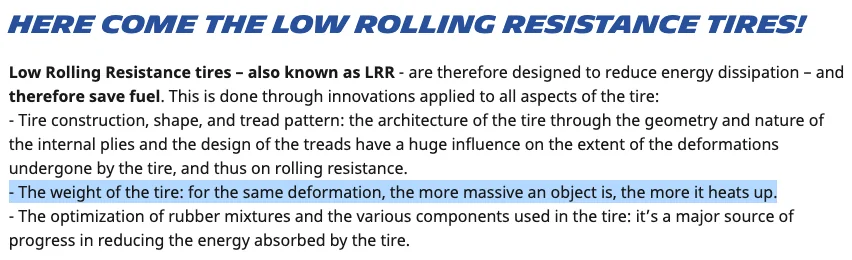
Rolling resistance is largely the mechanical expression of repeated viscoelastic hysteresis losses in the tire’s deforming rubber volume. As a tire rotates, the tread, sidewall, and internal belt package are continuously compressed, flexed, and released through the contact patch. Because rubber does not rebound perfectly, a portion of that deformation energy is lost as heat during each cycle. By a wide margin, tire weight is one of the strongest practical indicators of how much material must be repeatedly deformed; all else being equal, a heavier tire contains more rubber and structural mass that must flex with every rotation. More deforming material generally means greater hysteresis loss, more heat generation, and therefore higher rolling resistance.This is all fine and not wrong. But
1. Efficiency matters the most for steady speed highway situations, where the difference in tire weight has essentially zero impact.
2. Difference in tire compound and tread design (rolling resistance) matters much more than weight.
3. Let's see real world tests and numbers before we get too worked up.
One important caveat is that LT tires can offset some of this penalty when they are operated at substantially higher internal pressure, such as up to 80 psi in appropriate applications. Higher inflation pressure reduces tire deflection, shortens and stiffens the contact patch, and limits the amount of sidewall and tread deformation occurring with each rotation. That can reduce hysteresis losses and partially counteract the rolling-resistance penalty of the tire’s added mass. However, this does not erase the weight penalty entirely: LT tires are typically heavier, stiffer, and more heavily reinforced, so their rolling resistance depends on the balance between added material, casing construction, compound hysteresis, load, and actual operating pressure.
Sponsored