Sponsored

tivoboy

Well-Known Member
First Name
Paul
Joined
Nov 8, 2025
Threads
2
Messages
308
Reaction score
328
Location
Palo Alto, CA
Vehicles
M3
Not sure that is the case for the Gen2 R1.

This can be subjective, I guess, as certainly it isn't a 800V truck.

I was so frustrated with the horrible charging speed in my Mach-e, but my R1T is totally acceptable. I wish it would be faster, but I doubt it can be much faster and stay 400V.

1783699070700-8h.webp


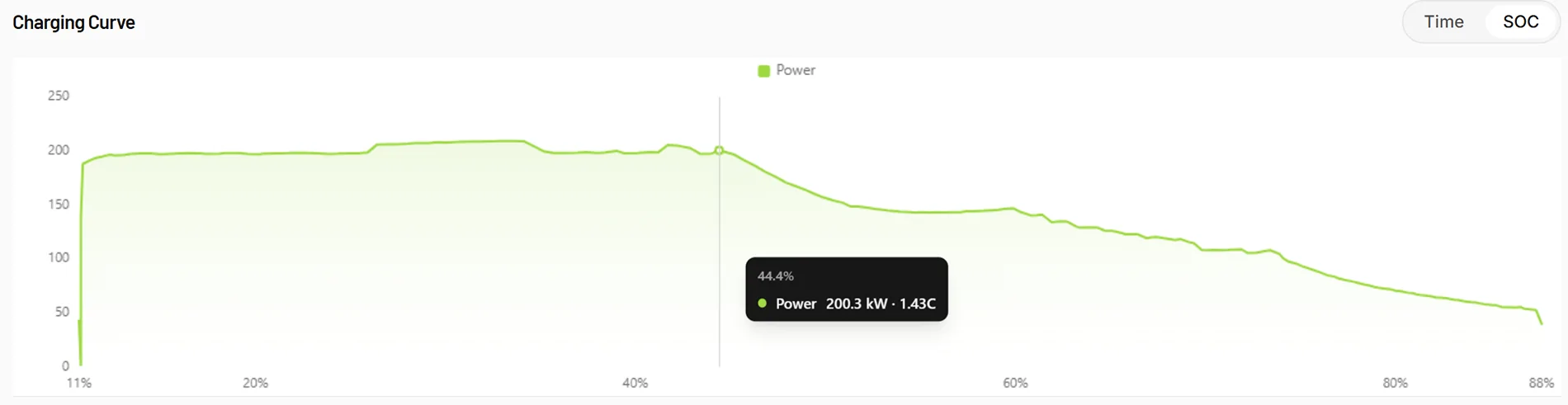
This is a recent charge I did on a RAN charger. The truck maintained over 200 kW until 45%.

Pretty decent charge curve, IMO.
That would be pretty incredible some of the best I’ve seen.
Sponsored


Jeremy3292

Well-Known Member
First Name
Jeremy
Joined
Apr 27, 2026
Threads
5
Messages
682
Reaction score
1,090
Location
South Carolina
Vehicles
R2
That would be pretty incredible some of the best I’ve seen.
It’s a 141 kWh battery. 200kW is nothing for a battery that large. R2 keeps 225kW to around 30% and is an 88 kWh battery. The equivalent of that for R1 would be keeping 360kW to 30%. This is why C rate matters.
 

mkhuffman

Well-Known Member
First Name
Mike
Joined
Nov 9, 2020
Threads
14
Messages
3,022
Reaction score
3,435
Location
Virginia
Vehicles
2025 R1T Tri-Max, Jeep GC-L, VW Jetta
It’s a 141 kWh battery. 200kW is nothing for a battery that large. R2 keeps 225kW to around 30% and is an 88 kWh battery. The equivalent of that for R1 would be keeping 360kW to 30%. This is why C rate matters.
11-70% was 32 minutes.
11-80% was 41 minutes.

I get it. Not amazing. But really, not bad considering how big the battery is. 32 minutes is a very reasonable time to wait, IMO. 41 isn't horrible, and totally livable. And much, much better than my Mach-e.

11-70% added about 83 kWh. That lets me drive another 200 miles at 2.4 mi/kWh. Which is typically what I see on the highway, on the east coast (with some thick traffic areas) and in good weather. I set the cruse for 81 (79 GPS), so I am moving it when the traffic is clear.

Winter is another story, of course, but every BEV has that issue.
 

sparked

Well-Known Member
Joined
Dec 16, 2025
Threads
13
Messages
274
Reaction score
462
Location
USA
Vehicles
R2 Deposit
Interesting that Tom had an a CCS adapter pin melt when using an adapter due to the R2's high amperage draw.
Tom had followup comments in a podcast where he said he was using an old Tesla adapter. He thinks that if he had used a new UL2252 certified adapter, it would have been fine. So just get UL2252 certified adapters from a reputable vendor for maximum safety long term.

Code:
Melted Pin and adapter comments start around 26:29:
https://youtu.be/ulIlyop8974?si=HcrddhZFf4We-59D&t=1589

Overall Comments about R2 charging start around 13:31:
https://youtu.be/ulIlyop8974?si=0KSyHlzKP6e0Moke&t=811
 

Jeremy3292

Well-Known Member
First Name
Jeremy
Joined
Apr 27, 2026
Threads
5
Messages
682
Reaction score
1,090
Location
South Carolina
Vehicles
R2
Tom had followup comments in a podcast where he said he was using an old Tesla adapter. He thinks that if he had used a new UL2252 certified adapter, it would have been fine. So just get UL2252 certified adapters from a reputable vendor for maximum safety long term.

Code:
Melted Pin and adapter comments start around 26:29:
https://youtu.be/ulIlyop8974?si=HcrddhZFf4We-59D&t=1589

Overall Comments about R2 charging start around 13:31:
https://youtu.be/ulIlyop8974?si=0KSyHlzKP6e0Moke&t=811
Yes, the Lectron UL rated one is $179 but is still rated for only 500 amps. It seems to be a more robust build though.
 

Sponsored

Indy avocado

Well-Known Member
First Name
Greg
Joined
Dec 17, 2022
Threads
3
Messages
223
Reaction score
310
Location
Indiana
Vehicles
'22 R1T, '17 Macan S, '11 Mustang GT
As you probably know, most of these specifications are not free - you have to pay a hefty fee to get an official copy. The publicly available sources seem to be wrong about the limits though - they all say 500A but I dug a little deeper and if you look at some of the specs it says only 400A. Which kind of makes sense - you do see some 400kW chargers out there, but I've never seen a 500kW charger ...

For example, IEC 62196-3:2026 "Plugs, socket-outlets, vehicle connectors and vehicle inlets – Conductive charging of electric vehicles" shows 1000V/400A as the rating for the CCS1 connector we all know and love. Unfortunately I can't give you a link for that because it's not public data, but you can probably find a bootleg copy online somewhere.

Regardless, this has nothing to do with adapters or J3400. The charger knows that it's a CCS charger, and if a request comes in for a voltage or a current (or combination) that it can't supply or is out of spec, then it's supposed to counteroffer with what it can supply. This happens regardless of whether there's an adapter or a J3400 plug involved because that doesn't change anything about the protocol.

There is no need to "announce" limits. The vehicle asks for what it wants then the charger replies with what it can deliver. Which of course can be different and less than requested, but never more. For example the Rivian can ask for 220kW at start (actually it has to specify voltage and current separately) but if you're plugged into a 50kW charger you're obviously not going to get that - the charger is going to come back with a voltage and current that make 50kW. And if the vehicle asks for 400V the charger isn't going to deliver 800V even if the charger is capable of 800V. But if the vehicle asks for 800V and the charger can only give 400V, that's all the vehicle is going to get. The Rivian never knows what the capacity of the charger is, it only knows what the charger can deliver at that point in time.

Checks out:
IEC 62196-3 does list a 1000V/400A rating for the CCS1/CCS2 DC pins

That's the natural-air-cooled baseline for the standard connector.


Doesn't check out:
"Never seen a 500kW charger": This is factually wrong. 500kW (and 600kW) CCS liquid-cooled connectors and charging cables are commercially available and IEC 62196-3-compliant right now (REMA, Mida, Fiver, and others all sell certified 500A/600A liquid-cooled CCS1/CCS2 guns).
The 400A figure is specifically the naturally-cooled rating. Liquid cooling is the standard mechanism used to exceed it.


Overstated:
"No need to announce limits" / adapters are irrelevant:
ISO 15118/DIN 70121's Charge Parameter Discovery step is a mutual capability exchange (EV and EVSE both report max voltage/current), not just a live counteroffer loop. These are intended to be safety limits on both sides that fully describe the system (vehicle side, EVSE).
So the "announcement" concept is in line with the general behavior during the communication handshake. The EVSE side and the vehicle side announce, but a 3rd party adapter is invisible to that exchange, and there's not (afaik) any communication mechanism for one to provide it's limits to the chain.

I do not have access to the specs to get into any recent documents to verify more specifically.
 

AmpedToGo

Member
First Name
David
Joined
Jul 8, 2026
Threads
0
Messages
6
Reaction score
3
Location
Seattle
Vehicles
Tesla Model 3, Tesla Model Y; R2 Reservation holder
Occupation
Retired
R2's fast DC charging and effective range is like our current Model Y or 3 (R2 has 20% bigger battery, 20% more drag), and those have been fine for long-distance trips crossing mountain ranges, driving 75-85 mph. As others have said, it is almost too fast if you're charging at an unshared 250 kW SC. I usually hurry a bit to finish lunch just before the car's done. We're not doing Cannonball runs and like having a day-long drive broken up with bio-breaks, lunch, and leg stretching or a snack. We tend to charge most often between ~20% and ~80 or 85%, depending on the segment. Driving down to 10% doesn't leave us many options when we get stuck in bad traffic or hit detours.
 

VSG

Well-Known Member
Joined
Oct 3, 2022
Threads
4
Messages
3,352
Reaction score
6,313
Location
WA
Vehicles
R1T LE/RB/OC/20
What I said is (emphasis added):
you do see some 400kW chargers out there, but I've never seen a 500kW charger ...
Doesn't check out:
"Never seen a 500kW charger": This is factually wrong.
Really? Factually wrong? You have some way of knowing what I've seen? I've seen lots of 350kW EA, EVGo, Pilot, Flying J, etc. chargers. I've seen 400kW IONNA and Walmart chargers. But I've never seen or otherwise encountered a CCS charger of >400kW.

That's a fact.

Do they exist, and do they exist in the wild? I don't know, but I've never seen one. Or heard of one for that matter. Have you? Can you link to one 500kW or 600kW CCS charger on PlugShare?

And in context, what I said was that what I read in the spec (1000V/400A for CCS) was consistent with what I have experienced on the road. Again, a fact.

The spec doesn't say anything about air-cooled or liquid-cooled - that's an implementation detail which frankly shouldn't even be in the spec. The whole point of standardization is so that the different manufacturers can implement things their own way. If I want to use superconducting cables I can, as long as I adhere to the mechanical specifications and communications specifications. Without this abstraction of interface vs implementation, standards aren't very useful.
 

VSG

Well-Known Member
Joined
Oct 3, 2022
Threads
4
Messages
3,352
Reaction score
6,313
Location
WA
Vehicles
R1T LE/RB/OC/20
ISO 15118/DIN 70121's Charge Parameter Discovery step is a mutual capability exchange (EV and EVSE both report max voltage/current), not just a live counteroffer loop. These are intended to be safety limits on both sides that fully describe the system (vehicle side, EVSE).
I had thought ISO 515118 was only plug and charge, but I see it also does have the "Charge Parameter Discovery" protocol.

However, as part of that protocol it specifies the maximum parameter value you can use for DC charging current is 400A
https://www.typhoon-hil.com/documen...ware-manual/References/iso15118_protocol.html
(see "Definitions of charge parameters")

So again, this is consistent with the other CCS specifications I've read that state 1000V/400A and is still inconsistent with CCS chargers providing more than 400A. The question I raised above remains: why do most public sources (e.g. Wikipedia) quote 500A as the CCS maximum current, and why are we seeing places like in the State of Charge video that supply 600A, when as far as I can tell all the specs still say 400A.

I don't know whether >400A is allowed in some proposed changes to the specifications, in some new specifications, or whatever, but I don't see that anywhere. In the case of J3400 there are actually two different plugs, one supporting the legacy 500V limit and a second that supports 1000V. Similarly, if CCS were to extend the standard to support higher currents I would think it essential that the mechanical specifications are revised so that high currents aren't provided to low-current sockets.
 

Indy avocado

Well-Known Member
First Name
Greg
Joined
Dec 17, 2022
Threads
3
Messages
223
Reaction score
310
Location
Indiana
Vehicles
'22 R1T, '17 Macan S, '11 Mustang GT

Sponsored

Jeremy3292

Well-Known Member
First Name
Jeremy
Joined
Apr 27, 2026
Threads
5
Messages
682
Reaction score
1,090
Location
South Carolina
Vehicles
R2
I have a lot to say, but for now, I will just leave this:

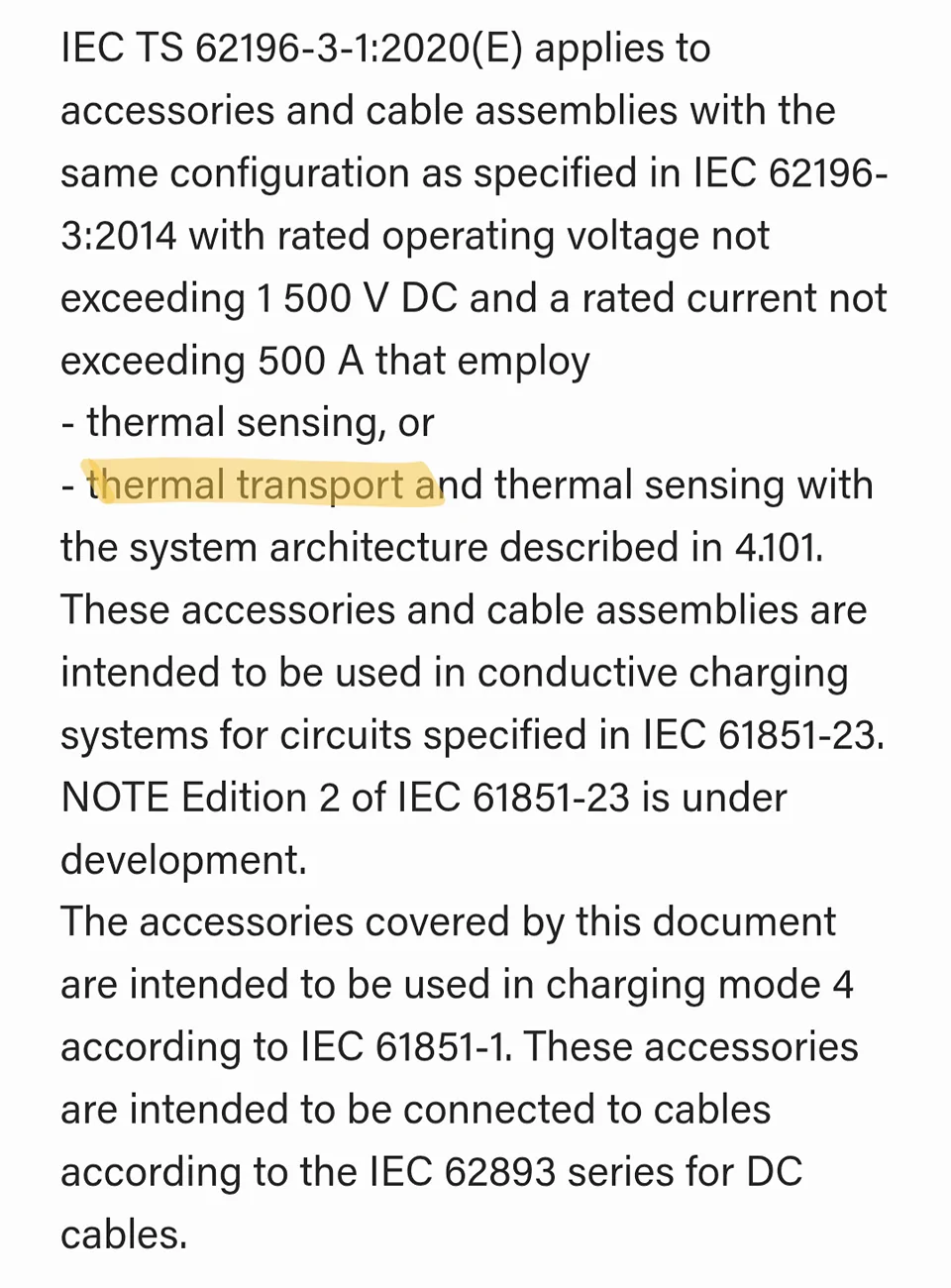
The broader IEC 62196 family has moved well past 400A. IEC 62196-1 (both the 2022 and 2025 editions) specifies up to 1500V DC at 800A.
Look in the history section:
https://en.wikipedia.org/wiki/IEC_62196

Additionally, liquid cooling is not an "implementation detail" - it's in the spec.
https://www.csagroup.org/store/product/iec_059654/
Screenshot_20260711-231539.webp
FYI I blocked that guy long ago. No need to continue with him.
 

Ilovejunebugs

Well-Known Member
First Name
Emily
Joined
Jan 15, 2024
Threads
4
Messages
211
Reaction score
262
Location
Wisconsin
Vehicles
2026 R1T Quad Max
Occupation
business owner, retired RN
Clubs
 
Still too complicated. Regular people who drive ice vehicles don't want to have to think about what charger to use to get max amps, kw, etc. They want to go to any charger, plug in (preferably without an adapter), and the performance is the same at each one.
My friends and family are very interested in ev's (especially the R2) but this overcomplication is a deterrent as they then assume the entire ownership is overcomplicated.
I, on the other hand,enjoy the nerd data and deep dive videos like this one from State of Charge.
 

iamnid

Well-Known Member
Joined
Aug 10, 2023
Threads
7
Messages
685
Reaction score
909
Location
California
Vehicles
Mercedes EQE, Rivian R1S
Still too complicated. Regular people who drive ice vehicles don't want to have to think about what charger to use to get max amps, kw, etc. They want to go to any charger, plug in (preferably without an adapter), and the performance is the same at each one.
My friends and family are very interested in ev's (especially the R2) but this overcomplication is a deterrent as they then assume the entire ownership is overcomplicated.
I, on the other hand,enjoy the nerd data and deep dive videos like this one from State of Charge.
As long as the charge initiates, "regular people" probably won't notice if the charge slightly derates. About the only thing they need to be schooled up on is that they shouldn't charge past 80%. I know plenty of people with Teslas that have no problem road tripping with very little understanding of preconditioning, optimal charge curves etc. They just drive and charge. As long as it starts charging and it doesn't do something weird like get stuck at 50kw for the whole session, they don't notice anything.
 

Hereforthesnacks

Well-Known Member
Joined
Jun 6, 2024
Threads
3
Messages
1,314
Reaction score
1,569
Location
West Coast
Vehicles
Ford Bronco
Is an 800 volt architecture better? The most widespread DC fast charger is the Tesla version 3 Supercharger. Charging an 800 volt car typically only can reach 150 kW at a version 3 Supercharger while the 400 volt Rivian R2 reaches 230 kw. On an Electrify America fast charger an 800 volt car can charge much faster although these chargers often have issues that lower the charging speed or fail to charge at all. So while 800 volt architectures can charge faster in theory in practice they often charge slower. There are version 4 Tesla Superchargers and other newer DC fast chargers that will support the full charging speed of 800 volt architecture.

https://www.bozy.com/2025-hyundai-ioniq-5-charging-vs-tesla-supercharger/
Electrify America has been extremely reliable on my trips.
 

sparked

Well-Known Member
Joined
Dec 16, 2025
Threads
13
Messages
274
Reaction score
462
Location
USA
Vehicles
R2 Deposit
Still too complicated. Regular people who drive ice vehicles don't want to have to think about what charger to use to get max amps, kw, etc. They want to go to any charger, plug in (preferably without an adapter), and the performance is the same at each one.
That charger had a NACS cable. Regular people would have just done that. No thinking involved as the rest of us won't run charging experiments with adapters like Tom.
Sponsored

 
Last edited:


Top