

R1Sky Business
Well-Known Member
We just need the vehicles to be delivered.
Sponsored
I just sat down and did the back of the napkin math comparing the cradle to grave CO2 emissions of a Max Pack R1T to a 3.0L turbo diesel Silverado as demonstrated in the video:Every time one of these threads pop up I drop in this link:
It is the best, accessible to anyone, discussion on the topic I have found. If you are willing to read the sources and academic papers, you can do better, but this is a really good overview of cradle to grave emissions impact
That’s a really high electricity CO2 cost. And that can go to 0 whereas the Silverado can never decrease. Also you didn’t include the CO2 cost of drilling for oil, refining oil to gas, transportation of oil. That’s would be a fair comparison and would mean the break even point is much sooner.I just sat down and did the back of the napkin math comparing the cradle to grave CO2 emissions of a Max Pack R1T to a 3.0L turbo diesel Silverado as demonstrated in the video:
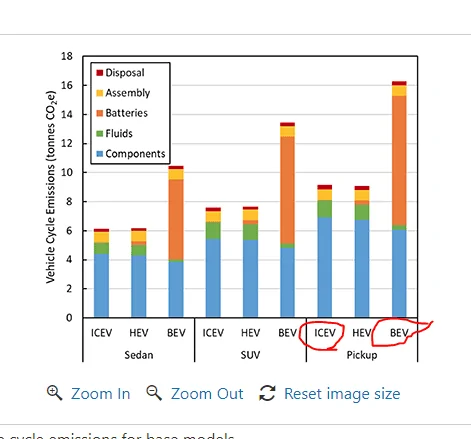
R1T: 10 tonnes to produce + 10.8 tonnes to produce battery (low estimate)+ 3.41 tonnes/year to drive 14,000miles using a Michigan electricity mix (from Alternative Fuels Data Center).
Silverado: 10 tonnes to produce + 5.06 tonnes/year
Break even time is around 6.5 years? It's 12.4 years if you use the higher estimates for battery production. This is very surprising and depressing to me! I've always assumed the R1 was the hands down environmental winner but it's not so clear now.
Forgive any math errors! I'm just following the video literally on the back of a napkin.

That stood out to me in the video, too. I don’t think anyone includes the cost of getting the oil to your vehicle in their estimates.Also you didn’t include the CO2 cost of drilling for oil, refining oil to gas, transportation of oil. That’s would be a fair comparison and would mean the break even point is much sooner.

Interesting. Looked at your numbers briefly, I don't see errors at first glance.Forgive any math errors! I'm just following the video literally on the back of a napkin.

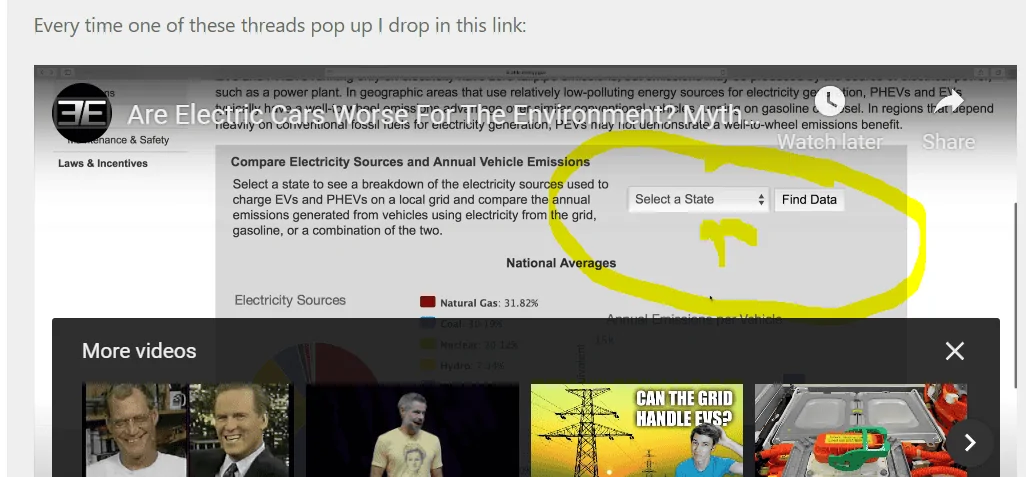
States are not their own grid (aside from Texas). That's not how it works.MIchigan apparently is a little worse than the national average as far GHG emissions from electricity,
True but each utility knows from whom it buys its electricity and thus for each state we can do a weighted sum over its utilities to determine the average carbon burden for that state. Is there any doubt that West Virginia that obtains most if its electricity from coal burning plants within the state is dirtier than, say, New York who buys a lot from Quebec Hydro?States are not their own grid (aside from Texas). That's not how it works.
The grid is energized by generators. You do not buy power from specific plants.True but each utility knows from whom it buys its electricity and thus for each state we can do weighted sums over each utility to determine the average carbon burden of each. Is there any doubt that West Virginia that obtains most if its electricity from coal burning plants within the state is dirtier than, say, New York who buys a lot from Quebec Hydro?
There is some truth to what you say when it comes to those REC scams (I shouldn't take that tone - I make about $700/yr selling them) whereby the tree huggers can claim they use only green electricity because they buy RECs but there is physics involved too. You can quickly see this by constructing, on your computer a simple network. Analysis shows that MOST of the power you get comes from the closest sources. thus where does my arch conservative, damn the tree huggers neighbor get most of his electricity on a sunny day? My solar panels. My excess generation does NOT go back to the utility. It goes straight into my closest neighbors houses. Similarly, while it is true that I would get a tiny, tiny amount of power from each coal burning plant in West Virginia (I am in Virginia) that amount is trivial compared to what I get from closer sources. Thus my statements are valid - not to the fraction of a percent but to a percent or so. When I am charging in VA (from the utility) my electricity is about 30% clean. When i am charging in Quebec it's 100% clean.What you describe is a financial function, not a physics function. I.e. you pay the generator to supply energy to the grid. That doesn't mean your utility is using that electricity.
OK. Sigh...... The "easily referenced" data we have showing GHG emissions from electrical supply is documented, tracked and sorted by state, and that is the kind of data often used in high level (ie ballpark) calculations. I agree, you can get more specific and accurate info for a specific case. The state level data is useful, but not perfect. Sorry for going forward with the simplification.States are not their own grid (aside from Texas). That's not how it works

But states can and do have their own power plant emission requirements. That's one reason on some state borders you can see a few power plants on one side of a border and not the other. The electricity all gets fed into the same grid (for the most part), and the emissions essentially the same place, but different states have different emission or water requirements in addition to any federal requirements. Let's say the City of Los Angeles owns a power plant in Utah, the emissions probably go into Utah's calculations, even though the "customer" is in California.States are not their own grid (aside from Texas). That's not how it works.


