DJG
Well-Known Member
Think it's 70% and 150k/10 years? Which is obviously well below actual expectations, as with any warranty.Does Rivian have a "not below xx% capacity after xx years" guarantee on the pack?
Sponsored
Think it's 70% and 150k/10 years? Which is obviously well below actual expectations, as with any warranty.Does Rivian have a "not below xx% capacity after xx years" guarantee on the pack?

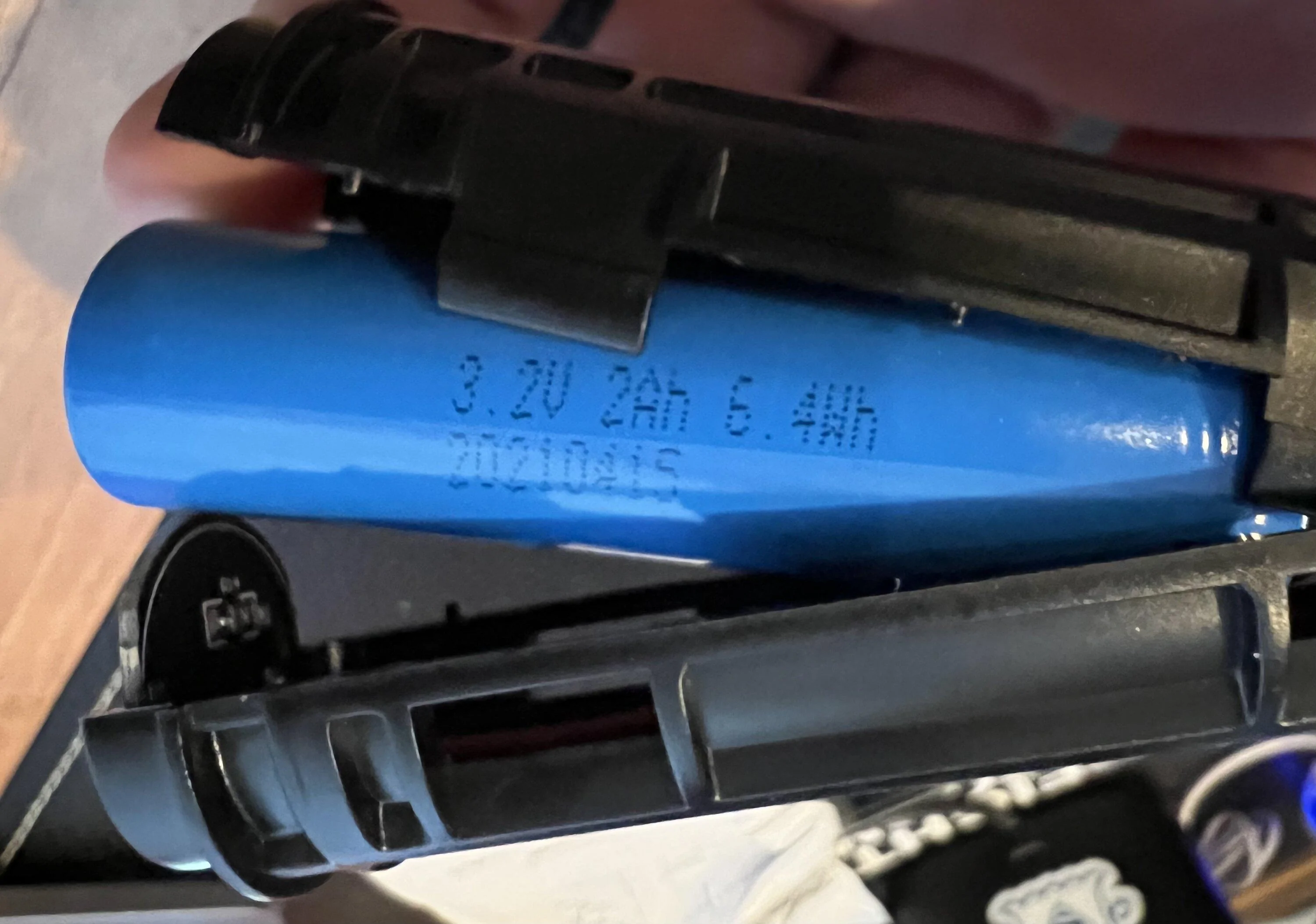
Well to be fair, no one ever claimed the flashlight was the exact same type of cell as the main battery, just that it was the 7,777th one. Not that it really matters. Different use cases may call for different types of cells, don't know.Well, that absolutely confirms that the door flashlight doesn’t contain the “7777th identical cell” - as my flashlight contains a 3.2V, 2Ah cell:


Actually pretty good...Am I reading the results correctly in that the cell retains 3880mAh of the original 4850mAh after 1000 cycles? Doesn't that kinda suck?
In other words, you're saying that's the equivalent of a nearly full discharge? What would the equivalent SoC be at 2.5V?The 80% capacity after 1,000 cycles test was done at 4.2v down to 2.5V, they didn't provide data for "partial" discharge cycle testing.

We have a 6 year old Model S it has the 18650 not the 21700 with 60k miles, probably 85% of charging on Super Chargers and have about 95% of capacity compared to new, most of that was lost in first 2 years.If 1 cycle is "314 miles", that's 314,000 miles with an 80% retention rate. Isn't that kinda good? What's a Tesla look like at 300k miles? Or 100k miles?
Well, that's the thing.. we don't know where Rivian's BMS bottoms out on cell voltage. They could bottom out at 2.6 or 2.7V?. But to get 135kWh out of these particular cells.. (7,776 of them) you have to charge them to 4.2V and discharge them to 2.5V. So, educated guess is Rivian brings them down to 2.5V and that would be 0% SOC for the pack.In other words, you're saying that's the equivalent of a nearly full discharge? What would the equivalent SoC be at 2.5V?
With the RiDE you could see the max voltage is 4.15V and the minimum is 2.85V.Well, that's the thing.. we don't know where Rivian's BMS bottoms out on cell voltage. They could bottom out at 2.6 or 2.7V?. But to get 135kWh out of these particular cells.. (7,776 of them) you have to charge them to 4.2V and discharge them to 2.5V. So, educated guess is Rivian brings them down to 2.5V and that would be 0% SOC for the pack.

The answer would be it depends on what you think sucks. It does mean that after 300,000 miles you should still have 80% capacity. You will probably have more because you didn't fully drain and then recharge the battery to 100% every time.
That's nearly 300,000 miles worth (1,000 cycles x 130kwh battery x 2.25 mi/kwh). At that point you'd still have a 240 mile range battery. I'd say that's pretty good.
Now, that test was done at a charge rate of only .33C, which is equivalent to about 42 kw? I'm not knowledgeable enough to say whether you should expect similar results if you realize an average charge rate over that time of about 42kw, or what. If that were true (completely uneducated guess), I think most people will probably experience a far lower average charge rate. Quick math, if you charge at full 48a Level 2 (11kw) for 90% of your miles, and average say 150kw at DCFC for the other 10%, that would average out to about 25kw.
I was reading it more as 1000 cycles, so say using it from 70-20, then charging to 70 or even 80%, and daily charging it. Which adds up to lets call it 3 years. That's what my concern was based upon. That was my error. Thanks guys for the clarification, I knew something wasn't adding up.If 1 cycle is "314 miles", that's 314,000 miles with an 80% retention rate. Isn't that kinda good? What's a Tesla look like at 300k miles? Or 100k miles?
I've seen reports that it's an 18650.Is it at least a 21700 cell and not an 18650 cell?
If it's a 21700 cell... it's a really lame, low capacity one.

I'd be surprised if the Rivian BMS brought them under 3V at all, there's really no capacity in that 2.5-3 range to begin with.Well, that's the thing.. we don't know where Rivian's BMS bottoms out on cell voltage. They could bottom out at 2.6 or 2.7V?. But to get 135kWh out of these particular cells.. (7,776 of them) you have to charge them to 4.2V and discharge them to 2.5V. So, educated guess is Rivian brings them down to 2.5V and that would be 0% SOC for the pack.
Wouldn't the current DC fast charging rate be above one c it's maximum charge rate? Or is violation of this rule allowed to a certain degree if adequate cooling is provided?Looks like they are using the Samsung INR21700-50G Lithium-ion cell.
INR21700-50G
Minimum capacity: 4850mAh
Nominal voltage: 3.6V
Standard charge current: 1.6A (0.33C)
Charge cut-off current: 121mA (0.025C)
Max. charge current: 4.85A (1C)
Charge end voltage: 4.2V
Max. discharge current: 9.7A (2C)
Discharge cut-off voltage: 2.5V
Max pulse discharge: 14.55A (3C)
AC impedance at 1kHz: 14±5mΩ
Max weight: 69.5g
The math works correctly out for that cell:
4.85Ah X 3.6V = 17.46Wh
7,776 cells X 17.46Wh = 135.8kWh pack capacity
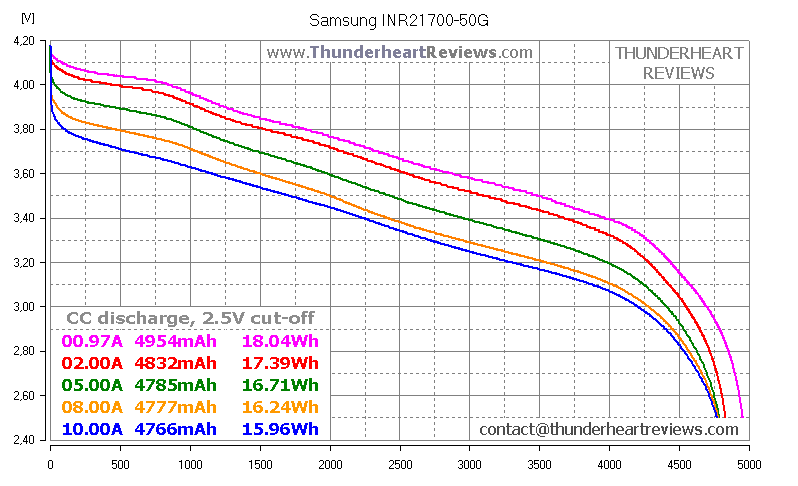
Here's test results of that particular cell compared to two other Samsung cells:
https://www.thunderheartreviews.com/2021/12/samsung-21700-50G-48G-50E-test-comparison.html
If you want to skip to the results... the cell Rivian uses is excellent!
Rivian did when I did my first mile. Because when they told me it was the 7777th, I was a smart ass and asked “What about the speaker?” “The speaker uses a different battery. The flash light uses the same one”Well to be fair, no one ever claimed the flashlight was the exact same type of cell as the main battery, just that it was the 7,777th one. Not that it really matters. Different use cases may call for different types of cells, don't know.