Megaman0025
Well-Known Member
Lotta negatives here. Any positives? Keeping the truck? Some of this stuff seems like we just need more Infrastructue and time, not a problem of the truck.I may post a separate trip report of my journey, but for now I'll limit this mostly to observations from along the way.
***********
Trip:
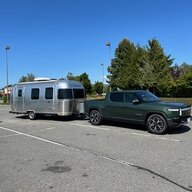
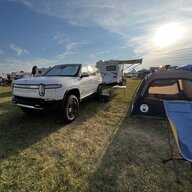
Drove from Bend, OR to San Diego (~1000 miles) over two days, then up to Temecula, CA where we stayed for about 10 days. While there we had a daily commute of 40-50 miles round trip, and often did that jaunt more than once a day. We also had a couple side trips to Newport and Irvine, down to San Diego again, and around the area we were staying. In all, I amassed about 1000 miles while in SoCal. I then did the ~1000 mile / 2-day trip back to Bend from Temecula.
I used Conserve mode whenever I was on the highway, whether a 10 mile run to town or long stretches of Interstate, and All Purpose mode otherwise. When in Conserve mode, I had ride height set to Low and in All Purpose set to Standard ... and regen was always set to High.
SitRep:
I was dependent on public charging 99% of the time, both on the road and while we were at our Airbnb. The rental property was located in a DCFC desert; Temecula / Murietta / Menifee have just three 350kW charge points (literally, and one didn't have a cable) with only a handful of 50kW stations spread about. I was always waiting for a charger, having to settle for slow "fast" chargers, settling for a 6kW L2 charger or having to be strategic about what time I tried to get on the 350s (which more than once I visited between midnight and 5am). Our rental didn't have EV charging capability, but I was able to sneak in a few 120V / 15A overnight charges in the garage for a few extra miles of range (couldn't reach the 14-30 or 14-50 plugs in the house).
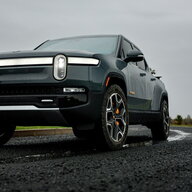
It's also worth noting the R1T replaced my Raptor, which has been my road warrior and adventure vehicle since 2018. I logged about 20k miles a year on road trips in that thing, and it was a mile-eating beast. Loved that truck for long-distance driving ... and so many of my observations below will be relative to the Raptor experience (covering this same route a couple times a year, in particular).
Observations ... covering the R1T specifically, DCFC and public charging, EV road tripping in general, etc:
1) R1T adaptive cruise is waaaaay too slow to accelerate back up to set speed when passing a vehicle that's triggered the system to slow down. If I came up on a vehicle going slower than my set speed, and ACC started to slow the R1T correspondingly, as I changed lanes to pass it took *forever* to build up momentum again. This is both dangerous -- trying to get over into the flow of traffic, only to be slowing anyone else coming up behind me as the R1T lags -- and annoying, as it kills travel momentum every time. In the Raptor, it would start to slow as it approached a slower vehicle, but as soon as I changed lanes (system detects clear path), it was on the throttle back to set speed. The Rivian is just too slow and required me to apply the throttle manually in those situations.
2) There's no "Resume" function for ACC. I played with all the ACC/Driver+ controls (stalk and steering wheel buttons) while on the trip and couldn't find anything that resumed a set speed. When I arrived to my hotel on the first day, I sifted through the owner's manual (pages 121-140) and don't see anything specifically noting "Resume". So after disengaging ACC for any reason, I'd need to return to my previous speed and set (engage) ACC again through the stalk. That seems silly.
3) ACC still gets "spooked", even after recent OTAs aimed at improving it. I had the system hard brake on me a few times, and it seemed to happen most when strong shadows crossed the road perpendicularly. Unsettling on the open road at speed ... and super dangerous on freeways in California, where traffic is often coming up on you at ridiculous speed (which could result in a rear-end collision).
4) ACC seems overly sensitive when cornering on curvy roads. I know Rivian's ACC/Driver+ uses "curb speed assist" to adjust vehicle speed when corning ... and I really like this feature (in general). I always wished the Raptor's ACC would slow it a bit during curves; instead it would go full beans into a corner without regard to speed (like a runaway train). That said, sometimes the R1T's CSA would brake really hard entering a corner on the interstate, almost like phantom braking, rather than gently backing off the throttle to ease momentum and flow through. In other words, it "overreacts". I do have regen set to High ... so maybe that's why it seems so aggressive?
5) Highway Assist (HWA) needs 'lane change' capability. This is well documented, but taking a long road trip you realize just how much it's needed. Between the aforementioned lag in resuming speed after being slowed and having to disable HWA to change lanes, then reenable, I found myself constantly interacting with ACC/Driver+ when it should be more seamless. HWA worked well overall, IMO, so long as you were in an open lane with no one ahead and stayed there for long distances. That scenario was rare on this trip, so ACC/Driver+ and HWA felt a bit crude (in need of refinement).
6) Buffeting in the R1T cabin when the windows are down is ridiculous. The effect can be partially offset by opening windows on both sides, but it sucks in general and is hard to find a comfortable set up if you only want windows down on one side (e.g., driver's window down). In the Raptor I could vent the sunroof or open the rear glass sliding window to offset the effect. I'm going to try some anti-buffeting products used on other cars to see if I can minimize it somehow.
7) Public charging stations/DCFCs lack travel conveniences like squeegees, trash bins and often restrooms. sucks when you're on a road trip. A few times I found myself stopping at a gas station -- on top of a charging stop! -- just to clean the windshield and throw trash away. (Note that most charging locations I visited had trash littering the site)
8) Public charging is a weird experience ... often wrought with strange behavior and lack of etiquette.
For example, stopping at a location where chargers are full and having to get out of your vehicle, look at each screen and see what everyone's SOC is. That feels odd enough, but then you have to strategize how you'll queue up to get the next available charge point. Then if another EV pulls up, wanting to do the same, you immediately feel defensive (combative) because there's no formal queuing process and depends on human nature to function smoothly. If there's anything we've learned about modern society ... people suck. More than once I had someone come to a location after me, then snake the first available spot before I could get positioned for it. That's bullshit, and I don't feel like having to be confrontational just to juice my vehicle.
Then there are the people who come up to you while charging, ask how long you'll be, and if you'd mind disconnecting so they can get some charge. What?!! Now, I understand if someone is at 85%+ SOC, charging at 12kWh, and you have 10% and need a charge; the former is poor etiquette and asking is warranted. But if I'm on a charger at 47% SOC and you ask me if I'd mind unplugging so you can charge ... that's going to come with a polite f*ck you. This honestly happened to me several times; not just someone asking how long I planned to charge (i.e., 75% or 100% or whatever), so they could gauge their wait time, but when I was under 60% SOC and someone asked me if I'd mind moving on so they could charge. Crazy.
Related to above, and probably the catalyst for such behavior, are the people charging to 100% when that might take an hour or more because they're already over 80% SOC. I don't know how many times I went to the 350kW station in Murietta and an Ioniq 5 was doing exactly this when I had 10% and really needed to connect. There seems to be a lack of education around battery tech, charging speeds, etc on top of etiquette (and modern societal "I'm the only one who matters" norms).
Charging in public locations late at night feels super vulnerable. Even when charge points are in well lit parking lots, like grocery stores or Walmarts, I felt uneasy about my vehicle being physically tethered to something and knowing I'd be there for 30+ minutes. You can't just jump in the car and drive off if someone sketchy approached; you're kinda trapped. And many public DCFCs are not well lit, with the only light coming from the charge point's illuminated signage. Public charging needs to become more like modern gas stations / convenience stores in this regard, with proper lighting and safety.
DCFCs in the part of Southern California I was at seem stupid expensive, and with limited to no choice (which of course drives some of the price gouging). A few times I had to pay a $2.99 session fee and $0.66/kW at a 50kWh EVGO charger. So a "slow" charger, with 1-hour max charge session, and stoopid rates. When comparing the calculatie the cost per mile for charging sessions at that location with my Raptor at 14.5 mpg and $4.50/gal fuel, it wasn't much different. I didn't buy a Rivian to save money on fuel ... bu that's not right, and does nothing to help EV adoption.
9) Rivian's estimated range math when route planning through in-vehicle NAV never adds up. This is a combination of a couple things: One is the guess-o-meter (GOM) in the driver's instrument screen, and how it only provides a theoretical range estimate based on SOC, tire/wheel package (20s, 21s, 22s) and drive mode (All Purpose, Conserv, etc). That's ... useless. Then there's the distance-to-destination and miles-remaining estimate when planning a route through the vehicle's NAV (route planner). This is often more *realistic*, but not really more accurate.
In a practical sense, subtracting the distance to a destination from the estimated range in the GOM should give you the estimated remaining range, right? That is never the case. Let's say the GOM says you have 260 miles of range, and your destination is 150 miles ... you should see 110 miles of estimated range remaining. Instead, it'll be like 50 miles. The math doesn't add up, because the GOM is theoretical and the route planning mileage is independent of that.
10) Estimated range remaining at destination is off by 20% or more. Building on above, I found the miles of range remaining estimate in the NAV route planner was off by 20% or more. In other words, if NAV said I'd have 113 miles left when I reached my destination, it would actually be more like 85 ... or worse. Several times it was really less than 50% of what it estimated I'd have (said I'd have 130 miles remaining and I had 60 when I arrived). This meant always factoring in much less range than I theoretically should have and my route planning, outside of the in-vehicle system, had to manually accommodate for the discrepancy.
It's worth noting I had a large cargo box on my roof, so my aero was affected and that had a negative impact on range. I also had probably 500-600 lbs of total payload (me, dogs, stuff). Over the 3000 miles I averaged 1.92 kWh ... not great. Having all-terrains mounted on the 22s also likely contributed to less range than if I had the stock PZero Sports on there. I generally drove about 5-7 over the posted limit on the 70 mph stretches, rarely going 80 mph or faster). With all of those caveats ... the 'estimated miles remaining' were never even close.
11) Many public charge points / DCFCs are *not* set up to accommodate large vehicles like the F150 Lightning, Hummer EV and future models like the Silverado and RAM Rev. I found the R1T a bit tight in many locations, with narrow lanes or awkwardly laid out charge stations, and couldn’t have imagined a full size truck in those situations.
12) Location-specific to Temecula / Murietta / Menifee, because that area is a DCFC desert, but I found myself *always* thinking about my SOC/range and how/when I'd charge. It was exhausting at times strategizing, trying to factor in a stop, stressing about how long the wait would be when I got to a charger, etc. I didn't enjoy that at all, and if my EV life was dependent on public charging like that ... I'd not own a Rivian (or any CCS EV).
These are all just things I recorded during the trip. I could bitch about public charging / DCFC infrastructure in general, but that's well documented. I could comment on the R1T's charging curve, but Kyle / Out of Spec and others have chronicled this many times. I could reiterate how much aero impacts range, but it kinda goes without saying with any EV.
Happy to answer any questions, from the trip in general or on observations above.
Sponsored