
Sponsored

Riviot
Well-Known Member
- Joined
- Mar 29, 2021
- Threads
- 121
- Messages
- 6,431
- Reaction score
- 10,807
- Location
- Kitsap, WA
- Vehicles
- R1T
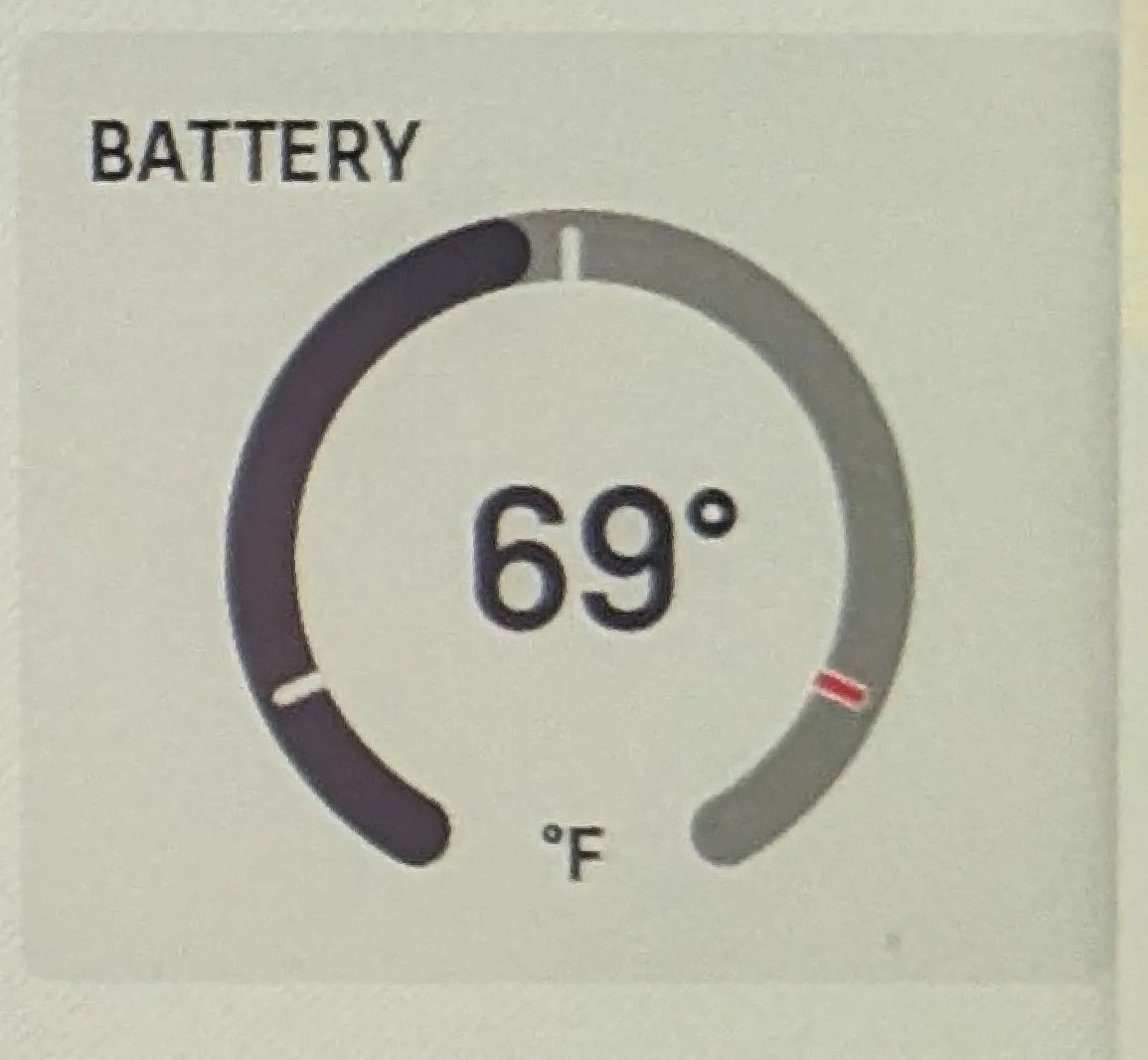
My battery never deviated from 69°F today. I think we know the ideal temp now...

R.I.P.
Well-Known Member
- First Name
- Sean
- Joined
- Jan 2, 2023
- Threads
- 13
- Messages
- 1,217
- Reaction score
- 1,681
- Location
- San Carlos, Mexico
- Vehicles
- Tesla Y, Cadillac ELR, Rivian R1T, Jeep TJ, F250
- Occupation
- Electrical Engineer
Maybe. Remember that the quad has larger motors in the back, while the enduro has lower gearing in the back... both designs giving a harder "shove" from the back given similar juice (at lower speeds). This means that if the telemetry is showing current (reasonable assumption), then it may use more _current_ going to the front to give similar torque front to rear.These were my thoughts as well. Was surprised how much of a bias there was for front in AP. Fun having the stats now.
Of course the reasons for front biased regen is obvious (weight transfer under braking).

Donald Stanfield
Well-Known Member
Everyone was doing that already. You can't throw a stone in this forum without hitting at least three engineers. Being curious and data focused are two traits that make engineers hugely successful. So its not surprising to me what goes on in here.Don't get me wrong, I love the new dashboard, but I bet some Rivian PM is watching this thread muttering "I told you so" ? It's just the right amount of information to get us all speculating and second guessing and correlating instead of just trusting the truck.
OTOH I am a people focused person. All this stuff is neat to me but I have no problem outsourcing the figuring stuff out to Rivian.
Sponsored
godfodder0901
Well-Known Member
- First Name
- Jared
- Joined
- Mar 12, 2019
- Threads
- 27
- Messages
- 5,749
- Reaction score
- 10,139
- Location
- Washington
- Vehicles
- 2022 Rivian R1T LE
The motors are identical in the Quad as well. The power difference comes from gearing too.Maybe. Remember that the quad has larger motors in the back, while the enduro has lower gearing in the back... both designs giving a harder "shove" from the back given similar juice (at lower speeds). This means that if the telemetry is showing current (reasonable assumption), then it may use more _current_ going to the front to give similar torque front to rear.
Of course the reasons for front biased regen is obvious (weight transfer under braking).
R.I.P.
Well-Known Member
- First Name
- Sean
- Joined
- Jan 2, 2023
- Threads
- 13
- Messages
- 1,217
- Reaction score
- 1,681
- Location
- San Carlos, Mexico
- Vehicles
- Tesla Y, Cadillac ELR, Rivian R1T, Jeep TJ, F250
- Occupation
- Electrical Engineer
That is how I understood it as well, but there have been some recent reports that the motors are actually larger:The motors are identical in the Quad as well. The power difference comes from gearing too.
" Quad-motor vehicles fit larger, more powerful motors at the rear with equivalent gearing front and rear. Dual Motor models flip that script with equivalent motors and lopsided gearing: 11.04:1 front, 13.70:1 rear. " (Motortrend, Aug 2023)
I am inclined to agree with you, the motors are the same, the gearing is different... MT may be in error.
godfodder0901
Well-Known Member
- First Name
- Jared
- Joined
- Mar 12, 2019
- Threads
- 27
- Messages
- 5,749
- Reaction score
- 10,139
- Location
- Washington
- Vehicles
- 2022 Rivian R1T LE
This wouldn't be the first time. The Sandy Munro video with RJ covers this specific question, though.That is how I understood it as well, but there have been some recent reports that the motors are actually larger:
" Quad-motor vehicles fit larger, more powerful motors at the rear with equivalent gearing front and rear. Dual Motor models flip that script with equivalent motors and lopsided gearing: 11.04:1 front, 13.70:1 rear. " (Motortrend, Aug 2023)
I am inclined to agree with you, the motors are the same, the gearing is different... MT may be in error.
Dark-Fx
Well-Known Member
Stator/rotor in the quad is actually larger in the back but they are geared identically. The rear motors are technically capable of higher power but, in practice, they still max out at the same amount. It could be they can tolerate higher current for longer due to the increased size, but we haven't had hard data on how Rivian is doing the control or temperatures until the gauge screen came in to play.That is how I understood it as well, but there have been some recent reports that the motors are actually larger:
" Quad-motor vehicles fit larger, more powerful motors at the rear with equivalent gearing front and rear. Dual Motor models flip that script with equivalent motors and lopsided gearing: 11.04:1 front, 13.70:1 rear. " (Motortrend, Aug 2023)
I am inclined to agree with you, the motors are the same, the gearing is different... MT may be in error.
godfodder0901
Well-Known Member
- First Name
- Jared
- Joined
- Mar 12, 2019
- Threads
- 27
- Messages
- 5,749
- Reaction score
- 10,139
- Location
- Washington
- Vehicles
- 2022 Rivian R1T LE
This directly contradicts what RJ said when he was asked about the differences in power and torque front to back: "slightly different gearing in the back":Stator/rotor in the quad is actually larger in the back but they are geared identically. The rear motors are technically capable of higher power but, in practice, they still max out at the same amount. It could be they can tolerate higher current for longer due to the increased size, but we haven't had hard data on how Rivian is doing the control or temperatures until the gauge screen came in to play.
Sandy and Rivian CEO RJ Scaringe talk about the R1T. - YouTube @ 12:34
Sponsored
Dark-Fx
Well-Known Member
I remember watching this and thinking the same thing, but their EPA certification documentation says they are the same ratio. I've chalked it up to RJ's mind likely being on their future enduro product which was probably still in early engineering validation at the time of this filming.This directly contradicts what RJ said when he was asked about the differences in power and torque front to back: "slightly different gearing in the back":
Sandy and Rivian CEO RJ Scaringe talk about the R1T. - YouTube @ 12:34

Rivifan
Well-Known Member
- First Name
- Chuck
- Joined
- Jun 13, 2023
- Threads
- 3
- Messages
- 53
- Reaction score
- 73
- Location
- Chicagoland
- Vehicles
- R1T, Infiniti QX60
- Occupation
- IT Solution Architect
Flatlander here, FWIW- Ive noticed all four motors mostly equal on acceleration, but will now pay more attention just in case. And I too noticed the front heavy regen, but I chalked that up to physics, figured its just like how front brakes do ~80% of the braking generally.Similarly, was surprised at how front-biased the motors are on acceleration and how little regen they attempt to pull from the rear motors.
BrentInCO
Well-Known Member
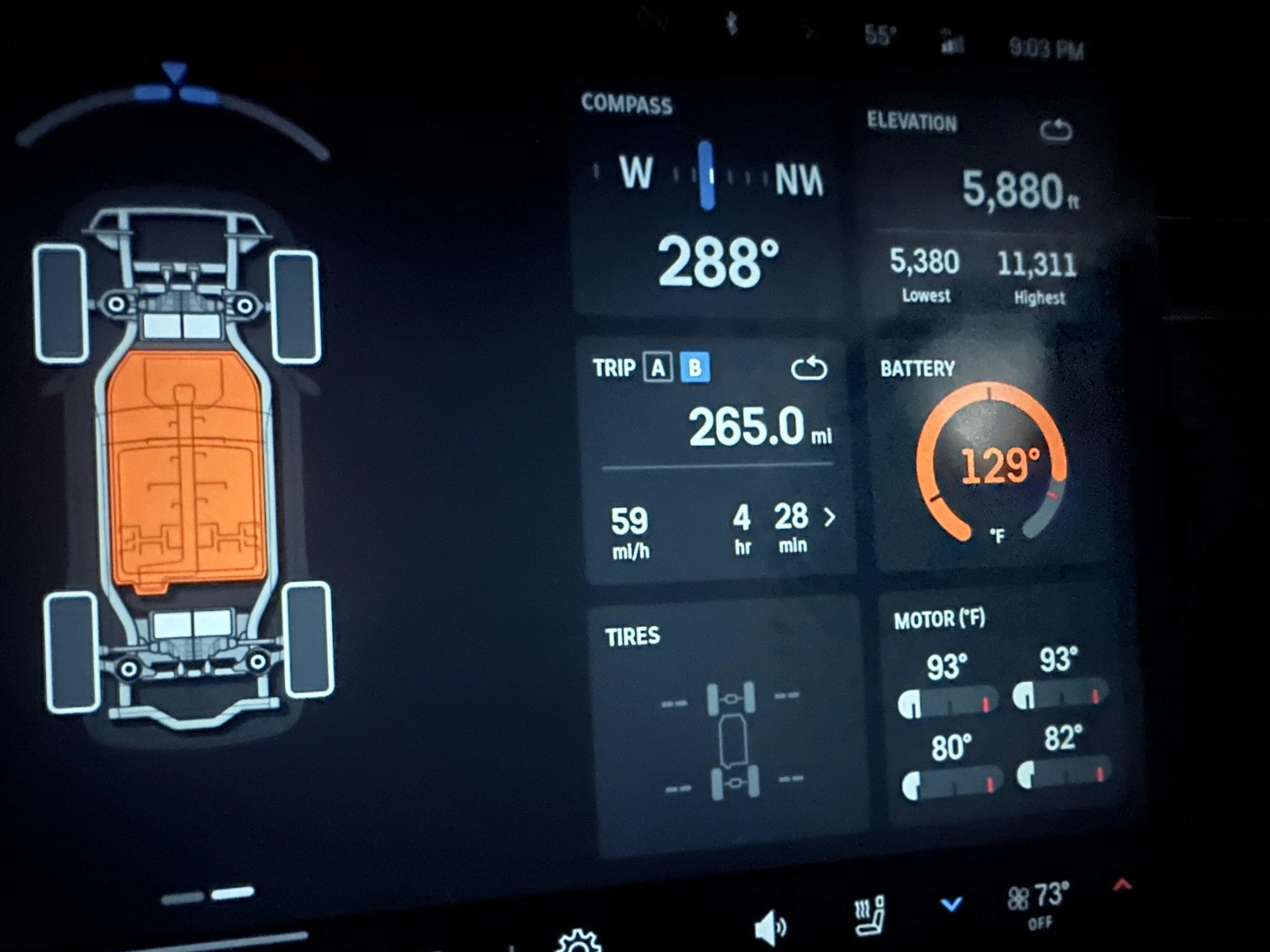
The Rivian fast charger stopped charging my car a little before 80% because the battery temperature was too hot at 130 degrees.
I had driven 4 & 1/2 hours non stop (other than construction delays) in Conserve mode 265 miles, arrived at the charger with 30 miles of range left (10%). This was on October 21, shortly after the software upgrade came available, so I have no basis for comparison on monitoring battery temp, but I’ve done this same drive over 20x without this issue, in much colder and much warmer ambient temperatures. There’s at least 30 minutes of downhill cruising before arriving at this RAN charger. Vehicle had probably been charging for 40 minutes to an hour at this point. I drove away and it’s temperature dropped quickly.

I had driven 4 & 1/2 hours non stop (other than construction delays) in Conserve mode 265 miles, arrived at the charger with 30 miles of range left (10%). This was on October 21, shortly after the software upgrade came available, so I have no basis for comparison on monitoring battery temp, but I’ve done this same drive over 20x without this issue, in much colder and much warmer ambient temperatures. There’s at least 30 minutes of downhill cruising before arriving at this RAN charger. Vehicle had probably been charging for 40 minutes to an hour at this point. I drove away and it’s temperature dropped quickly.
Last edited:
Dark-Fx
Well-Known Member
I take it you didn't get your Rivian home before Midnight and it turned into a pumpkin?The Rivian fast charger stopped charging my car a little before 80% because the battery temperature was too hot at 130 degrees.
I had driven 4 & 1/2 hours non stop (other than construction delays) in Conserve mode 265 miles, arrived at the charger with 30 miles of range left (10%). This was on October 21, shortly after the software upgrade came available, so I have no basis for comparison on monitoring battery temp, but I’ve done this same drive over 20x without this issue, in much colder and much warmer ambient temperatures.
Rivifan
Well-Known Member
- First Name
- Chuck
- Joined
- Jun 13, 2023
- Threads
- 3
- Messages
- 53
- Reaction score
- 73
- Location
- Chicagoland
- Vehicles
- R1T, Infiniti QX60
- Occupation
- IT Solution Architect
@zefram47 Sure enough, looked again, and yep my fronts are more engaged on initial acceleration, then they level out. I must not have looked down soon enough, it only takes a couple seconds to get up to the speed limit from a stopFlatlander here, FWIW- Ive noticed all four motors mostly equal on acceleration, but will now pay more attention just in case. And I too noticed the front heavy regen, but I chalked that up to physics, figured its just like how front brakes do ~80% of the braking generally.

Sponsored
Similar threads

- Replies
- 5
- Views
- 575


- Replies
- 19
- Views
- 3,522

- Replies
- 49
- Views
- 6,997

- Replies
- 33
- Views
- 3,287
