
kong
Well-Known Member
Local wheel repair and tire specialist known as the “wheel doctor”, who is also a certified tirerack installer.who did you get to install them?
Sponsored
Local wheel repair and tire specialist known as the “wheel doctor”, who is also a certified tirerack installer.who did you get to install them?

My setup exactly. Hakka LT3 in winter on my 20's and the Michelins on my 22. I didn't want the OEM rubber to wear so quick, but happier I now have shoes that work for me!I went with the 22 with a 119 load rating as well. Great tires I run them on my lightning too. For winter I run 20 with Nokian snow tires they are like glue.

I too have a 20” set for Winter” and off road and put the Defender LTX M/S2 on my 22”. They are noticeably better handling and more stable. I only have about 200 miles on them but will get about 450 more tomorrow up to Douglas, WY and back.My setup exactly. Hakka LT3 in winter on my 20's and the Michelins on my 22. I didn't want the OEM rubber to wear so quick, but happier I now have shoes that work for me!
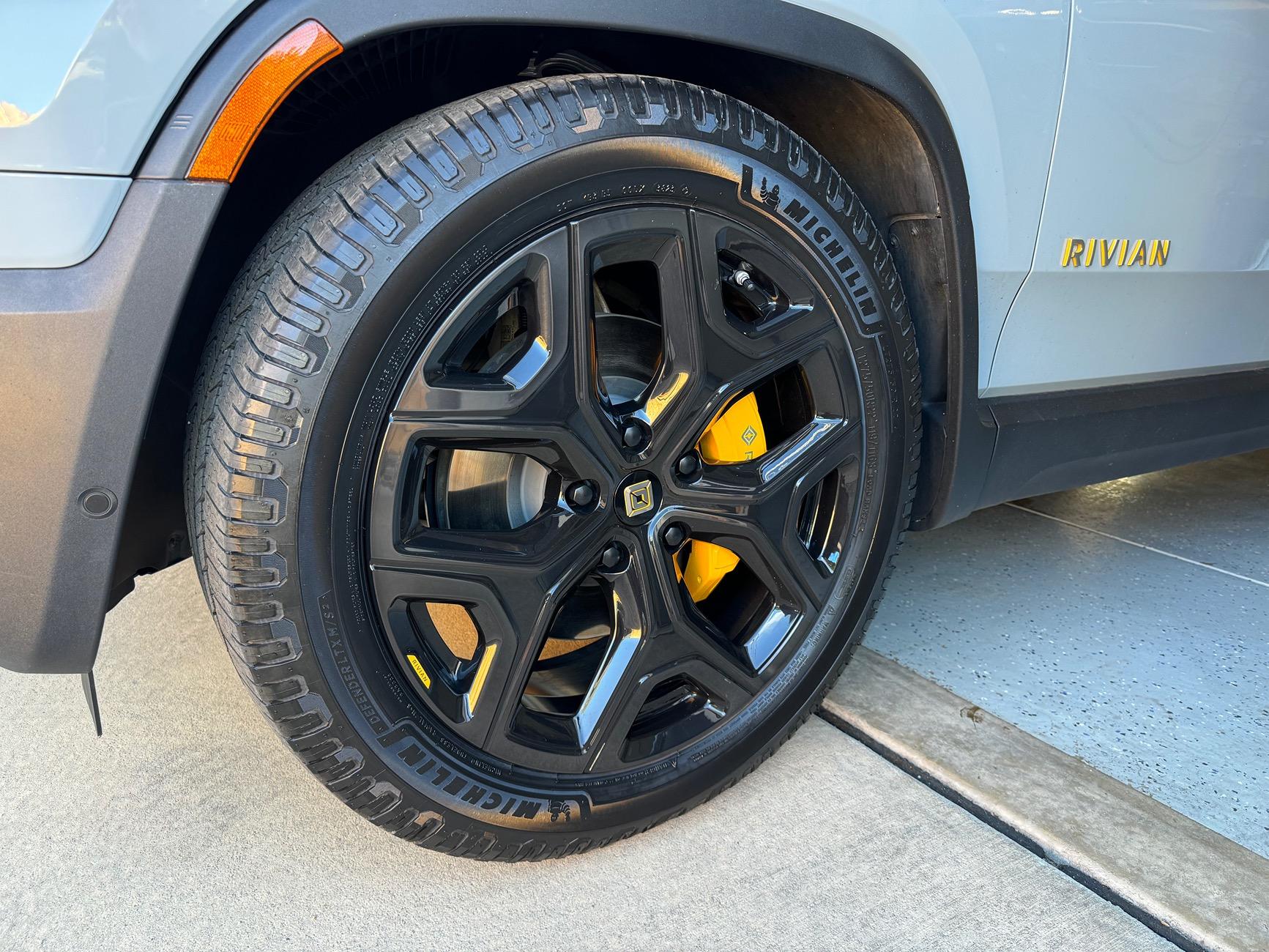
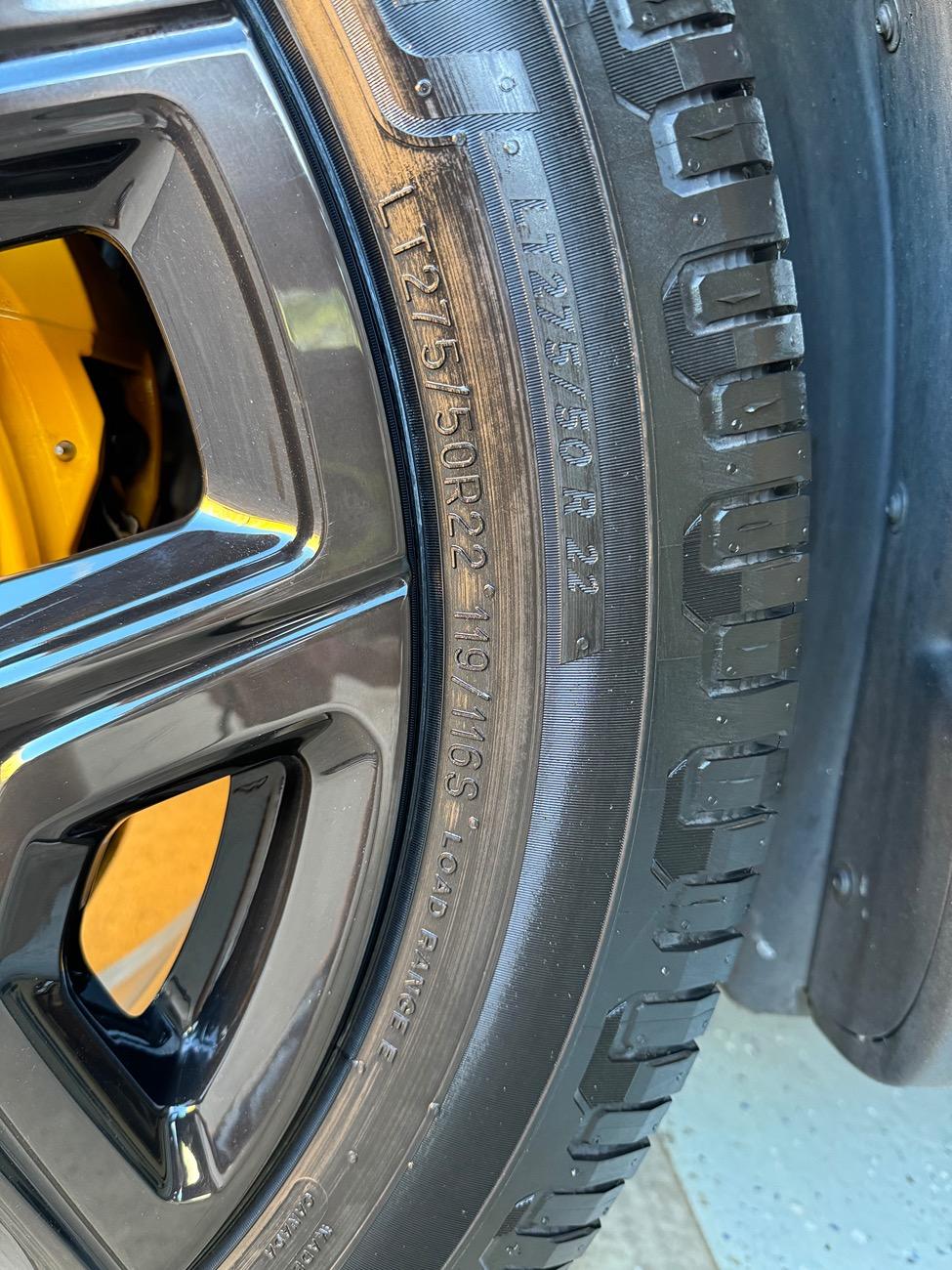

Any chance you could expand on this or point me at the source? I did a bunch of research before choosing my tire and I'll admit my naivety on this, but I didn't ever come across the inflation pressure as being a defining factor. You've given me pause to rethink this, however, I'm installed so unlikely to change, and just want to better educate myself.One concern I have for the 22” defenders in the 119S load rating is that it is an E load rated tire. That means the load rating is achieved at 80psi not 50psi (the rivian stock pressure). At 50psi, an e load rated tire can carry just 2300 lbs not the ~2600-2700 that a 116 load rated tire can carry at 50psi. Which means to carry 2600 lbs safely an E load tire must be inflated to a higher pressure. If Rivian owners run 50psi on the E load tires they might actually be under inflated for the load needed.
There is no straightforward reference. I just noticed that the load rating for an "E" load tire is at 80psi and not 50psi as it would be for an XL load tire.Any chance you could expand on this or point me at the source? I did a bunch of research before choosing my tire and I'll admit my naivety on this, but I didn't ever come across the inflation pressure as being a defining factor. You've given me pause to rethink this, however, I'm installed so unlikely to change, and just want to better educate myself.
One other question - the other thing I liked about the 119 was the extra ply on the sidewall for off-roading. I'm wagering that factor stands irrespective of inflation pressures?
Appreciate your insights on this.
I have done the math before presuming it's linear, but if you look at the tables, it's not quite linear. But I think if you assume linear that you'll be okay, as it'll have a higher load rating than calculated. If I recall correctly, the calculated PSI was around 60PSI, similar to what you showed here.There is no straightforward reference. I just noticed that the load rating for an "E" load tire is at 80psi and not 50psi as it would be for an XL load tire.
https://rvsafety.com/images/pdf/michelinloadandinflationrvtruck.pdf
This link does list some recommended inflation pressures for other Michelin RV and commercial truck tires. If you check one with a similar 3000lb per tire load rating, you will find that 50psi seems too low to support what a 116 load rating (~2750 lbs) would support at 50psi. The guide suggests you may need 65-70psi to support the same weight. However, I am aware these are not the same tires at all, just similar load ratings and 10 ply construction.
Thank you for the answer. I hope those who choose the "LT-metric" E load rating 10 ply Michelin offering will go with these inflation pressures instead of assuming the factory 50psi is sufficient. I actually emailed Michelin directly. Will post the reply if I hear back.I have done the math before presuming it's linear, but if you look at the tables, it's not quite linear. But I think if you assume linear that you'll be okay, as it'll have a higher load rating than calculated. If I recall correctly, the calculated PSI was around 60PSI, similar to what you showed here.
Wow ... sincerely appreciate you clarifying that. I have never varied from vehicle manufacturer recommended PSI levels on any vehicle irrespective of whatever tire I've put on the vehicle.Here's the official reply from Michelin regarding the LT sized "119S" load rating Defender MS2.
Hello Eric,
Case #04541069:
Thanks for contacting the Michelin Consumer Care Team.
We have to make a calculation when upsizing from a tire with an E-Metric (SL or XL) sizing format to a tire with an LT-Metric sizing format. According to our calculations, you would inflate the Defender LTX M/S2 LT275/50R22/E M + S 119/116S MSPN 15284 to 65 PSI. As always, we recommend that you confirm this with an authorized Michelin dealer. You can find an authorized dealer using our Dealer Locator.
This inflation pressure recommendation should be maintained throughout the year. Tires should be checked, once a month, when they are cold – at least three hours after the vehicle has been stopped and before it is driven one mile or two kilometers. Do not reduce pressure when tires are hot and use an accurate air pressure gauge to check pressure.
The Max PSI listed on your tire represents its maximum safe inflation pressure. It is not an inflation pressure recommendation. NEVER inflate your tires to this pressure unless you have been instructed to do so by us, your vehicle manufacturer or by an authorized Michelin dealer.
We hope this issue has been addressed to your satisfaction. If we can assist you further, please respond to this email, click here to chat, or call us at 866-866-6605 8am-7pm EST Mon-Fri, and 9am-1pm EST Sat.
We appreciate your business and thank you for choosing Michelin.
Sincerely,
Ian
Consumer Care Department
Certified Michelin Product Expert
The caveat with you running 50psi is that it will cover a load rating of (I'm guessing here based on those RV charts) of about 2300lbs per tire, which is fine, since the vehicle is 7000lbs unloaded and the max payload is around 1500lbs. So you will be well within the weight capacity at that psi. The stock tires max out at 50 or 51psi, and Rivian recommends 48psi, which puts them near their max weight capacity. So running an E load tire at 50psi probably can carry less weight (or safety margin) than an XL load tire at 48psi (pretty near its max weight capacity). Probably safe either way but you now have the official Michelin recommendation.Wow ... sincerely appreciate you clarifying that. I have never varied from vehicle manufacturer recommended PSI levels on any vehicle irrespective of whatever tire I've put on the vehicle.
For the R1T at 50PSI I think the suspension is working overtime ... at 65PSI not sure I even want to try it ... but the advice from Michelin is pretty clear, if you run the Defender LTX M/S2 LT 275/50 R22 119S E1 (which is the exact specification I purchased), they're saying I'm supposed to run 65 ...
I think there's a little bit of vagueness in the language on the second paragraph where they talk about the "safe inflation pressure" and the fact that it's not an "inflation pressure recommendation" ... I'm going to read that as (probably) deferring to either the vehicle or tire manufacturers recommendation.
I think I'm still going to run 50PSI (I always run 1 or 2 above) ... but if I start towing, I'll probably lift it to the 65PSI.
Sincerely appreciate you digging into this!

XL rating maxes out at 42 psi. Anything above that doesn't increase the capacity.The caveat with you running 50psi is that it will cover a load rating of (I'm guessing here based on those RV charts) of about 2300lbs per tire, which is fine, since the vehicle is 7000lbs unloaded and the max payload is around 1500lbs. So you will be well within the weight capacity at that psi. The stock tires max out at 50 or 51psi, and Rivian recommends 48psi, which puts them near their max weight capacity. So running an E load tire at 50psi probably can carry less weight (or safety margin) than an XL load tire at 48psi (pretty near its max weight capacity). Probably safe either way but you now have the official Michelin recommendation.
The max safe tire pressure of any particular tire is just how high of pressure that can be run on a tire. But the load rating maxes out at the max load tire pressure. For SL that's 35/36 PSI, for XL that's 41/42 PSI and for E that's 80 PSI. SL and XL tires can have a max safe pressure of like 50 or 51 PSI, but going above the max load isn't required for load rating safety purposes. But, it might be required for handling safety or other reasons.I think there's a little bit of vagueness in the language on the second paragraph where they talk about the "safe inflation pressure" and the fact that it's not an "inflation pressure recommendation" ... I'm going to read that as (probably) deferring to either the vehicle or tire manufacturers recommendation.


