Sponsored

Charging at home in Phoenix - I'm seeing a lot of auxiliary power used during charging

TM1

Well-Known Member
First Name
Tom
Joined
Jun 22, 2023
Threads
6
Messages
67
Reaction score
36
Location
Gilbert
Vehicles
R1S
Occupation
Scientist
Just wondering if this is normal. Garage is about 100 F. I try to do this at 5 am when temperatures are mildest.
Example:
12.5 kWh used to give 10.0 kWh to the battery and 2.5 kWh for ??

I can only assume ?? = cooling power.

Is this normal or should I have the service people take a look.
Climate is off.
Charging at 240 V, 30 A.
Sponsored

 

Polar

Well-Known Member
First Name
Scott
Joined
Feb 16, 2022
Threads
33
Messages
1,098
Reaction score
2,039
Location
WA
Vehicles
C40, LE CY R1S
Occupation
IT
Clubs
 
The Rivian will now tell you what power goes where when you’re charging it through the energy display.

It will show battery, vehicle, and conditioning usage independently.

At that temperature, it is not unlikely that the vehicle would run AC to keep the battery cool.
 
OP
OP

TM1

Well-Known Member
First Name
Tom
Joined
Jun 22, 2023
Threads
6
Messages
67
Reaction score
36
Location
Gilbert
Vehicles
R1S
Occupation
Scientist
Looking for other 100+ degree areas to see if they are getting that much sucked away too.
 

PaythePiper

Banned
Well-Known Member
Joined
Sep 2, 2024
Threads
5
Messages
587
Reaction score
697
Location
Phx AZ
Vehicles
Model Y, R1S Dual Max
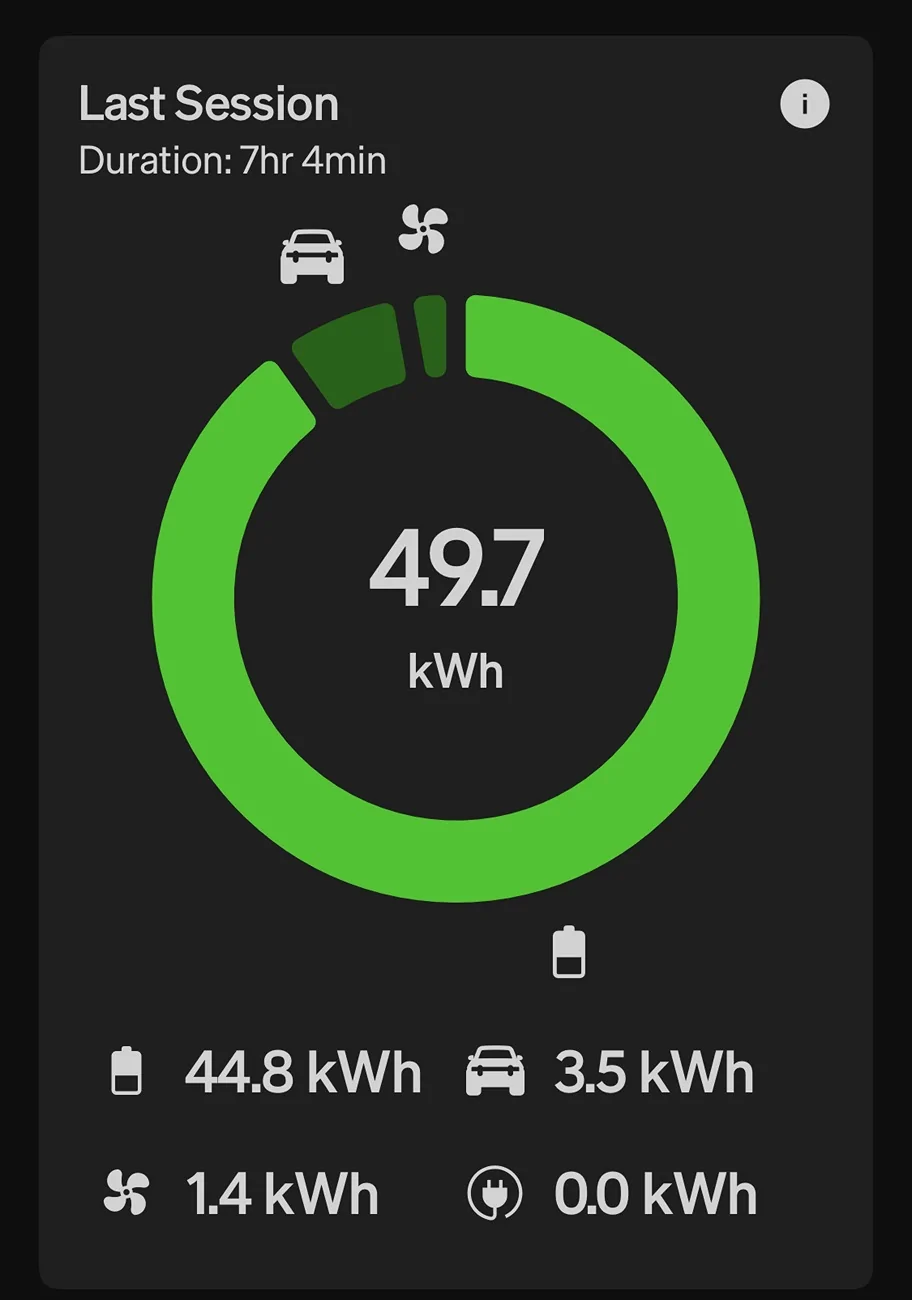
Fellow AZ resident here. About 100 degree garage as well. Here’s last nights charge from the app
Rivian R1T R1S Charging at home in Phoenix - I'm seeing a lot of auxiliary power used during charging IMG_3533
 
OP
OP

TM1

Well-Known Member
First Name
Tom
Joined
Jun 22, 2023
Threads
6
Messages
67
Reaction score
36
Location
Gilbert
Vehicles
R1S
Occupation
Scientist
Fellow AZ resident here. About 100 degree garage as well. Here’s last nights charge from the app
IMG_3533.jpeg
10% roughly - looks similar. I wonder what is consumed by the car symbol. I also wonder what the fan means - AC + fan cooling or just fan cooling?
In either case, I'm not alone sadly.

I notice you have a model Y too. Having a model Y spoils us software wise, but that is a topic for another thread. It is obvious to anyone with a Tesla and an R1S, so bringing it up for discussion is a waste of time.

Thanks for the confirmation on the energy use.
Tom
 

Sponsored

VSG

Well-Known Member
Joined
Oct 3, 2022
Threads
4
Messages
3,209
Reaction score
6,006
Location
WA
Vehicles
R1T LE/RB/OC/20
Charging at 240 V, 30 A.
Charging incurs a certain overhead energy cost. So the percentage of energy that goes into the battery vs. being used on overhead will be greater at lower charging rates.

I assume you mean you're on a 30A circuit, which means you are only sending 24A to the vehicle. That's 1/2 of what the vehicle can accept, so your overhead is going to be a correspondingly higher percentage of your energy use.

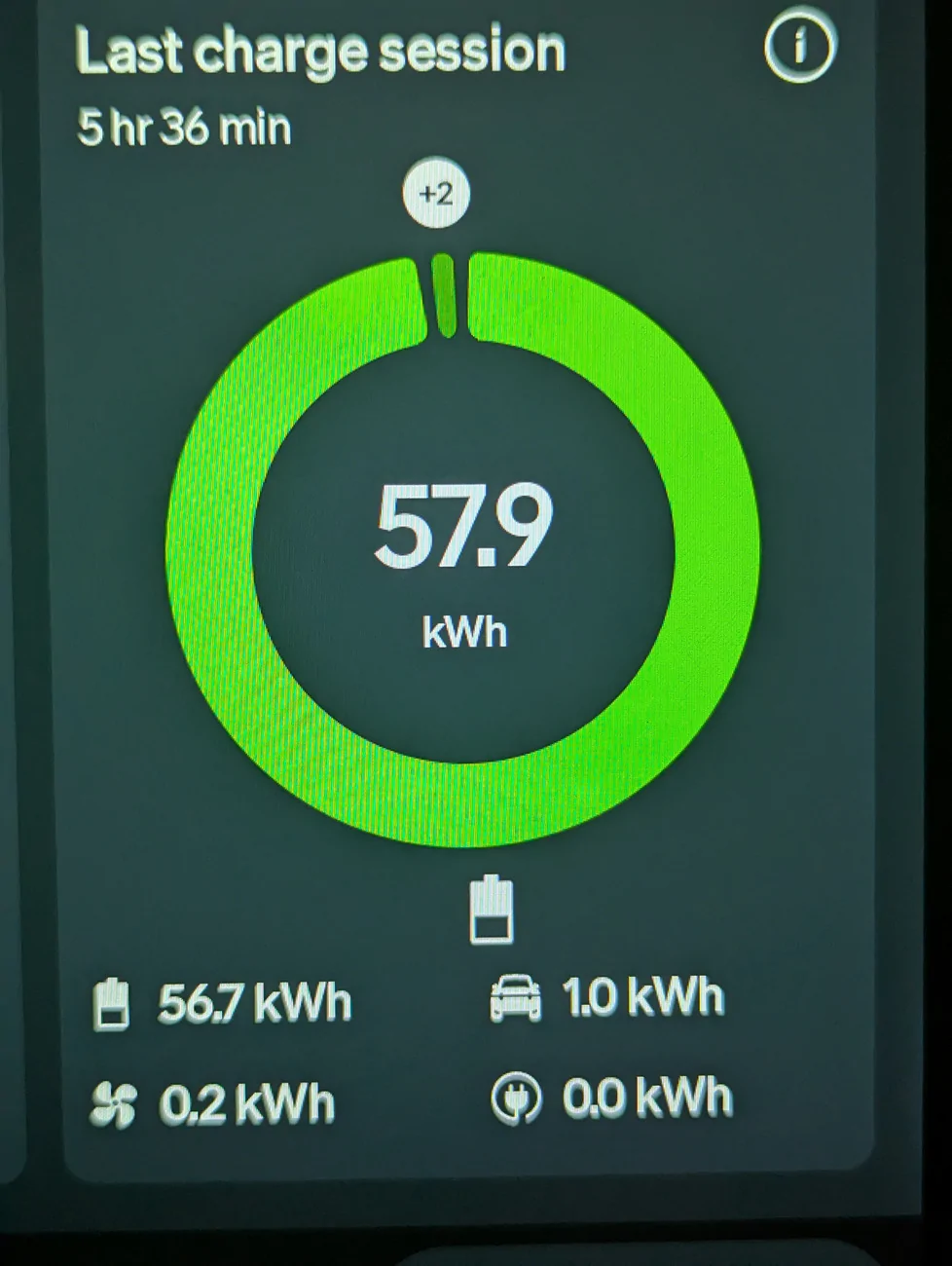
Here's an image from my last charging session a few days ago. I charge at home on a 60A circuit - 240V at 48A. This is not at 100 degrees - probably more like 75 degrees.

I can only assume ?? = cooling power.
No need to guess or speculate. Select the information button (the lower case i in the circle) and it will tell you exactly what the all the icons mean.
Rivian R1T R1S Charging at home in Phoenix - I'm seeing a lot of auxiliary power used during charging PXL_20250818_191459225
 

PaythePiper

Banned
Well-Known Member
Joined
Sep 2, 2024
Threads
5
Messages
587
Reaction score
697
Location
Phx AZ
Vehicles
Model Y, R1S Dual Max
10% roughly - looks similar. I wonder what is consumed by the car symbol. I also wonder what the fan means - AC + fan cooling or just fan cooling?
In either case, I'm not alone sadly.

I notice you have a model Y too. Having a model Y spoils us software wise, but that is a topic for another thread. It is obvious to anyone with a Tesla and an R1S, so bringing it up for discussion is a waste of time.

Thanks for the confirmation on the energy use.
Tom
Yeah thermals suck on these Rivians. Just a fact of life. Tesla spoils us in ways non Tesla owners don’t realize lol
 
OP
OP

TM1

Well-Known Member
First Name
Tom
Joined
Jun 22, 2023
Threads
6
Messages
67
Reaction score
36
Location
Gilbert
Vehicles
R1S
Occupation
Scientist
Charging incurs a certain overhead energy cost. So the percentage of energy that goes into the battery vs. being used on overhead will be greater at lower charging rates.

I assume you mean you're on a 30A circuit, which means you are only sending 24A to the vehicle. That's 1/2 of what the vehicle can accept, so your overhead is going to be a correspondingly higher percentage of your energy use.

Here's an image from my last charging session a few days ago. I charge at home on a 60A circuit - 240V at 48A. This is not at 100 degrees - probably more like 75 degrees.


No need to guess or speculate. Select the information button (the lower case i in the circle) and it will tell you exactly what the all the icons mean.
PXL_20250818_191459225.jpg
Good to know about the info on the icons. When I say 30 A, I mean that is what I set the current draw in the schedule portion. My circuit breaker is 50 A.
 

VSG

Well-Known Member
Joined
Oct 3, 2022
Threads
4
Messages
3,209
Reaction score
6,006
Location
WA
Vehicles
R1T LE/RB/OC/20
When I say 30 A, I mean that is what I set the current draw in the schedule portion. My circuit breaker is 50 A.
OK. But that just alters the numbers a bit; instead of charging at half the max L2 rate you're charging at 30/48 = 62.5% of the maximum rate. The logic remains the same - at 62.5% of the current it takes 60% longer to charge compared to 48A, so you are using the fixed overhead energy draw for 60% longer, while in the end still delivering the same amount of energy to the battery.

I mention this only because when trying to determine if the non-battery energy usage is "high", you need to be aware that what's normal depends not just on the temperature but also on the charging current and voltage. If you're 60% higher than others who have a more typical 48A charge current, then that's expected. If you're 200% higher, then that's not normal.

My data point is not at 100 degrees, so it is of limited use except to show that charging sessions don't necessarily consume a lot of energy other than what goes into the battery.

As others have said, it wouldn't surprise me to find out that the battery cooling turns on in your conditions, which could increase your energy usage significantly. Even charging when it's 75 degrees outside the inside of my R1T gets warm when L2 charging.
 
OP
OP

TM1

Well-Known Member
First Name
Tom
Joined
Jun 22, 2023
Threads
6
Messages
67
Reaction score
36
Location
Gilbert
Vehicles
R1S
Occupation
Scientist
OK. But that just alters the numbers a bit; instead of charging at half the max L2 rate you're charging at 30/48 = 62.5% of the maximum rate. The logic remains the same - at 62.5% of the current it takes 60% longer to charge compared to 48A, so you are using the fixed overhead energy draw for 60% longer, while in the end still delivering the same amount of energy to the battery.

I mention this only because when trying to determine if the non-battery energy usage is "high", you need to be aware that what's normal depends not just on the temperature but also on the charging current and voltage. If you're 60% higher than others who have a more typical 48A charge current, then that's expected. If you're 200% higher, then that's not normal.

My data point is not at 100 degrees, so it is of limited use except to show that charging sessions don't necessarily consume a lot of energy other than what goes into the battery.

As others have said, it wouldn't surprise me to find out that the battery cooling turns on in your conditions, which could increase your energy usage significantly. Even charging when it's 75 degrees outside the inside of my R1T gets warm when L2 charging.
You are getting 1 kWh for your session. I'm getting 2.5 kWh for a 3 hours session. Are you sure that number doesn't scale? The more current I use, the more heat I generate. I'm not so sure 48 A would be good for the car with a 100 ambient environment. If in fact it doesn't scale, then sure, but I think it is going to scale.
 

Sponsored

azbill

Well-Known Member
First Name
Bill
Joined
Jun 8, 2020
Threads
17
Messages
1,695
Reaction score
1,976
Location
Arizona
Vehicles
Escalade IQ, Mach E, Hummer EV SUT
Occupation
Retired
I live in Phoenix and all 3 of my EVs run the HVAC a lot while charging, but they typically cycle on and off during each session. My Hummer has a real-time readout of the power used, and while parked with the vehicle on it is always using at least 2kw of power in hot weather. So that is the combination of accessories (with everything on in the vehicle) and conditioning (battery, motors and cabin). Your consumption of 5kwh in 7 hours is less than that, and seems reasonable. The cabin conditioning is off during charging and not all of the computers are powered up either, so you are using less than 1kw per hour.
 
  • Like
Reactions: TM1
OP
OP

TM1

Well-Known Member
First Name
Tom
Joined
Jun 22, 2023
Threads
6
Messages
67
Reaction score
36
Location
Gilbert
Vehicles
R1S
Occupation
Scientist
I live in Phoenix and all 3 of my EVs run the HVAC a lot while charging, but they typically cycle on and off during each session. My Hummer has a real-time readout of the power used, and while parked with the vehicle on it is always using at least 2kw of power in hot weather. So that is the combination of accessories (with everything on in the vehicle) and conditioning (battery, motors and cabin). Your consumption of 5kwh in 7 hours is less than that, and seems reasonable. The cabin conditioning is off during charging and not all of the computers are powered up either, so you are using less than 1kw per hour.
It was losing a lot of range sitting in the garage doing nothing. I had a hip replacement 3 wks ago and hadn't driven it since maybe 4 weeks ago. I think about 4 kWh per day. These were days when we had several days in the 115 range. The model Y didn't seem to mind the heat as much.
 

JacobAZ

Well-Known Member
Joined
May 13, 2025
Threads
1
Messages
94
Reaction score
103
Location
Heber, AZ
Vehicles
2025 R1T dual large
Sounds normal. I have a house in Phoenix. At 100 degrees in the garage R1 uses a lot of energy for cooling and its LOUD (garage makes seem even louder since sound is contained. There is a big difference between cooling energy when temps are low 90's verses 100. To address the issue, I insulated my garage door. It keeps the peak temp down a little, but unfortunately, at night the garage cools more slowly. So, in the morning I open the garage door and man door to let heat out and hopefully get temp in low 90's, then start charging. In a prior house I added an exhaust fan to the garage to help it cool at night. Summer heat is a challenge.
 
  • Like
Reactions: TM1

BigSkies

Well-Known Member
First Name
Brian
Joined
Sep 4, 2021
Threads
17
Messages
1,233
Reaction score
2,651
Location
Denver
Vehicles
R1T, Model Y
Clubs
 
Not abnormal. As others have mentioned, charging at a higher amperage should reduce it a bit, but I don't know how measurable it would be. All the computers and electronics that power on while charging will just be running for a shorter period of time.

Actually, I'd be curious to know the numbers if you give it a try.

There's also some energy lost to heat with the inverter. I've heard ~10% quoted. I don't know if the Rivian is measuring energy in at the plug or after the inverter though.
 

KootenayEV

Well-Known Member
First Name
Andrew
Joined
Sep 22, 2021
Threads
28
Messages
614
Reaction score
589
Location
Nelson, BC
Vehicles
R1T, Tesla Model 3
Occupation
Environmental Engineer
Until there is a battery chemistry that is more tolerant of your ambient temps in Phoenix you are probably stuck with higher energy use to keep the battery temp down on almost any EV.
Sponsored


Top