Sponsored

Rivian R1T / R1S Endurance During Winter Emergencies

AdamsFan1983

Well-Known Member
First Name
Silence Dogood
Joined
Jun 22, 2021
Threads
73
Messages
1,063
Reaction score
3,821
Location
Pennsylvania
Vehicles
Rivian R1T LE in GW
Occupation
Public Relations
Good afternoon all:

Thought it might be a good idea to start a thread on how the Rivian R1 platform, and indeed, EV's in general handle long-term emergent situations during winter travel. More specifically, will an EV/R1T outlast an ICE vehicle when trapped/stranded on a highway during a winter storm.

I can't imagine it would be efficient to idle an ICE vehicle for hours to stay warm, but I don't believe I've seen any longevity estimates re: Rivian to know how big a draw cabin temperature and entertainment can be in these situations.

https://www.huffpost.com/entry/driv...-traffic-overnight_n_61d44c10e4b0c7d8b8a80706
Sponsored
 

kylealden

Well-Known Member
First Name
Kyle
Joined
Feb 25, 2021
Threads
20
Messages
1,458
Reaction score
4,461
Location
Seattle
Vehicles
2022 Rivian R1T LE (QM/L), 2024 Zero DSR/X
Occupation
Product Management
Good afternoon all:

Thought it might be a good idea to start a thread on how the Rivian R1 platform, and indeed, EV's in general handle long-term emergent situations during winter travel. More specifically, will an EV/R1T outlast an ICE vehicle when trapped/stranded on a highway during a winter storm.

I can't imagine it would be efficient to idle an ICE vehicle for hours to stay warm, but I don't believe I've seen any longevity estimates re: Rivian to know how big a draw cabin temperature and entertainment can be in these situations.

https://www.huffpost.com/entry/driv...-traffic-overnight_n_61d44c10e4b0c7d8b8a80706
I'm not sure if Rivian has published the heater specs for the R1T, but it should be comparable to an older Tesla's resistive heater; I believe the Model 3 was around 4kW.

So assuming peak draw (you're blasting heat on HI for cabin/battery conditioning), you're looking at 135kWh/4kW=about 33 hours of heat from a full battery. Of course you won't have a full battery, but you won't really be blasting heat on HI either.

Just speculating wildly, I think it's reasonable to expect 2-3%/hr drain with "comfortable but not toasty" cabin heat in cold (but not sub-zero) conditions. And you won't be inhaling your own exhaust fumes, which is nice. But it will absolutely impact your range - if you are stuck for a couple days, you might be warm but waiting for a flatbed...

Entertainment/lights/etc. will be more or less immaterial compared to the heater and general overhead of keeping the car powered.
 

Dark-Fx

Well-Known Member
First Name
Brian
Joined
Jul 15, 2020
Threads
147
Messages
13,517
Reaction score
27,275
Location
Michigan
Vehicles
R1T, R1S, Livewire One, Sierra EV, R1S
Occupation
Engineering
Clubs
 
Good afternoon all:

Thought it might be a good idea to start a thread on how the Rivian R1 platform, and indeed, EV's in general handle long-term emergent situations during winter travel. More specifically, will an EV/R1T outlast an ICE vehicle when trapped/stranded on a highway during a winter storm.

I can't imagine it would be efficient to idle an ICE vehicle for hours to stay warm, but I don't believe I've seen any longevity estimates re: Rivian to know how big a draw cabin temperature and entertainment can be in these situations.

https://www.huffpost.com/entry/driv...-traffic-overnight_n_61d44c10e4b0c7d8b8a80706
The nice thing about EVs is that you could set the heat to a lower temperature you can still tolerate that will equate to extending the time before empty. You can't really do that in an ICE vehicle.
 

SeaGeo

Well-Known Member
First Name
Brice
Joined
Jan 12, 2021
Threads
50
Messages
5,673
Reaction score
10,212
Location
Seattle
Vehicles
Xc60 T8
Occupation
Engineer
I'm not sure if Rivian has published the heater specs for the R1T, but it should be comparable to an older Tesla's resistive heater; I believe the Model 3 was around 4kW.

So assuming peak draw (you're blasting heat on HI for cabin/battery conditioning), you're looking at 135kWh/4kW=about 33 hours of heat from a full battery. Of course you won't have a full battery, but you won't really be blasting heat on HI either.

Just speculating wildly, I think it's reasonable to expect 2-3%/hr drain with "comfortable but not toasty" cabin heat in cold (but not sub-zero) conditions. And you won't be inhaling your own exhaust fumes, which is nice. But it will absolutely impact your range - if you are stuck for a couple days, you might be warm but waiting for a flatbed...

Entertainment/lights/etc. will be more or less immaterial compared to the heater and general overhead of keeping the car powered.
I was just wondering what the R1T has this weekend as well. The resistive heater in the ID.4 seems to be in the 2 to 3kW range based on fiddling around with it a week or two ago. I was guessing at around 3kw for the heater in the R1T.
 

Taycanfrank

Well-Known Member
First Name
Frank
Joined
Oct 30, 2021
Threads
1
Messages
465
Reaction score
1,165
Location
Seattle
Vehicles
Taycan 4S
2%-3% in 30ish degree / hour sounds right. Maybe up to 5% around zero. Of course you're in a bad situation of "how far to a charger". On highways they are definitely designed/spaced for summer driving.
 

Sponsored

Tim-in-CA

Well-Known Member
Joined
Sep 30, 2021
Threads
46
Messages
1,791
Reaction score
3,429
Location
So Cal
Vehicles
Gen 1 R1S, Lucid Air, T-Bird
Best to use the seat heaters as much as possible during situations like that.
 

sierraskier

Well-Known Member
First Name
Kendall
Joined
May 27, 2021
Threads
1
Messages
194
Reaction score
306
Location
Tahoe
Vehicles
Earthroamer, Rivian R1T x 2, KTM 300 XCW
There's quite a few variables particular to each situation. If you are talking about gridlocked highway in the winter, that is one situation that is probably best mitigated by having the common sense to anticipate large traffic volume + bad weather forecast = bad situation to be avoided in the first place.

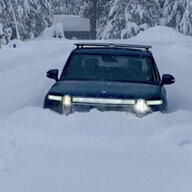
Here in the Sierras, we can get large storms with snowfall rates (~1" to 3 or even 4" / hr sometimes) that can exceed the plow crews ability to actually move snow off the road. Most people read a forecast and know this is coming so avoid getting themselves into a precarious situation however, there are still always a collection of folks who get stranded for one reason or another. We just had a record December snowfall and I cannot tell you how many Tesla's I saw on flatbeds - waaaaay more than I've ever seen in 20yrs. Very rarely is it because of gridlock. Vast majority of the time it is just people who are unprepared: 2WD, shitty summer or all season tires, no traction devices, etc..

If not that, usually it's b/c there is one blockage somewhere on the road keeps the plows from coming through long enough for a good amount of snow to accumulate or you're on a side road that is not a major travel route that can sometimes can go 2-3 days without being plowing in the biggest storms. It's not too uncommon to have 12-24"+ of unplowed snow in these situations. At that point it's really about 1) does your vehicle have the ground clearance and traction to make it through that amount of snow and if not and you get stuck, 2) can you self-extricate. This is where I expect (hope) the R1T to have a significant advantage over most other vehicles. Without fail, every winter in California there is at least 1 party that gets stranded somewhere and spends multiple nights stuck somewhere, sometimes with a bad outcome.

In any scenario, if you become stranded and cannot get out, it becomes simple math for both ICEs and EVs on available fuel for heat and each one has a finite amount. Probably obvious, but the best solution to either one is to not get yourself stuck in the first place. Pre-planning, being prepared if something does go sideways, and knowing when not to go goes a long way. Even with dedicated winter snows, I still have a shovel and traction pads most of the time....for myself or to get someone else unstuck that might be blocking the road.
 

virgnia_rivian

Well-Known Member
First Name
Ryan
Joined
Dec 13, 2021
Threads
4
Messages
640
Reaction score
866
Location
Alexandria, VA
Vehicles
R1T, Mazda Miata
There's quite a few variables particular to each situation. If you are talking about gridlocked highway in the winter, that is one situation that is probably best mitigated by having the common sense to anticipate large traffic volume + bad weather forecast = bad situation to be avoided in the first place.
Hahahah. I totally agree, but you don't know drivers in the mid-Atlantic states that say F-it, I'm going out anyway. Plus I-95 is bad on a good weather day.

I live in Northern Virginia. Sunday eveing the forecast was 3-6" and then 4-8" and then 5-10". In Fredericksburg (along this stretch of 95) they got over 13". I got 11" at my house in Alexandria. The highway crews just can keep up and the traffic didn't let up. I've seen much less snow cause even bigger problems here.

Back to this thread, I was just wondering this about the R1T this morning, so this has been some good information from the group. The seat heaters are a great suggestion as well. If you have the camp kitchen and tent you're all set.
 

dpc166

Well-Known Member
First Name
Dan
Joined
Dec 20, 2021
Threads
0
Messages
52
Reaction score
26
Location
Philadelphia
Vehicles
2019 Subaru Crosstrek Plug-in Hybrid
The nice thing about EVs is that you could set the heat to a lower temperature you can still tolerate that will equate to extending the time before empty. You can't really do that in an ICE vehicle.
Absolutely. In the winter, I run the heat in my plug-in hybrid at 60 degrees and that sometimes is still too hot. I saw some posts out in the interwebs about people saying 'If you had an EV and got stuck on I-95 last night, you'd be screwed' or to some extent like that. Instead of doing the legwork and some 'math' they wouldn't need to open their mouths.

As what Kyle was saying, the car really doesn't use that much power when sitting at idle. Most of the energy from the battery goes to the motors when you're driving, so if you're stationary you're pretty well off. The only questions are "How long will you likely be stuck in gridlock" and "Where are the nearest charging stations assuming I have x% range remaining".

A typical gas car will use up to 1/2 gallon per hour. If you had a 15 gallon tank, then you could last up to 30 hours. If the R1T sits using 4kW for 30 hours, you still have about 15kW (120kW used) remaining and the gas car is now stuck on the highway waiting for a flatbed. If you were able to cycle the climate control off every so often for 30min increments, you could conceivably bank that power and have even more (just like with a gas car, but remember the gas engine needs to warm up to provide heat).
 

kylealden

Well-Known Member
First Name
Kyle
Joined
Feb 25, 2021
Threads
20
Messages
1,458
Reaction score
4,461
Location
Seattle
Vehicles
2022 Rivian R1T LE (QM/L), 2024 Zero DSR/X
Occupation
Product Management
A side note - the other big advantage of EVs is they have storage for days. I always keep a pair of down camping blankets and a small pack of mylar emergency blankets in my Tesla's frunk, and keep water and some snacks in the cabin for myself and the dog. I also always carry an InReach any time I'm going into the woods or on long trips. You can dramatically extend the survivability of a bad situation with some basic prep. (And you look like a superhero when it's time for post-MTB beers on a cold patio with some friends.)

"Stuck in gridlock" is one bad scenario, but "slid into a ditch off a logging road, damaged the car, climate won't start, no cell service" is even worse.

Plan for a completely busted and immobile vehicle and then think about how you'll signal for help and survive until it arrives. It takes surprisingly little, but not nothing.
 

Sponsored

sierraskier

Well-Known Member
First Name
Kendall
Joined
May 27, 2021
Threads
1
Messages
194
Reaction score
306
Location
Tahoe
Vehicles
Earthroamer, Rivian R1T x 2, KTM 300 XCW
Hahahah. I totally agree, but you don't know drivers in the mid-Atlantic states that say F-it, I'm going out anyway. Plus I-95 is bad on a good weather day.

I live in Northern Virginia. Sunday eveing the forecast was 3-6" and then 4-8" and then 5-10". In Fredericksburg (along this stretch of 95) they got over 13". I got 11" at my house in Alexandria. The highway crews just can keep up and the traffic didn't let up. I've seen much less snow cause even bigger problems here.

Back to this thread, I was just wondering this about the R1T this morning, so this has been some good information from the group. The seat heaters are a great suggestion as well. If you have the camp kitchen and tent you're all set.
Yeah, I actually was going to say there is a segment of the population here that will read the Winter Storm Warning / news that specifically states "you could be stranded in your car for many hours if you get stuck" and still say F- it, I'm still going totally unprepared anyway. But out here it's mountain passes that will usually close during big storms, not the daily commute, so it's a different set of circumstances.
 
Last edited:

Tim-in-CA

Well-Known Member
Joined
Sep 30, 2021
Threads
46
Messages
1,791
Reaction score
3,429
Location
So Cal
Vehicles
Gen 1 R1S, Lucid Air, T-Bird
I always keep a survival backpack in all my vehicles with water/food/emergency supplies/hand crank radio/etc. Most people don't think that at anytime they could be stranded. Mine was driven more about the fact that I am in Earthquake country and if a major quake happened and I was at work (30 miles away) or in transit somewhere, there is the distinct possibility that freeways could become impassible with overpass collapses. At that point, my only option would be to walk home.
 

Whmorken

Well-Known Member
First Name
Hubert
Joined
Mar 4, 2019
Threads
3
Messages
411
Reaction score
368
Location
Jackson, WY
Vehicles
Tesla X. Toyota Land Cruiser.
Occupation
Retired
Clubs
 
I'm not sure if Rivian has published the heater specs for the R1T, but it should be comparable to an older Tesla's resistive heater; I believe the Model 3 was around 4kW.

So assuming peak draw (you're blasting heat on HI for cabin/battery conditioning), you're looking at 135kWh/4kW=about 33 hours of heat from a full battery. Of course you won't have a full battery, but you won't really be blasting heat on HI either.

Just speculating wildly, I think it's reasonable to expect 2-3%/hr drain with "comfortable but not toasty" cabin heat in cold (but not sub-zero) conditions. And you won't be inhaling your own exhaust fumes, which is nice. But it will absolutely impact your range - if you are stuck for a couple days, you might be warm but waiting for a flatbed...

Entertainment/lights/etc. will be more or less immaterial compared to the heater and general overhead of keeping the car powered.
I live in the coldest inhabited place in Wyoming, north of Jackson, and when traveling in our Tesla X always have emergency gear with us including down sleeping bags and water plus shovel and tow strap, etc. In an emergency, maintaining some battery charge is absolutely necessary so staying warm without having to use up the battery charge is wise. For everyday use: The battery is massive and in town or skiing we use it when shopping or otherwise active to keep the car minimally warm while we are gone. This takes very little of the charge when used for up to several hours. With motors off, heating an EV is efficient, I also warm the car up quickly using my phone app. Heat does not use the motors. P. S. The R1S will be much safer to drive up here as long as caution is “King”.
 
Last edited:

kylealden

Well-Known Member
First Name
Kyle
Joined
Feb 25, 2021
Threads
20
Messages
1,458
Reaction score
4,461
Location
Seattle
Vehicles
2022 Rivian R1T LE (QM/L), 2024 Zero DSR/X
Occupation
Product Management
On the topic, this guy got 72hrs in sub-zero temperatures in a Model 3:

The R1T has a dramatically larger batterybut equivalent (if not smaller?) cabin, but resistive heaters (this Model 3 had a heat pump). Still, promising!
 

Whmorken

Well-Known Member
First Name
Hubert
Joined
Mar 4, 2019
Threads
3
Messages
411
Reaction score
368
Location
Jackson, WY
Vehicles
Tesla X. Toyota Land Cruiser.
Occupation
Retired
Clubs
 
I live in the coldest inhabited place in Wyoming, north of Jackson, and when traveling in our Tesla X always have emergency gear with us including down sleeping bags and water plus shovel and tow strap, etc. In an emergency, maintaining some battery charge is absolutely necessary so staying warm without having to use up the battery charge is wise. For everyday use: The battery is massive and in town or skiing we use it when shopping or otherwise active to keep the car minimally warm while we are gone. This takes very little of the charge when used for up to several hours. With motors off, heating an EV is efficient, I also warm the car up quickly using my phone app. Heat does not use the motors. P. S. The R1S will be much safer to drive up here as long as caution is “King”.
Good afternoon all:

Thought it might be a good idea to start a thread on how the Rivian R1 platform, and indeed, EV's in general handle long-term emergent situations during winter travel. More specifically, will an EV/R1T outlast an ICE vehicle when trapped/stranded on a highway during a winter storm.

I can't imagine it would be efficient to idle an ICE vehicle for hours to stay warm, but I don't believe I've seen any longevity estimates re: Rivian to know how big a draw cabin temperature and entertainment can be in these situations.

https://www.huffpost.com/entry/driv...-traffic-overnight_n_61d44c10e4b0c7d8b8a80706
My strong preference if stuck in a winter storm is to be in an EV with all of my emergency gear. The battery is a great asset for heat and cell phone charging as starters. I think Rivians will help to keep us out of emergencies and enable us survive when stranded. After living in the high Rockies for 22+ years and with no plans to leave, I look forward to driving an R1S twelve months a year almost everywhere and anytime; but, and I mean but, the safest place for a Rivian to be in a mountain winter storm, is the garage. Right now I am checking the weather and plan to stay home for three days! It‘s time to enjoy an enclosed tractor snowblower, let the wind die down, and wait for the big plows to clear the Teton Park roads.
Sponsored


Top