Sponsored

iamnid

Well-Known Member
Joined
Aug 10, 2023
Threads
7
Messages
685
Reaction score
909
Location
California
Vehicles
Mercedes EQE, Rivian R1S
And the Tesla one I have is also 500 amps. I don't think there is one available that is actually rated for 600 amps. But Tom did say he did 0 to 100% and it melted, which is not a normal use case so maybe it's fine.
He also points out that very few DC fast chargers are rated for 600 amps -- most only provide up to 500 amps (the same as the adapter).
Sponsored


cwq93r

Well-Known Member
Joined
Jun 18, 2026
Threads
2
Messages
59
Reaction score
62
Location
Bay Area, CA
Vehicles
Ioniq 5, R2 Ordered
So why would Rivian have the R2 pull 600 amps when no adapter is rated for that power adapter when someone tries to use even the official adapter, it could melt? I'd rather it have a flatter charging curve and pull 200kw max from 0-60%, then slowly ramp down to 100kw by 80%
 

iamnid

Well-Known Member
Joined
Aug 10, 2023
Threads
7
Messages
685
Reaction score
909
Location
California
Vehicles
Mercedes EQE, Rivian R1S
FYI the Rivian adapter is made by Tesla.
So why would Rivian have the R2 pull 600 amps when no adapter is rated for that power adapter when someone tries to use even the official adapter, it could melt? I'd rather it have a flatter charging curve and pull 200kw max from 0-60%, then slowly ramp down to 100kw by 80%
Probably because they aren't assuming you'll use an adapter. Tom went out of his way to use that particular charger with an adapter not because it was more convenient, but because he wanted to try the 600 amps.
 

VegasWeezy

Well-Known Member
First Name
Brian
Joined
Mar 7, 2024
Threads
1
Messages
154
Reaction score
210
Location
Las Vegas, NV
Vehicles
2022 Mach E Premium
Occupation
Accountant
Probably because they aren't assuming you'll use an adapter. Tom went out of his way to use that particular charger with an adapter not because it was more convenient, but because he wanted to try the 600 amps.
From my understanding, the RAN chargers are only rated to 500 amps. I assume that future sites will be more powerful now that the R2 is designed to use 600 amps.

Given that RAN chargers and most other DC chargers out there are running at 500 amps, will this either a) cause these melting problems; or b) mean that we typically won't see optimum charging curves on the vast majority of our DCFC stops?
 

Sponsored

Jeremy3292

Well-Known Member
First Name
Jeremy
Joined
Apr 27, 2026
Threads
5
Messages
681
Reaction score
1,084
Location
South Carolina
Vehicles
R2
So why would Rivian have the R2 pull 600 amps when no adapter is rated for that power adapter when someone tries to use even the official adapter, it could melt? I'd rather it have a flatter charging curve and pull 200kw max from 0-60%, then slowly ramp down to 100kw by 80%
Bc R2 is not CCS. It pulls 600 amps on NACS natively. The ABB charger Tom charged at is the problem, not the R2. The Walmart and IONNA Alpitronic stations pull 600 amps just fine on NACS.
 

VSG

Well-Known Member
Joined
Oct 3, 2022
Threads
4
Messages
3,352
Reaction score
6,311
Location
WA
Vehicles
R1T LE/RB/OC/20
From my understanding, the RAN chargers are only rated to 500 amps. I assume that future sites will be more powerful now that the R2 is designed to use 600 amps.
https://www.rivianforums.com/forum/...-dispenser-technical-specs-ran-charger.53110/
  • Max Output Power: 300 kW DC
  • Max Output Current: 650 A DC (continuous)
  • Output Voltage Range: 200–920 V DC
The RAN v1.5 chargers were developed and deployed while the R2 was being developed, so it makes sense that the specs were set to allow the R2 to charge as fast as designed.

Almost all the RAN pedestals are now v1.5.
 

VegasWeezy

Well-Known Member
First Name
Brian
Joined
Mar 7, 2024
Threads
1
Messages
154
Reaction score
210
Location
Las Vegas, NV
Vehicles
2022 Mach E Premium
Occupation
Accountant

iamnid

Well-Known Member
Joined
Aug 10, 2023
Threads
7
Messages
685
Reaction score
909
Location
California
Vehicles
Mercedes EQE, Rivian R1S
https://www.rivianforums.com/forum/...-dispenser-technical-specs-ran-charger.53110/
  • Max Output Power: 300 kW DC
  • Max Output Current: 650 A DC (continuous)
  • Output Voltage Range: 200–920 V DC
The RAN v1.5 chargers were developed and deployed while the R2 was being developed, so it makes sense that the specs were set to allow the R2 to charge as fast as designed.

Almost all the RAN pedestals are now v1.5.
In that case, until there are adapters that can handle more than 500 amps, you'd probably want to make sure you just used a NACS pedestal at the RAN station.

The Walmart charger Tom went to had both NACS and CCS cables. He used the CCS cable because it was rated for more amperage than the NACS cable on the same pedestal. Had he not used the CCS cable, he wouldn't have needed an adapter -- conversely, the charge would have been slower as the NACS cable (on that charger) provides lower amperage than the CCS cable.
 

Kaiju

Well-Known Member
Joined
Aug 18, 2024
Threads
2
Messages
145
Reaction score
257
Location
Texas
Vehicles
R1T
Since the BMW iX3 was mentioned, as far as I can tell it has a 108 or 112kWh battery pack (sources vary) that charges 10-80 in 21 minutes vs the R2. So that's sucking down about 78 kWh in 21 minutes in the best case. Average of about 223 kW. Pretty impressive honestly, however that looks to be the numbers for a 400kW charger.

The R2 with its 88 kWh pack takes down 66.5 kWh in 27 minutes on its 400V system. Average of about 137kW. That's actually not quite as good as the R1, which can hit 157kW average on the large battery pack doing the same. Some of that is the fact that a bigger battery pack charges longer at a higher rate because it can soak more heat. Works in favor of the BMW too.

That all seems like a crushing advantage to the BMW, though some spitball math suggests the gap is a bit closer in real world terms. The thing is 400kW is pretty rare even among 800V chargers. I was trying to estimate how much extra time the BMW would've taken at the same 300kW charger as the test and I happened on an odd conclusion. While I haven't been able to find a charge curve for the 2027, it seems that the BMW can only hold that peak charge rate for something like 6 minutes in order for the average to make sense. Being throttled to 300kW would mean something like an extra 2 minutes charging. If it were to be throttled even further to a 400V charger pulling 500A (the max it pulls at 400kW), it would take about the same 27-ish minutes.

Owing to the bigger battery the BMW would still pack on more jiggawatts, however it seems a world without 400kW chargers would be one of disappointment. Not going to say that 800V isn't objectively better in this regard, since kilowatts are kilowatts, but there's definitely some strategic calculus going on there about just how useful it is for how much extra it costs. I'm sure there'd be some peeps who'd throw the money down for 800V, but I'd imagine they'd be drowned out by the consumer masses who don't understand the nuance and complain about why their car charges slower than the paper said it's supposed to at most chargers they'd encounter.
 

Sponsored

Indy avocado

Well-Known Member
First Name
Greg
Joined
Dec 17, 2022
Threads
3
Messages
221
Reaction score
310
Location
Indiana
Vehicles
'22 R1T, '17 Macan S, '11 Mustang GT
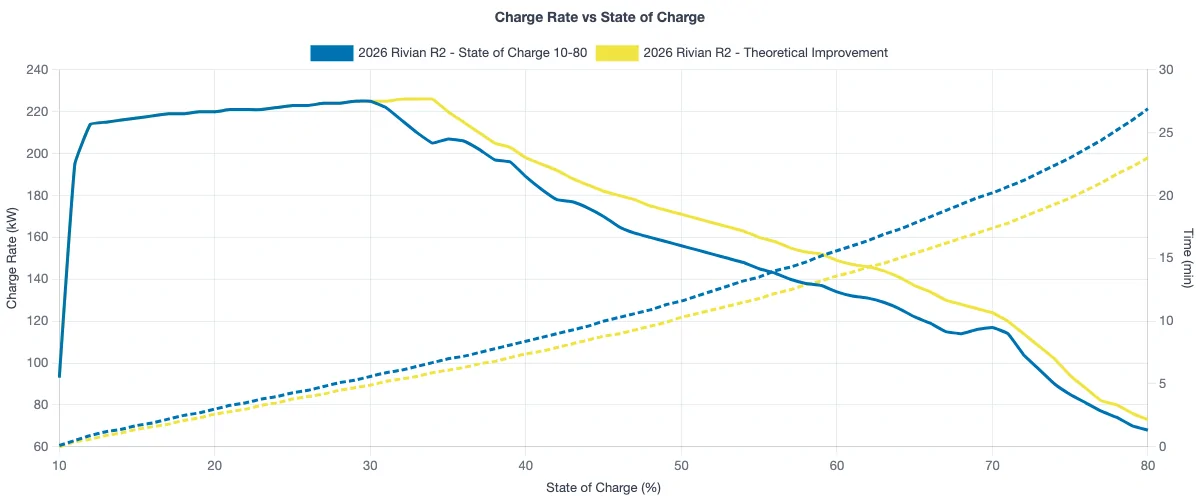
Interesting Tom said he thinks they can shave another 2 minutes off with an OTA update once they have enough real world user data presumably. That would be 10 to 80% in 25 minutes.
Possible. What's interesting though is that it charges exactly the same with production units as the "preproduction" ones tested months ago - the charge curve matches *exactly* the CarWow video from February.

I am skeptical, but if they can find 10-20kW across the 35-75% region, that would get it from 27 to 23 minutes.
Rivian R1T R1S R2 10-80% charge test (by State Of Charge) 1783424809369-jz


Is an 800 volt architecture better? The most widespread DC fast charger is the Tesla version 3 Supercharger. Charging an 800 volt car typically only can reach 150 kW at a version 3 Supercharger while the 400 volt Rivian R2 reaches 230 kw.
"Better" is subjective. But once you have a 80-100kWh battery, the 800V architecture becomes more important.
The *majority* of DCFC sites in the US are already 800V capable. As you noted, even Tesla sites going forward are 800V capable.
And the Lucid Gravity and BMW iX3 use boost systems that can charge at 200-230kW on a V3 supercharger (until the handle overheats) - so no "penalty" on superchargers.


I know I'm likely in the minority on this but I don't actually get excited about the prospects of 10-80% charging that's going to take anywhere in the 5-25 min range. I simply can't complete a rest stop and relieve the dogs, hit the restrooms, get snacks/food, etc that quickly. so, if charging completes while I'm away from the car, I'm rudely blocking a charger at best or incurring idle charges at worst. unless they can get 10-80% down to about 5 mins (and of course we're nowhere near that with current battery chemistries), which is about the limit for how long I'm willing to stand by watching the electrons flow, then slightly faster charging only creates an inconvenience for me. I've done numerous road trips over the past 3+ years of R1 ownership and I have yet to find myself hanging out waiting on charging to complete. but I've also never had to deal with idle fees or blocking others because my R1 was done charging but I'm still away from the vehicle.
I understand your perspective, but you can always just charge to 90-95% if you're not ready to leave... As someone who did ~15k road trip miles in my R1T in 2024 (with dogs), I find ~15-20 minutes to be the sweet spot if I need to pee and walk the dogs. Except when I sit down to eat I've never needed 30 minutes. But 30 minutes of charging gains about 180mi of range, or more like 120-140mi if you're doing 80mph or in the winter. Not even 2 full hours between stops. I don't need 20 minutes of rest that frequently.


These earlier 2018 LR RWD packs still charged faster..
Yup... Tesla batteries have been getting worse over time - cost optimization. Sadly, Tesla is still top of the pack when it comes to road trip capability in the US (excepting Porsche, Lucid).

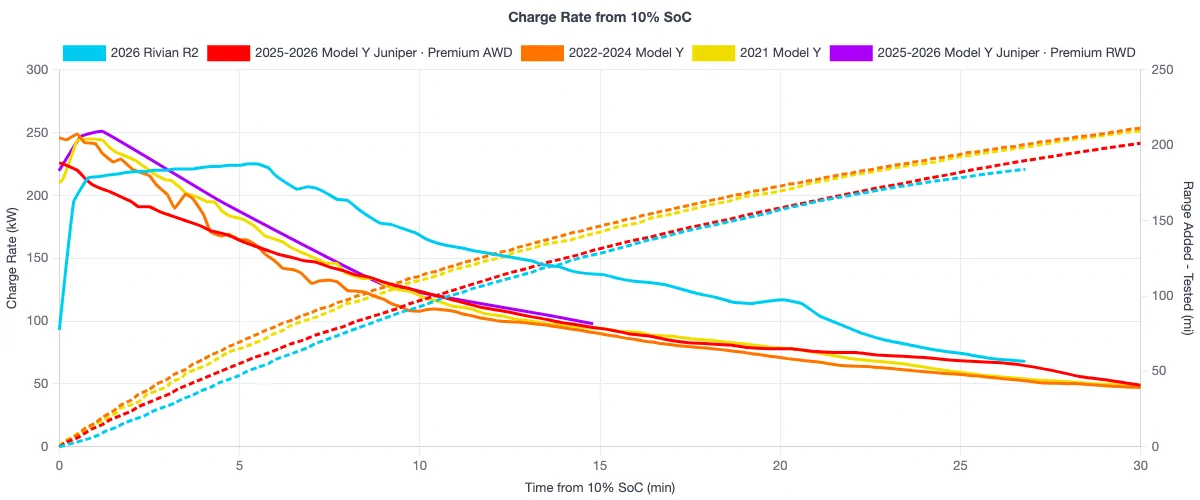
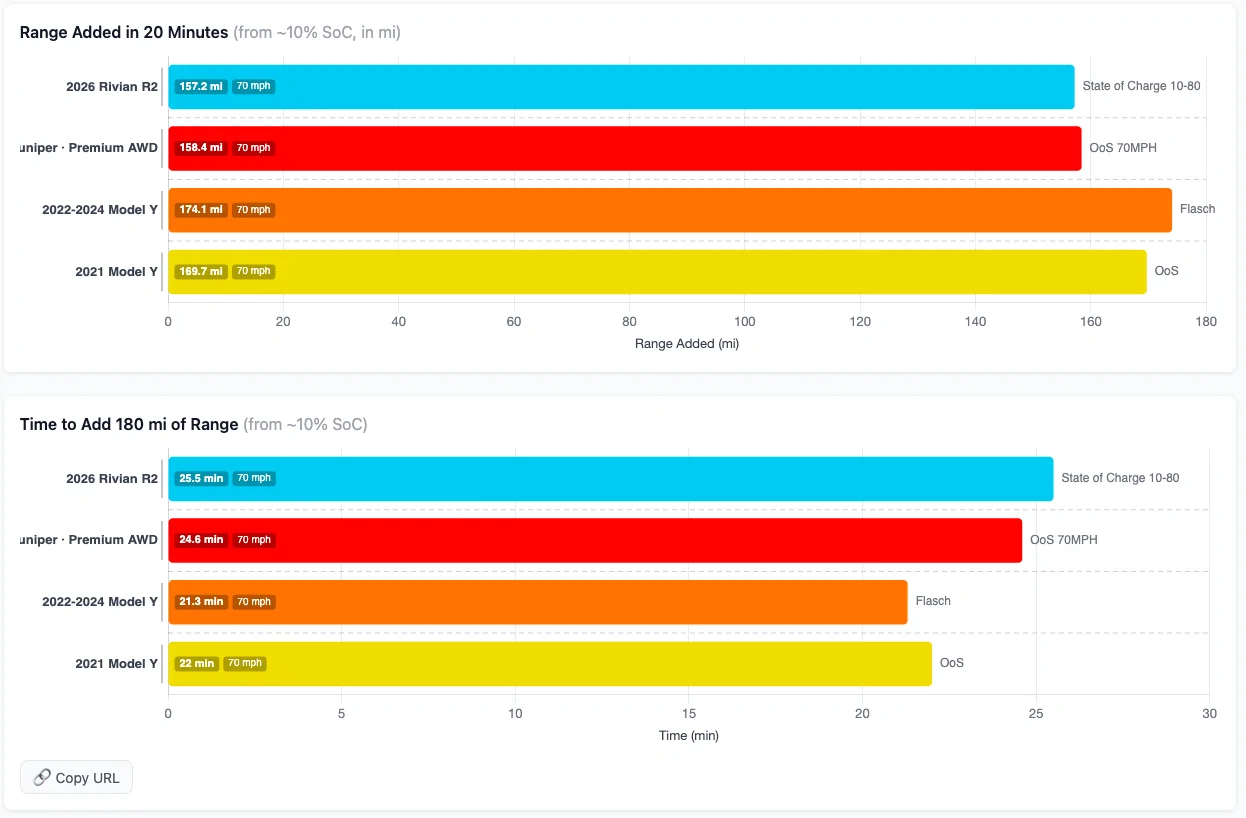
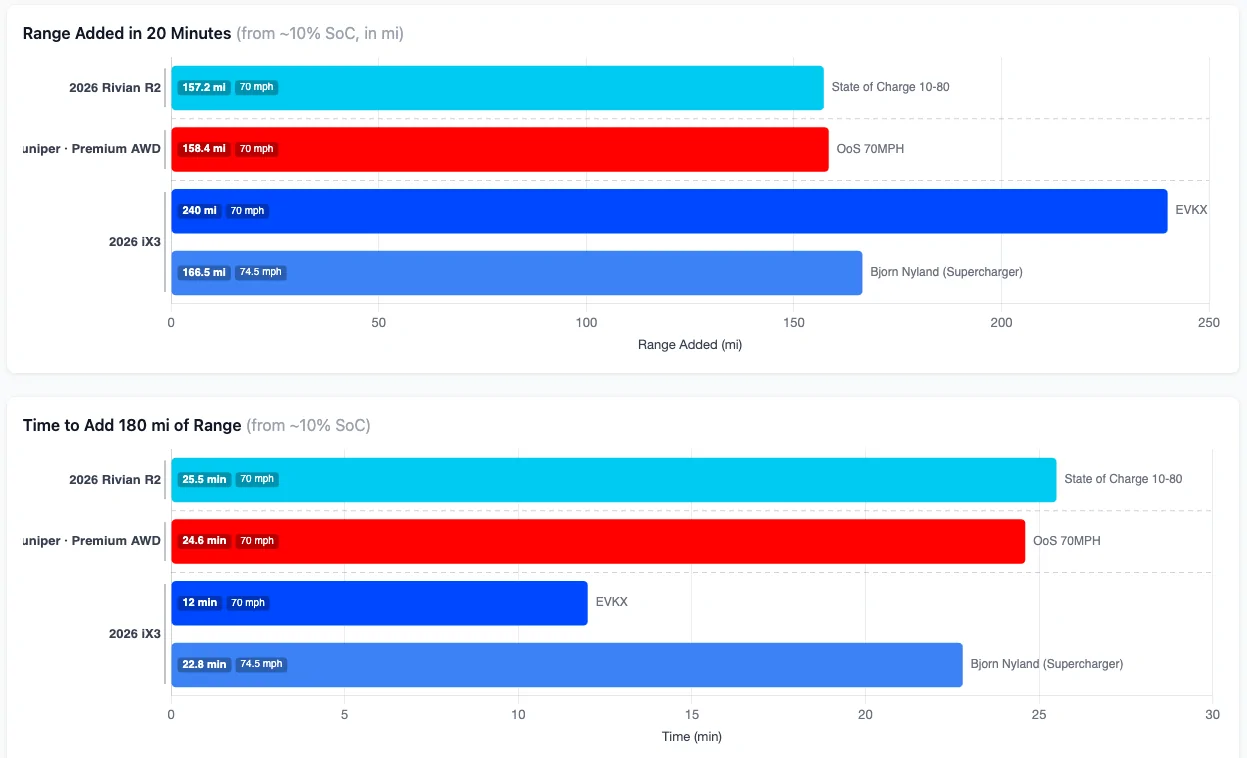
If you combine Tom's two pieces of data (highway range and charging) you get 180 real miles in 27 minutes if you are at 70 mph, and if you are running at 75mph you expect to stop for 25-30 minutes every two hours. This is what you would expect and is highly competitive with a model Y.
Rivian R1T R1S R2 10-80% charge test (by State Of Charge) 1783425627710-yc

(Solid lines are power, dashed lines are Range added)

Model Y efficiency makes it slightly better (~3.0 vs ~3.6mi/kWh @70mph).
R2 pulls much more power from 30-75% but is ~20% less efficient.

Note the data here is using individual testing events from various sources, so there could be some reasonable variation.

Rivian R1T R1S R2 10-80% charge test (by State Of Charge) 1783425814015-0m


Since the BMW iX3 was mentioned, as far as I can tell it has a 108 or 112kWh battery pack (sources vary) that charges 10-80 in 21 minutes vs the R2. So that's sucking down about 78 kWh in 21 minutes in the best case. Average of about 223 kW. Pretty impressive honestly, however that looks to be the numbers for a 400kW charger.

The R2 with its 88 kWh pack takes down 66.5 kWh in 27 minutes on its 400V system. Average of about 137kW. That's actually not quite as good as the R1, which can hit 157kW average on the large battery pack doing the same. Some of that is the fact that a bigger battery pack charges longer at a higher rate because it can soak more heat. Works in favor of the BMW too.

That all seems like a crushing advantage to the BMW, though some spitball math suggests the gap is a bit closer in real world terms. The thing is 400kW is pretty rare even among 800V chargers. I was trying to estimate how much extra time the BMW would've taken at the same 300kW charger as the test and I happened on an odd conclusion. While I haven't been able to find a charge curve for the 2027, it seems that the BMW can only hold that peak charge rate for something like 6 minutes in order for the average to make sense. Being throttled to 300kW would mean something like an extra 2 minutes charging. If it were to be throttled even further to a 400V charger pulling 500A (the max it pulls at 400kW), it would take about the same 27-ish minutes.

Owing to the bigger battery the BMW would still pack on more jiggawatts, however it seems a world without 400kW chargers would be one of disappointment. Not going to say that 800V isn't objectively better in this regard, since kilowatts are kilowatts, but there's definitely some strategic calculus going on there about just how useful it is for how much extra it costs. I'm sure there'd be some peeps who'd throw the money down for 800V, but I'd imagine they'd be drowned out by the consumer masses who don't understand the nuance and complain about why their car charges slower than the paper said it's supposed to at most chargers they'd encounter.
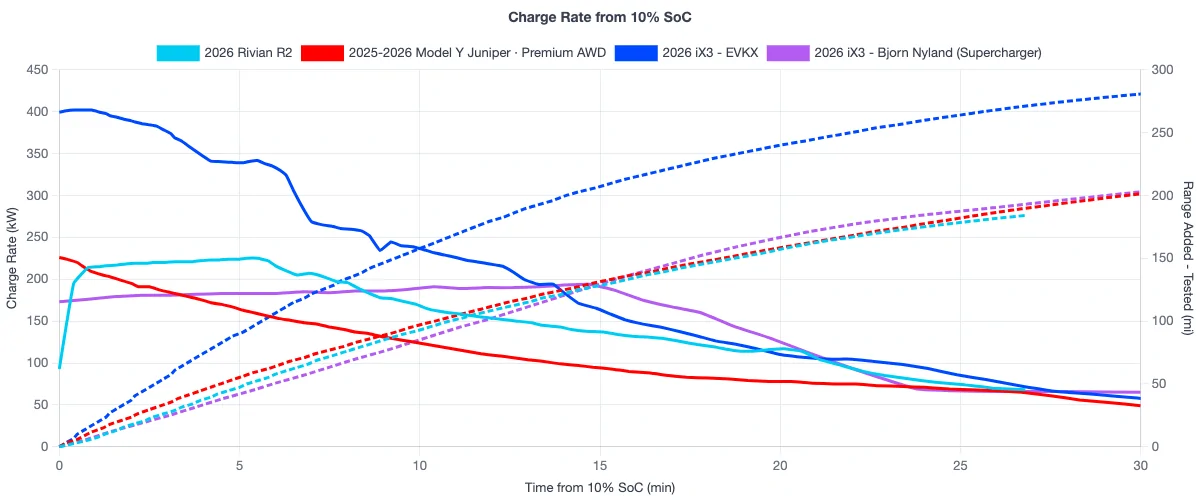
iX3 is not the same class, arguably, being ~$15k more expensive... but it destroys the R2 in both range and charging. Bigger battery, slightly more efficient, and MUCH faster charging throughout the curve. I would pay that $15k to get the iX3 battery in the R2.

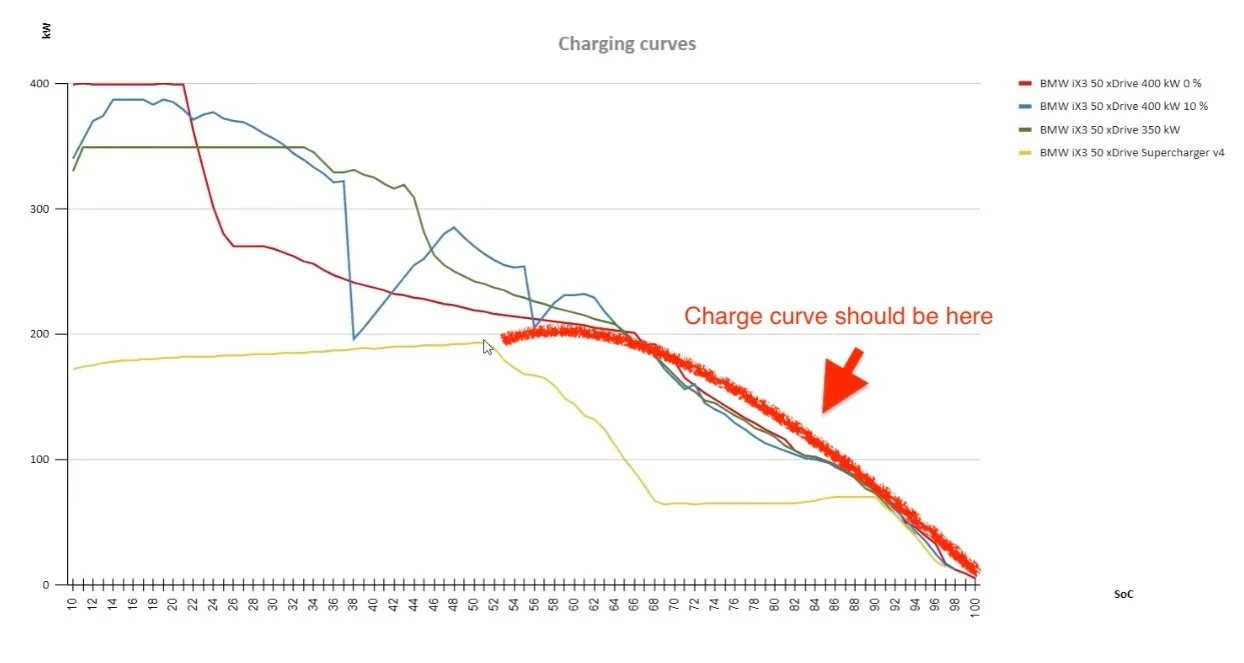
It *seems* like there's a bug (or genuine) limitation for iX3 when charging on superchargers - it holds ~190kW for a while, then drops off far earlier than it does on 800V. Perhaps the boost convert is thermally limited? Even with that limitation, it still can (just) beat out the R2 and Model Y.

Rivian R1T R1S R2 10-80% charge test (by State Of Charge) 1783426411260-qa

Rivian R1T R1S R2 10-80% charge test (by State Of Charge) 1783427116643-x8

Rivian R1T R1S R2 10-80% charge test (by State Of Charge) 1783426763664-qm
 
Last edited:

Jeremy3292

Well-Known Member
First Name
Jeremy
Joined
Apr 27, 2026
Threads
5
Messages
681
Reaction score
1,084
Location
South Carolina
Vehicles
R2
The R2 with its 88 kWh pack takes down 66.5 kWh in 27 minutes on its 400V system. Average of about 137kW. That's actually not quite as good as the R1, which can hit 157kW average on the large battery pack doing the same.
It's actually better. R2 has much better designed cooling and thermals.

R2: 137kW/88kWh = 1.56C
R1: 157kW/140kWh = 1.12C
 

mkhuffman

Well-Known Member
First Name
Mike
Joined
Nov 9, 2020
Threads
14
Messages
3,022
Reaction score
3,434
Location
Virginia
Vehicles
2025 R1T Tri-Max, Jeep GC-L, VW Jetta
Possible. What's interesting though is that it charges exactly the same with production units as the "preproduction" ones tested months ago - the charge curve matches *exactly* the CarWow video from February.

I am skeptical, but if they can find 10-20kW across the 35-75% region, that would get it from 27 to 23 minutes.
1783424809369-jz.webp


"Better" is subjective. But once you have a 80-100kWh battery, the 800V architecture becomes more important.
The *majority* of DCFC sites in the US are already 800V capable. As you noted, even Tesla sites going forward are 800V capable.
And the Lucid Gravity and BMW iX3 use boost systems that can charge at 200-230kW on a V3 supercharger (until the handle overheats) - so no "penalty" on superchargers.


I understand your perspective, but you can always just charge to 90-95% if you're not ready to leave... As someone who did ~15k road trip miles in my R1T in 2024 (with dogs), I find ~15-20 minutes to be the sweet spot if I need to pee and walk the dogs. Except when I sit down to eat I've never needed 30 minutes. But 30 minutes of charging gains about 180mi of range, or more like 120-140mi if you're doing 80mph or in the winter. Not even 2 full hours between stops. I don't need 20 minutes of rest that frequently.


Yup... Tesla batteries have been getting worse over time - cost optimization. Sadly, Tesla is still top of the pack when it comes to road trip capability in the US (excepting Porsche, Lucid).


1783425627710-yc.webp

(Solid lines are power, dashed lines are Range added)

Model Y efficiency makes it slightly better (~3.0 vs ~3.6mi/kWh @70mph).
R2 pulls much more power from 30-75% but is ~20% less efficient.

Note the data here is using individual testing events from various sources, so there could be some reasonable variation.

1783425814015-0m.webp


iX3 is not the same class, arguably, being ~$15k more expensive... but it destroys the R2 in both range and charging. Bigger battery, slightly more efficient, and MUCH faster charging throughout the curve. I would pay that $15k to get the iX3 battery in the R2.

It *seems* like there's a bug (or genuine) limitation for iX3 when charging on superchargers - it holds ~190kW for a while, then drops off far earlier than it does on 800V. Perhaps the boost convert is thermally limited? Even with that limitation, it still can (just) beat out the R2 and Model Y.

1783426411260-qa.webp

1783427116643-x8.webp

1783426763664-qm.webp
Great post! You should make it a new thread with all that extensive content.

Your post and many of the others have demonstrated to me that the R2 is very competitive in the space they are targeting, and the average buyer will be completely satisfied with the charging performance.

Unless they melt an adapter, that is. :CWL:
 

Indy avocado

Well-Known Member
First Name
Greg
Joined
Dec 17, 2022
Threads
3
Messages
221
Reaction score
310
Location
Indiana
Vehicles
'22 R1T, '17 Macan S, '11 Mustang GT
Great post! You should make it a new thread with all that extensive content.

Your post and many of the others have demonstrated to me that the R2 is very competitive in the space they are targeting, and the average buyer will be completely satisfied with the charging performance.

Unless they melt an adapter, that is. :CWL:
Yeah. I'm extremely disappointed with the R2 battery (both capacity and charging speed), but at the same time it's better than basically every other US market EV at the same or lower price.

I mostly just worry that in 2 years it will feel a bit like a dinosaur when the rest of the market starts moving to actually good batteries.

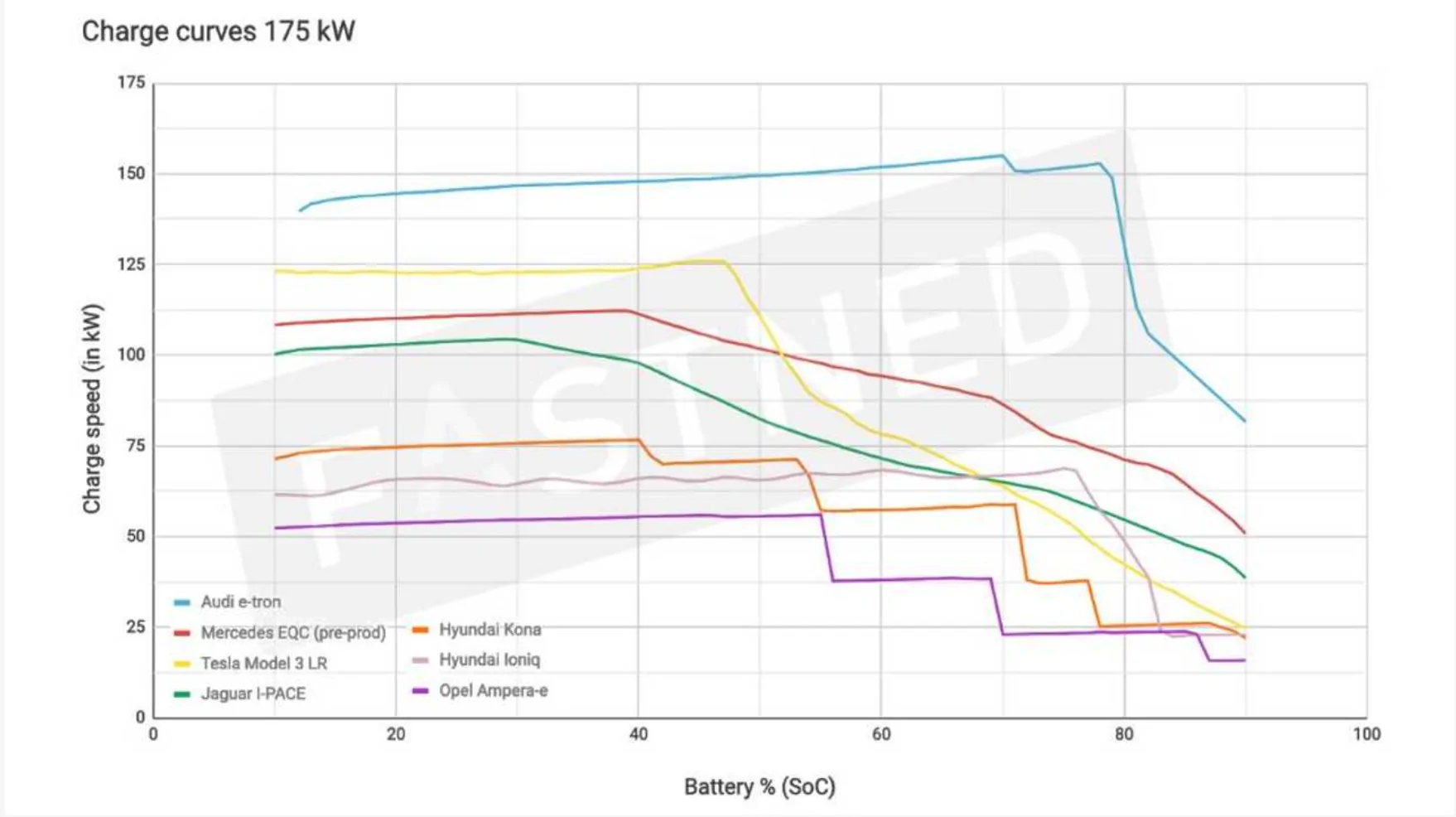
I just thought that we'd be charging faster than what Tesla and Audi was doing in 2019...
Original E-Tron held 150kW to 80%.
Rivian R1T R1S R2 10-80% charge test (by State Of Charge) 1783430195634-ga
 

Jeremy3292

Well-Known Member
First Name
Jeremy
Joined
Apr 27, 2026
Threads
5
Messages
681
Reaction score
1,084
Location
South Carolina
Vehicles
R2
The *majority* of DCFC sites in the US are already 800V capable.

It *seems* like there's a bug (or genuine) limitation for iX3 when charging on superchargers - it holds ~190kW for a while, then drops off far earlier than it does on 800V. Perhaps the boost convert is thermally limited? Even with that limitation, it still can (just) beat out the R2 and Model Y.
Great post! I agree with most of what you said but a couple of things. The vast majority of DCFC sites in the US are NOT 800v capable. Just Tesla superchargers alone account for over 50% of DCFC plugs in the USA, and they are not 800v capable. And that doesn't include a bunch of other "legacy" DCFC sites that can't do 800v either. Tesla superchargers can only do 400v, unless they are the very rare V4 "cabinets" superchargers that are rolling out slowly which can do up to 1000v. There's only like 10 of these sites currently. That's why iX3 can only do ~190kW on Tesla superchargers bc the amps are limited to 500 along with voltage.

Also we have to stop using miles as a metric :CWL: SoC or kWh added is all that matters. Miles added is meaningless IMO bc it's a metric that changes greatly depending on conditions.
Sponsored


Top