
Sponsored

TexasBob

Well-Known Member
First Name
Bob
Joined
Jan 15, 2022
Threads
49
Messages
1,268
Reaction score
2,865
Location
Houston
Vehicles
2024 R1T DM LRG, 2025 R1S Dune
Is an 800 volt architecture better? The most widespread DC fast charger is the Tesla version 3 Supercharger. Charging an 800 volt car typically only can reach 150 kW at a version 3 Supercharger while the 400 volt Rivian R2 reaches 230 kw. On an Electrify America fast charger an 800 volt car can charge much faster although these chargers often have issues that lower the charging speed or fail to charge at all. So while 800 volt architectures can charge faster in theory in practice they often charge slower. There are version 4 Tesla Superchargers and other newer DC fast chargers that will support the full charging speed of 800 volt architecture.

https://www.bozy.com/2025-hyundai-ioniq-5-charging-vs-tesla-supercharger/
This is correct for the poorly engineered units like the new Volvo EX60 that uses a boost strategy. It is incorrect for the modern 800V architecture on the BMX iX3 for example.
Sponsored


tivoboy

Well-Known Member
First Name
Paul
Joined
Nov 8, 2025
Threads
2
Messages
308
Reaction score
328
Location
Palo Alto, CA
Vehicles
M3
I'm gunna be honest with you as I simply don't believe this as someone who owned a 2021 M3 LR and a 2024 M3P. 10 to 70% sure but definitely not 10 to 80%. In fact I did 10% to 80% a month ago as a test at an empty V4 supercharger at 8am in 75 degree weather and it took 30 minutes. I can post the charging session from the Tesla app if needed lol.
These earlier 2018 LR RWD packs still charged faster..maybe 5-6 years ago I could produce the charging session data for you, but A) not Interested and B) it’s over on TMC for sure still. (although probably archived at this point.

Technically the car I have has always had a charging curve higher than the posted standard TM#3 V3 (that was the best at the time) and not really sure why. But the cells have been baby’d and maintained and now even 8+ years later the car still has 94% capacity.
 

Jeremy3292

Well-Known Member
First Name
Jeremy
Joined
Apr 27, 2026
Threads
5
Messages
682
Reaction score
1,090
Location
South Carolina
Vehicles
R2
Is an 800 volt architecture better? The most widespread DC fast charger is the Tesla version 3 Supercharger. Charging an 800 volt car typically only can reach 150 kW at a version 3 Supercharger while the 400 volt Rivian R2 reaches 230 kw. On an Electrify America fast charger an 800 volt car can charge much faster although these chargers often have issues that lower the charging speed or fail to charge at all. So while 800 volt architectures can charge faster in theory in practice they often charge slower. There are version 4 Tesla Superchargers and other newer DC fast chargers that will support the full charging speed of 800 volt architecture.

https://www.bozy.com/2025-hyundai-ioniq-5-charging-vs-tesla-supercharger/
You have come to the problem currently in the USA: there aren't many 800v chargers available. Yes, they do exist and are being rolled out - IONNA, Rivian, Walmart, and now Tesla with their true V4 cabinet - but they are still not ubiquitous at all. This is likely why Rivian did not go to 800v for R2 (also cost), as they know most of their consumers will be using 400v chargers, while still being best in class for 400v speed. By 2030 800v will be the standard in the USA and probably most vehicles will adopt 800v architecture. We just aren't there today.

If you're a nerd you could plan your trip out with only 800v chargers, but that is a PITA and the everyday person doesn't even know the difference.
 

Jeremy3292

Well-Known Member
First Name
Jeremy
Joined
Apr 27, 2026
Threads
5
Messages
682
Reaction score
1,090
Location
South Carolina
Vehicles
R2
These earlier 2018 LR RWD packs still charged faster..maybe 5-6 years ago I could produce the charging session data for you, but A) not Interested and B) it’s over on TMC for sure still. (although probably archived at this point.
Good to see Tesla has gotten worse over the years 🤮 :CWL:
 

TexasBob

Well-Known Member
First Name
Bob
Joined
Jan 15, 2022
Threads
49
Messages
1,268
Reaction score
2,865
Location
Houston
Vehicles
2024 R1T DM LRG, 2025 R1S Dune
If you combine Tom's two pieces of data (highway range and charging) you get 180 real miles in 27 minutes if you are at 70 mph, and if you are running at 75mph you expect to stop for 25-30 minutes every two hours. This is what you would expect and is highly competitive with a model Y.
 

Sponsored

Whale Blubber

Well-Known Member
Joined
May 2, 2023
Threads
4
Messages
400
Reaction score
555
Location
Austin
Vehicles
2019 BMW X3 3.0si, 2021 Toyota RAV4 XLE
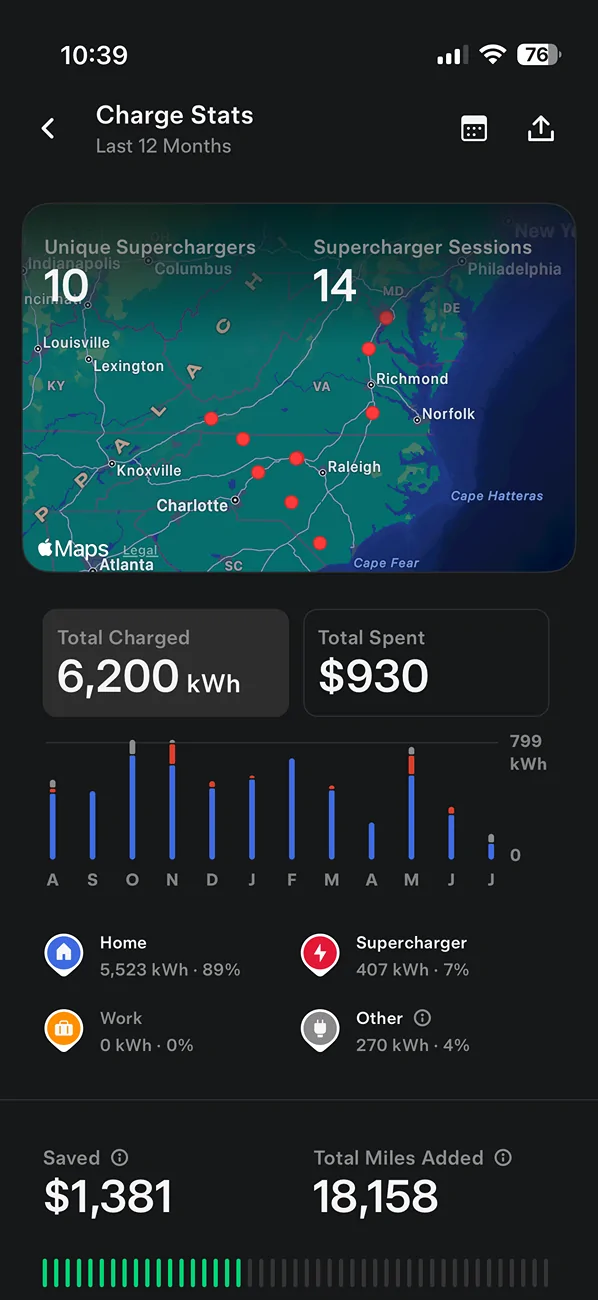
I'd like faster charging just as much as the next guy, but after looking at my stats over the past year, my usage nearly mirrors what RJ expected for fast-charging sessions. 89% of my time is spent charging at home, 4% at my MiL's beach house, and the other 7% is Supercharging. And this is from someone who drives ~20,000 miles/year.

I think I'll do just fine with the R2's charging curve :D

IMG_1385.webp
Sorry if I'm being dense or just way behind the times, but how did you extract that info? Is this one of those 3rd party apps I should be well aware of by now?
 

macb00kemdanno

Well-Known Member
First Name
Brandon
Joined
Feb 19, 2024
Threads
8
Messages
408
Reaction score
1,048
Location
Garner, NC
Vehicles
2024 Tesla Model 3 Long Range Dual Motor, 2023 Tesla Model Y Long Range
Sorry if I'm being dense or just way behind the times, but how did you extract that info? Is this one of those 3rd party apps I should be well aware of by now?
It's directly from the Tesla app.
 

Whale Blubber

Well-Known Member
Joined
May 2, 2023
Threads
4
Messages
400
Reaction score
555
Location
Austin
Vehicles
2019 BMW X3 3.0si, 2021 Toyota RAV4 XLE
Ahh, Tesla. Sorry, gotcha.
 

tivoboy

Well-Known Member
First Name
Paul
Joined
Nov 8, 2025
Threads
2
Messages
308
Reaction score
328
Location
Palo Alto, CA
Vehicles
M3
Good to see Tesla has gotten worse over the years 🤮 :CWL:
Better before and getting worse aren’t really the same thing: Simple prompt

”We’re the original 2018 tesla model 3 lr RWD better at charging fast?”

They absolutely were—and in many ways, they still are. The 2018 Model 3 Long Range RWD was built with an aggressively tuned battery pack that gives it a distinct advantage over many of the newer Long Range models when it comes to raw charging speed.

Here is the breakdown of why that original setup is so capable.

The Panasonic NCA Advantage
The original 2018 Long Range packs were built using Panasonic 2170 NCA (Nickel Cobalt Aluminum) cylindrical cells. These cells are known for their ability to accept an immense amount of current at low states of charge.

When Tesla rolled out V3 Supercharging (250 kW) in 2019, they pushed a software update that allowed these early Panasonic packs to pull a true 250 kW peak. By contrast, as Tesla scaled globally, they transitioned many of the newer Long Range AWD models to LG Chem NCM or NCMA cells. While the LG packs are incredibly durable and show excellent longevity, they have a different internal resistance profile and typically peak slightly lower—often around 190 to 210 kW—and taper off a bit differently.

The Panasonic pack’s ability to "gulp" energy right out of the gate is why the 2018 LR models were originally rated to add up to "175 miles in 15 minutes"—a metric driven by the battery sprinting from 10% to nearly 60% in that quarter-hour window.
 

Sponsored

Jeremy3292

Well-Known Member
First Name
Jeremy
Joined
Apr 27, 2026
Threads
5
Messages
682
Reaction score
1,090
Location
South Carolina
Vehicles
R2
Better before and getting worse aren’t really the same thing: Simple prompt

”We’re the original 2018 tesla model 3 lr RWD better at charging fast?”

They absolutely were—and in many ways, they still are. The 2018 Model 3 Long Range RWD was built with an aggressively tuned battery pack that gives it a distinct advantage over many of the newer Long Range models when it comes to raw charging speed.

Here is the breakdown of why that original setup is so capable.

The Panasonic NCA Advantage
The original 2018 Long Range packs were built using Panasonic 2170 NCA (Nickel Cobalt Aluminum) cylindrical cells. These cells are known for their ability to accept an immense amount of current at low states of charge.

When Tesla rolled out V3 Supercharging (250 kW) in 2019, they pushed a software update that allowed these early Panasonic packs to pull a true 250 kW peak. By contrast, as Tesla scaled globally, they transitioned many of the newer Long Range AWD models to LG Chem NCM or NCMA cells. While the LG packs are incredibly durable and show excellent longevity, they have a different internal resistance profile and typically peak slightly lower—often around 190 to 210 kW—and taper off a bit differently.

The Panasonic pack’s ability to "gulp" energy right out of the gate is why the 2018 LR models were originally rated to add up to "175 miles in 15 minutes"—a metric driven by the battery sprinting from 10% to nearly 60% in that quarter-hour window.
I know they threw in some LG Chem packs in there, but my 2021 M3LR had NCA Panasonic cells and so does my 2024 M3P. So yeah it got worse.
 

TexasBob

Well-Known Member
First Name
Bob
Joined
Jan 15, 2022
Threads
49
Messages
1,268
Reaction score
2,865
Location
Houston
Vehicles
2024 R1T DM LRG, 2025 R1S Dune
You have come to the problem currently in the USA: there aren't many 800v chargers available. Yes, they do exist and are being rolled out - IONNA, Rivian, Walmart, and now Tesla with their true V4 cabinet - but they are still not ubiquitous at all. This is likely why Rivian did not go to 800v for R2 (also cost), as they know most of their consumers will be using 400v chargers, while still being best in class for 400v speed. By 2030 800v will be the standard in the USA and probably most vehicles will adopt 800v architecture. We just aren't there today.

If you're a nerd you could plan your trip out with only 800v chargers, but that is a PITA and the everyday person doesn't even know the difference.
FWIW, there are more than 11,000 800V charge ports at 2,386 stations as of the beginning of this year. To put that in context, the total Tesla Supercharger network in the US surpassed 1,000 stations (~8,000 plugs) just five years ago in jan 2021. There are a lot of 800V stations out there and almost everything being built is now supporting 800V.

https://cleantechnica.com/2026/04/0...4,665 public EV,EV chargers at 2,386 stations.
 

sparked

Well-Known Member
Joined
Dec 16, 2025
Threads
13
Messages
274
Reaction score
462
Location
USA
Vehicles
R2 Deposit
FWIW, there are more than 11,000 800V charge ports at 2,386 stations as of the beginning of this year. To put that in context, the total Tesla Supercharger network in the US surpassed 1,000 stations (~8,000 plugs) just five years ago in jan 2021. There are a lot of 800V stations out there and almost everything being built is now supporting 800V.

https://cleantechnica.com/2026/04/0...4,665 public EV,EV chargers at 2,386 stations.
Ionna is expanding crazy fast as just one example. Here's a recent example of them taking over Circle K locations: https://www.ionna.com/news/ionna-an...ng-in-the-u-s-at-ionna-rechargeries-circle-k/
 

Budman

Well-Known Member
First Name
Rick
Joined
Oct 22, 2021
Threads
60
Messages
853
Reaction score
2,924
Location
Minnesota
Vehicles
Honda CRV
Clubs
 
I checked the CCS to NACS adapter I got from Rivian for my R2. It says 500A max current. So it could have the pin melting issue Tom mentioned in the video.
 

Jeremy3292

Well-Known Member
First Name
Jeremy
Joined
Apr 27, 2026
Threads
5
Messages
682
Reaction score
1,090
Location
South Carolina
Vehicles
R2
I checked the CCS to NACS adapter I got from Rivian for my R2. It says 500A max current. So it could have the pin melting issue Tom mentioned in the video.
And the Tesla one I have is also 500 amps. I don't think there is one available that is actually rated for 600 amps. But Tom did say he did 0 to 100% and it melted, which is not a normal use case so maybe it's fine.
Sponsored


Top