

HaveBlue
Well-Known Member
If Trump follows 1950s trade structure, this is only step 1. Deals will be made with "friendly" countries to alleviate tariffs.
Sponsored
That’s an interesting in-depth analysis of Trumps tariffs strategy. Can you explain what Chinas 34% reciprocal tariffs and lock downs on exports of key minerals are with respect to “deals” and how they will alleviate tariffs? Same explanation please for the reciprocal tariffs coming from Europe in the next week or so. Also, could you define a “friendly” country and which of those you think are currently of the opinion that the US is friendly and why?If Trump follows 1950s trade structure, this is only step 1. Deals will be made with "friendly" countries to alleviate tariffs.

If tax rates were reduced, reduced taxes paid won’t have any relationship to tariffs paid at the individual level. Some people would lose and some would gain. I wonder which individuals would gain and which would lose?I think it's interesting to think about tariffs as similar to VAT. I wonder what you all think about using the money from the tariff's to reduce taxes? It seems very possible, but it also seems like the current leaders will more likely distribute the tax rebates to the higher tax brackets. Has anyone seen an analysis about how much an average person in each income range might be effected by the tariffs?

No other country is friendly anymore, except Russia, Hungary, Belarus and North Korea… were you still friendly with the bully of your school ?If Trump follows 1950s trade structure, this is only step 1. Deals will be made with "friendly" countries to alleviate tariffs.


Why the snark? If you're trying to have a decent conversation, lose your attitude. This is the second poster you've taken an unnecessarily aggressive tone with. You need to do better.That’s an interesting in-depth analysis of Trumps tariffs strategy. Can you explain what Chinas 34% reciprocal tariffs and lock downs on exports of key minerals are with respect to “deals” and how they will alleviate tariffs? Same explanation please for the reciprocal tariffs coming from Europe in the next week or so. Also, could you define a “friendly” country and which of those you think are currently of the opinion that the US is friendly and why?
The people who will gain the most are the ones paying the most taxes. Most people assume that's the billionaires and super wealthy, but it's not. They already pay very little tax under our current system, as most of their wealth is tied to investments. The people one or two tiers down have a couple million, including their homes. Many of the people on this forum would stand to gain the most from a tax cut.If tax rates were reduced, reduced taxes paid won’t have any relationship to tariffs paid at the individual level. Some people would lose and some would gain. I wonder which individuals would gain and which would lose?

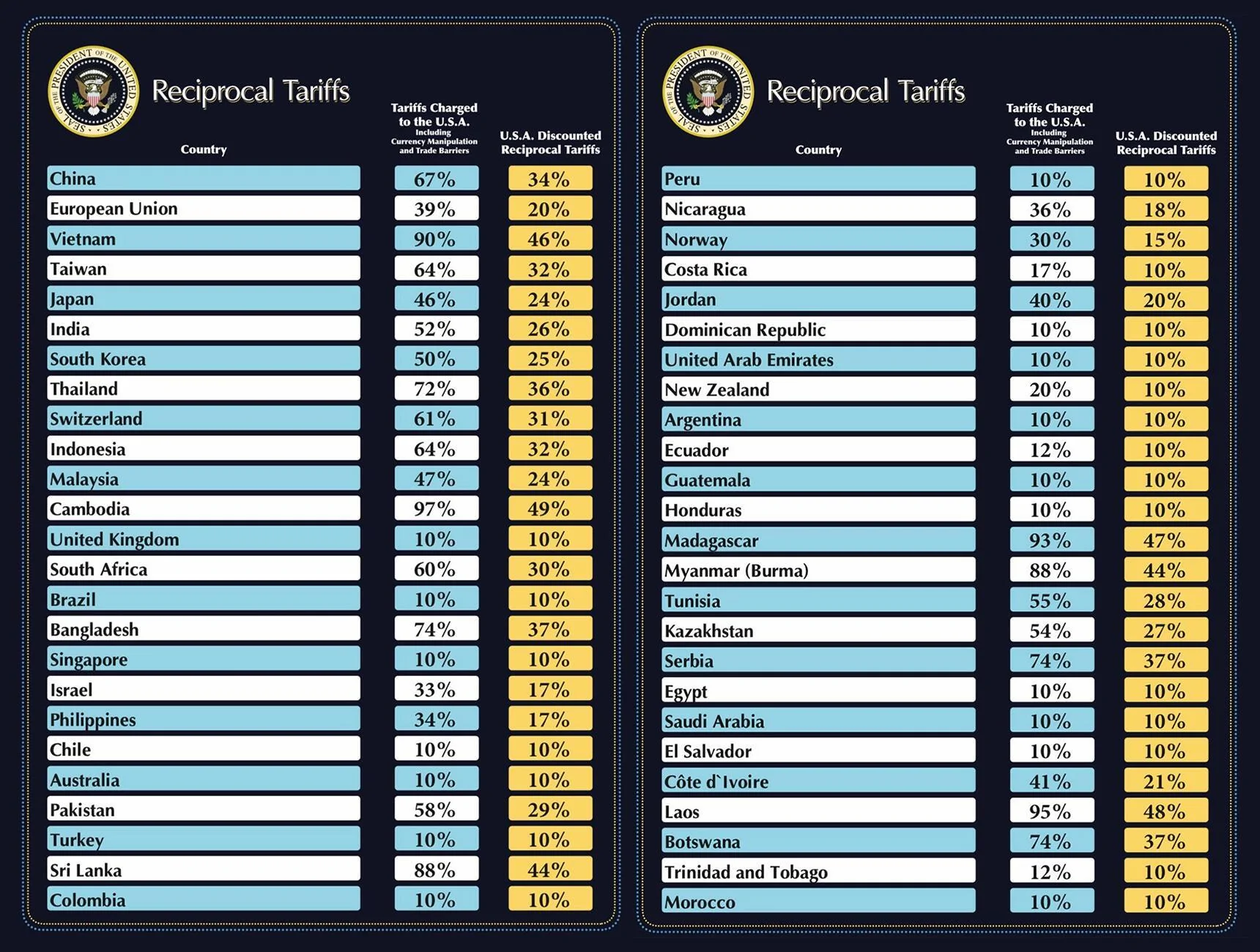
you do realize that chart you posted is made up numbers not reciprocal tariffs correct?Nobody can predict the future. Everyone posting here is just posting opinion. Those who think they have facts about the future are wrong.
As far as tariffs go, we have been subsidizing the world for decades (as @Donald Stanfield pointed out). It isn't political, because no administration before has done anything about it. It is common sense. We should not subsidize anyone other than our own citizens. We certainly should not subsidize our enemies.
These new tariffs are moving us to something closer to free trade. If our friends and enemies want to reduce their tariffs, we can as well. But if they tariff our goods, we should do the same to theirs. That is common sense.

If all we did was add tariffs, I agree with what people are posting about the negative consequences to Rivian and the economy in general. But this is NOT a stand-alone policy. The approach is comprehensive: increase the cost of importing goods, reduce the cost of producing them here. The second part is critical, and it is all part of what the administration is doing.
The administration is reducing regulations that will drive down the cost of doing business in the United States. This has been a top priority since day one, yet I read every single post in this thread and nobody even mentioned it.
$3.079 trillion
The estimated cost of regulations in the US is $3.079 trillion in 2022, which is equal to 12% of U.S. GDP23. Federal agencies finalized $1.4 trillion in net regulatory costs in 2024, making it the costliest year recorded since 20051. However, the benefits of federal regulations in FY2023 were estimated to be $48 to $79 billion at an estimated cost of $15 to $19 billion5.
If the administration can reduce a significant percentage of that burden, which I firmly believe they can, it will be deflationary, offsetting the impact of tariffs significantly. It is possible the reduced regulatory costs will offset the economic impact of tariffs 100%. This is something nobody actually knows, but in my opinion, the positive economic impact of deregulation is vastly underestimated.
But that isn't all they are doing. The administration will pass tax cuts. It has not happened yet, so there is a risk it won't happen the way it should. But I am confident it will happen. (Predicting the future, of course, but it is my opinion.) We all know "no tax on tips, no tax on overtime" but did you also hear "no tax on auto loan interest"? For anyone financing a $100k vehicle, that will be significant. Huge, as some would say. And it will definitely benefit Rivian.
So while it appears I (and one or two others) are in the minority here, I think those in the majority are wrong. You guys are focusing on only one thing and ignoring all the other actions that will have a massively positive impact on the cost of doing business in the USA.
And while many of you are radical environmentalists, and hate this, the cost of energy production will go down. Energy drives the cost of everything, from transportation to manufacturing. And yes, the cost of running data centers will go down also.
Stop focusing on one thing, tariffs. That is only one part of a much bigger picture. And it is about time we started caring more about our own citizens than those of other countries by paying their tariffs and refusing to charge the same here. Common sense is back, finally.

Regarding energy costs going down, it's not clear cut that it will ever happen, and there will be a floor that the industry will not go below. A recent survey of oil industry execs collected the following comments, including several commenting that $50 / bbl oil is not going to happen, contrary to White House predictions. They will lose money on drilling and free cash flow will certainly not improve. Low oil prices do not increase free cash flow:Nobody can predict the future. Everyone posting here is just posting opinion. Those who think they have facts about the future are wrong.
As far as tariffs go, we have been subsidizing the world for decades (as @Donald Stanfield pointed out). It isn't political, because no administration before has done anything about it. It is common sense. We should not subsidize anyone other than our own citizens. We certainly should not subsidize our enemies.
These new tariffs are moving us to something closer to free trade. If our friends and enemies want to reduce their tariffs, we can as well. But if they tariff our goods, we should do the same to theirs. That is common sense.
If all we did was add tariffs, I agree with what people are posting about the negative consequences to Rivian and the economy in general. But this is NOT a stand-alone policy. The approach is comprehensive: increase the cost of importing goods, reduce the cost of producing them here. The second part is critical, and it is all part of what the administration is doing.
The administration is reducing regulations that will drive down the cost of doing business in the United States. This has been a top priority since day one, yet I read every single post in this thread and nobody even mentioned it.
$3.079 trillion
The estimated cost of regulations in the US is $3.079 trillion in 2022, which is equal to 12% of U.S. GDP23. Federal agencies finalized $1.4 trillion in net regulatory costs in 2024, making it the costliest year recorded since 20051. However, the benefits of federal regulations in FY2023 were estimated to be $48 to $79 billion at an estimated cost of $15 to $19 billion5.
If the administration can reduce a significant percentage of that burden, which I firmly believe they can, it will be deflationary, offsetting the impact of tariffs significantly. It is possible the reduced regulatory costs will offset the economic impact of tariffs 100%. This is something nobody actually knows, but in my opinion, the positive economic impact of deregulation is vastly underestimated.
But that isn't all they are doing. The administration will pass tax cuts. It has not happened yet, so there is a risk it won't happen the way it should. But I am confident it will happen. (Predicting the future, of course, but it is my opinion.) We all know "no tax on tips, no tax on overtime" but did you also hear "no tax on auto loan interest"? For anyone financing a $100k vehicle, that will be significant. Huge, as some would say. And it will definitely benefit Rivian.
So while it appears I (and one or two others) are in the minority here, I think those in the majority are wrong. You guys are focusing on only one thing and ignoring all the other actions that will have a massively positive impact on the cost of doing business in the USA.
And while many of you are radical environmentalists, and hate this, the cost of energy production will go down. Energy drives the cost of everything, from transportation to manufacturing. And yes, the cost of running data centers will go down also.
Stop focusing on one thing, tariffs. That is only one part of a much bigger picture. And it is about time we started caring more about our own citizens than those of other countries by paying their tariffs and refusing to charge the same here. Common sense is back, finally.
https://taxfoundation.org/blog/trump-reciprocal-tariffs-calculations/you do realize that chart you posted is made up numbers not reciprocal tariffs correct?

The calculation has been posted and takes into account money manipulation (subsidies), so it's not made up as much as some news agencies have posted...you do realize that chart you posted is made up numbers not reciprocal tariffs correct?
So you don't understand there are additional trade barriers outside of tariffs? If you don't know that, you're not qualified to continue discussing this.you do realize that chart you posted is made up numbers not reciprocal tariffs correct?
You don't add the two together. China, using a combination of currency manipulation, regulation, and tariffs, has a burden of 67% of the product's cost applied to the goods that we sell to them. In response, we have instituted a 34% tariff on the goods they sell to us. Also, it's more like a 46% tariff we are charging them now on most things.Please help me understand...If China was already charging USA 67 percent tariff according to the White House chart, and are retaliating with 34 percent, that's over 100 percent tariff?!? That can't be right.


