Sponsored

DIY A/C Recharge Help

HotPocket

Active Member
First Name
Nate
Joined
Nov 19, 2024
Threads
3
Messages
36
Reaction score
46
Location
12508
Vehicles
Rivian R1S
Occupation
Software Developer
Hey fellow DIY'ers! I'm trying to do a pretty simple A/C recharge on my out-of-warranty R1S. Has anyone attempted this? The service manual is very vague and was written around the use of automated tools, so no answers there.

For a normal ICE recharge I can easily force the pump to run and see that it's engaged via the flywheel. In our Rivians it's not obvious if it's running, or at least not to me (no flywheel, no discernable sounds). I've turned the temp setting on the dashboard as low as it will go and maxed out the air flow. However, while trying to push new refrigerant into the system, the high side pressure isn't getting above 100 psi (needs to get to 200-250) and the low side pressure continues to climb well into the red (should equalize if the pump runs). Normally I'd conclude a faulty pump but, in this case, I'm not convinced I've tricked the pump into engaging. Anyone have any ideas?

Thanks in advance, as always!
Sponsored
 

NY_Rob

Well-Known Member
First Name
Rob
Joined
Feb 9, 2022
Threads
23
Messages
5,396
Reaction score
7,970
Location
long island
Vehicles
Model 3 LR AWD, BMW i3 REX, 2024 Rubicon 4xe
Occupation
IT
You will 1000% hear and feel when the A/C compressor turns on, it is loud as hell and vibrates a lot!

If you have the cab temp set to lowest temp and the compressor isn't coming on, it may be the low-pressure self protection circuit activating to protect the compressor from running with too low refrigerant levels. You can try to add some refrigerant in order to get the compressor to run. I've had this problem happen on a BMW that lost almost all it's refrigerant, adding a few ounces of new refrigerant allowed the compressor to turn on so I could fill it to the proper level.
 
OP
OP

HotPocket

Active Member
First Name
Nate
Joined
Nov 19, 2024
Threads
3
Messages
36
Reaction score
46
Location
12508
Vehicles
Rivian R1S
Occupation
Software Developer
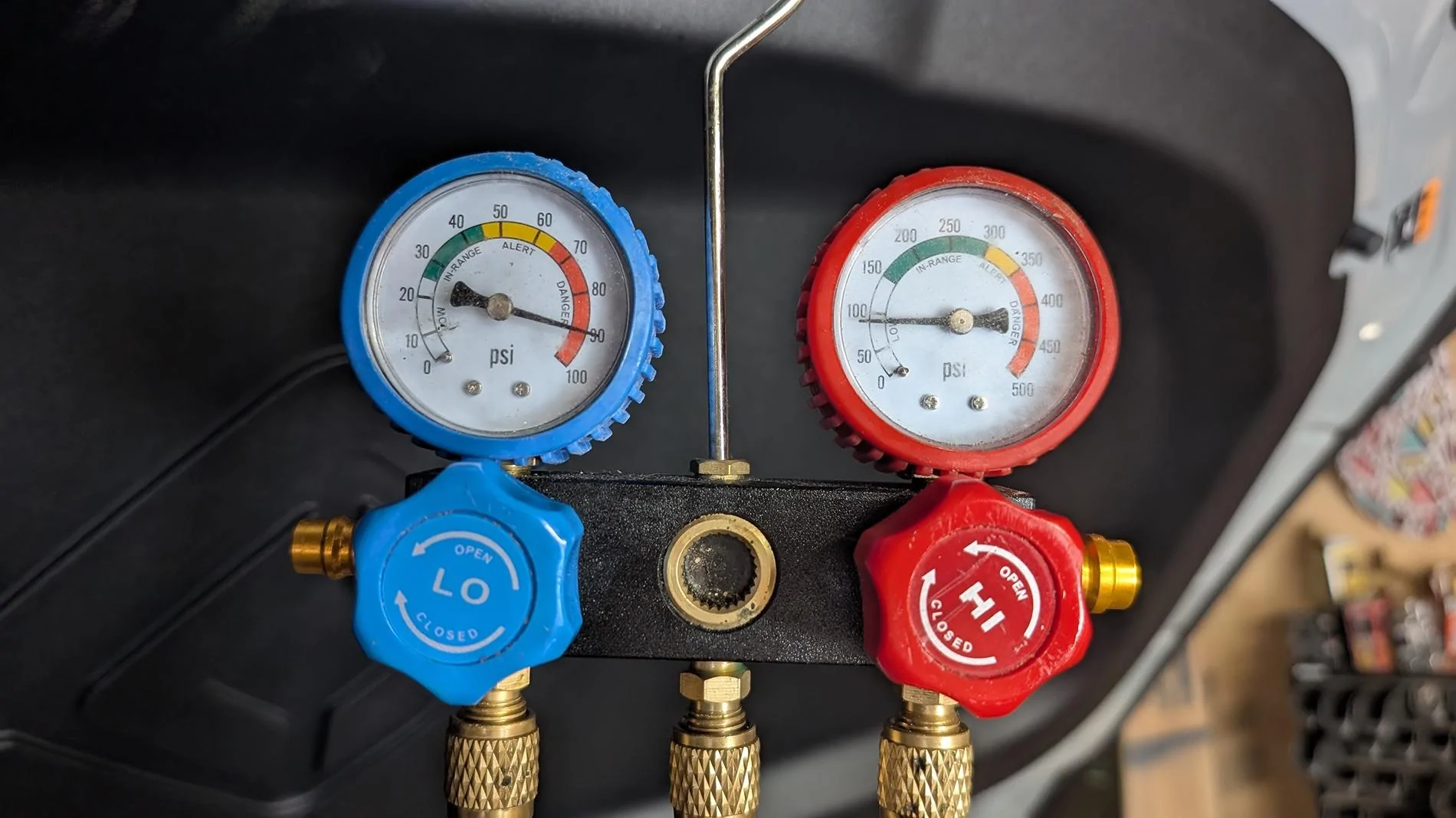
This is very helpful, thank you Rob! So, if my gauges are reading as below, is it safe to say it should have kicked on by now? Perhaps it is a compressor problem? Or could there be high pressure with relatively low refrigerant? It calls for 30 ounces and I'm only 2 cans, or about 16 ounces in.
Rivian R1T R1S DIY A/C Recharge Help ac-pressure-guag
 

NY_Rob

Well-Known Member
First Name
Rob
Joined
Feb 9, 2022
Threads
23
Messages
5,396
Reaction score
7,970
Location
long island
Vehicles
Model 3 LR AWD, BMW i3 REX, 2024 Rubicon 4xe
Occupation
IT
^ were you completely out of refrigerant? I have no experience with the Rivian system, but with 100 PSI on the high side I would guess that's enough to get it out of low pressure protection mode?

Have you checked the fuse (if it has one?) for the A/C compressor? Sorry I have no info on that circuit.

Modern vehicles seldom need recharging, what's the backstory on why yours is low, that may be helpful here.
 

Joe schmoe

Well-Known Member
Joined
Sep 23, 2021
Threads
24
Messages
337
Reaction score
506
Location
Tennessee
Vehicles
Tesla model S
The advice above is good, but another thing to consider is that EVs have to have robust cooling (and heating) to manage not only cabin temps but the battery temp. If your AC isn't working, I'm guessing you'll be unable to DC fast charge.

Hopefully it's the fuse, or something else simple, but you can't run without AC like you can in an ICE vehicle.
 

Sponsored

OP
OP

HotPocket

Active Member
First Name
Nate
Joined
Nov 19, 2024
Threads
3
Messages
36
Reaction score
46
Location
12508
Vehicles
Rivian R1S
Occupation
Software Developer
Hey Rob, Joe,

Thank you for your replies! The main symptoms have been (1) it has blown hot since I got it from the salvage auction; (2) it's giving a "thermal error" whenever I start it; and (3) it eventually seems to overheat and slow to a crawl after about 45 minutes of driving. One service center gave me an unhelpful, cryptic message about a possible issue with the rear drive inverter before telling me they were too busy and short-staffed to work on it (waited 6 weeks for that appointment). Though I'm guessing the drive inverters are cooled with the main coolant system, not the refrigerant.

So, not knowing the full vehicle history, I wanted to start with a full vacuum and replacement of the refrigerant. It did seem to be holding its pressure steady, so I'm guessing no leaks. You're both right- I should have checked the fuse first. It's a bit more involved than a typical fuse and it almost looks like the HV battery and compressor share one giant fuse, according to the attached PDF. I welcome all thoughts and advice.

Thank you both!
 

Attachments

zymolysis

Well-Known Member
First Name
Ross
Joined
May 9, 2022
Threads
3
Messages
891
Reaction score
562
Location
Phoenix Arizona
Vehicles
2022 R1T [RUS, PTC (upgraded), 20"] 2008 Ford E350
Occupation
third party service
Clubs
 
I think there is a thermal transfer liquid (antifreeze) that carries heat to/from the evap coil to the battery, motors, and probably to the cabin heat exchanger, too. Perhaps if this is low or empty, the compressor won't run - it may not actually be low on refrigerant. I'm not sure what the "main coolant system" (that you refer to) is - I think that everything is cooled/heated with liquid (antifreeze) that recycles through the A/C evap coil. There must also be solenoid valves that direct the liquid to where it is needed, and the electronics to turn on/off the appropriate valves. I think there are a lot of possible issues that have nothing to do with refrigerant charge.
 

zymolysis

Well-Known Member
First Name
Ross
Joined
May 9, 2022
Threads
3
Messages
891
Reaction score
562
Location
Phoenix Arizona
Vehicles
2022 R1T [RUS, PTC (upgraded), 20"] 2008 Ford E350
Occupation
third party service
Clubs
 
This is very helpful, thank you Rob! So, if my gauges are reading as below, is it safe to say it should have kicked on by now? Perhaps it is a compressor problem? Or could there be high pressure with relatively low refrigerant? It calls for 30 ounces and I'm only 2 cans, or about 16 ounces in.
ac-pressure-guage.jpg
Your gauges are showing an equalized system - ~90 psi on the high and low side. I assume that your manifold valves are closed?
I don't know what refrigerant is used in the Rivian. What is the appropriate pressure for that refrigerant at ambient?
 

ebellinder2

Well-Known Member
First Name
ED
Joined
Dec 14, 2022
Threads
2
Messages
95
Reaction score
111
Location
Missouri
Vehicles
R1T, Model Y
Occupation
Retired electrician
Your gauges are showing an equalized system - ~90 psi on the high and low side. I assume that your manifold valves are closed?
I don't know what refrigerant is used in the Rivian. What is the appropriate pressure for that refrigerant at ambient?
R1234y
 
OP
OP

HotPocket

Active Member
First Name
Nate
Joined
Nov 19, 2024
Threads
3
Messages
36
Reaction score
46
Location
12508
Vehicles
Rivian R1S
Occupation
Software Developer
Your gauges are showing an equalized system - ~90 psi on the high and low side. I assume that your manifold valves are closed?
I don't know what refrigerant is used in the Rivian. What is the appropriate pressure for that refrigerant at ambient?
Thank you Ross! I very much appreciate your analysis. I think my understanding is similar to yours. The gauges are equalized (valves closed) but my thinking had been that if the compressor runs, and by the description other had offered it seems it did not, then it will be lower on the low pressure side and higher on the high side. So, something isn't happening. I'll try addressing the antifreeze system next to see if that makes a difference. The levels in the reservoir look fine but maybe it's blocked somewhere. I will also check the fuses (just ordered the lineman's gloves).

Ed is right, it's r1234yf, but my research turned up nothing indicating normal ambient pressures for either side of the Rivian system. In every typical ICE system it would be around 50psi on the low and 200-250psi on the high, but the compressor would have to run to achieve that differential (I'm assuming).

This is super helpful and I am grateful for everyone's time and insights. Hopefully this will be helpful for others, eventually.
 

Sponsored

zymolysis

Well-Known Member
First Name
Ross
Joined
May 9, 2022
Threads
3
Messages
891
Reaction score
562
Location
Phoenix Arizona
Vehicles
2022 R1T [RUS, PTC (upgraded), 20"] 2008 Ford E350
Occupation
third party service
Clubs
 
Thank you Ross! I very much appreciate your analysis. I think my understanding is similar to yours. The gauges are equalized (valves closed) but my thinking had been that if the compressor runs, and by the description other had offered it seems it did not, then it will be lower on the low pressure side and higher on the high side. So, something isn't happening. I'll try addressing the antifreeze system next to see if that makes a difference. The levels in the reservoir look fine but maybe it's blocked somewhere. I will also check the fuses (just ordered the lineman's gloves).

Ed is right, it's r1234yf, but my research turned up nothing indicating normal ambient pressures for either side of the Rivian system. In every typical ICE system it would be around 50psi on the low and 200-250psi on the high, but the compressor would have to run to achieve that differential (I'm assuming).

This is super helpful and I am grateful for everyone's time and insights. Hopefully this will be helpful for others, eventually.
Yeah, if the compressor is running normally, the low side will be much lower than the high side. Automotive A/C isn't my area of expertise, so I don't know what would be typical pressures in an R1234yf system when operating.
However, according to the P-T chart, 90psi would be about +48F or +9C - 90 psi is the pressure that pure R1234yf refrigerant will exhibit at that temperature when equalized. If that is the temperature that the mechanics of your Rivian were at when you had the manifold attached, then that much checks out. Adding refrigerant or recovering/evacuating/recharging would be unlikely to be helpful, if that is the case.
There is so much more going on in the refrigeration system in a Rivian, compared to a standard ICE car - heating/cooling the battery and motors, etc.
Fuses (of course), sensors, valves, electronic modules (and wiring harness), thermal transfer system (which must have it's own pump) could all cause issues that would prevent the compressor from running, or prevent it from doing what is expected, if it did run.
 

ebellinder2

Well-Known Member
First Name
ED
Joined
Dec 14, 2022
Threads
2
Messages
95
Reaction score
111
Location
Missouri
Vehicles
R1T, Model Y
Occupation
Retired electrician
Yeah, if the compressor is running normally, the low side will be much lower than the high side. Automotive A/C isn't my area of expertise, so I don't know what would be typical pressures in an R1234yf system when operating.
However, according to the P-T chart, 90psi would be about +48F or +9C - 90 psi is the pressure that pure R1234yf refrigerant will exhibit at that temperature when equalized. If that is the temperature that the mechanics of your Rivian were at when you had the manifold attached, then that much checks out. Adding refrigerant or recovering/evacuating/recharging would be unlikely to be helpful, if that is the case.
There is so much more going on in the refrigeration system in a Rivian, compared to a standard ICE car - heating/cooling the battery and motors, etc.
Fuses (of course), sensors, valves, electronic modules (and wiring harness), thermal transfer system (which must have it's own pump) could all cause issues that would prevent the compressor from running, or prevent it from doing what is expected, if it


It’s typical to charge an automotive system by weighing in the charge. But Rivian maybe complex to the point that sub cooling or superheat calculations might be of value. Similar to a residential system. We really need to view the service manual for the recommended charging procedure
Sponsored


Top