Sponsored

Effect of temperature on battery capacity

Michal

Well-Known Member
First Name
Michael
Joined
Mar 19, 2024
Threads
13
Messages
104
Reaction score
49
Location
NYC
Vehicles
R1T LE
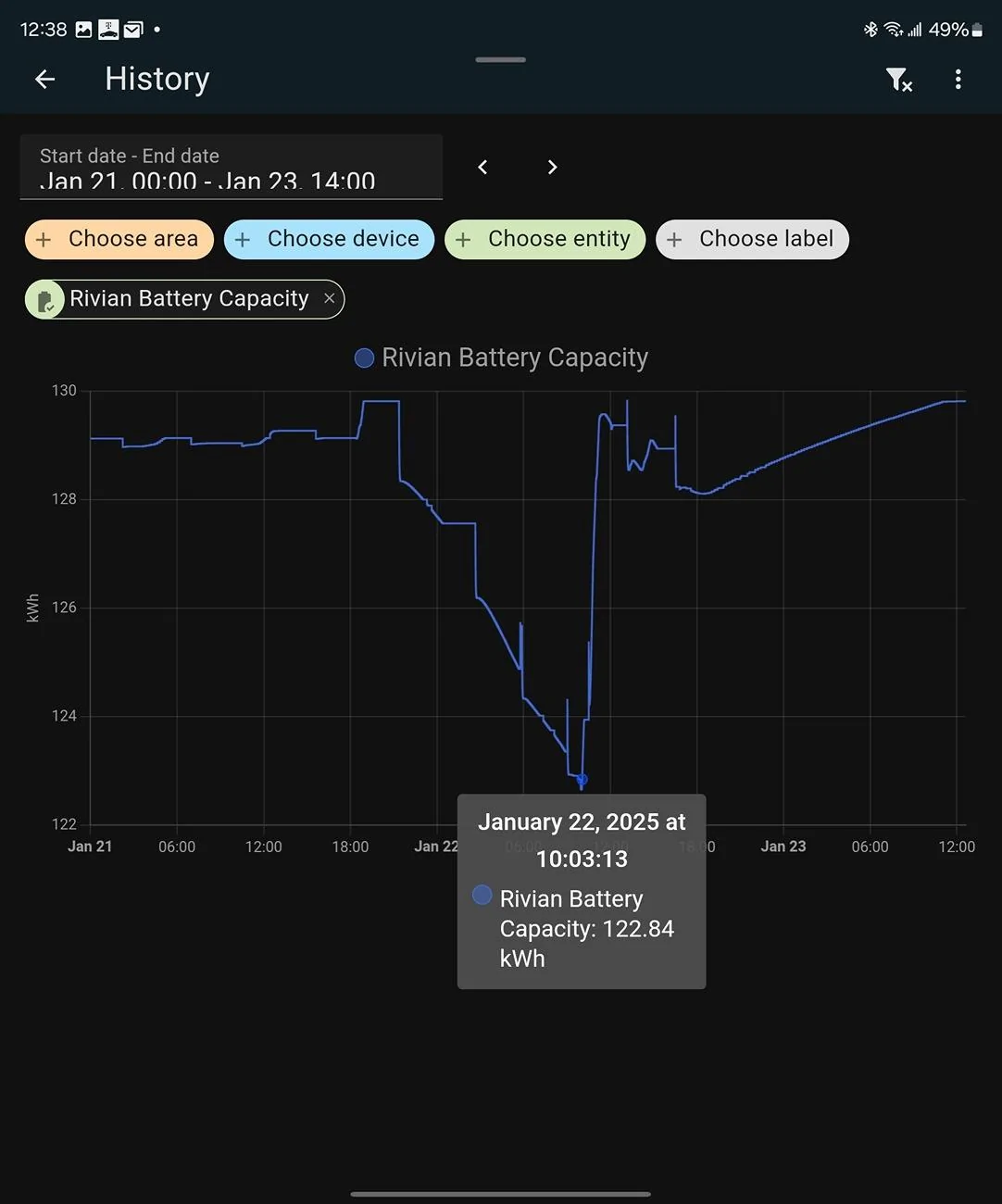
We have all witnessed a drop in range as the temperatures drop. I usually monitor my battery capacity to estimate degradation. Interestingly, the battery capacity reported by BMS changes with temperature. I started in my garage at about 65 degrees. And about 129kW capacity. When I got to my destination the outside temperature overnight was 10F.The next morning reported capacity dropped to about 122kW. I drove home starting with 0.8mi/kw efficiency. Once I plugged into L1 charger in a heated garage the reported capacity came back
2022 R1T LE

Rivian R1T R1S Effect of temperature on battery capacity Screenshot_20250123_123818_Home Assistant
Sponsored


KidThunder

Well-Known Member
First Name
Andrew
Joined
Mar 1, 2022
Threads
0
Messages
50
Reaction score
40
Location
Iowa
Vehicles
R1T
Occupation
Entertainment
Clubs
 
I drove home starting with 0.8mi/kw efficiency.
I just had a similar experience where I charged the vehicle up overnight, but outside with temps in the single digits. On a full charge I wasn't able to make a 190 mile trip without stopping. And even with preconditioning, we weren't able to pull charging speeds faster than 22kW and we tried two different locations and multiple stalls at each one. It was not a great experience.
 

VSG

Well-Known Member
Joined
Oct 3, 2022
Threads
4
Messages
3,252
Reaction score
6,078
Location
WA
Vehicles
R1T LE/RB/OC/20
Interestingly, the battery capacity reported by BMS changes with temperature
Isn't this obvious and expected?

Google "battery capacity as a function of temperature"

This is extremely well-known, for something like two hundred years. The details depend on the battery chemistry because these are chemical reactions where, like most chemical reactions, the reaction rate is sensitive to temperature.
 
OP
OP

Michal

Well-Known Member
First Name
Michael
Joined
Mar 19, 2024
Threads
13
Messages
104
Reaction score
49
Location
NYC
Vehicles
R1T LE
Thank your for your insightful response ;)

Isn't this obvious and expected?

Google "battery capacity as a function of temperature"

This is extremely well-known, for something like two hundred years. The details depend on the battery chemistry because these are chemical reactions where, like most chemical reactions, the reaction rate is sensitive to temperature.
 

Sponsored

VSG

Well-Known Member
Joined
Oct 3, 2022
Threads
4
Messages
3,252
Reaction score
6,078
Location
WA
Vehicles
R1T LE/RB/OC/20
Shrug. I don't know why people act surprised about things like this. It's all well-known. Same thing happens to the 12V on an ICE car for example. Did you do the Google search I suggested? Those results have nothing to do with EVs - this is just how batteries of all kinds work.

I would expect the range on the vehicle computer would say 150 instead of 300
Umm, the driver's screen is just a fuel gauge. It shows you percent capacity times the (fixed) EPA mileage. When the temperature drops, the percent capacity doesn't change, so the fuel gauge doesn't change.
 

VSG

Well-Known Member
Joined
Oct 3, 2022
Threads
4
Messages
3,252
Reaction score
6,078
Location
WA
Vehicles
R1T LE/RB/OC/20
Oh, and also, you know a similar thing happens with ICE vehicles, right? Gasoline, like most liquids, expands with temperature, so in really hot weather you actually have less energy available per gallon, because gallon is a volume. So your range on a full tank goes down.
 

MidnightM00N

Well-Known Member
Joined
Aug 7, 2024
Threads
1
Messages
115
Reaction score
93
Location
Cincinnati
Vehicles
2025 R1S DM Max, 2015 Tesla S90D, 2000 Lexus LX470
Shrug. I don't know why people act surprised about things like this. It's all well-known. Same thing happens to the 12V on an ICE car for example. Did you do the Google search I suggested? Those results have nothing to do with EVs - this is just how batteries of all kinds work.


Umm, the driver's screen is just a fuel gauge. It shows you percent capacity times the (fixed) EPA mileage. When the temperature drops, the percent capacity doesn't change, so the fuel gauge doesn't change.
The odd thing is rivians method in the cold (per my electrafi data) is to reduce the total kWh capacity and not the available capacity based on temp. This increases percentage charge to maintain a steady range estimate and is misleading.
 
OP
OP

Michal

Well-Known Member
First Name
Michael
Joined
Mar 19, 2024
Threads
13
Messages
104
Reaction score
49
Location
NYC
Vehicles
R1T LE
@VSG I dont think anyone is surprised. As much as I appreciate your explanation, I am not talking about the effect of temperature on the battery chemistry I am referring to the "perceived" battery capacity as reported by the BMS.

The odd thing is rivians method in the cold (per my electrafi data) is to reduce the total kWh capacity and not the available capacity based on temp. This increases percentage charge to maintain a steady range estimate and is misleading.
 

Sponsored

OP
OP

Michal

Well-Known Member
First Name
Michael
Joined
Mar 19, 2024
Threads
13
Messages
104
Reaction score
49
Location
NYC
Vehicles
R1T LE
The odd thing is rivians method in the cold (per my electrafi data) is to reduce the total kWh capacity and not the available capacity based on temp. This increases percentage charge to maintain a steady range estimate and is misleading.
exactly


Top