
ksurfier
Well-Known Member
- Thread starter
- #1
Why Tire Weight Affects EVs More Than ICE Vehicles
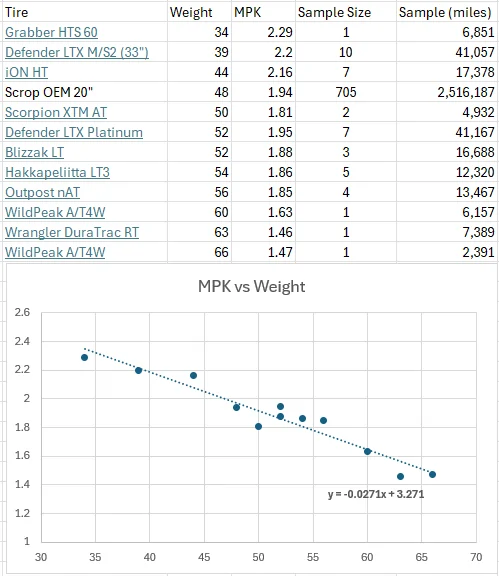
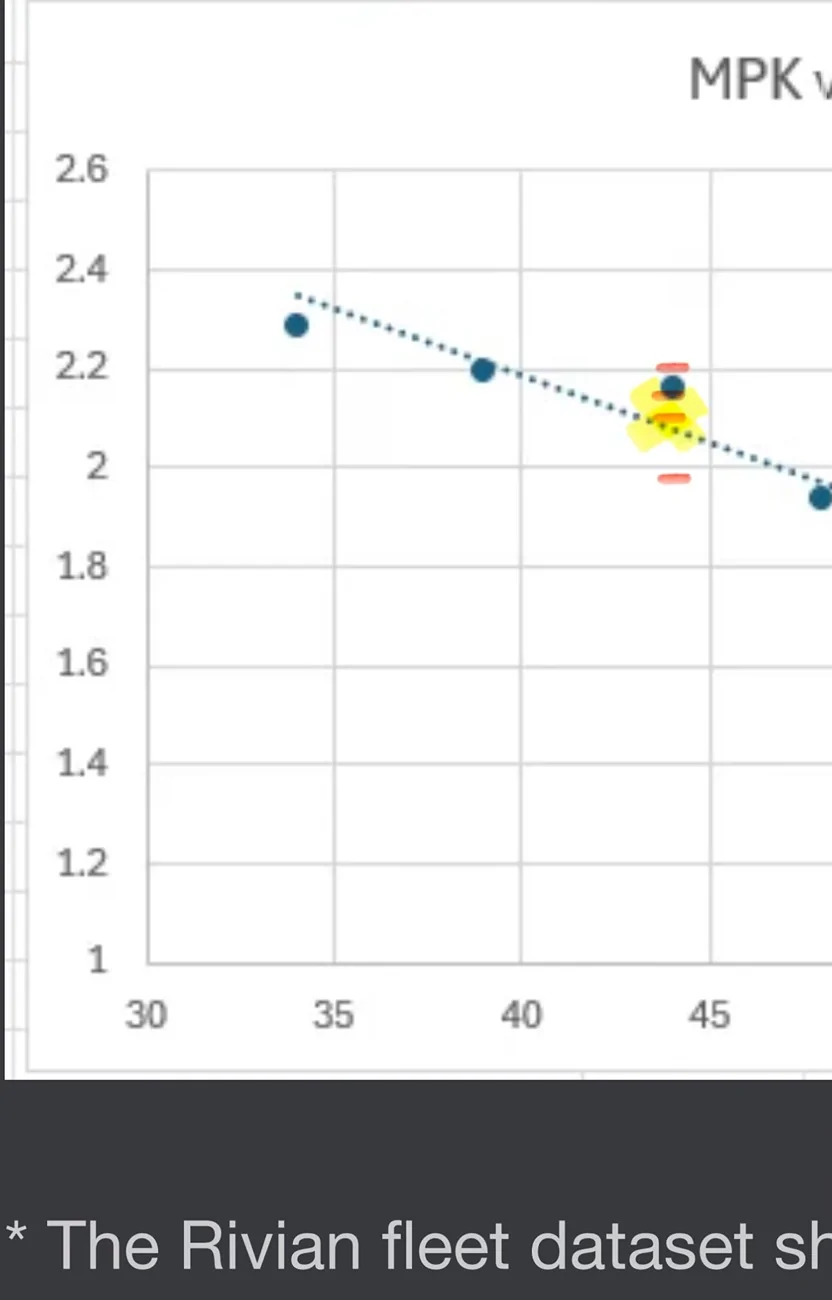
Tire weight matters on every vehicle, but it tends to matter more noticeably on EVs because EV efficiency is already very high, range is directly tied to battery energy, and the tire is not just “dead weight” like cargo in the trunk. A tire is rotating mass located near the outside of a large-diameter wheel assembly. That means it affects acceleration, regenerative braking, rolling resistance, ride quality, suspension control, and ultimately range.
The key point is this: a heavier tire hurts an EV twice during acceleration. First, the vehicle must move the tire forward as part of the vehicle’s total mass. Second, the motor must also spin that tire. Because much of a tire’s mass is near the outside diameter, its rotational inertia is relatively high. For a simplified tire treated like a hoop:
E_{rot} = 1/2 mv^2
and the tire also has translational energy:
E_{trans} = 1/2 mv^2
So, during acceleration, each pound added to the tire can behave roughly like two pounds of effective mass. That is not perfectly exact because real tires are not perfect hoops, but it is a useful rule of thumb. A pound added to the tread/outer tire carcass is much worse than a pound added near the hub.
This is why a 54 lb tire is not merely “20 lb heavier” than a 34 lb tire. On a four-wheel vehicle, it adds 80 lb of actual vehicle mass, but during acceleration it can feel closer to 160 lb of added effective mass because the tire must both translate and rotate.
NHTSA notes that tire design, materials, construction, tread design, inflation, and rolling resistance all affect fuel efficiency, and it estimates that a 10% reduction in tire rolling resistance can improve vehicle fuel economy by about 1–2%. NHTSA also specifically notes that low-rolling-resistance replacement tires can extend the range of electric and hybrid vehicles. Tire Rack similarly describes low rolling resistance as the main defining feature of EV-focused tires because the less force the tire works against, the farther the vehicle can travel on one charge.
⸻
The Three 33-Inch Examples
Assume all three options use the same 33-inch overall tire diameter and the same 30 lb rim. Only the tire weight changes.
Option | Rim | Tire | Wheel/tire per corner | Total wheel/tire set | Diff. vs 34 lb tire
Light all-season | 30 lb | 34 lb | 64 lb | 256 lb | Baseline
Medium all-season | 30 lb | 44 lb | 74 lb | 296 lb | +40 lb actual
Heavy all-season | 30 lb | 54 lb | 84 lb | 336 lb | +80 lb actual
The 44 lb tire set adds 40 lb of actual vehicle mass compared with the 34 lb tire set. Because that added mass is in the tire, near the outer rotating radius, it behaves roughly like 80 lb of added acceleration mass. The 54 lb tire set adds 80 lb actual and roughly 160 lb effective acceleration mass compared with the 34 lb option.
At one 0–60 mph acceleration event, the extra energy stored in the four tire/wheel assemblies is not enormous, but it is real. Using a simplified 33-inch rolling radius and treating the tire as hoop-like mass:
Tire option | Approx. wheel/tire energy at 0–60 mph | Extra vs 34 lb tire
34 lb tire + 30 lb rim | ~19.8 Wh | Baseline
44 lb tire + 30 lb rim | ~23.4 Wh | +3.6 Wh
54 lb tire + 30 lb rim | ~27.0 Wh | +7.3 Wh
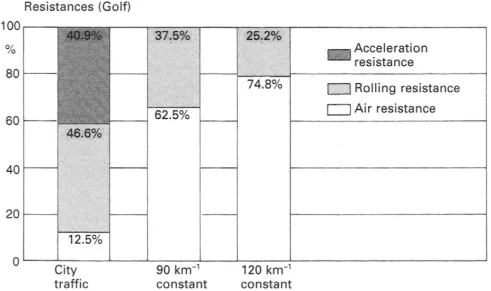
That may not look huge for a single acceleration, but real driving is made of hundreds of small accelerations, decelerations, grade changes, speed corrections, and stop-and-go events. More importantly, the heavier tire usually also has a heavier casing, deeper tread, stiffer reinforcement, or more aggressive construction. Those design choices can increase rolling resistance and heat loss. Oak Ridge National Laboratory reviewed BEV range loss related to replacement tires and reported that replacement tires can have meaningfully higher rolling-resistance coefficients than OEM tires; in one cited CEC dataset, replacement tires averaged 20.7% higher rolling resistance than OEM tires, and Michelin data showed a 23% difference.
That rolling-resistance effect is usually much more important for highway range than rotational inertia alone.
⸻
Why EVs Feel the Penalty More
An ICE vehicle also pays for heavier tires. The same physics applies. But in an EV, the penalty is more visible for several reasons.
First, an EV has a limited onboard energy reserve compared with gasoline. A 100 kWh battery sounds large, but a gasoline tank contains far more chemical energy. The EV uses its energy far more efficiently, but because the pack is finite and range is shown directly on the dashboard, small changes in Wh/mi become noticeable. A tire that adds 15–30 Wh/mi through higher rolling resistance can take a real bite out of range.
Second, EVs expose tire losses because their drivetrains are efficient. In an ICE vehicle, the engine already wastes a large share of fuel energy as heat. Tire losses still reduce MPG, but they are partly hidden inside a much larger set of engine, transmission, pumping, and thermal losses. In an EV, the motor and inverter are efficient enough that tire losses stand out more clearly. A few percent range loss is easy to notice.
Third, EVs are heavy and have high instant torque. Continental notes that EV tires are designed around heavier vehicle weight, instant torque, low rolling resistance, and regenerative braking demands. That instant torque makes tire mass and tire construction more important. A heavy tire is harder to spin up, and a soft/heavy/high-hysteresis tire converts more energy into heat every revolution.
Fourth, regenerative braking does not fully erase the penalty. In theory, some kinetic energy from a heavier tire can be recovered during braking. In practice, regen is not 100% efficient, and energy lost inside the tire as heat from deformation cannot be recovered. Rolling resistance is a one-way loss. Once the tire flexes and heats the rubber, that energy is gone.
Fifth, EVs are quiet, so tire effects are more noticeable. In an ICE vehicle, engine and exhaust noise mask tire noise and vibration. In an EV, road noise, tread slap, casing stiffness, and unsprung mass become more obvious.
⸻
The 34 lb Tire Option: Efficiency-Focused
The 34 lb all-season tire is the efficiency choice. With a 30 lb rim, each wheel/tire assembly is 64 lb, or 256 lb for the set. For a 33-inch EV tire, that is relatively light.
This option should generally give the best result for:
* range
* acceleration response
* braking feel
* ride comfort
* suspension compliance
* steering lightness
* efficiency in stop-and-go driving
The biggest advantage is not just the 40–80 lb total weight savings compared with the heavier options. The advantage is that the weight savings are located in the most sensitive place: the outer rotating tire. A lighter tire reduces rotational inertia and usually reduces unsprung mass. Unsprung mass matters because the suspension has to control the wheel/tire assembly as it moves over bumps. Lower unsprung mass helps the tire follow the road with less impact harshness and less wasted motion.
For an EV truck/SUV, a 34 lb 33-inch all-season tire would be the tire you choose if range is the priority and the tire still has the required load rating, sidewall strength, speed rating, and durability.
The caution is that a very light tire may achieve that weight by having less tread depth, lighter casing construction, lower puncture resistance, or less load capacity. For a heavy EV, the tire cannot merely be light; it must also be structurally appropriate.
⸻
The 44 lb Tire Option: Balanced Middle Ground
The 44 lb all-season tire is probably the practical middle choice. With the same 30 lb rim, the assembly becomes 74 lb per corner and 296 lb for the set. Compared with the 34 lb tire, the vehicle gains 40 lb of actual mass and roughly 80 lb of effective acceleration mass.
That penalty is real, but not catastrophic. If the 44 lb tire has better load rating, better tread life, stronger sidewalls, lower noise, better wet traction, or better puncture resistance, it may be the best real-world compromise. For a heavy EV SUV or truck, this is often where the tire market lands: not ultralight, but not overbuilt.
The key is rolling resistance. A 44 lb tire with an EV-oriented low-rolling-resistance compound may outperform a 34 lb tire that has a stickier, higher-loss compound. Weight is an important clue, but it is not the entire answer. The best tire is the one that combines low mass, low rolling resistance, adequate load rating, and good casing design.
For EV use, the 44 lb option is the “prove it with data” tire. If its rolling resistance is low and the tire is EV-tuned, it could be acceptable. If it is simply heavier because it has more rubber and a less efficient casing, it will likely cost noticeable range.
⸻
The 54 lb Tire Option: Durability-Heavy, Efficiency-Poor
The 54 lb tire is the range-risk option. With a 30 lb rim, each corner becomes 84 lb, or 336 lb for the full set. Compared with the 34 lb option, the set adds 80 lb of actual vehicle mass and about 160 lb of effective acceleration mass.
That is a meaningful penalty for an EV. It will not destroy range by itself, but it pushes the vehicle in the wrong direction. It increases rotational inertia, unsprung mass, ride harshness, suspension workload, and likely rolling losses. If the extra weight comes from deeper tread, stronger sidewalls, LT construction, reinforced plies, or more aggressive tread blocks, then the range loss could be much larger than the scale weight suggests.
A 54 lb 33-inch all-season tire may still make sense in certain cases: heavy towing, rough roads, high puncture risk, commercial use, off-pavement driving, or if the lighter tire lacks the required load rating. But for EV efficiency, it is the least attractive of the three.
For a Rivian-style EV SUV/truck, going from the 34 lb tire to the 54 lb tire is the kind of change that can make the vehicle feel slightly more sluggish, reduce range, increase road impact harshness, and make the suspension work harder. The penalty is especially noticeable around town and on rolling terrain. At steady highway speed, the main penalty is less about rotational inertia and more about rolling resistance and tire deformation.
⸻
The Important Distinction: Tire Weight vs Rolling Resistance
Tire weight and rolling resistance are related, but they are not the same thing.
A heavier tire often has more material, deeper tread, stronger sidewalls, or more aggressive construction. Those features can increase hysteresis, which is the energy lost as the rubber flexes and rebounds. That lost energy becomes heat. But a light tire is not automatically efficient, and a heavy tire is not automatically inefficient. Compound, tread pattern, casing design, inflation pressure, load index, temperature, and tread depth all matter.
That is why two tires of the same size and same category can behave very differently. One 44 lb all-season tire might be EV-optimized and efficient. Another 44 lb tire might be a range killer. ORNL’s review is important here because it shows that replacement tire rolling resistance can differ materially from OEM tires, and those differences can affect BEV range.
For EVs, the best ranking method is not simply “pick the lightest tire.” A better hierarchy is:
1. Correct load rating and safety margin
2. Low rolling resistance / EV-tuned construction
3. Lower tire weight
4. Reasonable tread depth and durability
5. Acceptable wet braking and ride/noise performance
For range, a 34 lb tire with poor rolling resistance could lose to a 44 lb EV tire. But if the tires are otherwise similar all-season designs, the lighter tire has a major advantage.
⸻
Why the Same Tire Change Seems Smaller on an ICE Vehicle
On an ICE vehicle, the 34/44/54 lb tire comparison still matters. It affects acceleration, braking, suspension response, MPG, and ride quality. But the owner may notice it less because the vehicle has a large liquid-fuel energy reserve, fast refueling, engine noise, transmission gearing, and much higher baseline energy waste.
An ICE driver may see a modest MPG drop. An EV driver sees the same type of loss as reduced range, more frequent charging, lower mi/kWh, and more obvious road noise. That makes tire choice feel more consequential.
Also, EVs rely on efficiency as part of their design identity. A tire that costs an ICE vehicle 1–2% fuel economy may feel like a minor MPG issue. A tire that costs an EV 3–8% range can meaningfully affect whether a trip needs an extra charging stop.
⸻
Bottom Line
For a 33-inch EV tire on a 30 lb rim, the three examples sort out clearly:
The 34 lb tire is the efficiency leader. It minimizes rotating mass, unsprung mass, and acceleration energy. It is the best choice if it has the correct load rating and acceptable durability.
The 44 lb tire is the likely compromise. It may be worth the 40 lb set penalty if it provides better load capacity, tread life, comfort, or EV-specific low rolling resistance.
The 54 lb tire is the durability-heavy option. It may be appropriate for rough use, towing, or severe-duty needs, but it is the worst choice for EV efficiency unless its rolling resistance is surprisingly good.
The most important conclusion is that tire weight affects EVs more than ICE vehicles not because EVs obey different physics, but because EVs make tire losses more visible. They are efficient enough that the tire becomes a larger share of the total energy budget, they recover some but not all kinetic energy through regen, and their range is directly tied to every Wh/mi. For an EV, especially a heavy EV SUV or truck, tire choice is not a small accessory decision. It is one of the most important range and drivability decisions you can make
Tire weight matters on every vehicle, but it tends to matter more noticeably on EVs because EV efficiency is already very high, range is directly tied to battery energy, and the tire is not just “dead weight” like cargo in the trunk. A tire is rotating mass located near the outside of a large-diameter wheel assembly. That means it affects acceleration, regenerative braking, rolling resistance, ride quality, suspension control, and ultimately range.
The key point is this: a heavier tire hurts an EV twice during acceleration. First, the vehicle must move the tire forward as part of the vehicle’s total mass. Second, the motor must also spin that tire. Because much of a tire’s mass is near the outside diameter, its rotational inertia is relatively high. For a simplified tire treated like a hoop:
E_{rot} = 1/2 mv^2
and the tire also has translational energy:
E_{trans} = 1/2 mv^2
So, during acceleration, each pound added to the tire can behave roughly like two pounds of effective mass. That is not perfectly exact because real tires are not perfect hoops, but it is a useful rule of thumb. A pound added to the tread/outer tire carcass is much worse than a pound added near the hub.
This is why a 54 lb tire is not merely “20 lb heavier” than a 34 lb tire. On a four-wheel vehicle, it adds 80 lb of actual vehicle mass, but during acceleration it can feel closer to 160 lb of added effective mass because the tire must both translate and rotate.
NHTSA notes that tire design, materials, construction, tread design, inflation, and rolling resistance all affect fuel efficiency, and it estimates that a 10% reduction in tire rolling resistance can improve vehicle fuel economy by about 1–2%. NHTSA also specifically notes that low-rolling-resistance replacement tires can extend the range of electric and hybrid vehicles. Tire Rack similarly describes low rolling resistance as the main defining feature of EV-focused tires because the less force the tire works against, the farther the vehicle can travel on one charge.
⸻
The Three 33-Inch Examples
Assume all three options use the same 33-inch overall tire diameter and the same 30 lb rim. Only the tire weight changes.
Option | Rim | Tire | Wheel/tire per corner | Total wheel/tire set | Diff. vs 34 lb tire
Light all-season | 30 lb | 34 lb | 64 lb | 256 lb | Baseline
Medium all-season | 30 lb | 44 lb | 74 lb | 296 lb | +40 lb actual
Heavy all-season | 30 lb | 54 lb | 84 lb | 336 lb | +80 lb actual
The 44 lb tire set adds 40 lb of actual vehicle mass compared with the 34 lb tire set. Because that added mass is in the tire, near the outer rotating radius, it behaves roughly like 80 lb of added acceleration mass. The 54 lb tire set adds 80 lb actual and roughly 160 lb effective acceleration mass compared with the 34 lb option.
At one 0–60 mph acceleration event, the extra energy stored in the four tire/wheel assemblies is not enormous, but it is real. Using a simplified 33-inch rolling radius and treating the tire as hoop-like mass:
Tire option | Approx. wheel/tire energy at 0–60 mph | Extra vs 34 lb tire
34 lb tire + 30 lb rim | ~19.8 Wh | Baseline
44 lb tire + 30 lb rim | ~23.4 Wh | +3.6 Wh
54 lb tire + 30 lb rim | ~27.0 Wh | +7.3 Wh
That may not look huge for a single acceleration, but real driving is made of hundreds of small accelerations, decelerations, grade changes, speed corrections, and stop-and-go events. More importantly, the heavier tire usually also has a heavier casing, deeper tread, stiffer reinforcement, or more aggressive construction. Those design choices can increase rolling resistance and heat loss. Oak Ridge National Laboratory reviewed BEV range loss related to replacement tires and reported that replacement tires can have meaningfully higher rolling-resistance coefficients than OEM tires; in one cited CEC dataset, replacement tires averaged 20.7% higher rolling resistance than OEM tires, and Michelin data showed a 23% difference.
That rolling-resistance effect is usually much more important for highway range than rotational inertia alone.
⸻
Why EVs Feel the Penalty More
An ICE vehicle also pays for heavier tires. The same physics applies. But in an EV, the penalty is more visible for several reasons.
First, an EV has a limited onboard energy reserve compared with gasoline. A 100 kWh battery sounds large, but a gasoline tank contains far more chemical energy. The EV uses its energy far more efficiently, but because the pack is finite and range is shown directly on the dashboard, small changes in Wh/mi become noticeable. A tire that adds 15–30 Wh/mi through higher rolling resistance can take a real bite out of range.
Second, EVs expose tire losses because their drivetrains are efficient. In an ICE vehicle, the engine already wastes a large share of fuel energy as heat. Tire losses still reduce MPG, but they are partly hidden inside a much larger set of engine, transmission, pumping, and thermal losses. In an EV, the motor and inverter are efficient enough that tire losses stand out more clearly. A few percent range loss is easy to notice.
Third, EVs are heavy and have high instant torque. Continental notes that EV tires are designed around heavier vehicle weight, instant torque, low rolling resistance, and regenerative braking demands. That instant torque makes tire mass and tire construction more important. A heavy tire is harder to spin up, and a soft/heavy/high-hysteresis tire converts more energy into heat every revolution.
Fourth, regenerative braking does not fully erase the penalty. In theory, some kinetic energy from a heavier tire can be recovered during braking. In practice, regen is not 100% efficient, and energy lost inside the tire as heat from deformation cannot be recovered. Rolling resistance is a one-way loss. Once the tire flexes and heats the rubber, that energy is gone.
Fifth, EVs are quiet, so tire effects are more noticeable. In an ICE vehicle, engine and exhaust noise mask tire noise and vibration. In an EV, road noise, tread slap, casing stiffness, and unsprung mass become more obvious.
⸻
The 34 lb Tire Option: Efficiency-Focused
The 34 lb all-season tire is the efficiency choice. With a 30 lb rim, each wheel/tire assembly is 64 lb, or 256 lb for the set. For a 33-inch EV tire, that is relatively light.
This option should generally give the best result for:
* range
* acceleration response
* braking feel
* ride comfort
* suspension compliance
* steering lightness
* efficiency in stop-and-go driving
The biggest advantage is not just the 40–80 lb total weight savings compared with the heavier options. The advantage is that the weight savings are located in the most sensitive place: the outer rotating tire. A lighter tire reduces rotational inertia and usually reduces unsprung mass. Unsprung mass matters because the suspension has to control the wheel/tire assembly as it moves over bumps. Lower unsprung mass helps the tire follow the road with less impact harshness and less wasted motion.
For an EV truck/SUV, a 34 lb 33-inch all-season tire would be the tire you choose if range is the priority and the tire still has the required load rating, sidewall strength, speed rating, and durability.
The caution is that a very light tire may achieve that weight by having less tread depth, lighter casing construction, lower puncture resistance, or less load capacity. For a heavy EV, the tire cannot merely be light; it must also be structurally appropriate.
⸻
The 44 lb Tire Option: Balanced Middle Ground
The 44 lb all-season tire is probably the practical middle choice. With the same 30 lb rim, the assembly becomes 74 lb per corner and 296 lb for the set. Compared with the 34 lb tire, the vehicle gains 40 lb of actual mass and roughly 80 lb of effective acceleration mass.
That penalty is real, but not catastrophic. If the 44 lb tire has better load rating, better tread life, stronger sidewalls, lower noise, better wet traction, or better puncture resistance, it may be the best real-world compromise. For a heavy EV SUV or truck, this is often where the tire market lands: not ultralight, but not overbuilt.
The key is rolling resistance. A 44 lb tire with an EV-oriented low-rolling-resistance compound may outperform a 34 lb tire that has a stickier, higher-loss compound. Weight is an important clue, but it is not the entire answer. The best tire is the one that combines low mass, low rolling resistance, adequate load rating, and good casing design.
For EV use, the 44 lb option is the “prove it with data” tire. If its rolling resistance is low and the tire is EV-tuned, it could be acceptable. If it is simply heavier because it has more rubber and a less efficient casing, it will likely cost noticeable range.
⸻
The 54 lb Tire Option: Durability-Heavy, Efficiency-Poor
The 54 lb tire is the range-risk option. With a 30 lb rim, each corner becomes 84 lb, or 336 lb for the full set. Compared with the 34 lb option, the set adds 80 lb of actual vehicle mass and about 160 lb of effective acceleration mass.
That is a meaningful penalty for an EV. It will not destroy range by itself, but it pushes the vehicle in the wrong direction. It increases rotational inertia, unsprung mass, ride harshness, suspension workload, and likely rolling losses. If the extra weight comes from deeper tread, stronger sidewalls, LT construction, reinforced plies, or more aggressive tread blocks, then the range loss could be much larger than the scale weight suggests.
A 54 lb 33-inch all-season tire may still make sense in certain cases: heavy towing, rough roads, high puncture risk, commercial use, off-pavement driving, or if the lighter tire lacks the required load rating. But for EV efficiency, it is the least attractive of the three.
For a Rivian-style EV SUV/truck, going from the 34 lb tire to the 54 lb tire is the kind of change that can make the vehicle feel slightly more sluggish, reduce range, increase road impact harshness, and make the suspension work harder. The penalty is especially noticeable around town and on rolling terrain. At steady highway speed, the main penalty is less about rotational inertia and more about rolling resistance and tire deformation.
⸻
The Important Distinction: Tire Weight vs Rolling Resistance
Tire weight and rolling resistance are related, but they are not the same thing.
A heavier tire often has more material, deeper tread, stronger sidewalls, or more aggressive construction. Those features can increase hysteresis, which is the energy lost as the rubber flexes and rebounds. That lost energy becomes heat. But a light tire is not automatically efficient, and a heavy tire is not automatically inefficient. Compound, tread pattern, casing design, inflation pressure, load index, temperature, and tread depth all matter.
That is why two tires of the same size and same category can behave very differently. One 44 lb all-season tire might be EV-optimized and efficient. Another 44 lb tire might be a range killer. ORNL’s review is important here because it shows that replacement tire rolling resistance can differ materially from OEM tires, and those differences can affect BEV range.
For EVs, the best ranking method is not simply “pick the lightest tire.” A better hierarchy is:
1. Correct load rating and safety margin
2. Low rolling resistance / EV-tuned construction
3. Lower tire weight
4. Reasonable tread depth and durability
5. Acceptable wet braking and ride/noise performance
For range, a 34 lb tire with poor rolling resistance could lose to a 44 lb EV tire. But if the tires are otherwise similar all-season designs, the lighter tire has a major advantage.
⸻
Why the Same Tire Change Seems Smaller on an ICE Vehicle
On an ICE vehicle, the 34/44/54 lb tire comparison still matters. It affects acceleration, braking, suspension response, MPG, and ride quality. But the owner may notice it less because the vehicle has a large liquid-fuel energy reserve, fast refueling, engine noise, transmission gearing, and much higher baseline energy waste.
An ICE driver may see a modest MPG drop. An EV driver sees the same type of loss as reduced range, more frequent charging, lower mi/kWh, and more obvious road noise. That makes tire choice feel more consequential.
Also, EVs rely on efficiency as part of their design identity. A tire that costs an ICE vehicle 1–2% fuel economy may feel like a minor MPG issue. A tire that costs an EV 3–8% range can meaningfully affect whether a trip needs an extra charging stop.
⸻
Bottom Line
For a 33-inch EV tire on a 30 lb rim, the three examples sort out clearly:
The 34 lb tire is the efficiency leader. It minimizes rotating mass, unsprung mass, and acceleration energy. It is the best choice if it has the correct load rating and acceptable durability.
The 44 lb tire is the likely compromise. It may be worth the 40 lb set penalty if it provides better load capacity, tread life, comfort, or EV-specific low rolling resistance.
The 54 lb tire is the durability-heavy option. It may be appropriate for rough use, towing, or severe-duty needs, but it is the worst choice for EV efficiency unless its rolling resistance is surprisingly good.
The most important conclusion is that tire weight affects EVs more than ICE vehicles not because EVs obey different physics, but because EVs make tire losses more visible. They are efficient enough that the tire becomes a larger share of the total energy budget, they recover some but not all kinetic energy through regen, and their range is directly tied to every Wh/mi. For an EV, especially a heavy EV SUV or truck, tire choice is not a small accessory decision. It is one of the most important range and drivability decisions you can make
Sponsored