
Sponsored

If the official EPA range is....

DuckTruck

Well-Known Member
First Name
Duck
Joined
Dec 23, 2020
Threads
36
Messages
2,352
Reaction score
6,287
Location
PNW
Vehicles
Corvair, BMW325, Acura Legend, XC60, '16 Caddy ELR
Clubs
 
In WY we say the 3 seasons are this winter, last winter and next winter…
That's funny! When I moved to Pocatello many years ago, I was told that there was Winter and the Fourth of July. Then they through in the caveat that one year, the fireworks on the Fourth were canceled. Because of snow.....
Sponsored


ajdelange

Well-Known Member
First Name
A. J.
Joined
Aug 1, 2019
Threads
9
Messages
2,883
Reaction score
2,319
Location
Virginia/Quebec
Vehicles
Tesla XLR+2019, Lexus, Landcruiser, R1T
Occupation
EE Retired
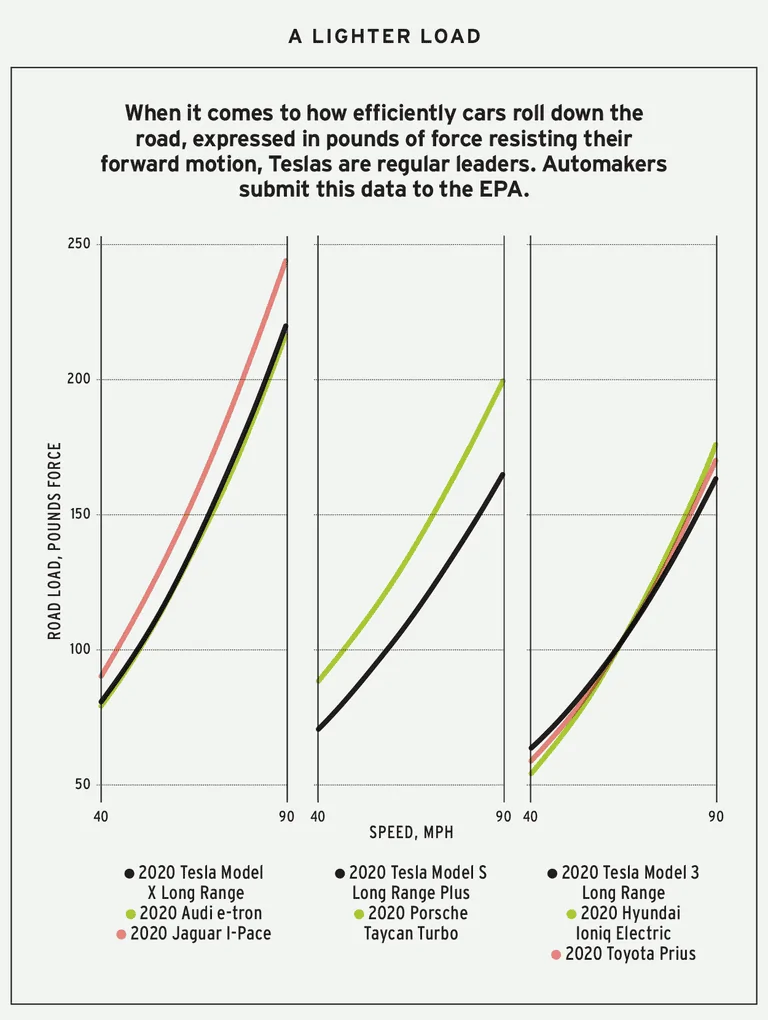
While manufacturers can't really sandbag the tests themselves, they do provide the numbers (aerodynamic drag, tire rolling resistance, and driveline friction) that set the road load on the dyno. Teslas numbers reflect a much lower road load than the Taycan. Tesla seems to be more aggressive in their road load and Porsche much more conservative (Teslas will indeed have lower road load, but probably less than the dyno settings reflect)

1624132329323.png
Analysis of the Tesla X curve here shows that it should consume about 300 Wh/mi at 70 mph which in fact in my couple of years driving one is very close to what it does. What is disturbing about this curve is that it indicates that out of that 300 Wh/mi only 93 Wh/mi are attributable to drag. That seems low.

Road load is measured through coastdown tests, wherein vehicles coast—hence the name—in neutral from about 80 mph all the way down to 10 mph. The resulting data of how quickly the vehicle slows is used to calculate the three coefficients for a quadratic equation that expresses the pounds of force resisting a vehicle's forward motion at a given speed. Those coefficients define the dyno's resistance during efficiency and range testing.
An analyst looking at this data would say "Hey, there is no road load when the vehicle is standing still therefore the first coefficient has to be 0" and use that fact in doing his fit (calculation of the other two coefficients). I did that in looking at this curve but one always sees reference to 3 coefficients when this is being discussed. Can it be that a real analyst never looked at this?


Hmp10

Well-Known Member
Joined
Mar 7, 2019
Threads
5
Messages
629
Reaction score
542
Location
Naples, FL
Vehicles
2015 Tesla Model S P90D; 2018 Honda Odyssey
This. I am not smart enough to know how Tesla seems to cheat the EPA ratings but as a Model S owner, it is very annoying how inaccurate the onboard range estimate is. It seems like the Mach E, Porchse and other brands are much truer to their numbers. Hopefully Rivian is the same way.
For most automakers, the EPA takes the raw dynamometer mileage of the car tested using EPA protocols and multiplies it by 0.70 to approximate the effects of real-world road conditions on range. The EPA approved using a 0.75 factor for adjusting Tesla mileage based on Tesla's claims that its ancillary systems were more efficient than other EVs. I suspect the use of this more favorable factor in assigning a range number to Teslas is one of the reasons that Teslas invariably fall the shortest of their EPA-rated ranges of any brand in real-world driving. Their ancillary system efficiencies apparently aren't what they're cracked up to be.
 

irish26

Well-Known Member
Joined
Apr 14, 2021
Threads
4
Messages
71
Reaction score
151
Location
Florida
Vehicles
R1T
Clearly this is an example of an experienced BEV driver who does not understand the principles discussed above. He is not alone! The Teslas' on board estimators are excellent. Today, for example, the SoC at end of trip was withinn 1 or 2% of the original estimates. And that happens time and time again. If an estimate is off by more than that it is (or should be) obvious why (you drove faster or slower than the speed limit, there was a head or tail wind, it rained or snowed...)
Our experiences with the onboard estimator couldn’t be more different.
 

ajdelange

Well-Known Member
First Name
A. J.
Joined
Aug 1, 2019
Threads
9
Messages
2,883
Reaction score
2,319
Location
Virginia/Quebec
Vehicles
Tesla XLR+2019, Lexus, Landcruiser, R1T
Occupation
EE Retired
As it is unlikely that the hardware or software in your car(s) is different from mine this is just further evidence that you don't understand what it does and what it is telling you. It is worth making the effort to get to the point where you do as the information it provides is incredibly useful both in terms of planning, making en-route decisons (we've go enough to make it to xxx - the restaurants are better there....) and in reassuring driver and passengers that you will not run out of juice.

Maybe I've just been lucky.

I expect the Rivian system to be as good and will be most disappointed if it isn't.
 

Sponsored

ajdelange

Well-Known Member
First Name
A. J.
Joined
Aug 1, 2019
Threads
9
Messages
2,883
Reaction score
2,319
Location
Virginia/Quebec
Vehicles
Tesla XLR+2019, Lexus, Landcruiser, R1T
Occupation
EE Retired
For most automakers, the EPA takes the raw dynamometer mileage of the car tested using EPA protocols and multiplies it by 0.70 to approximate the effects of real-world road conditions on range. The EPA approved using a 0.75 factor for adjusting Tesla mileage based on Tesla's claims that its ancillary systems were more efficient than other EVs.
As the article linked in No. 38 explains the dyno tests are run following SAE protocol. As it says there and in dozens of posts here and elsewhere there are 5 tests in the SAE suite. The EPA came up with a fudge factor, presumably that compares the 5 test set to the two test, which they allow for use in estimating EPA range if you only do the 2. If you do the 5 obviously you get a more robust result and so the adjustment factor doesn't have to be degraded to compensate for the missing data. Tesla and Audi do all 5 runs and so are permitted to omit this degradation. If the 3 additional tests push the composite higher they are allowed to indicate this.

I suspect the use of this more favorable factor in assigning a range number to Teslas is one of the reasons that Teslas invariably fall the shortest of their EPA-rated ranges of any brand in real-world driving.
This is upside down reasoning. The Tesla (and Audi) numbers are more robust than anyone else's and are better predictors of actual range than anyone else's. An EPA estimate that resembles realized performance at highway speeds is a terrible estimate. It is not supposed to represent performance at highway speed.

Their ancillary system efficiencies apparently aren't what they're cracked up to be.
They are every bit as good as they are cracked up to be as indicated by their ability to give accurate range predictions under actual driving conditions.

Here are two posts in a row that propagate this FUD. It is clear that the FUDsters are doing a good job.
 

guernsej

Well-Known Member
Joined
Nov 17, 2020
Threads
0
Messages
144
Reaction score
235
Location
San Diego
Vehicles
2017 Raptor; 2015 X5
An analyst looking at this data would say "Hey, there is no road load when the vehicle is standing still therefore the first coefficient has to be 0" and use that fact in doing his fit (calculation of the other two coefficients). I did that in looking at this curve but one always sees reference to 3 coefficients when this is being discussed. Can it be that a real analyst never looked at this?
The first coefficient doesn't have to be zero unless the test requires the fit curve to accurately model load at zero mph.

What equation are you using to isolate drag from the above curves?
 
Last edited:

lefkonj

Well-Known Member
First Name
Jeff
Joined
Feb 6, 2021
Threads
37
Messages
1,445
Reaction score
2,594
Location
New Jersey
Vehicles
Gen2 R1S Tri, I4-m50
Clubs
 
All I can say is the EPA numbers are crap. My Audi A7 has a rating of 22/29 and an estimated range of 463. I can tell you I never ever get those numbers. Local driving I am in the high teens and if that is what I do I get about 330 on a tank. Highway driving is the exact opposite, I can get in the mid to upper 30s and our 550 miles of range.

The testing is BS and is a problem for not just EVs but vehicles in general .
 

ajdelange

Well-Known Member
First Name
A. J.
Joined
Aug 1, 2019
Threads
9
Messages
2,883
Reaction score
2,319
Location
Virginia/Quebec
Vehicles
Tesla XLR+2019, Lexus, Landcruiser, R1T
Occupation
EE Retired
The first coefficient doesn't have to be zero unless the test requires the fit curve to accurately model load at zero mph.
The main reason to use this physical fact is that in improves the "geometric dilution of precision" in the estimate of the linear term (b) appreciably.

What equation are you using to isolate drag from the above curves?
The retarding force is modeled as: F = a + b*v + c*v*v
The drag component of this is F' = c*v*v
The energy that goes to overcoming drag is then to to go x is E = F'*x
And the power is P = dE/dt = F'*dx/dt = F'*v = c*v*v*v
P is in watt hours per hour so dividing by v gets us to Wh/x = + c*v*v
Attention must be paid, of course, to converting miles, mph and pounds to the appropriate units
 
Last edited:

St Bernard

Well-Known Member
Joined
Aug 25, 2020
Threads
2
Messages
170
Reaction score
223
Location
Ca
Vehicles
R2 2026, Prius
All I can say is the EPA numbers are crap. My Audi A7 has a rating of 22/29 and an estimated range of 463. I can tell you I never ever get those numbers. Local driving I am in the high teens and if that is what I do I get about 330 on a tank. Highway driving is the exact opposite, I can get in the mid to upper 30s and our 550 miles of range.

The testing is BS and is a problem for not just EVs but vehicles in general .
I have come up with a much better system than the EPA. Take 5 people age 50 and have them drive in a City at the posted speed limit for half a tank. Then have them drive on the Highway for the balance of the Tank at 70 MPH. That is what all of us will do and then we will be reporting the mileage we got. It would save millions in testing cost and we would not have to guess the mileage number. It would also be much more accurate.
 

Sponsored

ajdelange

Well-Known Member
First Name
A. J.
Joined
Aug 1, 2019
Threads
9
Messages
2,883
Reaction score
2,319
Location
Virginia/Quebec
Vehicles
Tesla XLR+2019, Lexus, Landcruiser, R1T
Occupation
EE Retired
All I can say is the EPA numbers are crap. My Audi A7 has a rating of 22/29 and an estimated range of 463. I can tell you I never ever get those numbers. Local driving I am in the high teens and if that is what I do I get about 330 on a tank. Highway driving is the exact opposite, I can get in the mid to upper 30s and our 550 miles of range.
I might be able to comment if I knew what 22 and 29 were.

I can comment in general, however, that you will never get the rated range. That's not what the rated range is intended to convey. If you understood what the EPA rating is, what it is for and how it can be used you would change your song. But you shouldn't really have to do that. The car's navigation system (I know nothing about Audi) should do all that for you.
 

ajdelange

Well-Known Member
First Name
A. J.
Joined
Aug 1, 2019
Threads
9
Messages
2,883
Reaction score
2,319
Location
Virginia/Quebec
Vehicles
Tesla XLR+2019, Lexus, Landcruiser, R1T
Occupation
EE Retired
I have come up with a much better system than the EPA. Take 5 people age 50 and have them drive in a City at the posted speed limit for half a tank. Then have them drive on the Highway for the balance of the Tank at 70 MPH. That is what all of us will do and then we will be reporting the mileage we got. It would save millions in testing cost and we would not have to guess the mileage number. It would also be much more accurate.
People that understand what the EPA ratings are (a benchmark) know the wisdom of your proposal. What they do is drive the car and use its instrumentation and third party apps such as TeslaFi and Stats to learn how the car, as driven by them, deviates from the benchmark. If, for example, they observe that freeway consumption goes up from 300 to 380 Wh/mi on a rainy day they will know to expect a penalty of 80 Wh/mi if it starts to rain. Etc.
 

guernsej

Well-Known Member
Joined
Nov 17, 2020
Threads
0
Messages
144
Reaction score
235
Location
San Diego
Vehicles
2017 Raptor; 2015 X5
If it isn't it can't possibly model the real world as in the real world the curve has to go thru 0.
The vehicle is stationary for less than 0.1% of the highway test cycle, so precise modeling of stationary conditions is pretty trivial. It's entirely possible a small non-zero first coefficient more accurately describes the rest of the data.

Using 0 as a "known' data point just because it's theoretically true definitely doesn't guarantee improved precision of the linear variable. At speeds near zero, you're probably better off using a separate equation given the transitory state from static to dynamic friction forces and non-linear scaling of rolling resistance as torqued is applied.

Again, it's trivial so not a huge deal either way, but asking if "a real analyst never looked at this?" seemed unnecessarily condescending (I otherwise really appreciate your posts!)

The retarding force is modeled as: F = a + b*v + c*v*v
The energy to go x is E = f*x
The power is the first derivative of the energy: P = dE/dt = f*dx/dt = F*v = a*v + b*v*v + c*v*v*v
P is in watt hours per hour so dividing by v gets us to Wh/x = a + b*v + c*v*v

a is 0 and b models the loads that increase linearly with speed. That leaves c*v*v as the drag consumption.
Sorry, I meant what did you come up with for B and C. I didn't see a data table and was wondering if you were eyeballing it from the graphs.
 

ajdelange

Well-Known Member
First Name
A. J.
Joined
Aug 1, 2019
Threads
9
Messages
2,883
Reaction score
2,319
Location
Virginia/Quebec
Vehicles
Tesla XLR+2019, Lexus, Landcruiser, R1T
Occupation
EE Retired
Using 0 as a "known' data point just because it's theoretically true definitely doesn't guarantee improved precision of the linear variable. At speeds near zero, you're probably better off using a separate equation given the transitory state from static to dynamic friction forces and non-linear scaling of rolling resistance as torqued is applied.
It is not only theoretically true. It is actually true. And so, if a quadratic is a good model, and it should be, then using the zero point improves the DOP (dilution of precision appreciably. If the quadratic is a good model only in some region which excludes the origin then it's a different matter. Should that be the case then I have a problem doing what I did because the data in those curves doesn't have enough span to estimate the coefficients from it (the DOP is poor).

Again, it's trivial so not a huge deal either way, but asking if "a real analyst never looked at this?" seemed unnecessarily condescending (I otherwise really appreciate your posts!)
Well the curves didn't come from a peer reviewed journal. They came from an article in a motoring magazine written by journalists - not scientists or engineers - so one needs to take them with a grain of salt.


Sorry, I meant what did you come up with for B and C. I didn't see a data table and was wondering if you were eyeballing it from the graphs.
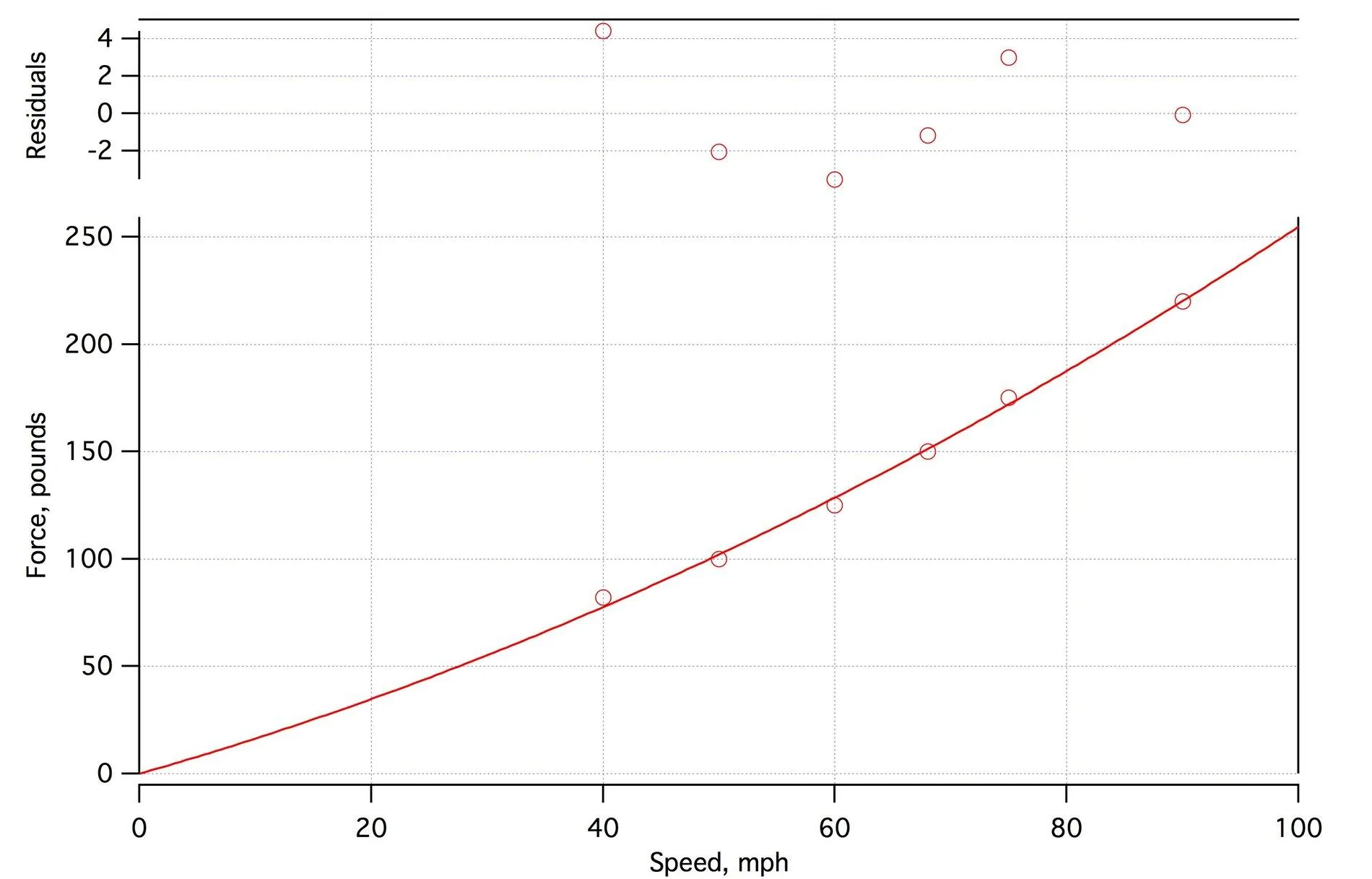
Not sure how much detail you want but in case you want the whole 9 yards here it is. Yes, I eyeballed points off the graph. Here's what I got:
Rivian R1T R1S If the official EPA range is.... RollForc


I think under the circumstances my eyeballs were pretty good! I then fit the best quadratic to the data weighting by the inverses of the residfuals. Here's what I got when I estimated all three parameters:

a =23.345 ± 21
b =0.79463 ± 0.673
c =0.015647 ± 0.00515

These are pretty poor estimates.

Here's what I get when I recognize that F(0) has to be 0.

a =0 ± 0
b =1.5354 ± 0.117
c =0.01011 ± 0.00159

Clearly these are much better quality and, as the residuals only change a tiny bit it's clear that the improvement comes from the DOP. We can argue as to whether I really have the right to do this but if I don't the available data is not really good enough for me to draw any conclusions from.

In any case this is how I amuse myself.
 

Hmp10

Well-Known Member
Joined
Mar 7, 2019
Threads
5
Messages
629
Reaction score
542
Location
Naples, FL
Vehicles
2015 Tesla Model S P90D; 2018 Honda Odyssey
They are every bit as good as they are cracked up to be as indicated by their ability to give accurate range predictions under actual driving conditions.
While the EPA test might not be meant to indicate highway range accurately, it is highway range when driving on long trips in real-world conditions that is of most concern to EV owners. Range is far less critical for local driving for most EV owners, especially when home charging is used.

In repeated testing, Edmunds has found Teslas chronically to fall shorter of their range estimates in highway driving than other brands:

https://www.edmunds.com/car-news/testing-teslas-range-anxiety.html
Sponsored


Top