Sponsored

Pre wire for EV charger

MacO512

Well-Known Member
Joined
Dec 31, 2021
Threads
3
Messages
208
Reaction score
137
Location
Austin
Vehicles
2024 Rivian R1S - 2023 Tesla Model Y
Whatever you decide, my advice is: Do not hardwire your charger. Having a 14-50 receptical gives you the flexibility to easily move your charger around in the garage AND you can easily remove the charger and take it with you on long trips. A lot of Airbnb's advertise now with 14-50 receptacles.

Regardless of what anyone says, a NEMA 14-50 receptacle for your charger is just as safe and just as efficient as being hard-wired in.
Disagree with this - 99% of the time I strongly prefer to hardwire.

If OP already has the expensive GFCI breaker and wiring that can't use 60 amps I can see the receptacle argument. This won't work with a Tesla Wall Connector though - you need an EVSE that is UL listed with a 14-50 plug from the manufacturer. Majority of them only charge at 32 amps such as the mobile chargers - although you can find 40 amp ones.
Sponsored


 

MacO512

Well-Known Member
Joined
Dec 31, 2021
Threads
3
Messages
208
Reaction score
137
Location
Austin
Vehicles
2024 Rivian R1S - 2023 Tesla Model Y
If you use a NEMA 14-50, I highly recommend using Hubbell 9450A. Leviton has cut corners on their outlet, and the Amazon cheap non-name stuff is garbage. Saving $35 and burning up the wiring or your house is a poor decision.

Yes agreed. Many electricians will even put in the junk $7 Leviton ones from Home Depot. Those are for ovens/stoves, maybe an RV that cycle on and off. Those are not designed for something that is sitting for half a day nonstop drawing huge current like our power hungry R1. Most likely those receptacle will melt at some point. Could be weeks, months, or years. Either way its a ticking time bomb. Search the internet for plenty of stories and pictures of it.
 

MacO512

Well-Known Member
Joined
Dec 31, 2021
Threads
3
Messages
208
Reaction score
137
Location
Austin
Vehicles
2024 Rivian R1S - 2023 Tesla Model Y
For many people who charge at home overnight, being "stuck" at 40 amps is just fine. 48 amps is at best a 20% improvement over 40 amps (actually less due to heat losses), translating into 1 to 2 hours shorter charge time.
Its actually better than a 20% improvement due to power savings from the vehicle sleeping once charged. That exceeds increased heat loss. Heat loss can further be reduced by increasing wire size or a short wire run. A Nema 14-50 EVSE might have smaller wires than a hardwire unit so it actually doesn't have a heat loss advantage. But if its a hard wired unit set to 40 amps vs 48 amps yes there could be less heat.

40 amps is still very good and useable though. But why not get a hardwired solution when its cheaper to hardwire without expense GFCI breaker/commercial receptacle, less connection point of failure, and yes also the bonus of more power?
 

Zoidz

Well-Known Member
First Name
Gil
Joined
Feb 28, 2021
Threads
226
Messages
5,185
Reaction score
11,687
Location
PA
Vehicles
23 R1S Adv, Avalanche, BMWs-X3,330cic,K1200RS bike
Occupation
Engineer
Its actually better than a 20% improvement due to power savings from the vehicle sleeping once charged. That exceeds increased heat loss.

40 amps is still very good and useable though. But why not get a hardwired solution when its cheaper to hardwire without expense GFCI breaker/commercial receptacle, less connection point of failure, and yes also the bonus of more power?
I'm not going to get into a debate about which is "better" - because that is dependent on the individual use case. As someone mentioned above, there are use cases where a plug in connection might be their best choice.
 

BigSkies

Well-Known Member
First Name
Brian
Joined
Sep 4, 2021
Threads
17
Messages
1,231
Reaction score
2,647
Location
Denver
Vehicles
R1T, Model Y
Clubs
 
These are all great points and reflective of reality.

However, I want to point out to the OP that these are all fairly minor distinctions combined with personal preferences. There are about a dozen ways to do this (which have been listed through the thread) that are correct and will charge your car perfectly fine.

I personally have a single NEMA 14-50 outlet (50 amp) that charges both my Rivian and a Model Y using a Grizzl-e duo charger.

The 50 amp circuit has always been sufficient to keep two EV's fully charged for our families needs. I have never once needed to go to a backup DCFC because of limited charging speeds. Yes, a 60 amp circuit will charge the car faster. But the practical benefits are relatively small unless you have some extreme commute patterns.

You can choose to upgrade to a 60 amp circuit if you feel it's beneficial and worth the cost.

Every charger I'm aware of can be set to be wired to a lower-amp circuit. It's important to do correctly, but it isn't hard to do.
 

Sponsored

MacO512

Well-Known Member
Joined
Dec 31, 2021
Threads
3
Messages
208
Reaction score
137
Location
Austin
Vehicles
2024 Rivian R1S - 2023 Tesla Model Y
I'm not going to get into a debate about which is "better" - because that is dependent on the individual use case. As someone mentioned above, there are use cases where a plug in connection might be their best choice.
I suspect most people that believe a 14-50 new install is better aren't fully aware of all the advantages and disadvantages of both options. There's a lot of people out there that think its cheaper to get a 14-50. Many of them are pricing a nonGFCI breaker (violates current electrical code) or a junk receptacle (huge fire risk).
 

beatle

Well-Known Member
Joined
Jun 20, 2024
Threads
17
Messages
1,144
Reaction score
1,562
Location
Springfield, VA
Vehicles
'23 R1T PDM Max, '97/'25 Miatas, '19 Monkey
Occupation
IT
Clubs
 
5-6 years ago it used to make more sense to have a receptacle. That was before the GFCI breaker requirement, the need for a more expensive EVSE-rated receptacle, the cost of wiring went up, the cost of EVSEs went down, and the desire to have multiple EVSEs in a single home was more popular.

After my Leviton 14-50R melted, I reevaluated a replacement and it made a lot more sense to just install a hardwired EVSE.
 

Mark_AZR1T

Well-Known Member
Site Sponsor
First Name
Mark
Joined
May 28, 2021
Threads
42
Messages
2,218
Reaction score
3,861
Location
Gilbert, AZ
Website
jackpucks.com
Vehicles
R1T Launch, R1S Canyon Red
Clubs
 
Good info here. I’d recommend going with a direct wire connection only. Introducing a NEMA connector—especially one that will be pushing significant current for hours at a time—isn't ideal for long-term reliability.

Ask your builder if they can bypass the NEMA and wire directly instead.

While you're at it, I’d suggest getting a quote for pulling wire for a 60A circuit. I'm not sure where you are in the construction process, but I’m a strong believer in future-proofing. Running a 50A circuit in 2025 just doesn’t make much sense, especially with how fast EV charging and power demands are evolving.
 

CampfireWisdom

Well-Known Member
First Name
Greg
Joined
Mar 22, 2025
Threads
14
Messages
97
Reaction score
108
Location
Rancho Cucamonga, CA
Website
www.campfirewisdompodcast.com
Vehicles
2014 Toyota Prius C, 2018 Subaru Forester
Occupation
Teacher
Great thread!

I’m gleaning lots of info here. I found out this weekend that my electrical panel is pre-wired for a dryer, but we have a gas dryer. We turned off the breaker with no affect to my house so we are good to go. In short, I was able to free up room on my panel for an EV charger. Happy day!!!

Based on the info here, I plan on…

1. Installing NEMA 14-50
2. Equipped with Hubbel 9450a
3. 6 ga. THHN wiring

Thanks for letting me soak up info from this thread!

Greg
 

Zoidz

Well-Known Member
First Name
Gil
Joined
Feb 28, 2021
Threads
226
Messages
5,185
Reaction score
11,687
Location
PA
Vehicles
23 R1S Adv, Avalanche, BMWs-X3,330cic,K1200RS bike
Occupation
Engineer
While you're at it, I’d suggest getting a quote for pulling wire for a 60A circuit. I'm not sure where you are in the construction process, but I’m a strong believer in future-proofing. Running a 50A circuit in 2025 just doesn’t make much sense, especially with how fast EV charging and power demands are evolving.
That's exactly why I ran #2 and a new 100A subpanel.
 

Sponsored

theonetruestripes

Well-Known Member
First Name
Josh
Joined
Mar 19, 2025
Threads
7
Messages
167
Reaction score
169
Location
VT - North Eastern Kingdom
Vehicles
Tesla Model Y, for a few days before I “swap” it for an R1S
Occupation
Programmer
Clubs
 
Whatever you decide, my advice is: Do not hardwire your charger. Having a 14-50 receptical gives you the flexibility to easily move your charger around in the garage AND you can easily remove the charger and take it with you on long trips. A lot of Airbnb's advertise now with 14-50 receptacles.
Any arguments about 14-50 v hardwired aside, this isn’t nearly as important on a Rivian. The R1 still (in 2025) comes with a “travel charger” in the frunk. So if you buy a wall charger for your garage either because you like how it looks better, or because when hardwired it can charge faster, or because it has a rebate in your locale, or whatever you still have something to take to AirBnBs and/or RV campgrounds and whatnot.

I’m not saying not to go the 14-50 route (I did), I’m just saying “so you can take your wallbox on adventures” isn’t an important reason to do so as Rivian helpfully provides you with a travel charger that does 220V at 40A or thereabouts (is it 32A? I used it once to make sure it worked and packed it back up...)
 
Last edited:

iQB

Active Member
Joined
Mar 14, 2025
Threads
1
Messages
33
Reaction score
38
Location
DMV
Vehicles
R1T
In the case of this being a new build (assuming permanent residence), I'd recommend going with a hard wire install using #4 wiring on a 60A circuit. The install is exactly the same as the NEMA, except it requires larger wiring and breaker (#6 vs #4; 50A vs 60A).

When I made the switch from Tesla earlier this year, the first thing I noticed is how slow the R1T charges with the mobile charger (16-19 mph). I have the smallest battery (259) and if I take a road trip and drop below 10%, I can't get a full charge in 12 hours. That extra 6-9 miles of range per hour from the hard wired unit makes a significant difference when charging over extended periods of time.
 

Zoidz

Well-Known Member
First Name
Gil
Joined
Feb 28, 2021
Threads
226
Messages
5,185
Reaction score
11,687
Location
PA
Vehicles
23 R1S Adv, Avalanche, BMWs-X3,330cic,K1200RS bike
Occupation
Engineer
In the case of this being a new build (assuming permanent residence), I'd recommend going with a hard wire install using #4 wiring on a 60A circuit. The install is exactly the same as the NEMA, except it requires larger wiring and breaker (#6 vs #4; 50A vs 60A).

When I made the switch from Tesla earlier this year, the first thing I noticed is how slow the R1T charges with the mobile charger (16-19 mph). I have the smallest battery (259) and if I take a road trip and drop below 10%, I can't get a full charge in 12 hours. That extra 6-9 miles of range per hour from the hard wired unit makes a significant difference when charging over extended periods of time.
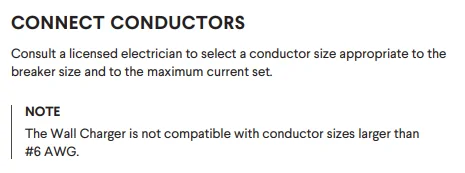
Most current EVSEs are designed for #6 max wire size.
 

iQB

Active Member
Joined
Mar 14, 2025
Threads
1
Messages
33
Reaction score
38
Location
DMV
Vehicles
R1T
Most current EVSEs are designed for #6 max wire size.
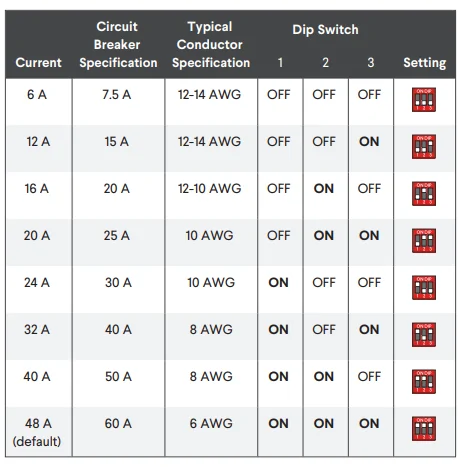
Maybe I'm missing something, but I don't know of any EV hardwire install that'll support #6 wiring @ 48A. I think many of the manufacturers switched to 32A mobile connectors due to the 40A overheating long term on the NEMA 14-50s.
 

Zoidz

Well-Known Member
First Name
Gil
Joined
Feb 28, 2021
Threads
226
Messages
5,185
Reaction score
11,687
Location
PA
Vehicles
23 R1S Adv, Avalanche, BMWs-X3,330cic,K1200RS bike
Occupation
Engineer
Maybe I'm missing something, but I don't know of any EV hardwire install that'll support #6 wiring @ 48A. I think many of the manufacturers switched to 32A mobile connectors due to the 40A overheating long term on the NEMA 14-50s.
From the Rivian EVSE Manual, pages 21 and 22:
Rivian R1T R1S Pre wire for EV charger 1747323592068-7x

Rivian R1T R1S Pre wire for EV charger 1747323633639-77
Sponsored


Top