Sponsored

scottf200

Well-Known Member
First Name
Scott
Joined
Nov 25, 2019
Threads
6
Messages
433
Reaction score
297
Location
WNC
Vehicles
Past Ford Exped; curr TMX 100D; future BEV truck/SUV
Occupation
sw engineer
The latest Enphase bi-directional charger has a few differences.
  1. Its now standards based. As I understand it a critical one, NEMA EVSE 40011, was only finalized in early in 2025. I suspect waiting for standards is what has been delaying bi-directional charging from a number of potential suppliers inluding Enphase and Rivian. More on the standard here if interested.
  2. The charger can be used with the IQ Meter Collar, which was only introduced in the last year by Enphase; Tesla did a meter collar first for use with their Powerwall. Per Enphase web site "When integrated with an IQ Meter Collar, the charger can seamlessly transition between EV charging, home backup, and grid export functions even without a home battery. The scalable architecture allows for future system upgrades to include home solar and battery."
  3. According to Enphase FAQ there will be versions to support AC as well as DC bi-directional charging. "The IQ EV Charger 2, available in the second half of 2025, will support AC bidirectional functionality. The IQ Bidirectional EV Charger, launching in 2026, will support DC bidirectional functionality." Rivian users would care about both because as I understand it R1 supports DC while I seem to recall R2 will support AC.
Enphase website with latest details, which also has a link to a ~20 page updated whitepaper :- https://enphase.com/ev-chargers/bidirectional
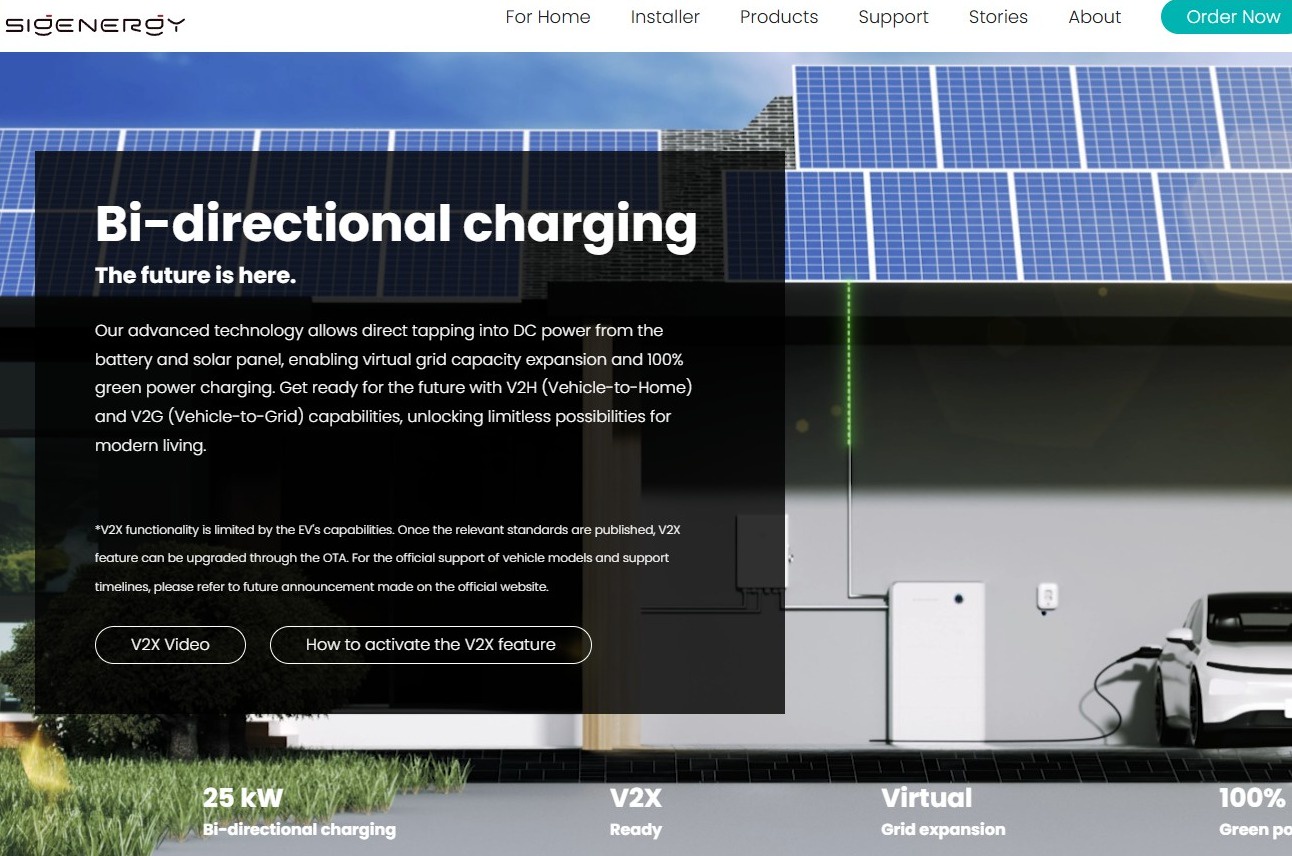
Sigenergy does bi-directional too. Videos on YT working with a Rivian.
[PointGuard Energy (usa) is Now Sigenergy (intl)]
Rivian R1T R1S Rivian preparing in-house V2H charger IFZbvIL
Sponsored


Just Passing By

Well-Known Member
First Name
John
Joined
Jan 18, 2025
Threads
1
Messages
214
Reaction score
295
Location
Bay Area
Vehicles
(Ancient Audi A6 gone) - 2 wheels-only for now Honda CB500X
Sigenergy does bi-directional too. Videos on YT working with a Rivian.
[PointGuard Energy (usa) is Now Sigenergy (intl)]
IFZbvIL.jpg
Yes, I saw another thread in this section where someone detailed their use of Signergy with a Rivian R1 as an expansion to their existing solar plus battery system. The Signergy solution works but the standards based solution, formally endorsed by the EV manufacturer, using a meter collar seems to be a better approach to me. The latter seems more flexible as using a meter collar doesn't require either a solar system or a home battery system if all people want is an emergency backup system. But it can be extended to add either or both at a later stage. More companies are getting their meter collar solutions approved by the utilities, as you indicated in your earlier post, probably for this reason amongst others such as a lower cost to implement.
 

strykerwsu

Well-Known Member
Joined
Dec 21, 2022
Threads
6
Messages
984
Reaction score
1,212
Location
Kansas
Vehicles
Chevy SS, Ford Bronco, Ram Rebel, Ford Flex, G8
Looking for advise on what to ensure upcoming solar install is forward planned for "when" this becomes implemented by Rivan. I will have a tesla powerwall in basement by panel. Currently I have the Rivian charger in garage. Not knowing about 2 way systems. This Rivian solution will simply change out charger and then be able to send power back to panel with current wiring installed? Or do I need to future proof with additonal electric work?
 

kanundrum

Well-Known Member
Joined
May 2, 2020
Threads
276
Messages
4,716
Reaction score
13,714
Location
Washington, DC
Vehicles
Giulia QV, R1S (Sept 22 Delivery)
Occupation
IT
Clubs
 
Looking for advise on what to ensure upcoming solar install is forward planned for "when" this becomes implemented by Rivan. I will have a tesla powerwall in basement by panel. Currently I have the Rivian charger in garage. Not knowing about 2 way systems. This Rivian solution will simply change out charger and then be able to send power back to panel with current wiring installed? Or do I need to future proof with additonal electric work?

You will most likely have to replace the rivian charger
 

ebellinder2

Well-Known Member
First Name
ED
Joined
Dec 14, 2022
Threads
2
Messages
99
Reaction score
119
Location
Missouri
Vehicles
R1T, Model Y
Occupation
Retired electrician
You will most likely have to replace the rivian charger
I would agree and need to add an inverter to take the 400 HV battery DC voltage down to usable AC power. Most likely a bit expensive to set up.
 

Sponsored

docwhiz

Well-Known Member
First Name
Mark
Joined
May 22, 2023
Threads
5
Messages
670
Reaction score
619
Location
Lake Tahoe, California
Vehicles
Tesla Model S LR (2022), Land Rover Discovery 2
Occupation
Retired
Looking for advise on what to ensure upcoming solar install is forward planned for "when" this becomes implemented by Rivan. I will have a tesla powerwall in basement by panel. Currently I have the Rivian charger in garage. Not knowing about 2 way systems. This Rivian solution will simply change out charger and then be able to send power back to panel with current wiring installed? Or do I need to future proof with additonal electric work?
Since you'll have a Tesla Powerwall, that installation will perform isolation from the grid and switchover during outages.
The question then becomes how to attach the Rivian V2H. It depends on the Rivian V2H system.
If the V2H unit outputs AC 240V split phase (ie standard house power), then you could just wire it to the house side of the Tesla Powerwall. This will most likely be the case. The V2H unit should sync AC with the Tesla Powerwall.
If the V2H unit only outputs HVDC (unlikely), you'll need an inverter such as a solar PV panel inverter to attach to the house side of the Tesla Powerwall.
As far as preparation goes, since your Powerwall is in the basement it would be good to run some wire up to the garage so you can run power down to the basement. Probably 6 gauge 3 wire with ground.
 
Last edited:

Rivian Owner

Well-Known Member
First Name
Mark
Joined
Sep 15, 2024
Threads
1
Messages
233
Reaction score
297
Location
Pacific North West
Vehicles
1971 GTO, 2019 F150,
Clubs
 
Looking for advise on what to ensure upcoming solar install is forward planned for "when" this becomes implemented by Rivan. I will have a tesla powerwall in basement by panel. Currently I have the Rivian charger in garage. Not knowing about 2 way systems. This Rivian solution will simply change out charger and then be able to send power back to panel with current wiring installed? Or do I need to future proof with additonal electric work?
Strykerwsu, there are several things to consider for your situation. 1. How much power are you planning on drawing from the Rivian? This will impact how heavy a gauge of wire you will need from your inverter/batteries/panel to the Rivian interface and possibly what inverter you end up purchasing. 2. Are you willing to go with something like the Sigenergy inverter so you won't have to upgrade the inverter when/if Rivian releases a solution or approves something like the Sigenergy solution? If so, are you willing to use the Sigenergy inverter and bidi without Rivian's blessing? Keep in mind that battery warranty could be an issue if you don't have Rivian's approval. 3. Is the inverter you are getting for your upcoming solar panel install also capable of V2H bidi charging, and if not is your solar installer willing and able to install one of the current day solutions that will provide you with V2H today instead of whatever they typically use? Again if the answer is yes, you'll probably save a ton of cash by not having to replace your solar inverter when you decide to go with V2H whether you use Rivian's or some other solution.

Yes, you will have to replace your current charger as it is not designed to handle bidi charging.

Keep in mind that most of this is new technology, so like any early adoption you will be a bit of an experiment. If your installer isn't versed in V2H and the various companies and offerings you might consider looking for someone who is more familiar with the state of the art devices and configurations. There is a lot of misinformation out there and some less than reputable people selling systems (not to say your installer falls into this group) so buyer beware. You seem to be asking the right questions which will help you avoid a lot of extra cost. With the tax credits expiring at the end of the year, I understand your rush to get something installed, just keep in mind that your savings could get gobbled up if you have to replace or buy another inverter next year when/if Rivian releases their solution and you want their blessing.
Sponsored


Top