
Sponsored
Thedude
Well-Known Member
No, it’s not a realistic means to charge the vehicle. By the time you have enough solar panels to output the power needed to charge the battery you’ll have no room for camping supplies.
solaskaze
Well-Known Member
To see the scope of the problem, see:
https://traveltomorrow.com/portable-solar-roofs-could-allow-electric-cars-to-charge-anywhere/
Now, if that product had awnings for both shade and additional solar, AND structural support for a tent … you’re getting there, still short .
https://traveltomorrow.com/portable-solar-roofs-could-allow-electric-cars-to-charge-anywhere/
Now, if that product had awnings for both shade and additional solar, AND structural support for a tent … you’re getting there, still short .

UnsungZero_OldTimeAdMan
Well-Known Member
https://www.rivianforums.com/forum/search/3149888/?q=solar&o=relevance
Nothing's changed. Charge rate is too slow to be meaningful/practical. You would need a very large solar array or cumulated sum over many days of uninterrupted charging.
If you are concerned about energy consumption while camping, better to draw power from a small or medium power pack for cooking etc.. And recharge that with a small 100-200W panel.
Nothing's changed. Charge rate is too slow to be meaningful/practical. You would need a very large solar array or cumulated sum over many days of uninterrupted charging.
If you are concerned about energy consumption while camping, better to draw power from a small or medium power pack for cooking etc.. And recharge that with a small 100-200W panel.
Sponsored

- Banned
- #6
Awesome question, and some excellent answers as well. The efficiency of solar has increased quite well over the past decade plus. The National Renewable Energy Lab (NREL) that is part of the US Department of Energy has put quite a lot of emphasis on this. Here are a couple of papers from the NREL.gov website:Has Rivian thought about a means to connect solar panel charging when out and about camping?
https://research-hub.nrel.gov/en/pu...vskite-solar-modules-using-blade-coating-and-
https://research-hub.nrel.gov/en/pu...nd-operational-cost-savings-a-framework-for-a
When I read articles like this I’m lucky if I understand 5% of the content. So I tend to read the abstracts.
Tlohrenz
Well-Known Member
- First Name
- Tim
- Joined
- Jun 16, 2024
- Threads
- 17
- Messages
- 75
- Reaction score
- 52
- Location
- Golden, CO
- Vehicles
- 2023 Rivian R1T
- Occupation
- Retired
Not realistic. You would need about 10,000 watts of solar. I have 7,500 watts of solar and on a good summer day I can generate about 55 kWh. My R1T with Max pack takes a lot more than 55 kWh to charge to 70%.
RedRaiderRivian
Well-Known Member
- Joined
- Dec 23, 2022
- Threads
- 0
- Messages
- 358
- Reaction score
- 535
- Location
- San Antonio
- Vehicles
- 2022 Rivian R1T - Canyon Red, 2016 Nissan Leaf
I like your question and think there should be somekind of port to direct DC solar output in to the 12v or HV battery. No need to charge the truck but it would be helpful to make up for AC, lights, or cook top while camping.Has Rivian thought about a means to connect solar panel charging when out and about camping?
UnsungZero_OldTimeAdMan
Well-Known Member
Unless you are powering portable AC units, this 256Wh Ecoflow powerpack + panel kit would more than cover all base camp needs. Can even power a battery tender to top off your Rivian's 12V. https://a.co/d/7P6p4YmI like your question and think there should be somekind of port to direct DC solar output in to the 12v or HV battery. No need to charge the truck but it would be helpful to make up for AC, lights, or cook top while camping.
Last edited:
RedRaiderRivian
Well-Known Member
- Joined
- Dec 23, 2022
- Threads
- 0
- Messages
- 358
- Reaction score
- 535
- Location
- San Antonio
- Vehicles
- 2022 Rivian R1T - Canyon Red, 2016 Nissan Leaf
I have a 2 kWH Anker already. But there is a a 128 kwH battery under me in the truck. Why not have panels integrated into a roof top tent that charge up the battery so I don't have to carry something else.Unless you are powering portable AC units, this 256Wh Ecoflow powerpack + panel kit would more than cover all base camp needs. Can even power a battery tender to top off your Rivian's 12V. https://a.co/d/7P6p4Ym
Sponsored
UnsungZero_OldTimeAdMan
Well-Known Member
Why not indeed. It's just money. I'm no electrical engineer, but IIRC whatever you intend to charge, you have to have enough oomph to overcome resistance of charge already contained in the battery. Current solar panels that can fit on the roof of a car or RTT do not have enough oomph to make a dent in the HV pack. It barely tickles the HV pack. Different story if you intent to charge the 12V or an auxiliary pack (intended for accessories).I have a 2 kWH Anker already. But there is a a 128 kwH battery under me in the truck. Why not have panels integrated into a roof top tent that charge up the battery so I don't have to carry something else.
This idea/question isn't new. But laws governing electricity on this planet, and available technology, remain the same.
Last edited:

- First Name
- Mark
- Joined
- May 28, 2021
- Threads
- 42
- Messages
- 2,222
- Reaction score
- 3,867
- Location
- Gilbert, AZ
- Website
- jackpucks.com
- Vehicles
- R1T Launch, R1S Canyon Red
If you had two (2) 600W panels, yielding about 900 watts (total). You could probably add about 1.7 miles of range per hour during peak panel performance. Let's say 5 hours, so about 8 miles of range, toss in 2 more for the remainder of a wonderfully sunny day (assuming panels are following sun). 10 miles per day. If you are on a 10-day camping trip, you could hit 100 miles of added range.
We have almost 20kW of solar and make about 160 kWh per day in peak season. We charge both Rivian's about 85% of the time off solar for about 9 months out of the year. The remainder we can add about 70 miles a day in range.
We have almost 20kW of solar and make about 160 kWh per day in peak season. We charge both Rivian's about 85% of the time off solar for about 9 months out of the year. The remainder we can add about 70 miles a day in range.

shrink
Well-Known Member
- Joined
- Feb 16, 2021
- Threads
- 102
- Messages
- 1,387
- Reaction score
- 2,707
- Location
- Phoenix, AZ and Kailua-Kona, HI
- Vehicles
- '23 R1S Quad x 2; '26 Gen 2 R1T Quad Launch; '25 Ioniq 5; '24 Jeep Cherokee
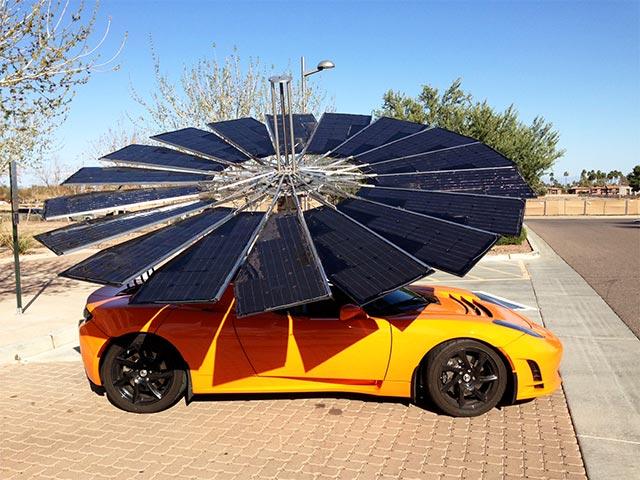
I’ve actually met this professor a few times (as I used to own an orange Tesla Roadster as well)
Have since lost touch but I appreciate his overly optimistic endeavors:
https://prod-fullcircle.fsewp.asu.edu/research/professor-has-plans-to-help-solar-power-use-blossom/

Have since lost touch but I appreciate his overly optimistic endeavors:
https://prod-fullcircle.fsewp.asu.edu/research/professor-has-plans-to-help-solar-power-use-blossom/
Thedude
Well-Known Member
Minus all the losses converting it to AC power through an inverter and the truck then converting it back to DC to charge the battery.If you had two (2) 600W panels, yielding about 900 watts (total). You could probably add about 1.7 miles of range per hour during peak panel performance. Let's say 5 hours, so about 8 miles of range, toss in 2 more for the remainder of a wonderfully sunny day (assuming panels are following sun). 10 miles per day. If you are on a 10-day camping trip, you could hit 100 miles of added range.
We have almost 20kW of solar and make about 160 kWh per day in peak season. We charge both Rivian's about 85% of the time off solar for about 9 months out of the year. The remainder we can add about 70 miles a day in range.

Zoidz
Well-Known Member
Consider the math and the practicalities. A typical 400 watt solar panel is 20" x 40". At best, if you could somehow physically integrate three of them into a roof top tent (or even the flat roof) of an R1S (tough challenge), that's a theoretical 1.2 kw max. But that's only going to happen for a few hours each day in the summer, due to the sun angle not being optimal, except at noon. Other times of the day and year the output will be much lower due to the sun angle.I have a 2 kWH Anker already. But there is a a 128 kwH battery under me in the truck. Why not have panels integrated into a roof top tent that charge up the battery so I don't have to carry something else.
Even if we assume you could get a total of 4kwh solar, the voltage needs to be inverted to HV battery voltage, which means for efficiency a DC to DC inverter is needed, which might be 90% efficient, so it's now 3.6 kwh - at best. Or you could invert the DC solar to 120 VAC, and then use a portable EV charger. But you just introduced about 2 x 10% inverter losses, or 20% loss. THe net result is maybe 5 to 8 miles charge per day at best.
It generates little to no power on cloudy days. It adds weight to the vehicle. It adds at least $2500 to the price of the vehicle or tent. You can't rely on it for that camping trip you planned because overcast weather occurs the entire time.
There are products out there that attempt to do it.
Sponsored
Similar threads


- Replies
- 5
- Views
- 603
- Replies
- 51
- Views
- 4,743

- Replies
- 2,289
- Views
- 617,253
