
Sponsored

Solar panel charging for camping?

docwhiz

Well-Known Member
First Name
Mark
Joined
May 22, 2023
Threads
5
Messages
668
Reaction score
618
Location
Lake Tahoe, California
Vehicles
Tesla Model S LR (2022), Land Rover Discovery 2
Occupation
Retired
Besides all the very true practical limitations other posters have raised, there is one main hurdle that would not easily be overcome:
To charge the HV battery system you would need solar array to output around 500vdc, which in the solar world typically equates to about 10 or 12 standard residential modules in series.
The charge controller that can handle this costs about $1000 (wholesale) and would be completely in-feasible for camping for sooo many reasons I can think of.
Love the thought though!
R
There are things called solar inverters which change any low DC voltage to AC. Your in car charge controller takes the AC and charges your battery.
Sponsored


bigsky

Banned
Well-Known Member
Joined
Jan 8, 2024
Threads
12
Messages
1,098
Reaction score
740
Location
MUM
Vehicles
MUM
About 39 kWh more to be exact :)
I think I know what you meant.
 

CarlM408

Well-Known Member
First Name
Carl
Joined
Jun 29, 2024
Threads
7
Messages
107
Reaction score
250
Location
Si Valley, CA
Vehicles
2023 R1T DM Perf Max
A penny saved is a penny earned right? Over in this thread we're working on the idea of using a 12v battery tender (of which solar options totally exist and are practically sized) to keep the computers and HV->12v charger from cycling, possibly stopping the ~1%/day phantom drain loss:
https://www.rivianforums.com/forum/threads/gen-1-vampire-drain-possibly-solved-or-hacked.31506/

And if you're toting around an elecrtic cooler, don't forget about leveraging the new Auto mode for the power outlets: https://www.rivianforums.com/forum/...nverters-new-auto-mode-from-2024-27-30.31845/

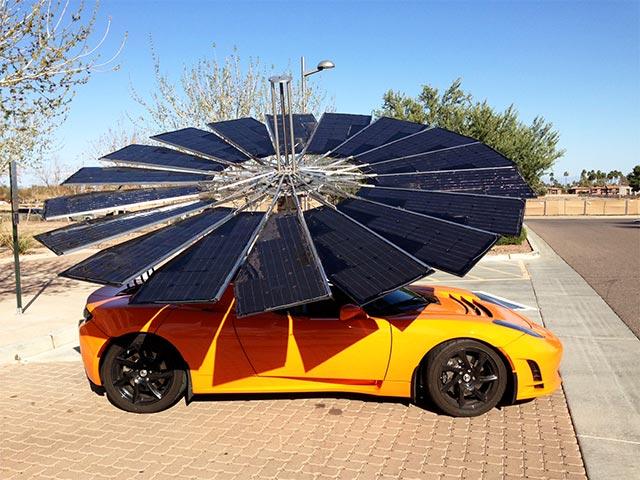
Also, there's this silly thing I've seen pop up now and then: https://gosun.co/pages/ev-solar-charger
Seems it might generate enough to at least be net positive, add a few percent per day if you were camping in a single off-grid location for a number of days.

And then there's the Tesla Model Y dude who literally did all this, cross country road trip powered by the sun...
 
Last edited:

Yota2R1T

Well-Known Member
First Name
Rich
Joined
Nov 21, 2022
Threads
7
Messages
210
Reaction score
246
Location
Calgary, Canada
Vehicles
Blue 2024 R1T, Large-DM, 21", OC int.
Occupation
Solar PV professional
Clubs
 
There are things called solar inverters which change any low DC voltage to AC. Your in car charge controller takes the AC and charges your battery.
But why would you buy an inverter to charge the...

Oh never mind - ?
 

Robin

Well-Known Member
First Name
Robin
Joined
Jan 20, 2023
Threads
0
Messages
869
Reaction score
328
Location
Petaluma
Vehicles
Bicycle
Occupation
Waitress

Sponsored

Thedude

Well-Known Member
Joined
Oct 28, 2022
Threads
4
Messages
1,638
Reaction score
2,931
Location
Alaska
Vehicles
R1T
There’s still the problem of inefficiencies. Those 1200 watts of panels are really only putting out 900w in ideal conditions, which is only a small part of the day unless you continually angle them at the sun. Now it’s .9kwh into the portable battery and drops to .73kwh after conversion to AC and then back to DC. After 12 hours you have just under 9kwh of charge in perfect, ideal conditions. Having spent a long time living off solar alone while off grid I can assure you that ideal conditions rarely exist and no one wants to spend a full day from sun up to sun down repositioning panels.

I am interested in what happens if the truck is asking for 24amps/2.6kwh but the battery pack is drained and only passing through what the panels are supplying, about 7.4amps/.81kwh (after AC conversion loss).
 

NY_Rob

Well-Known Member
First Name
Rob
Joined
Feb 9, 2022
Threads
23
Messages
5,402
Reaction score
7,980
Location
long island
Vehicles
Model 3 LR AWD, BMW i3 REX, 2024 Rubicon 4xe
Occupation
IT
There's also the issue that solar panels produce DC, but that must get converted to AC and stepped up to 120V in order to charge via L2 EVSE, then that gets converted back to DC by the vehicle onboard charger to actually charge the vehicle batteries which are DC. Lots of losses in all the DC to AC back to DC conversions and step up/step down voltage conversions, so much so that 1,200 watts of panels are going to get you very little added range for a inefficient vehicle like our Rivians. You also need either a few very large panels or quite a few more reasonable sized panels to actually produce 1,200 watts.

What we really need is Mr Fusion ?
 

docwhiz

Well-Known Member
First Name
Mark
Joined
May 22, 2023
Threads
5
Messages
668
Reaction score
618
Location
Lake Tahoe, California
Vehicles
Tesla Model S LR (2022), Land Rover Discovery 2
Occupation
Retired
There's also the issue that solar panels produce DC, but that must get converted to AC and stepped up to 120V in order to charge via L2 EVSE, then that gets converted back to DC by the vehicle onboard charger to actually charge the vehicle batteries which are DC. Lots of losses in all the DC to AC back to DC conversions and step up/step down voltage conversions, so much so that 1,200 watts of panels are going to get you very little added range for a inefficient vehicle like our Rivians. You also need either a few very large panels or quite a few more reasonable sized panels to actually produce 1,200 watts.
There are losses but not "lots of losses". The conversions are greater than 90% efficient.

I think some of the confusion here is talking about two different use cases.
1. Using an electric kitchen (inverter stovetop, lights, etc.) which will use just a few kWh/day (probably not more than 5 to 10 kWh/day). A 1200 W solar PV array could meet this use case.

2. Trying to gain range in the battery through solar charging. Since the Rivian gets about 2 miles/kWh you would need, for instance, 25 kWh to gain 50 miles of range. This would require significantly more solar PV (or a much longer time ... days). You would need something like the large solar array used by that Tesla Model Y guy in the video above. (Probably even larger since the Model Y gets about 4 miles/kWh.)
 

majorfriend

Well-Known Member
First Name
Seth
Joined
Nov 18, 2021
Threads
5
Messages
179
Reaction score
294
Location
Colorado
Vehicles
Land Cruiser 100, LE R1T, EV9
Occupation
IT Consultant
The Anker Solix F3800 has a built in NEMA 14-50 outlet. It's available for $2700, you could add on some solar panels to that and have a decent solution. It'll accept 2.4kW of solar so theoretically you could add ~40 miles of range on a day with good sunlight (2.4*8 hours=19.2kWh).

You'd have some losses so probably wouldn't quite realize that in the real world. You could also add a second F3800 and maybe get up to 80 miles a day.
 

Thedude

Well-Known Member
Joined
Oct 28, 2022
Threads
4
Messages
1,638
Reaction score
2,931
Location
Alaska
Vehicles
R1T
The Anker Solix F3800 has a built in NEMA 14-50 outlet. It's available for $2700, you could add on some solar panels to that and have a decent solution. It'll accept 2.4kW of solar so theoretically you could add ~40 miles of range on a day with good sunlight (2.4*8 hours=19.2kWh).

You'd have some losses so probably wouldn't quite realize that in the real world. You could also add a second F3800 and maybe get up to 80 miles a day.
Yeah, but at that point your entire bed is stacked full of solar panels and you're left camping with whatever you fit in the backseat. Not terrible, I've camped with just a backpack for long periods of time, but if I'm hauling a truck around with me I typically plan to be camping in luxury with all the nice stuff I don't have to carry on my back.
 

Sponsored

Zoidz

Well-Known Member
First Name
Gil
Joined
Feb 28, 2021
Threads
226
Messages
5,192
Reaction score
11,696
Location
PA
Vehicles
23 R1S Adv, Avalanche, BMWs-X3,330cic,K1200RS bike
Occupation
Engineer
There are losses but not "lots of losses". The conversions are greater than 90% efficient.

I think some of the confusion here is talking about two different use cases.
1. Using an electric kitchen (inverter stovetop, lights, etc.) which will use just a few kWh/day (probably not more than 5 to 10 kWh/day). A 1200 W solar PV array could meet this use case.

2. Trying to gain range in the battery through solar charging. Since the Rivian gets about 2 miles/kWh you would need, for instance, 25 kWh to gain 50 miles of range. This would require significantly more solar PV (or a much longer time ... days). You would need something like the large solar array used by that Tesla Model Y guy in the video above. (Probably even larger since the Model Y gets about 4 miles/kWh.)
Yes, typical good quality inverter efficiency is greater than 90%. But.... Whether for mileage or power storage, in the scenario of charging the Rivian battery with solar and then using the on board Rivian inverter for 120VAC, you have three inverters - Solar DC to 120VAC, vehicle 120VAC to vehicle HV, and vehicle HV to vehicle 120VAC, so the inversion losses are tripled.... AND since some Rivian subsystems must power up to manage the vehicle charging, there are additional loses. All told, even if each inverter is 93% efficient, you lose 21% to inverters plus some more for the Rivian control modules. Net result might be 75%. Much more efficient to do it with completely standalone solar to LiFePO4 storage with one inverter.

Or you could really go camping instead of glamping, and use ice and charcoal/wood/propane ? for cooling and cooking, lol. All of which work regardless of how cloudy it is.
 

CharonPDX

Well-Known Member
First Name
Charon
Joined
Jul 12, 2021
Threads
31
Messages
2,506
Reaction score
4,178
Location
Cascadia
Vehicles
'22 R1T LE, '16 Model S, '19 Arcimoto FUV
Occupation
InfoSec Geek
Clubs
 
Relevant xkcd:
https://xkcd.com/1924

My house has 750 pounds of solar panels on its roof. If all stacked up, they would fit in the bed of my R1T (with the tailgate down,) stacked to cab roof height.

That would eat up my entire bed, and most of my carrying weight. On the summer solstice, a perfectly sunny day, my solar panels generated enough energy to drive my Rivian ~100 miles.

But then I'd have to set up these solar panels out in the sun, taking up more than the space of a whole campsite in some campgrounds - and in a place with no trees blocking them.

Really, unless you plan on boondocking far from power, for long periods of time, with long (multiple day) breaks between driving each segment, attempting to recharge your truck via solar is a silly idea.

Solar to run your campsite on the other hand, makes a lot more sense. It generally doesn't take much solar (~100-500 Watts of solar panels instead of multiple thousands watts, a couple kWh instead of over 100,) to keep most campsites good to go. My travel trailer has 300W of solar panels, and 3kWh of storage. That is enough for nearly all of my use.
 

VSG

Well-Known Member
Joined
Oct 3, 2022
Threads
4
Messages
3,223
Reaction score
6,017
Location
WA
Vehicles
R1T LE/RB/OC/20
You're too high by a factor of two at least. Where are you going to put 1200W of panels on your truck? You're going to park in the open in the full sun every day facing north so the cab doesn't shade your panels? 15kWh a day even in ideal conditions is just unrealistic. And Level 1 charging a Rivian has something like 15% loss right off the top, so no way are you ever going to get 1.2kW into the battery from those panels. Try your Rivian portable charger on a wall outlet (12A @ 120V = 1440W) and see how fast you charge. (Answer: 2 miles per hour). So don't tell me you're ever going to get 30 miles from 1200W of panels, which is the equivalent of >15 hours (x2 = 30 miles) of peak production per day (full sun at full height (not on the horizon) in the peak of summer with the panels pointed straight at the sun). Not going to happen. Geometry alone means your panels are not ever going to be 90 degrees to the sun - you'll be lucky if you average 45 degrees over the day and only if you slant them. And 45 degrees means you only get 70% of the power. And the Sun has to go through more atmosphere when it's not at its highest, so it delivers less power.

Actual usable output, with optimal placement of the panels, isn't going to AVERAGE more than 3-5 times the panel rating per day, depending on where in the country you are. By contrast, you're claiming about 12 times ... With 1200W of panels (again, that's a lot of space ...) that means you can plan on between 3.6kWh and 6kWh a day averaged over a year. (i.e. not just calculating using the best and most optimal conditions). That's 7-12 miles of range, not 20-30.

You can build a system that will cover your vampire drain and your powered cooler usage, and that could be worthwhile to some poeple, but that's about it.
Sponsored


Top