

Zoidz
Well-Known Member
- Thread starter
- #1
PatentlyApple.com
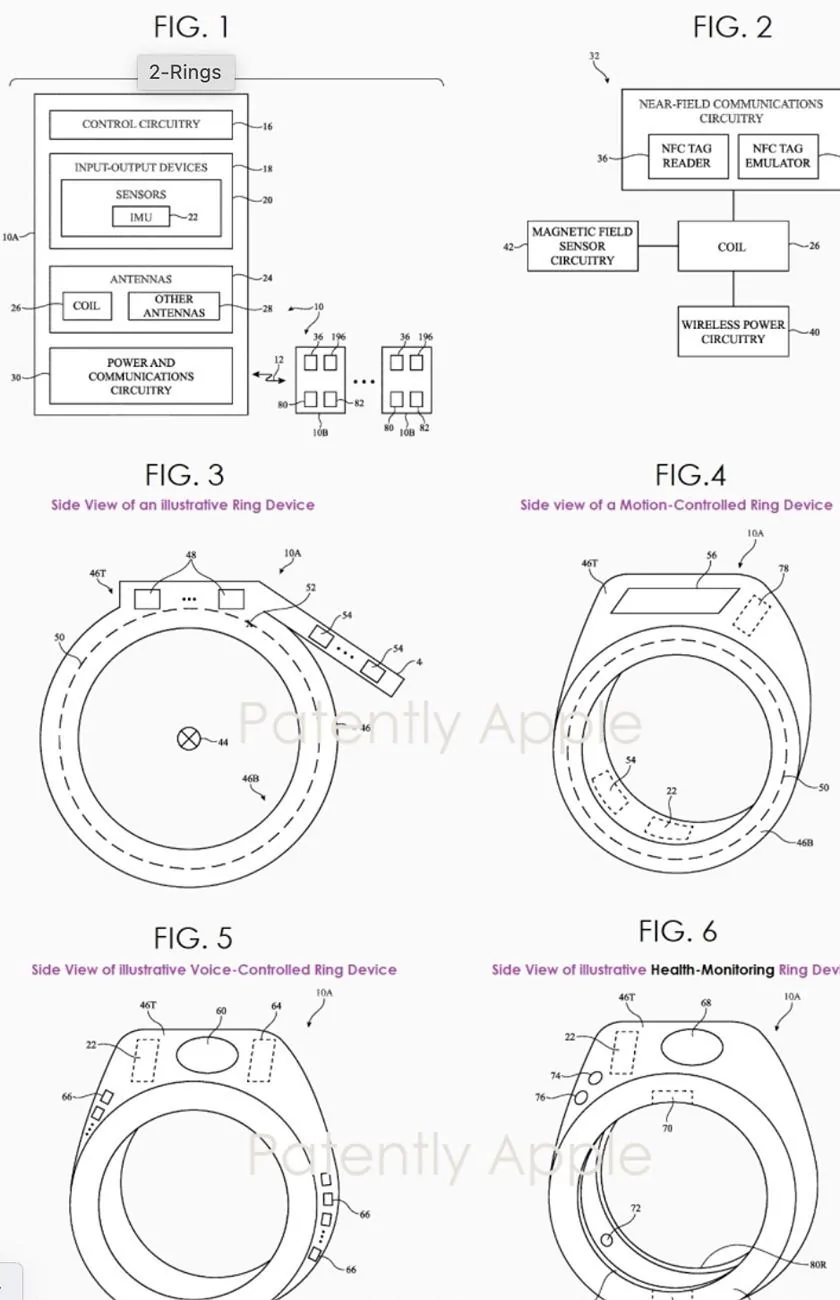
"Today the U.S. Patent and Trademark Office officially published an extensive patent application from Apple that relates to future smart rings that could control your TV, home devices, computers (iPhone, iPad, Macs, Apple Watch) while also having health sensor built in (to some rings). Apple also describes a secondary "Power Ring" that could transfer power to the main ring to keep it functional. This is one of Apple's most extensive ring-related patent.
...
Use of a ring device may facilitate the gathering of user input. During operation of a companion device, a user may wish to supply user input to the companion device in the form of hand gestures, touch input, force input, voice input, pointing input, gaze input, other user input involving the position of the user's body (e.g., the location, orientation, and movement of one or more fingers and/or other body parts), and/or other user input. The ring device may have sensors such as inertial measurement units and/or other sensors that allow such body-based input to be gathered. Because a ring device may be worn throughout the day, a ring device will generally be immediately available to the user, unlike devices that are stored in a user's pocket or more distant locations. This facilitates interactions between the ring device and objects in the user's environment. For example, a ring device can easily be brought into close proximity with near-field communications tags in the user's environment."

"Today the U.S. Patent and Trademark Office officially published an extensive patent application from Apple that relates to future smart rings that could control your TV, home devices, computers (iPhone, iPad, Macs, Apple Watch) while also having health sensor built in (to some rings). Apple also describes a secondary "Power Ring" that could transfer power to the main ring to keep it functional. This is one of Apple's most extensive ring-related patent.
...
Use of a ring device may facilitate the gathering of user input. During operation of a companion device, a user may wish to supply user input to the companion device in the form of hand gestures, touch input, force input, voice input, pointing input, gaze input, other user input involving the position of the user's body (e.g., the location, orientation, and movement of one or more fingers and/or other body parts), and/or other user input. The ring device may have sensors such as inertial measurement units and/or other sensors that allow such body-based input to be gathered. Because a ring device may be worn throughout the day, a ring device will generally be immediately available to the user, unlike devices that are stored in a user's pocket or more distant locations. This facilitates interactions between the ring device and objects in the user's environment. For example, a ring device can easily be brought into close proximity with near-field communications tags in the user's environment."
Sponsored