Sponsored

Rivian Wall Charger inefficiency

Dan_Foothill

Member
Joined
Sep 17, 2022
Threads
3
Messages
13
Reaction score
8
Location
Orange Country, CA
Vehicles
R1T, Corvette C7 ZO6, MB C300
Occupation
Engineer
Rivian R1T R1S Rivian Wall Charger inefficiency 1665603797395


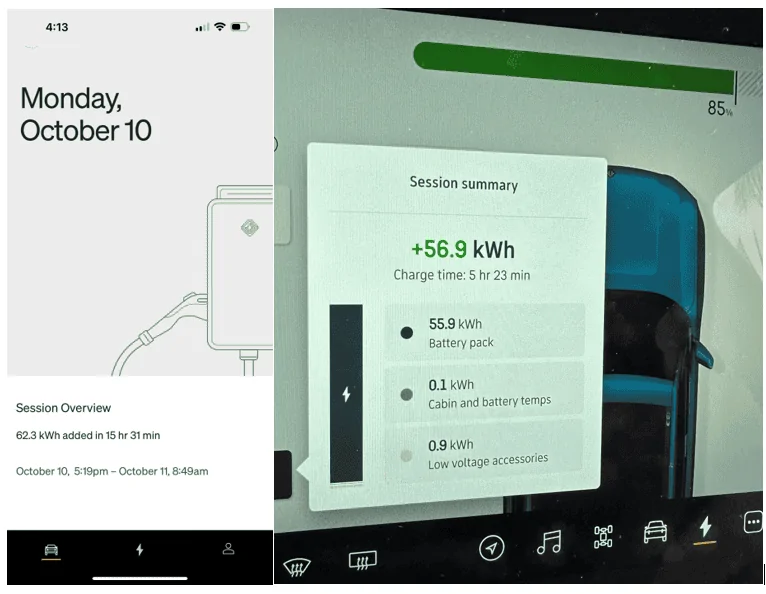
Has anyone see and more importantly know how to correct this charging issue with the Rivian Charger. It seems to waste approximately 5kw of power per charge. This coupled with all of the Vampire Drain makes for a very inefficient vehicle to own.
Sponsored


 

CommodoreAmiga

Well-Known Member
Joined
Dec 30, 2020
Threads
39
Messages
4,104
Reaction score
7,729
Location
INACTIVE
Vehicles
INACTIVE
Looks like 1kW didn't go to the battery... not 5kW.
 
OP
OP

Dan_Foothill

Member
Joined
Sep 17, 2022
Threads
3
Messages
13
Reaction score
8
Location
Orange Country, CA
Vehicles
R1T, Corvette C7 ZO6, MB C300
Occupation
Engineer
Looks like 1kW didn't go to the battery... not 5kW.
the Picture on the left is from the wall charger which was 62.3kw used. the picture on the right is the changing summary that was 56.9kw received by the car. so the 5kw must have go up in thin air to heat i guess? See like a lot of waste.
 

Aroohoo

Well-Known Member
Joined
Sep 8, 2021
Threads
14
Messages
337
Reaction score
471
Location
Seattle
Vehicles
R1S
I would assume that the charger is reporting the AC power because that is all it sees. I suspect that the R1 is reporting DC power delievered, which would happen after the onboard charger/inverter converts from AC to DC. Typically, these have a 90-95% effeciency, so could explain the difference you are seeing.

A good test would be to hook up different lvl 2 EVSE.


One other thought, could be that if the EVSE is using a current couoler to measure current it has the wrong correction factor to convert to Watts. This happens a lot in home solar power applications where the installer doesn't set the right value resulting in Watt reading higher or lower than actuals.
 

tojesky

Member
First Name
Tim
Joined
Oct 18, 2021
Threads
0
Messages
21
Reaction score
16
Location
West Houston
Vehicles
Tesla 2021 Model X Long Range
Occupation
Retired.
1665603797395.webp


Has anyone see and more importantly know how to correct this charging issue with the Rivian Charger. It seems to waste approximately 5kw of power per charge. This coupled with all of the Vampire Drain makes for a very inefficient vehicle to own.
62.3/55.9 yields 1.114 or 11.44% losses. That number is typical for Level 2 EVSEs. My average loss over 10,000 miles of charging my Bolt with a 240v/32 amp EVSE is about 9.1%. (I do keep detailed charging records) But that includes cooler non-summer weather charging.

I assume you are on a timer with only 4kWh added each hour you were plugged in.
 

Sponsored

Kidentist

Well-Known Member
First Name
Carlitos way
Joined
Oct 28, 2021
Threads
2
Messages
271
Reaction score
324
Location
PNW
Vehicles
Audi A3, Cayenne E-Hybrid, R1T DM Std.+
Occupation
Mouth Janitor
So, please correct me if my math is wrong, but in the OC, 5 Kwh is about $1.50. Is this a daily issue? If it is, well I do agree it adds up to about $550 per year (rounded up).
Still I wonder how much fuel your comparable ICE vehicle would consume "idling" per year....?? My guess, you're still better off with the EV???
 

HimuraMOdo

Well-Known Member
First Name
Gavin
Joined
Oct 28, 2021
Threads
5
Messages
98
Reaction score
110
Location
Colorado
Vehicles
Blue R1T Adventure+22" ; 14 Durango
Occupation
Engineer
So 56.9kwh/62.3kwh =91.33%. If the 62.3kwh reported from the charger was the actual total power consumed. It seems this is reasonably good. I'd doubt other charger would be anymore better.

If you want to test it out, try lowering the charge current from the vehicle so there would be less IR drop through the current path. That might help in efficiency.
 

shrink

Well-Known Member
Joined
Feb 16, 2021
Threads
101
Messages
1,381
Reaction score
2,696
Location
Phoenix, AZ and Kailua-Kona, HI
Vehicles
'23 R1S Quad x 2; '26 Gen 2 R1T Quad Launch; '25 Ioniq 5; '24 Jeep Cherokee
Clubs
 
62.3/55.9 yields 1.114 or 11.44% losses. That number is typical for Level 2 EVSEs. My average loss over 10,000 miles of charging my Bolt with a 240v/32 amp EVSE is about 9.1%. (I do keep detailed charging records) But that includes cooler non-summer weather charging.
Exactly. I think 10% charging loss is pretty typical.

So 56.9kwh/62.3kwh =91.33%. If the 62.3kwh reported from the charger was the actual total power consumed. It seems this is reasonably good. I'd doubt other charger would be anymore better.

If you want to test it out, try lowering the charge current from the vehicle so there would be less IR drop through the current path. That might help in efficiency.
There's an engineer over on the Tesla boards who did a big study on most efficient charging amperage. I think he used the old school dual charger Model S's. Those were 40 amps each for a total of 80 amp charging capability. I had one of those cars and I really liked it, but just sold it for my current R1T.

Anyway, if I recall correctly, I think the most efficient charging amperage was 42 amps.

I have no idea what would be most efficient on the Rivian. We need an electrical engineer to do some testing.
 

Dirty_B

Well-Known Member
Joined
Apr 26, 2022
Threads
36
Messages
565
Reaction score
490
Location
USA
Vehicles
Rivian R1T
Occupation
Sales
So, please correct me if my math is wrong, but in the OC, 5 Kwh is about $1.50. Is this a daily issue? If it is, well I do agree it adds up to about $550 per year (rounded up).
Still I wonder how much fuel your comparable ICE vehicle would consume "idling" per year....?? My guess, you're still better off with the EV???
Comparable would be how much drops/drips onto floor when refueling ... Not idling.

My ICE loses approaching 0 gas in 24hrs.

So vampire drain, coupled with inefficient "refueling" does make it a not very efficient BEV all things considered. My last long non use period I lost over 100mi to vampire drain... Yep they got it licked.
 

jphillips97

Well-Known Member
First Name
James
Joined
Mar 5, 2022
Threads
2
Messages
99
Reaction score
122
Location
Florida
Vehicles
Jeep Wrangler
1665603797395.png


Has anyone see and more importantly know how to correct this charging issue with the Rivian Charger. It seems to waste approximately 5kw of power per charge. This coupled with all of the Vampire Drain makes for a very inefficient vehicle to own.
Looks like two different charging sessions... One was 15 hours long and the other was 5 hours long.... Also it is not kW, it is kWh.... One is a measure of power (rate of energy flow) and one is a measure of energy.......
 

Sponsored

OP
OP

Dan_Foothill

Member
Joined
Sep 17, 2022
Threads
3
Messages
13
Reaction score
8
Location
Orange Country, CA
Vehicles
R1T, Corvette C7 ZO6, MB C300
Occupation
Engineer
Comparable would be how much drops/drips onto floor when refueling ... Not idling.

My ICE loses approaching 0 gas in 24hrs.

So vampire drain, coupled with inefficient "refueling" does make it a not very efficient BEV all things considered. My last long non use period I lost over 100mi to vampire drain... Yep they got it licked.
Totally Agree. I loose 10mi/day doing nothing. so that is 5kw*365 + I loose another 5kw every charge so like once a week. 5*52. Total lose of energy would be 2085kw @ $.18= $375

So exciting right. i could drive 1000 miles with the shitty current cali gas prices for that. This is a total joke that needs to get fixed.
 

tojesky

Member
First Name
Tim
Joined
Oct 18, 2021
Threads
0
Messages
21
Reaction score
16
Location
West Houston
Vehicles
Tesla 2021 Model X Long Range
Occupation
Retired.
...
Anyway, if I recall correctly, I think the most efficient charging amperage was 42 amps.
...
Power losses are equal to current squared times resistance. So a higher current at 240 volts would have higher losses. That is why long distance power transmission lines have higher voltages so current is kept lower and line losses are reduced.
 

zipzag

Well-Known Member
Joined
Nov 15, 2021
Threads
15
Messages
1,088
Reaction score
983
Location
Chicago
Vehicles
Model Y
The charger is in your vehicle. The "wall charger" is a fancy extension cord with a few saftey feature. All level 2 chargers are the same as far as efficiency of near 100%. (some resistance loss on the cord).

The charge in you vehicle is perhaps 90% efficient. How did you feel about your gas vehicle being 30% efficient?
 

sillygoose

Active Member
First Name
Rick
Joined
May 22, 2021
Threads
3
Messages
44
Reaction score
35
Location
Finger Lakes, NY
Vehicles
2023 R1S, 2022 Mustang Mach-E GT
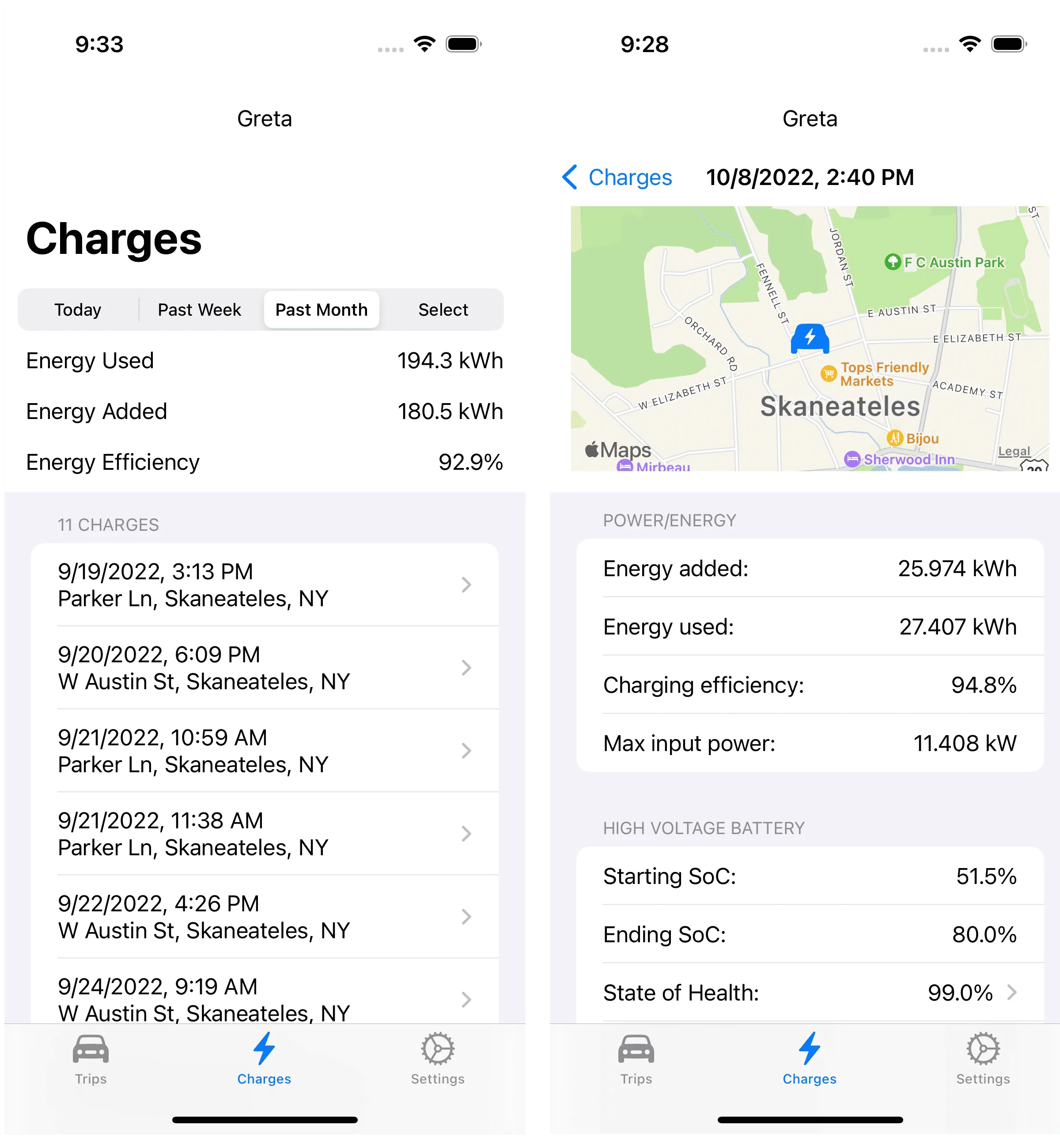
You are seeing the loss converting from 240V AC to ~360V DC where the efficiency is the kWh delivered to the battery (energy added) divided by the kWh measured at the charger (energy used) times 100. There are other small resistive losses but AC to DC conversion is the big one.

About 10% percent is pretty common, here is a snapshot of the past months charging sessions on my Mustang Mach-E with the session details on one:

Rivian R1T R1S Rivian Wall Charger inefficiency 1665624852262


Top