Sponsored

Amping down for a wall outlet is capped at 14 Amps?

VSG

Well-Known Member
Joined
Oct 3, 2022
Threads
4
Messages
3,202
Reaction score
5,984
Location
WA
Vehicles
R1T LE/RB/OC/20
The resistor values are part of the J1772 specification so Tesla, Rivian and everyone else use the same values to communicate a requested Amperage.
Q: How does the J1772 spec have anything to do with the adapter cord on the other end of the charger? (A: It doesn't).
Sponsored


VSG

Well-Known Member
Joined
Oct 3, 2022
Threads
4
Messages
3,202
Reaction score
5,984
Location
WA
Vehicles
R1T LE/RB/OC/20
I'm wondering how many incidents there have actually been. I can't find any via a google search. Pretty silly since I can leave the air conditioning on day and night while I'm there if I want.
Exactly.

IMO this has more to do with money than anything else. Electricity is a big expense for RV parks. For short-term stays, they charge you a fixed daily rate, but for long-term stays they meter your site so you pay the actual electric bill.

I suspect that most short-term stays end up paying for a lot more electricity than they use - I don't think most RVs come anywhere near to 80% continuous use of either the TT-30 or the 14-50 outlets.

If that's the case, then the upcharge for a short-term hookup is a source of net profit. If you have an EV which uses *more* when charging than a typical RV, then I think the RV parks are worried about losing money. And I think they don't know enough or have enough experience with this so they just say no out of fear. (And try to justify it as them doing you a favor by preventing damage to your expensive vehicle :rolleyes:)

I've charged my R1T at state parks in 7 different states, as well as a few small, private campgrounds and I've never had a problem charging my EV. I usually ask ahead of time because I'm usually counting on getting a charge overnight.

I know KOA now prohibits EV charging, but I tend to avoid KOAs so that hasn't been an issue for me yet. I don't buy the argument from campgrounds that their shitty infrastructure doesn't support EV charging. Are they saying their infrastructure isn't up to code and they know it? That sounds like a legal liability to me. If they are worried about this then the solution would be to limit the current to what a typical RV pull, not to forbid EV charging.
 

BrentInCO

Well-Known Member
Joined
Jun 22, 2021
Threads
17
Messages
403
Reaction score
529
Location
Colorado
Vehicles
Tesla S, Toyota FJ, R1S Quad Large Pack Feb 2023
Bingo. A nice description of the differences.

One is a quality piece of equipment with an incredibly solid track record, that has the ability to test and adapt to less than optimal conditions, while allowing you to plug into any and all of the different outlets you could possibly encounter.

The other is... Well... Not.

While we are on the topic, I will mention that Tesla does not ship a TT30 attachment with its NEMA kit. Tesla is not a fan of the TT30, and would rather people not use it. The problem with that thought process, is that the TT30 is ubiquitous, and in my opinion that dongle is needed. You can add it to your Tesla kit here:

AC WORKS EV Charging Adapter for Tesla Use (TT-30P RV/Trailer 30A Gen2) https://a.co/d/ciXTnTo

This dongle, combined with your Tesla mobile EVSE will charge at up to 24 amps. Two exemplify why the Tesla unit is so superior, it will often back it down to about 18 amps, because the old RV plugs just can't handle the higher pull. Many other EVSEs on the market (including Rivian) will just keep pulling until flames sever the contacts.
?

To those who keep recommending the use of RV style adapters with "dumb" mobile EVSEs; please stop. One by one, we are seeing campgrounds start to ban EVs, because we are destroying their outlets with the prolonged pulls. If we abuse this resource, we are going to lose this resource. The key to keeping this resource open for all is to be smart and respectful, and not damage their equipment.

Please stop!
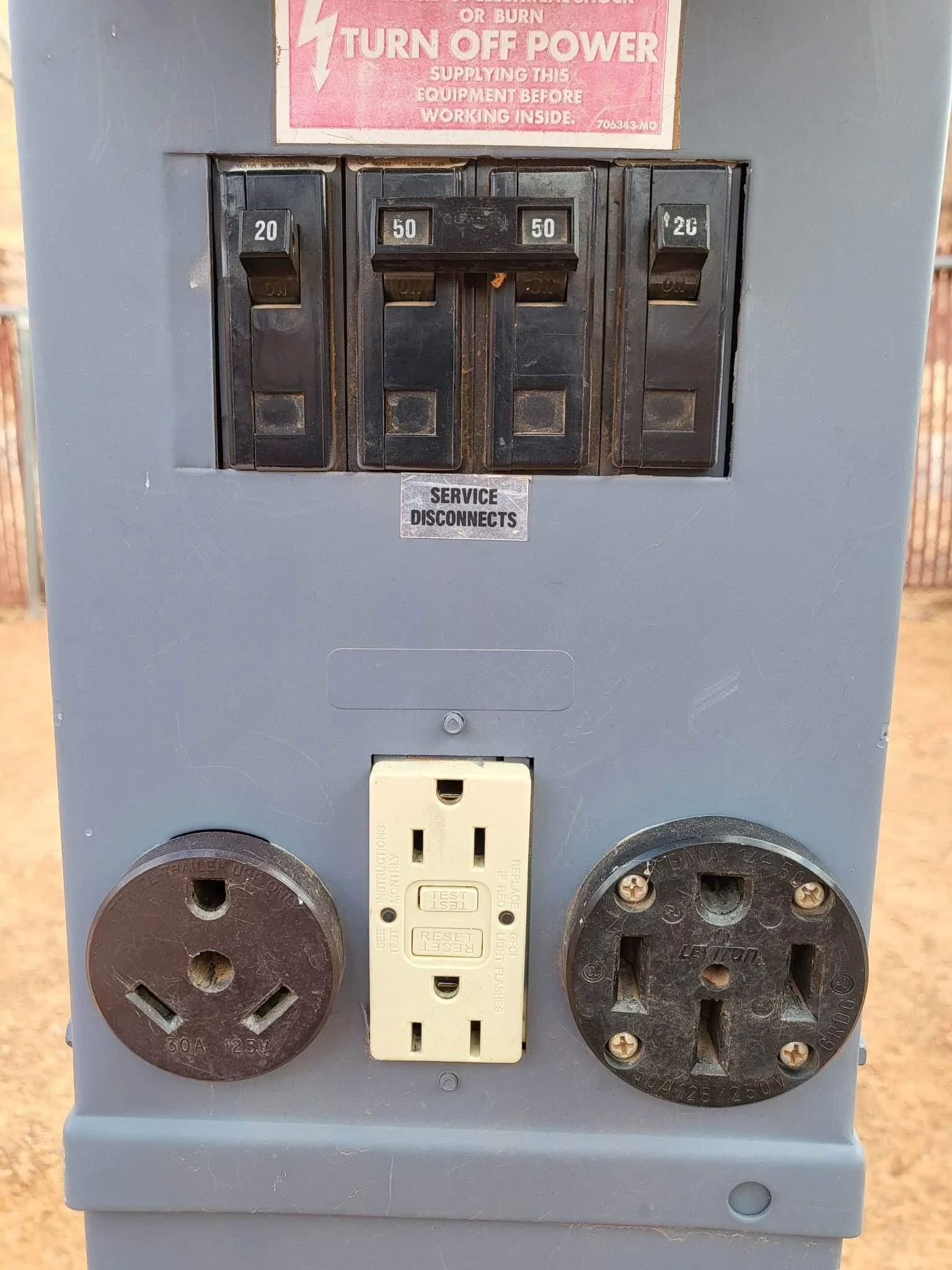
@R.I.P. I’ve reserved an RV spot for a trip in a couple months. It has a 30 amp and 50 amp outlet; they sent me the attached photo. Is your recommendation to use the Rivian portable charging cord, or some alternative? I do have a gen1 Tesla mobile charging cord.

Plug in my Rivian mobile charging cord to the 14-50 50 amp outlet, but on the Rivian center display manually reduce amps down to that cord’s 32 amp max? Or even lower?

And / or do you recommend a specific RV 30 amp TT-30P adapter for the Rivian charger cord or a Tesla gen1 charger cord? I had bought this one long ago based on another forum member’s recommendation / experience https://a.co/d/7nhY06F

Edit: oops, I previously shared the link to an adapter I purchased for an odd outlet in a 1970s quanset on a family member’s farm. https://a.co/d/8ux8Cyu

Rivian R1T R1S Amping down for a wall outlet is capped at 14 Amps? IMG_2560
 
Last edited:

Electrified Outdoors

Well-Known Member
First Name
Ken
Joined
Jan 30, 2023
Threads
63
Messages
3,683
Reaction score
3,980
Location
Mount Airy, Maryland
Website
EVoutdoors.org
Vehicles
2024 Rivian R1S Quad, 2024 Silverado EV RST First Edition
Occupation
Real Estate
Clubs
 
Are you using the Shockflo Gmini?
Yes we use the shockflo portable charger only when traveling. At home we have two Tesla wall connectors that power share 60amps total.
 

VSG

Well-Known Member
Joined
Oct 3, 2022
Threads
4
Messages
3,202
Reaction score
5,984
Location
WA
Vehicles
R1T LE/RB/OC/20
@BrentInCO

General rule:
If there's a NEMA 14-50 outlet available (and there is - that's the outlet on the right side of your picture), use that. That is by far the fastest way to charge. It's also what most people will use, so chances are that outlet is working - if it wasn't, the RV park would have heard about it from the previous user.

You can plug your Rivian portable charger directly into that NEMA 14-50. You do NOT need to change any settings inside the Rivian - the portable charger "knows" it is plugged into a 14-50 outlet and will not use more than 32A. Your Gen 1 Tesla charger probably works the same way, but I don't have one of those so I can't say for sure.

That picture also shows a 20A breaker for the TT-30 outlet (the outlet on the left), which is weird because the TT-30 outlet is a 30A outlet. Also the NEMA 5-15 (wall outlet) is hooked up to a 20A breaker, even though it's a 15A outlet. I try to avoid using outlets that don't make sense.

And / or do you recommend a specific RV 30 amp TT-30P adapter for the Rivian charger cord or a Tesla gen1 charger cord?
The adapter cord you linked to will not fit ANY outlets that you would normally find in an RV park. It is definitely not a TT-30 adapter. The one I have (also found through this forum) is https://www.amazon.com/Parkworld-885378-TT-30P-Adapter-Charging/dp/B07G2MT4T6 This one works - I've used it a few times when a NEMA 14-50 wasn't available. You WILL have to manually change the charge rate from inside your Rivian when using an adapter like this, because you are essentially fooling the charger by plugging into an outlet type the charger doesn't know about. The maximum you should draw from a 30A TT-30 is 24A (80% of the breaker rating). With the picture above, which uses a 20A breaker for the TT-30, the maximum you should draw is 16A. That's barely more than a wall outlet ...

Regardless, adapters are convenient only when there is no better way to charge. They're not foolproof because you have to manually reduce the current from inside your vehicle, and they introduce an extra plug and and extra point of possible failure, so they're not great as a permanent or semi-permanent solution. Don't use them for regular charging at home, for example.
 

Sponsored

BrentInCO

Well-Known Member
Joined
Jun 22, 2021
Threads
17
Messages
403
Reaction score
529
Location
Colorado
Vehicles
Tesla S, Toyota FJ, R1S Quad Large Pack Feb 2023
@BrentInCO

General rule:
If there's a NEMA 14-50 outlet available (and there is - that's the outlet on the right side of your picture), use that. That is by far the fastest way to charge. It's also what most people will use, so chances are that outlet is working - if it wasn't, the RV park would have heard about it from the previous user.

You can plug your Rivian portable charger directly into that NEMA 14-50. You do NOT need to change any settings inside the Rivian - the portable charger "knows" it is plugged into a 14-50 outlet and will not use more than 32A. Your Gen 1 Tesla charger probably works the same way, but I don't have one of those so I can't say for sure.

That picture also shows a 20A breaker for the TT-30 outlet (the outlet on the left), which is weird because the TT-30 outlet is a 30A outlet. Also the NEMA 5-15 (wall outlet) is hooked up to a 20A breaker, even though it's a 15A outlet. I try to avoid using outlets that don't make sense.


The adapter cord you linked to will not fit ANY outlets that you would normally find in an RV park. It is definitely not a TT-30 adapter. The one I have (also found through this forum) is https://www.amazon.com/Parkworld-885378-TT-30P-Adapter-Charging/dp/B07G2MT4T6 This one works - I've used it a few times when a NEMA 14-50 wasn't available. You WILL have to manually change the charge rate from inside your Rivian when using an adapter like this, because you are essentially fooling the charger by plugging into an outlet type the charger doesn't know about. The maximum you should draw from a 30A TT-30 is 24A (80% of the breaker rating). With the picture above, which uses a 20A breaker for the TT-30, the maximum you should draw is 16A. That's barely more than a wall outlet ...

Regardless, adapters are convenient only when there is no better way to charge. They're not foolproof because you have to manually reduce the current from inside your vehicle, and they introduce an extra plug and and extra point of possible failure, so they're not great as a permanent or semi-permanent solution. Don't use them for regular charging at home, for example.
Thanks. I was also speculating that an RV park’s 14-50 outlet may not be wired to accommodate the constant draw of an EV, even at 80% of max amperage.

I’ve edited my post now: this is the TT30 adapter I meant to link https://a.co/d/7nhY06F

Edit: oops, I previously shared the link to an adapter I purchased for an odd outlet in a 1970s quanset on a family member’s farm. https://a.co/d/8ux8Cyu
 

R.I.P.

Well-Known Member
First Name
Sean
Joined
Jan 2, 2023
Threads
13
Messages
1,217
Reaction score
1,681
Location
San Carlos, Mexico
Vehicles
Tesla Y, Cadillac ELR, Rivian R1T, Jeep TJ, F250
Occupation
Electrical Engineer
@R.I.P. I’ve reserved an RV spot for a trip in a couple months. It has a 30 amp and 50 amp outlet; they sent me the attached photo. Is your recommendation to use the Rivian portable charging cord, or some alternative? I do have a gen1 Tesla mobile charging cord.

Plug in my Rivian mobile charging cord to the 14-50 50 amp outlet, but on the Rivian center display manually reduce amps down to that cord’s 32 amp max? Or even lower?

And / or do you recommend a specific RV 30 amp TT-30P adapter for the Rivian charger cord or a Tesla gen1 charger cord? I had bought this one long ago based on another forum member’s recommendation / experience https://a.co/d/7nhY06F

Edit: oops, I previously shared the link to an adapter I purchased for an odd outlet in a 1970s quanset on a family member’s farm. https://a.co/d/8ux8Cyu

IMG_2560.jpeg
The Rivian Mobile cord usually does fine off the 14-50 pictured, but will not back the draw down when things like voltage sags occur (common in RV parks). This can cause damage to the park's equipment, and overload a system that frankly was not built for the steady, prolonged pull EVs put on their grid. Because of this, if you are not using an EVSE that will monitor and adjust for this, it is good practice to back the draw down to 28a from the truck, then monitor the plug temp by hand.

As stated before, to automate this process, and for any other outlets such as the TT30, I highly recommend the Tesla EVSE.
 

BrentInCO

Well-Known Member
Joined
Jun 22, 2021
Threads
17
Messages
403
Reaction score
529
Location
Colorado
Vehicles
Tesla S, Toyota FJ, R1S Quad Large Pack Feb 2023
As stated before, to automate this process, and for any other outlets such as the TT30, I highly recommend the Tesla EVSE.
Does the Tesla Gen1 mobile cord have the intelligence you mention?
 

pc500

Well-Known Member
Joined
Jun 22, 2021
Threads
20
Messages
1,045
Reaction score
562
Location
US
Vehicles
dodge ram
I’ve had my R1S for about three months, and have made numerous trips from MSP area to my cabin in northern WI. For now, I’m charging up north on a wall outlet, but— it’s a 20 amp outlet, a GFI actually, and a 20 amp rated one at that…which I wired with 12/2. And of course it’s on a 20 amp breaker. So from what I can tell, the entire stream is rated for 20.
Problem is, the vehicle always defaults to 14 amps. I can set the amperage to 18 or 16, etc. but as soon as I plug in, it drops back to 14. Is this a bug? Or is there another adapter I need that didn’t come with the vehicle?
Any info is much appreciated.
It's a feature, not a bug. 120v plug on the Rivian EVSE is limited to 12 amps for safety reasons as they do not give you a 5-20 pigtail.

This will trick it and solve your problems:
https://www.amazon.com/gp/product/B07DWDKX8R/ref=ppx_yo_dt_b_search_asin_title?ie=UTF8&psc=1

But, I'd recommend just buying a 16 amp 120v EVSE like this and just leaving it at the cabin:
https://www.amazon.com/AplysiaTech-...&keywords=16a+120v+evse&qid=1708669924&sr=8-3
 
OP
OP

Lawrence-of-Blaine

Well-Known Member
First Name
Larry
Joined
Feb 26, 2022
Threads
21
Messages
200
Reaction score
263
Location
Blaine, Mn
Vehicles
Audi A6, GMC Envoy, Nissan 350Z
Occupation
Photographer/Artist
Clubs
 
I don't know if someone on this topic already told you about it, but.

Charging your Rivian with a wall outlet and noticing it caps at 14 amps, even on a 20 amp circuit? It's a common safety feature to prevent overloading. Most chargers, including Rivian's, will limit the charge to 80% of the circuit's capacity to play it safe, which should be around 16 amps for a 20-amp circuit. If it's dropping to 14, it might be the charger playing it extra safe or recognizing the adapter as a lower capacity. Double-check your charger settings and the adapter you're using.
I’m using Rivian’s supplied adapter. 80% of rated would give me 16 amps, hence my question. Actually, the best throughput I’ve had is like 12.4, on a legit 20 amp circuit end to end.
 

supernu8

Well-Known Member
Joined
Dec 30, 2022
Threads
3
Messages
86
Reaction score
127
Location
PA
Vehicles
R1T
Occupation
Engineer
I’m using Rivian’s supplied adapter. 80% of rated would give me 16 amps, hence my question. Actually, the best throughput I’ve had is like 12.4, on a legit 20 amp circuit end to end.
Rivian's supplied adapter for 120v outlets is designed for a 15amp circuit. You can plug it into a 20A 120v outlet but it will treat it as a 15A circuit. It should only pull 12 amps nominal.
Sponsored


Top