
Supratachophobia
Well-Known Member
Lulz, hydrogen isn't going anywhere except away: https://m.slashdot.org/story/424796
Sponsored

You said "20 years." Now you are changing your story and adding a bunch of fluff that doesn't back up your original assertion.Who said anything about Tesla? Not me. I don't see that anyone in this thread has talked about Tesla , so I don't know what your point is here.
(Almost 90 posts in this thread with no mention of Tesla - that must be some sort of record!)
Are you seriously unaware of the fact that Toyota for one has been promising solid state batteries for a long time? (https://pressroom.toyota.com/tmc-outlines-eco-car-plans-battery-research-progress/) They make a press release, miss the date, then kick the can down the road. This time they're talking about "as soon as 2027", but even if they can do it by then will Toyota have an EV to put them in?

Solid State batteries are the immediate future.
That's what we've been hearing for about 20 years now ...
I underestimated. It has been far longer than that.You said "20 years."
I worked at BMW some years ago, hydrogen was abandoned due to the insurmountable complexities of producing, storing, distributing and refueling hydrogen stations and cars. The fuel is highly explosive and corrosive, and requires extremely high pressures and frequent, specialized maintenance. It is inefficient and expensive to produce. There is almost no hydrogen refueling infrastructure and refueling stations cost about 15x more to build than a gasoline station, and 1000x more than a row of superchargers. EV superchargers fuel is distributed over power lines and not via risky super high pressure tanker trucks, which are essentially hydrogen bombs waiting for the right set of circumstances to explode. Likely in areas of high density population, as that is the only place where it makes financial sense to build hydrogen fueling stations.Apparently BMW is shifting to Team Hydrogen. See links below.
This aligns with hints I heard from an industry insider late in 2023.
He said he works in Electric Vehicle drivetrains. He said he was in the edge of buying a great condition Tesla for a great price when we began to hear things specifically from Tesla.
He said Tesla is so big that they have the bulk of the world’s best minds working on their drivetrains.
He said it’s really early in the technology and there are some major advances coming in the next 5 years that are mind blowing. It convinced him not to buy the Tesla or any current EV.
I said, “like solid state batteries?” And he didn’t respond or say much more. I didn’t get the feeling that was it.
Hydrogen could be it though. Batteries are so heavy and Tesla’s had trouble bringing advances in batteries to mass production. Charging times still suck and that’s not changing any time soon.
I think hydrogen makes a ton of sense. It solves many of the problems, including charging time and weight. The biggest problem is hydrogen’s explosiveness, but solid state hydrogen would be a game changer (I think I said that right. It’s a “dry” way to store the hydrogen that isn’t easily explosive.)
It’s interesting to me that BMW is ready to go big on hydrogen.
https://hydrogen-central.com/bmw-sa...w-solved-the-problem-of-hydrogen-engines-mes/
https://www.dhakatribune.com/amp/business/338624/bmw-bids-farewell-to-electric-cars-set-to-launch

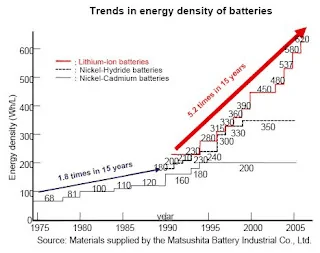
It's worth pointing out that there is a theoretical max of 800watts per liter for lithium ion.I remember hearing someone who studies battery technology discuss breakthrough improvements. He said that some new "breakthrough" is regularly announced as having been invented or demonstrated in the lab. However, if you look back over history, there has been a steady progression of improvement of x% per year, which is what you should use for planning. I did a quick search to see if I could find a graph showing this and found:

which shows an inflection point around 1990 with a significantly higher rate of improvement post 1990. So, Li-Ion didn't produce a step change in energy density similar to what's being claimed as possible with the switch to solid state. It does look to have resulted in a step change in the rate of improvement though.
A friend of mine did a well to wheel analysis of H2 for locomotive propulsion. Using a green source of electricity such as solar or wind to produce H2 from electrolysis of water, compression, refrigeration (almost to absolute zero) to produce liquid H2, shipment to point of fueling, production of electricity via H2 fuel cell and traction motor efficiency to motion has approximately 10% efficiency.
H2 has a number of technical challenges that it's possible to solve with sufficient engineering effort, but it's far from easy. Liquid H2 is almost at absolute zero; super cryogenic. Contact with storage vessels and piping must be prevented! Embrittlement is a durability issue. You need vaporization systems and a significant source of heat to make those work. If the storage vessel warms at all, there has to be a venting mechanism to avoid pressure exceeding the storage vessel's strength (ever seen a car where someone left a scuba tank in the trunk on a hot day?) H2 is the smallest molecule, so the most difficult to prevent from leaking. H2 is colorless and odorless. Putting in something like mercaptan (the chemical that makes natural gas smell) isn't effective since H2 can leak and leave the odorous gas behind. H2 when burning is not visible in sunlight. Leak detection systems on vehicle and in service and storage buildings will be needed for safety. A friend of mine likes to say "Hydrogen - the fuel of the future, and it always will be". All that being said, the DOE is funding programs to address safety concerns and try and reduce the cost of production significantly (dirty H2 from methane, the main method of production, is a fair bit more expensive than gasoline or diesel currently). I think it will have its niches, but it seems unlikely to me that it will be the dominant technology.

No risk from Mr. Fusion powering our vintage but highly modified Delorean...If people are going to choose hydrogen fuel cells, we might as well go with nuclear powered cars - about the same difficulty and risk
[/QUOTE]I underestimated. It has been far longer than that.
Solid Power https://www.solidpowerbattery.com/about/history/default.aspx and especially QuantumScape https://www.quantumscape.com/company/ are two examples of companies founded on "revolutionary" solid state battery technology developed in academia 15 years ago. You don't get hundreds of millions in funding over that length of time without hype.
Now let's go further back:
Ilika https://www.ilika.com/about-ilika was also founded to commercialize solid state battery technology developed in academia - that was 20 years ago. Also a public company.
And even further back:
BlueSolutions https://www.blue-solutions.com/en/about-us/ has been working on solid state batteries for at least 25 years, with pilot manufacturing 23 years ago, and production and sales at scale for automotive use for at least 12 years.
ORNL developed a solid state battery in 1991 that they commercialized long ago. That's 33 years.
https://www.oakridger.com/story/new...icles-utilities-have-solid-future/8255580002/
I'm not going to research a treatise for you on "new" battery technology over the years. The fact is, every year we see half a dozen new types of batteries that promise to revolutionize the industry. All of these are long-term prospects, and few of them ever reach commercialization. There are currently over 60 public listed companies working primarily on solid state batteries. None are ready for mass market automotive use.
Here is a good recent overview article which says the same thing I said - solid state batteries are not the "immediate future": https://www.sae.org/news/2023/11/solid-state-battery-status
Yea, these sources are suspect. Makes no sense… bmw is clearly all in on electric cars if anyone actually is doing their homework.How is this thread still alive? Has no one noticed that the source data was just a bogus bit of internet nonsense from dhaka tribune? BMW says on it hydrogen promotion page: "In conclusion, hydrogen drives have the potential to make ecologically sustainable mobility possible. However, this depends in particular on using renewable energies in hydrogen production and expanding the technical infrastructure to achieve shorter transport routes." This is a dozen other caveats on its web site underscore the point that BMW believes this has a long way to go and lots of hurdles to clear and may never happen.
IOW BMW is not going all in or mostly in or even significantly in for fuel cells. It is keeping the work alive as a sensible hedge. The english language Bangladeshi news site picked up some old press and rehashed it with an unrealistic spin that was then amplified by a hydrogen fan site.


