
DucRider
Well-Known Member
Warranty is 8/175K, so right in the ballparkimagine the amount of mileage and recharge/discharge cycles would play big part. 8 years and I may have 150-200k miles on this thing ?Who knows. Hope you are correct
Sponsored
Warranty is 8/175K, so right in the ballparkimagine the amount of mileage and recharge/discharge cycles would play big part. 8 years and I may have 150-200k miles on this thing ?
The warranty is it will have 70% after 8 years or 80k miles.Warranty is 8/175K, so right in the ballpark
Three mi is 333 Wh/mi. That's too good to be true for the freeway and a little optimistic for around town. Two is 500 Wh/mi and I think that's about where it's going to fall for highway. Perhaps a bit more. ABRP is using 516 (for 65 mph) in their alpha model for R1T.In the q&a with RJ, he kind of said the trucks efficiency in passing....
He said 2to3 miles per kWh. That would be better than I would expect.
Sure we do. The details are going to be different but the physics are the same. If you drive a BEV and know a little physics you have, or should have, a pretty good idea as to what is reasonable and what is not. We also know that Rivian's engineers know and have known for years. We know that they have been talking 400+ miles for EPA range for years and that the battery is going to have about 180 kW discharge capacity which implies 450 Wh/mi. We know that + means at most a few miles and that they aren't going to release a vehicle they've advertised for years as 400+ with 370. Putting all this together we can tell that RJ is being a bit optimistic at 333 (implies + = 33 mi EPA range) and probably pretty close at 500 for highway.However an EV this size is still an unknown, the public has no reference to understand what av EV truck is doing at highway speeds...
We do have to wait to see what people are experiencing and what the rated numbers are. This will lead to the usual round of arguments on the flaws of the EPA tests, whether Rivian did all 5 or the minimum 3, whether they are sandbagging etc. It's going to be all the more complicated with these vehicles because they will be taken off road.So we have to wait for some range tests when people get them.
We know that they have been talking 400+ miles for EPA range
I held off responding to this in the hope that the member whi was concerned about battery weight would explain his concern but he didn't. Having a bound on the weight increase will help in looking at what the ∆ weight impact might actually be. Of course to do that I need the curb weight. I'm assuming an even 3000 kg (6600 lbs). Do you have a more precise number? For now a ∆ of 350 implies a weight increase of 5.3%when talking with RJ about the 300 vs. 400 mile batteries, he said the weight difference would be in the 300-350 pound range.
The power required for a given rate of acceleration is P = a*m*v (acceleration times mass times velocity) which is directly proportional to mass (at any rate of acceleration or speed). Thus the max truck is going to need 5.3% more power if it is going to do 0 - 60 in the same time as the large. Is the inverter for the max different from that for the large? It only has to handle an extra 5.3% as it would have to do if you add a couple of people or put 7 sacks of malt in the bed.That came up when he was explaining the decision to upgrade the MaxPack version to make it as fast or faster than the LargePack, in part to acknowledge the extra outlay for those buying the top-of-the-line vehicle in either body style.
I know we saw at least one set of inverters for the MaxPack. I'd guess any increase in weight for those would be minimal, especially compared to the battery.
In writing the last paragraph it became clear to me that there are a whole host of effects such as whether the inverter would be different, what the losses in the inverter would be as the necessary current would go up, if briefly during acceleration but not briefly when going up a long hill but that would be offset by lesser loss in the bigger battery (135/180ths of the current in each cell)....While we didn't discuss the specific effect on range by carrying that extra weight, I'm guessing you probably have that down to a very specific effect.
Inertial loss is more important in town than it is on the freeway but it is a load in either case and yes, the regen system is going to recover the majority of it. That is I think why ABRP uses the same number for all three models of the R1T in its 65 mph model. Regen is also responsible for recovering most of the energy you use in going up a hill when you come down. Just to throw out a number suppose you go up in elevation 1 mile (1600 m) in the course of driving 10. That requiresAm I right in guessing that once the vehicle is up to speed, the increased weight has less of an effect on "mileage" during sustained highway driving than it does in start and stop driving, where you're having to routinely accelerate and slow with more weight in play? If that's the case, I'm guessing that at least a small percentage of that range-loss from acceleration would recaptured by the extra regen created by slowing that extra mass, is that correct?
And I appreciate the specific facts you have brought to us and I am sure I am not alone in this.I always appreciate your specific factual calculations, input, and feedback.
Your bio squib says you drive a BEV. You should have some idea as to how it performs relative to its rated consumption when you drive it at 65 to 85. The CT is going to have a worse drag coefficient and larger projected area and is going to weigh more but if you know a little physics you ought to be able to put a little "english" on the EPA number and if you don't you can always go to ABRP and let them do it for you. No, you won't get the exact number. As you should know from driving a BEV there is no exact number. In any case many of us have a pretty good idea of what we are going to get when out trucks finally arrive.Yes we know the EPA range which is a mix of city and fairly slow highway speeds.
We really don't know how the truck behaves at highway speeds like 65 to 80mph. There no other EV at this size on the highway to see how much more battery drain it is going get when actually driving at more realistic road trip highway speeds.

Now I can say, "AJ, Thank you for your specific factual calculations, input, and feedback. I expected nothing less. As always, I appreciate your help in answering my questions and those of others. Have a great rest of your weekend!"I held off responding to this in the hope that the member whi was concerned about battery weight would explain his concern but he didn't. Having a bound on the weight increase will help in looking at what the ∆ weight impact might actually be. Of course to do that I need the curb weight. I'm assuming an even 3000 kg (6600 lbs). Do you have a more precise number? For now a ∆ of 350 implies a weight increase of 5.3%
The power required for a given rate of acceleration is P = a*m*v (acceleration times mass times velocity) which is directly proportional to mass (at any rate of acceleration or speed). Thus the max truck is going to need 5.3% more power if it is going to do 0 - 60 in the same time as the large. Is the inverter for the max different from that for the large? It only has to handle an extra 5.3% as it would have to do if you add a couple of people or put 7 sacks of malt in the bed.
In writing the last paragraph it became clear to me that there are a whole host of effects such as whether the inverter would be different, what the losses in the inverter would be as the necessary current would go up, if briefly during acceleration but not briefly when going up a long hill but that would be offset by lesser loss in the bigger battery (135/180ths of the current in each cell)....
Inertial loss is more important in town than it is on the freeway but it is a load in either case and yes, the regen system is going to recover the majority of it. That is I think why ABRP uses the same number for all three models of the R1T in its 65 mph model. Regen is also responsible for recovering most of the energy you use in going up a hill when you come down. Just to throw out a number suppose you go up in elevation 1 mile (1600 m) in the course of driving 10. That requires
(350/2.2)*9.8*1600/3600/10 = 69.3 Wh/mi of which you get 80% back when you come down making the net cost 13.8 Wh/mi.
This leaves rolling resistance which also goes up with weight. Assuming a coefficient of 0.01 the cost per mile of the extra 350 lbs is
(350/2.2)*9.8*0.01*1600/3600 = 6.9 Wh/mi
Thus it appears that for highway cruising on nominally level terrain my consumption might increase by 1.5% and on hilly terrain by 4% because of the extra battery weight but that extra weight is giving me over 30% more range. Is the man concerned about his electric bill?
I always appreciate your specific factual calculations, input, and feedback.
Yes, but you have tasted the fruit!As to the initial question of the poll in this thread, I am in the camp of staying with the Launch Edition, which currently sits as 55.1%.
No, I don't. You can't ignore weather and terrain. Both are big factors. For example drag starts to emerge as a the major load above around 65 mph and it increases as the square of the speed. A 20 mph head wind increases drag, relative to 65 mph, by a factor of (85/65)^2 = 1.71. In addition to that a surprisingly small amount of water on a smooth roadbed can increase consumption appreciably.Here's a question for you BEV owners out there.... How far do you think you'd have to drive to get a decent sense of range?
For my test drive I am hoping to get up to highway speed for 20 miles or so and then attempt to calculate for myself how far I could reasonably go in similar conditions with a full charge.
Do you think 20 miles is enough to gauge range? (ignoring weather and terrain for now)
I'm pretty certain the diagnostics on the dashboard will give you a good feel (i.e. accurate idea) for charge used and available range left after driving 20 miles on a flat surface at highway speed.Here's a question for you BEV owners out there.... How far do you think you'd have to drive to get a decent sense of range?
For my test drive I am hoping to get up to highway speed for 20 miles or so and then attempt to calculate for myself how far I could reasonably go in similar conditions with a full charge.
Do you think 20 miles is enough to gauge range? (ignoring weather and terrain for now)
You will find that you come to think of your fuel condition in a very different way than you are used to doing from your ICE driving experience. I can talk about it all day long but you won't appreciate it until you experience it. In reality the world isn't any different in a BEV than it is in an ICE vehicle. If conditions chage en route such that your fuel consumption goes way up your range will go way down (if the condition persists) and you will run out unless you top up. The way in which your experience is different is that if that happens in an ICE vehicle (the light comes on way before your next planned fuel stop) you just pull off at the next exit and get gas. In a BEV you don't because there probably is no place to charge at the next off ramp. This results in obsession with fuel condition at all times throughout the trip. I don't have to explain this to pilots because they already know all about it.I'm pretty certain the diagnostics on the dashboard will give you a good feel (i.e. accurate idea) for charge used and available range left after driving 20 miles on a flat surface at highway speed.
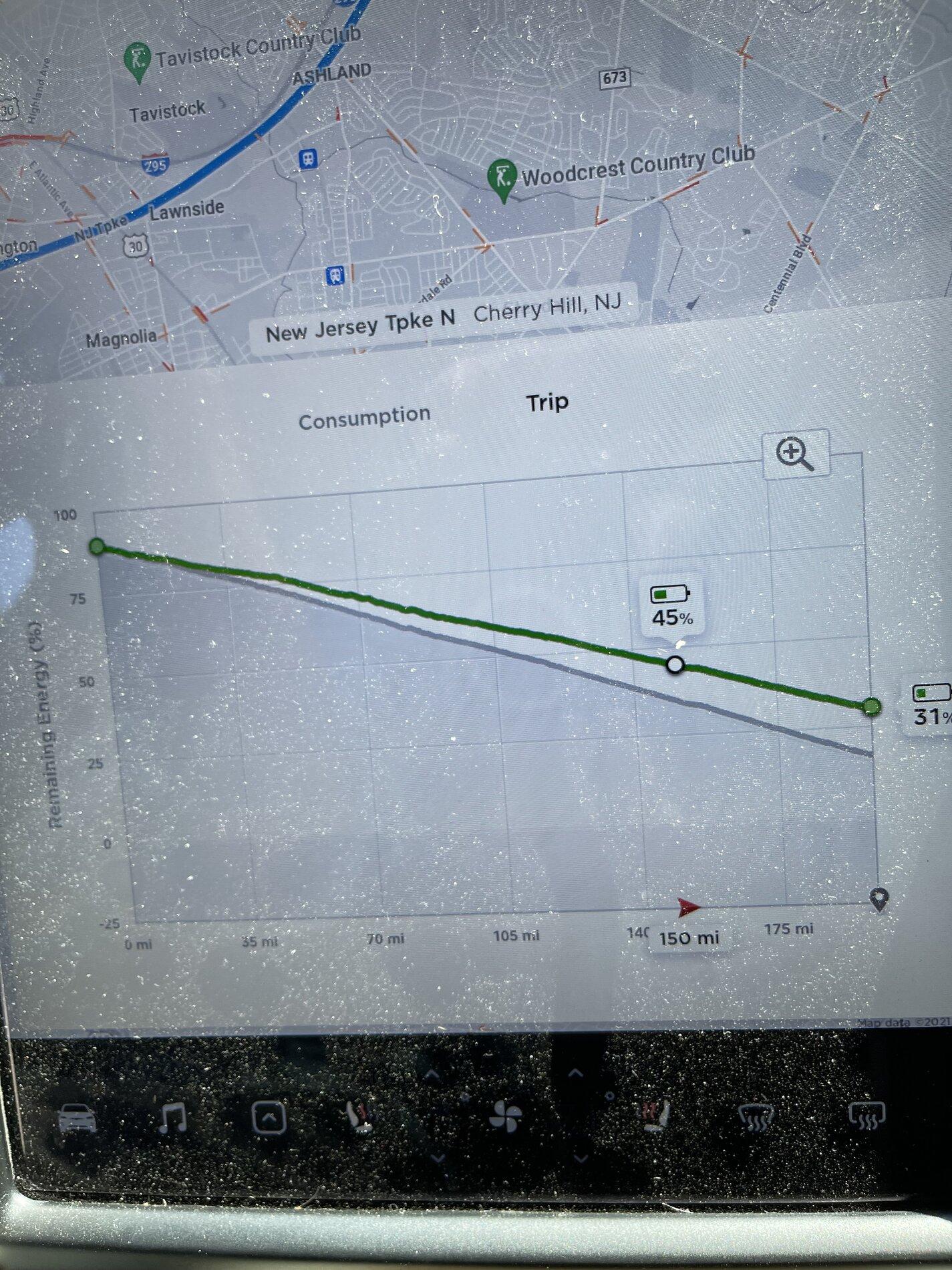
It's inherent with this sort of estimator that it is always going to be right at the end. The real question is as to whether being told before setting out you will have 37 miles range left at destination you can be assured that you will in fact have 37 miles range when you get there. No display can do that because it can't know that it might start raining heavily or that a head wind might spring up mid trip. It is the job of this graph to let you know if something that does impact end SoC comes up in enough time that you can do something about it if that's necessary.I can only speak to the experience in my Cadillac, but if it tells me I have 37 miles worth a range, it pretty much nails it by the end of that drive.
This example picture shows that the story based on the first 20 miles can be deceptive with regard to the rest of the trip (especially if it is a long one). But note that just as this display can warn you that you had better slow down and/or charge sooner than plan it tells us, in cases like this example, that we could, on observing the more favorable than anticipated consumption at, say the 35 mile point, dial another 10 mph into the auto pilot. This means more consumption so as we drive at this higher speed the red line slope increases and the red meatball starts to descend the right axis. If it stabilizes at a lower SoC value lower than we are comfortable with we just dial the autopilot back a bit. Getting used to this is what requires the experience and some thought.That's especially the case when doing what you've laid out, that of maintaining a fairly constant speed in a highway setting.
Some will be pleased and some will be pissed off. I can guarantee posts in this forum a few months hence to the effect that that Scaringe bastard is as much of a scoundrel as that Musk bastard. These will come from people who have no clue about the physics involved and who think they should get 300 + miles range while driving 85 mph in hot weather. No reasonable person would think that but these are not reasonable people. I sure RJ is being fitted for his lead underwear as launch approaches.But With our Rivians, I'm guessing we're gonna be pleasantly surprised. RJ and his team didn't seem to indicate that even the A/T tires were going to keep us from reaching their claimed range.
This may be one of the hardest things for new BEV drivers to grasp. You will almost never achieve the advertised range. Sometimes you will get more and sometimes you will get less. It depends on how you drive, where you drive and when you drive. In the west where there are long stretches of road with 75 mph speed limits you will not get 300+ miles of range. On the east coast where speed limits are lower you will and might even get a bit over.It's not like anyone made a proclamation that "Thou Shall Garner The Advertised Range!", it was just that they didn't seem to be concerned that these things wouldn't be able to produce the range we're expecting.
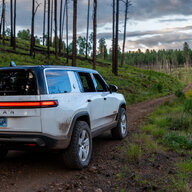
Electrify America, in cooperation with APS, are installing fast chargers in Payson, Show Low, and Globe. Expected completion is spring 2022. Not sure if that changes your mind. We travel to our favorite camping location just south of Big Lake and that area was a concern for me also.I live in the PHX metroplex and have a place in Pinetop-Lakeside in eastern AZ with my brothers. It's a great area year round. It's about 180 miles uphill (both ways in the snow!!!) and we try to go several times a year. The 300 mile pack just isn't enough to get up there comfortably every trip and there are no CCS chargers on either of the direct routes up the hill.
Thus, I'm holding out for the Max pack. As @TessP100D would say - Range is King!
On a side note, I bought my daughter a Tesla Model 3 Standard Range Plus that has a 240 mile range and I regret it every day. I should have purchased the Long Range.


