Sponsored

What would you do? Get LE version (300+) or wait for MaxPack (400+)?

What do you think?

  • Get the truck sooner, and sacrifice the extra 100 miles

  • Be patient and wait for that MaxPack


Results are only viewable after voting.

BigE

Well-Known Member
First Name
Eric
Joined
Nov 19, 2020
Threads
41
Messages
839
Reaction score
1,402
Location
North Carolina
Vehicles
Rivian R1T, Honda S2000
I was of the opinion that 300 miles range is enough but that an extra 100 in your back pocket would definitely be nice to have. Then someone posted on this forum asking about his favorite off road trip which involves 27 miles on the beach. He didn't think he could do that with 300 miles range given where the beach (Assateague island) is located relative to charging and he is right. Some quick calculation show that driving on sand can get your consumption to well over 1 kWh/mile. I am therefore now firmly of the opinion that if you plan to do anything off road or tow you should definitely wait for the 400 mile truck or SUV. I live on the east coast.

Where you are coming from may have something to do with it. At the time I learned of the Rivians I was driving a 294 mile Tesla and 400 miles just seemed unbelievable. I'm now driving a 351 mile Tesla and 400 doesn't seem that exciting. I can't see going back to 300.
AJ, my brother, and I were discussing the R1T this morning and Large vs Max. He's up in MN and has a Model Y as do I. This summer we did a 3,500-mile road trip in his Y. On a day-to-day basis, the Y is fine, but trying to road trip and put on 500-600 miles a day is pretty hard on the route we took. Hard in meaning, time-consuming. So for me, the 400-mile pack is really minium as we camp, pull a small trailer, etc. I also have an early reservation on the Tri-Motor CyberTruck so anxious to see how that will turn out on weight, pack size, etc. Thanks for all your deep dives into some of the calculations you do, I honestly don't know where you have the time. Best regards.
Sponsored


ajdelange

Well-Known Member
First Name
A. J.
Joined
Aug 1, 2019
Threads
9
Messages
2,883
Reaction score
2,319
Location
Virginia/Quebec
Vehicles
Tesla XLR+2019, Lexus, Landcruiser, R1T
Occupation
EE Retired
Thanks for all your deep dives into some of the calculations you do, I honestly don't know where you have the time. Best regards.
You are certainly most welcome.

As for time: I am retired and its a cold rainy day here so time I have a plenty. Also it actually often gets me pretty deep into the stuff I used to do when I was working and that helps keep the rust out of the hinges which is pretty important at my age.

Of course I find the tech fascinating but equally fascinating is the way people from different walks in life approach it.

I keep saying what I said in the post you quoted (300 is enough but the extra 100 is nice to have) and I also say, a lot, that most of the time you just jump in the car and go and that is often true but only in the more settled areas. We are headed down into Maine this week and the route is being planned in no small measure by charging.
 

DucRider

Well-Known Member
First Name
Gary
Joined
Oct 21, 2019
Threads
17
Messages
1,691
Reaction score
3,188
Location
ORegon
Vehicles
Polestar 2, Ioniq, R1S
This may be one of the hardest things for new BEV drivers to grasp. You will almost never achieve the advertised range. Sometimes you will get more and sometimes you will get less.
The bolded statement varies greatly by vehicle, but it is usually true.

People that have experience with multiple EVs have experienced a broader range of results.

The Taycan does much, much better in the real world than it's EPA rating and it is extremely easy for owners to exceed the EPA range.
The same is true to some extent for the Ioniq EV and a few other EVs as well.
Those models are as much outliers as most Teslas are - but in the other direction.

I expect that the Rivian will fairly easily match the EPA number in mixed driving at around 70 degrees without doing anything special.


We really can't know the dispersion of real world range until they are in the hands of owners in the real world - some will do better than others due to climate, terrain, driving habits, etc.
 

DuckTruck

Well-Known Member
First Name
Duck
Joined
Dec 23, 2020
Threads
36
Messages
2,352
Reaction score
6,287
Location
PNW
Vehicles
Corvair, BMW325, Acura Legend, XC60, '16 Caddy ELR
Clubs
 
You will find that you come to think of your fuel condition in a very different way than you are used to doing from your ICE driving experience. I can talk about it all day long but you won't appreciate it until you experience it. In reality the world isn't any different in a BEV than it is in an ICE vehicle. If conditions chage en route such that your fuel consumption goes way up your range will go way down (if the condition persists) and you will run out unless you top up. The way in which your experience is different is that if that happens in an ICE vehicle (the light comes on way before your next planned fuel stop) you just pull off at the next exit and get gas. In a BEV you don't because there probably is no place to charge at the next off ramp. This results in obsession with fuel condition at all times throughout the trip. I don't have to explain this to pilots because they already know all about it.

A pilot knows how many gph his plane burns and what it's airspeed (TAS) is and picks an altitude where the wind speed is such that his ground speed is sufficient to get him to his destination with a comfortable reserve. A BEV driver knows how many Wh/mi his car burns when there is no wind an recognizes that head winds don't change his ground speed but that they increase the Wh/mi he will consume. He knows that he may not make it to his destination unless he can lower than Wh/mi number (which he does by slowing down) or can refuel.

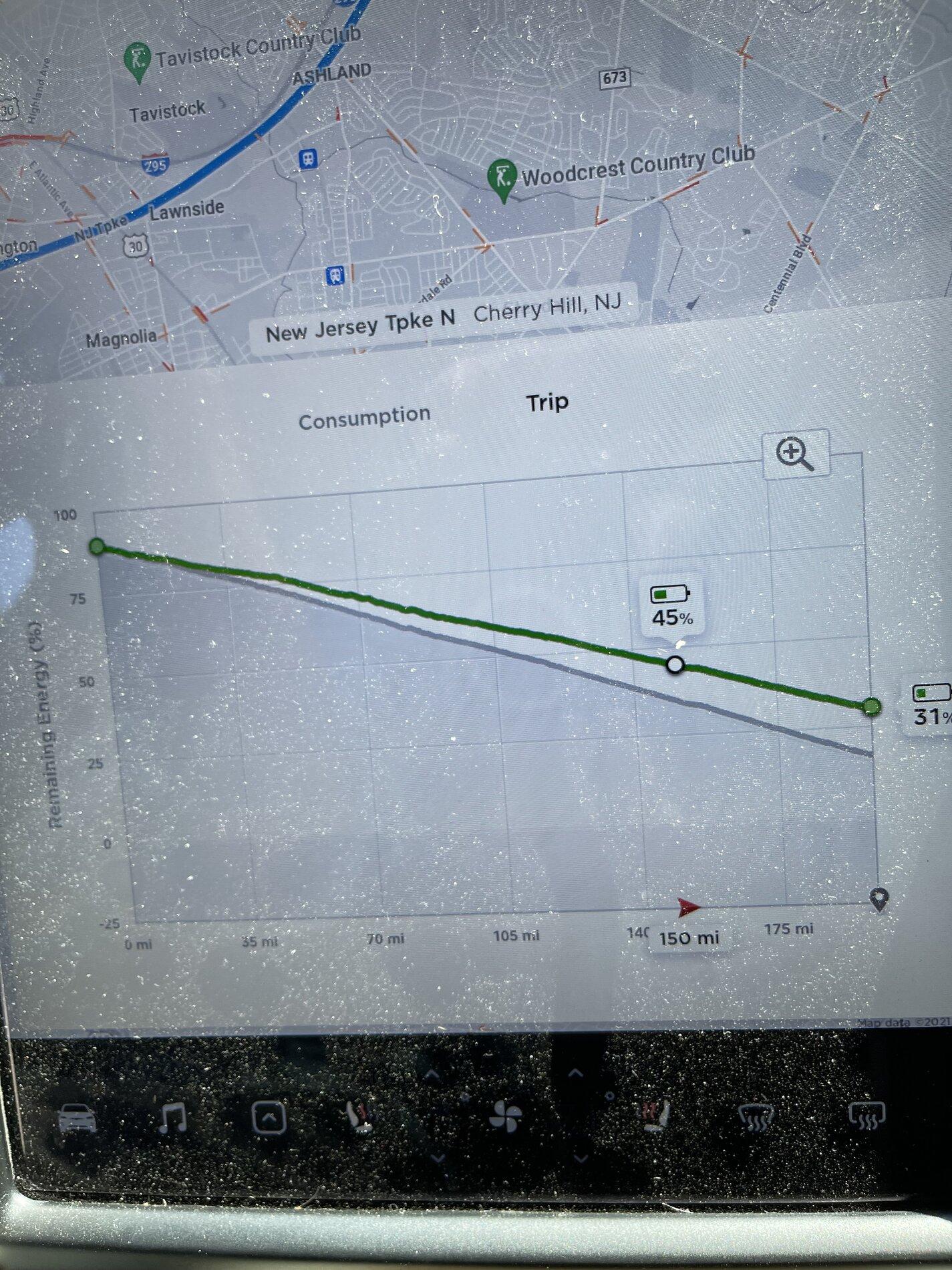
Most of you don't want to mess with any of the stuff I have just described and so the car gives you a display like this one:
IMG_1580.jpg


The gray line shows how much energy the car thought would be used in accomplishing this trip - that you will start out with about 80% charge and arrive with about 20%. Note that the line is not of constant slope because the navigation system knows where you are planning to go, that the speed limits vary and that the terrain isn't level. Sometimes the jogs in the line are much more dramatic than they are in this example.

The heavy red line shows the actual trip consumption history up to the open circle (your location) and a projection based on recent history beyond that point out to the destination. In this case the first 20 or so miles confirmed the original prediction but at that point it starts to become clear that you are really going to do better than the early prediction and at 150 miles you have obviously done quite a bit better than originally thought. Consequently the prediction for the destination is much better than the planner originally said things would be. The planner would use the rated range adjusted for terrain and speed limit to make its prediction of 20% SoC at the destination so obviously the rated range is not the appropriate range to use here. Why not? Probably, in this case, because of a tail wind but a more conservative than average driver might be the answer too. Were I to drive this route a month or even a day later the result might be substantially different. Your job is to observe what conditions lead to better and what conditions lead to worse performance. Or at least to understand what you need to do if the red meatball dips beneath 0 at the destination end of the plot.

There is much more detail on this plot in another thread but the essence is somewhat obscured in that thread by extensive discussion about what the planning system can and cannot know a priori.

The obvious assumption in all of this is that the Rivians will have a similar display as I think they must.

It's inherent with this sort of estimator that it is always going to be right at the end. The real question is as to whether being told before setting out you will have 37 miles range left at destination you can be assured that you will in fact have 37 miles range when you get there. No display can do that because it can't know that it might start raining heavily or that a head wind might spring up mid trip. It is the job of this graph to let you know if something that does impact end SoC comes up in enough time that you can do something about it if that's necessary.

This example picture shows that the story based on the first 20 miles can be deceptive with regard to the rest of the trip (especially if it is a long one). But note that just as this display can warn you that you had better slow down and/or charge sooner than plan it tells us, in cases like this example, that we could, on observing the more favorable than anticipated consumption at, say the 35 mile point, dial another 10 mph into the auto pilot. This means more consumption so as we drive at this higher speed the red line slope increases and the red meatball starts to descend the right axis. If it stabilizes at a lower SoC value lower than we are comfortable with we just dial the autopilot back a bit. Getting used to this is what requires the experience and some thought.


Some will be pleased and some will be pissed off. I can guarantee posts in this forum a few months hence to the effect that that Scaringe bastard is as much of a scoundrel as that Musk bastard. These will come from people who have no clue about the physics involved and who think they should get 300 + miles range while driving 85 mph in hot weather. No reasonable person would think that but these are not reasonable people. I sure RJ is being fitted for his lead underwear as launch approaches.


This may be one of the hardest things for new BEV drivers to grasp. You will almost never achieve the advertised range. Sometimes you will get more and sometimes you will get less. It depends on how you drive, where you drive and when you drive. In the west where there are long stretches of road with 75 mph speed limits you will not get 300+ miles of range. On the east coast where speed limits are lower you will and might even get a bit over.
AJ,

As always, thanks for the deep detail within the information you provide. Some may not appreciate the minutiae of what you present, but I always find both the concepts and the fine details of interest.

I know what you're speaking of when you're talking about different driving styles and how conditions alone can make a big change. I used to have a Volkswagen Sirocco that had an EPA Highway Range of 40 MPG. The only time I ever got that, at 65 MPH, was with Cruise control while going through the Columbia River Gorge with a tremendous tail wind. Coming back the other direction, at the same speed the following day, at roughly the same temperature, but with a tremendous headwind, my mileage dropped to under 30MPG.

In the 5 years with the ELR, I've played with many of the types of calculations and observations you mentioned, but on a very limited basis with only about 35 miles of battery range before the "range extender" kicks in to continue the journey. Of course, with the gasoline engine as the backup, it's nothing like flying a plane where, when you run out of fuel, your luck meter has pretty well bottomed out, as well.

Before the Rivian arrives, I know I will be going back through your older posts to check out the information you referenced here. Despite my attempt at humor this morning, I feel confident I will be able to drive around freely in the world without fear of running out of charge. Part of that has to do with a reasonable amount of common sense, the rest of it has to do with the fear of running out of charge.

It would be fun, under controlled circumstances, to drive the Rivian on a flat, dry surface, at 65 miles an hour until it goes dead, just to see what it's capable of under "ideal conditions:. I've never been a hyper-miler, but knowing when prudent behavior is needed to arrive at the next station with some range left will be one of the first skills I'll work on. Of course the real skill is not letting it get anywhere near a critical stage before having to take action.

Thanks again for pointing me in the right direction before those skills will be needed in earnest.
 

ajdelange

Well-Known Member
First Name
A. J.
Joined
Aug 1, 2019
Threads
9
Messages
2,883
Reaction score
2,319
Location
Virginia/Quebec
Vehicles
Tesla XLR+2019, Lexus, Landcruiser, R1T
Occupation
EE Retired
The bolded statement varies greatly by vehicle, but it is usually true.

People that have experience with multiple EVs have experienced a broader range of results.
Not sure what you are trying to say here. A Porsche driver never realizes rated range more than a Tesla driver never realizes it?

The Taycan does much, much better in the real world than it's EPA rating and it is extremely easy for owners to exceed the EPA range.
The same is true to some extent for the Ioniq EV and a few other EVs as well.
This says those cars' manufacturers did a lousy job in making the measurements and EPA did a lousy job in approving their results. In technical terms their estimates are said to contain systematic or bias error.

Those models are as much outliers as most Teslas are - but in the other direction.

I expect that the Rivian will fairly easily match the EPA number in mixed driving at around 70 degrees without doing anything special.
Bias error is built in. There is nothing the driver can do to get it out of the car. Only the manufacturer can do that by going back and repeating the test so it more accurately reflects what it is supposed to represent.

What the driver can do is estimate the bias error and subtract it out (which is exactly what an analyst does when he knows he is dealing with a biased data source). What this practically means is that he observes how much juice he uses where and when. For starters I assume the Rivian will come with a few trip odometers built in. A lot of guys like to never touch one using it to record consumption over the lifetime of the car. A few thousand miles in the driver sees that though the manufacturer tells him that rated consumption is 500 Wh/mi his has, over the miles he has driven so far he only using on average 380. As far as where, when and how he drives the manufacturers consumption number is biased +120 Wh/mi. He uses the other trip odometers to see what, for example, his consumption is on the trip up to the mountain cabin as compared to the trip back home, how it surged the day it rained etc.


We really can't know the dispersion of real world range until they are in the hands of owners in the real world - some will do better than others due to climate, terrain, driving habits, etc.
I think you are conflating system/bias error with random error. There are things that neither the factory nor the driver can control such as wind, terrain and temperature. When you imply that Porsche is a better car than Tesla because they sandbag their EPA ratings whereas Tesla does the opposite you are talking about bias errors. Dispersion is associated with random errors in which I think we must include driver behaviours in the current context. I too trust that Rivian will, like Tesla and Audi, do the full set of 5 tests which should, as is the case with Tesla (don't know about Audi) result in small bias error. But as you say we won't know until we get some data and, of course, we won't get that until the Rivians are on the road and in the hands of people who understand how to interpret the data. But the dispersion we should be able to bound. The interesting aspect of it in this case is that these vehicles are going to have big frontal projected area and not so good (compared to sedans) drag coefficients meaning that drag is going to emerge as the major load at lower speed. I expect the Rivians will match their EPA rated consumption numbers in around town driving but I'd also expect consumption to rise faster with them than it does with the sedans when speeds get up over 60. I really don't think Rivian is going to sandbag and I think that this is going to open them up to a lot of brickbats from the plentiful pool of unsophisticated "experts" who post YouTube videos (this does not include the "EE explained" guy - he'll get it right).
 
Last edited:

Sponsored

Dark-Fx

Well-Known Member
First Name
Brian
Joined
Jul 15, 2020
Threads
148
Messages
13,589
Reaction score
27,458
Location
Michigan
Vehicles
R1T, R1S, Livewire One, Sierra EV, R1S
Occupation
Engineering
Clubs
 
I decided to get the LE because charging infrastructure has gotten a lot better than it was when I first got my Bolt in 2018. I'm of the opinion that the 400 mile range of the Max Pack is still not going to be adequate for pulling a trailer on snowy freeway in the coldest parts of winter. With the 300 mile I'm probably not even going to bother trying it. By the time I'm ready to get rid of the R1T I'm anticipating there being lots of options for 450-500 mile range trucks with a high towing rating. Would rather invest that extra $10k now in something with growth.
 

Jarico75

Well-Known Member
First Name
Joe
Joined
Jan 1, 2020
Threads
7
Messages
320
Reaction score
575
Location
Slc
Vehicles
Rivian R1T, Tesla Model Y, Camry Hybrid
Clubs
 
Now, if I decide to play in the mountains of Colorado and the dirt of Utah's canyons along the way, I know my range will suffer. But that's also true for our ICE-Shakers when getting off of the pavement. I know I'll be stopping in Salida to visit P.T. and his distillery. The extra weight of a few cases of mostly-full bottles might negatively impact my range a little, but that payload should have a sizable and positive impact on my perma-grin. ????
If you swing through SLC on your way....... Reach out. I will buy dinner and beverages for a first look of your R1T.
 

DucRider

Well-Known Member
First Name
Gary
Joined
Oct 21, 2019
Threads
17
Messages
1,691
Reaction score
3,188
Location
ORegon
Vehicles
Polestar 2, Ioniq, R1S
[/QUOTE]
AJ your original statement is I'm sure be true in your experience with your vehicle.
This may be one of the hardest things for new BEV drivers to grasp. You will almost never achieve the advertised range.
Thousands of other EV drivers have a much different experience and you need to back off on the "never"

You want to explain this away by statements such as:
This says those cars' manufacturers did a lousy job in making the measurements and EPA did a lousy job in approving their results.
This is, in fact, confirmation by you that you black and white statement isn't always true.

We currently have two EVs in the garage. One reaches the EPA range numbers in our normal driving pattern a bit over about 1/2 the year. The other is much, much better and routinely exceeds them by a large margin.
Earlier this year we took a weekend trip that wound up being a bit under 500 miles. Often 80+ degrees with liberal use of A/C. Primarily 2 people and luggage or sometimes 4 people in the car.
Most of the driving was freeway (~380 miles), and we pretty much went with the reasonable flow of traffic (75 in the 70 zones, etc), some stop and go. Rural roads at 55, and in town driving made up the balance.
EPA number translates to 225 Wh/mi. We got 198 Wh/mi for the trip.
But that can't be true because we would never get the EPA range.

I think it likely that most people with general around town use (mixed freeway and city) will easily meet or exceed the EPA number during mile conditions.

It is almost certain that a constant 75 mph on the freeway will result in a lower number than the EPA listed range (there is a slight chance that Rivian does as poor of a job as VW did on the measurements for all of the Taycan models and then the EPA follows up by botching the approval).
 

JeremyP

Well-Known Member
Joined
Feb 27, 2021
Threads
12
Messages
382
Reaction score
701
Location
Grand Junction, CO
Vehicles
Toyota 4runner, BMW I3, preordered R1S
Occupation
Engineer
I'm pretty certain the diagnostics on the dashboard will give you a good feel (i.e. accurate idea) for charge used and available range left after driving 20 miles on a flat surface at highway speed.

I can only speak to the experience in my Cadillac, but if it tells me I have 37 miles worth a range, it pretty much nails it by the end of that drive. That's especially the case when doing what you've laid out, that of maintaining a fairly constant speed in a highway setting. With our Rivians, I'm guessing we're gonna be pleasantly surprised. RJ and his team didn't seem to indicate that even the A/T tires were going to keep us from reaching their claimed range.

It's not like anyone made a proclamation that "Thou Shall Garner The Advertised Range!", it was just that they didn't seem to be concerned that these things wouldn't be able to produce the range we're expecting. After my factory pick up and during my drive back to Oregon, I'll take the over on whether the 300-mile range is attainable while on the highways, even with the A/T's.

Now, if I decide to play in the mountains of Colorado and the dirt of Utah's canyons along the way, I know my range will suffer. But that's also true for our ICE-Shakers when getting off of the pavement. I know I'll be stopping in Salida to visit P.T. and his distillery. The extra weight of a few cases of mostly-full bottles might negatively impact my range a little, but that payload should have a sizable and positive impact on my perma-grin. ????
Let me know if you need some suggestions for mountain or desert trails to explore, and I would love to take a peek at the truck if you pass through Grand Junction!
Regarding the max pack, another influencing factor could be the future implementation of V2H or using the vehicle as a backup power source. Compared to home energy storage batteries the price for an extra 45kwh of batteries in the Rivian is cheap!
 

Brookliner

Well-Known Member
First Name
Kenneth
Joined
Jun 17, 2021
Threads
2
Messages
89
Reaction score
151
Location
Brookline, MA
Vehicles
R1T
Occupation
Dad
Clubs
 
Wait for it……

Range is King.

always buy the biggest battery you can afford.
Wait for it……

Range is King.

always buy the biggest battery you can afford.
I just drive up the Maine coast in a Taycan 4S with an estimated 280 miles range. Despite the ac blasting during the whole 500+ miles we drove, charging was no more a consideration than filling the tank. Only once did we have problem with a blocked charger (a fully charged Tesla) and already half of the inns had j-1772 compatible chargers free to guests. I signed up for the Max Pack fearing that trips to Baxter State Park from Massachusetts wouldn’t be possible without it. I recognize now this is untrue.
 

Sponsored

DuckTruck

Well-Known Member
First Name
Duck
Joined
Dec 23, 2020
Threads
36
Messages
2,352
Reaction score
6,287
Location
PNW
Vehicles
Corvair, BMW325, Acura Legend, XC60, '16 Caddy ELR
Clubs
 
Let me know if you need some suggestions for mountain or desert trails to explore, and I would love to take a peek at the truck if you pass through Grand Junction!
Regarding the max pack, another influencing factor could be the future implementation of V2H or using the vehicle as a backup power source. Compared to home energy storage batteries the price for an extra 45kwh of batteries in the Rivian is cheap!
Regarding V2H, that's a great point! Regarding Grand Junction, that's a deal! Let's keep in touch!
 

ajdelange

Well-Known Member
First Name
A. J.
Joined
Aug 1, 2019
Threads
9
Messages
2,883
Reaction score
2,319
Location
Virginia/Quebec
Vehicles
Tesla XLR+2019, Lexus, Landcruiser, R1T
Occupation
EE Retired
As always, thanks for the deep detail within the information you provide. Some may not appreciate the minutiae of what you present, but I always find both the concepts and the fine details of interest.
As always, you are most welcome. It is gratifying to know that there are at least some here who are benefiting from it. Of course I am one of those people. When I start a post I often don't how it will end because I don't know the answer to the question being asked. I have gained so much insight by having to figure that out.

I know what you're speaking of when you're talking about different driving styles and how conditions alone can make a big change...
It is really no different with an ICE vehicle. It is just that you now care a lot more about the details of your fuel flow because you can't just pull over anywhere to fill up.

... like flying a plane where, when you run out of fuel, your luck meter has pretty well bottomed out, as well.
Reminded me of my crusty old mechanic whose favorite expression seemed to be "He ran out of airspeed, altitude and ideas."


Despite my attempt at humor this morning, I feel confident I will be able to drive around freely in the world without fear of running out of charge.
You are not the kind of driver I am worried about.


It would be fun, under controlled circumstances, to drive the Rivian on a flat, dry surface, at 65 miles an hour until it goes dead...
There are a number of practical problems with this but it is, of course, something you want to know and it is possible to figure it out. You have probably noted that I never mention rated range in any of my posts but I am always talking about rated consumption and consumption in general. The two are tied together through the battery's discharge capacity. Thus if my car has rated consumption of 282 Wh/mi and rated range of 351 miles it's battery must be able to deliver 351*.282 = 98.982 kWh and everyone accepts that my cars battery is 100 kWh (it has actually lost a bit over time - another thing you have to accept). One of the first things you will want to do is determine your new truck's "rated" range. I put "rated" in quotes because the manufacturer may make it so hard to determine that you will have to determine for your self, by observing consumption, what it is. Tesla hides it on one of its displays. Rivian may come right out and put it in the manual. It is now found on the Monroney sticker but heavily quantized e.g. "32 kW per hundred miles". We want at least 3 significant digits e.g. 323 Wh/mi. As noted in earlier posts the first thing you'll want to do is find out what your actual nominal consumption is. Call it your baseline. If you can discover what the rated consumption is you can then compare your baseline to the rated and see how you are doing relative to it. You will also discover biases.

With out too much difficulty you should be able to find out what the consumption is on a dry level road at 65 mph. Just drive that a half dozen times and take the average. While doing this record the percentage of the battery you use. It's a simple matter from there to extrapolate to how far you can go on 100% of the battery and that is the range for the vehicle at 65 mph.
 

ajdelange

Well-Known Member
First Name
A. J.
Joined
Aug 1, 2019
Threads
9
Messages
2,883
Reaction score
2,319
Location
Virginia/Quebec
Vehicles
Tesla XLR+2019, Lexus, Landcruiser, R1T
Occupation
EE Retired
AJ your original statement is I'm sure be true in your experience with your vehicle.
It's not only true with my vehicle. It is true with every other measurement system I've used in 50 years of engineering experience as it must be because the nature of random processes math makes it so.

Thousands of other EV drivers have a much different experience and you need to back off on the "never"
I shouldn't have said "almost never" I should have said "never".

You want to explain this away by statements such as:
This says those cars' manufacturers did a lousy job in making the measurements and EPA did a lousy job in approving their results. In technical terms their estimates are said to contain systematic or bias error.
This is, in fact, confirmation by you that you black and white statement isn't always true.
I'm afraid that what it actually confirms is that you don't understand the fundamentals of statistics. If you did you would have no problem with what I am saying. Thus my recommendation to you is that if you want to have meaningful discussions on these things you get a basic text or two and start reading.


We currently have two EVs in the garage. One reaches the EPA range numbers in our normal driving pattern a bit over about 1/2 the year. The other is much, much better and routinely exceeds them by a large margin.
You interpret a lousy estimator that makes you feel good as being a "better" estimator than one that doesn't.
Earlier this year we took a weekend trip that wound up being a bit under 500 miles. Often 80+ degrees with liberal use of A/C. Primarily 2 people and luggage or sometimes 4 people in the car.
Most of the driving was freeway (~380 miles), and we pretty much went with the reasonable flow of traffic (75 in the 70 zones, etc), some stop and go. Rural roads at 55, and in town driving made up the balance.

EPA number translates to 225 Wh/mi. We got 198 Wh/mi for the trip.
But that can't be true because we would never get the EPA range.
And you didn't. 198 ≠ 225 by my reckoning. You are stumbling over simple mathematical/statistical concepts here.


It is almost certain that a constant 75 mph on the freeway will result in a lower number than the EPA listed range (there is a slight chance that Rivian does as poor of a job as VW did on the measurements for all of the Taycan models and then the EPA follows up by botching the approval).
It is certain that 75 mph driving will involve more consumption than 65 mph, ceteris paribus, whatever the published EPA number.

To the other readers: You will not get the EPA range or EPA consumption on any trip. You will get close to them if your driving style and the driving conditions are close to the protocols under which the tests were performed (assuming that Rivian does a good job of the testing). Your task is to determine how much deviation from the EPA numbers a particular set of driving conditions or style causes.
 
Last edited:

TessP100D

Banned
Well-Known Member
Joined
Feb 10, 2021
Threads
0
Messages
587
Reaction score
429
Location
So cal
Vehicles
Tesla 2017 P100D MS
I just drive up the Maine coast in a Taycan 4S with an estimated 280 miles range. Despite the ac blasting during the whole 500+ miles we drove, charging was no more a consideration than filling the tank. Only once did we have problem with a blocked charger (a fully charged Tesla) and already half of the inns had j-1772 compatible chargers free to guests. I signed up for the Max Pack fearing that trips to Baxter State Park from Massachusetts wouldn’t be possible without it. I recognize now this is untrue.
congrats are soon to be with you, and you did the right thing because if you can afford it, the max pack is the way to go. Good choice. You won’t regret.
 

TessP100D

Banned
Well-Known Member
Joined
Feb 10, 2021
Threads
0
Messages
587
Reaction score
429
Location
So cal
Vehicles
Tesla 2017 P100D MS
It's not only true with my vehicle. It is true with every other measurement system I've used in 50 years of engineering experience as it must be because the nature of random processes math makes it so.

I shouldn't have said "almost never" I should have said "never".


I'm afraid that what it actually confirms is that you don't understand the fundamentals of statistics. If you did you would have no problem with what I am saying. Thus my recommendation to you is that if you want to have meaningful discussions on these things you get a basic text or two and start reading.


You interpret a lousy estimator that makes you feel good as being a "better" estimator than one that doesn't.
And you didn't. 198 ≠ 225 by my reckoning. You are stumbling over simple mathematical/statistical concepts here.


It is certain that 75 mph driving will involve more consumption than 65 mph, ceteris paribus, whatever the published EPA number.

To the other readers: You will not get the EPA range or EPA consumption on any trip. You will get close to them if your driving style and the driving conditions are close to the protocols under which the tests were performed (assuming that Rivian does a good job of the testing). Your task is to determine how much deviation from the EPA numbers a particular set of driving conditions or style causes.
You sir are of course 100% correct. You will not get the range the EPA says you will. Not even close.
Sponsored


Top