

Acoustic71
Well-Known Member
I could've sworn I passed a Canyon Red R2 on Hwy 1 near Depoe Bay yesterday. Took me by surprise. Then I wondered if there were out shooting a commercial?
Sponsored

If you take the 270 mile range for the base model and use some inference and basic math you’ll get range numbers that are pretty close based on those pack sizes.I agree with Kyle that these specs, if they hold, are weak. Here is how I am betting they roughly stack:
$45k - 75 kwh RWD, ~260 EPA / ~230 hwy 70 mph range, 10% - 80% ~25 min
$50k - 75 kwh AWD, ~250 EPA / ~215 hwy 70 mph range, 10% - 80% ~25 min
$55k - 95 kwh RWD, ~320 EPA / ~285 hwy 70 mph range, 10% - 80% ~30 min
$60k - 95 kwh AWD, ~305 EPA / ~270 hwy 70 mph range, 10% - 80% ~30 min
$65k - 95 kwh Tri, ~280 EPA / ~255 hwy 70 mph range, 10% - 80% ~30 min
(Updated cost guess and fixed charge time cut / paste error)
Ah, I see that. I hope they keep the overhangs short like that. I’m a big MINI fan and they completely ruined the Cooper over the years. They supposedly did this due to safety regulations.No, it also has shorter front and rear overhangs. It’s significantly shorter than the R1 and R2. The image I posted above has the vehicles overlayed with their front wheels aligned. If you push the R3 up so that its front bumper aligns with the others, you see how much shorter it is.
So do I because it takes too long to get to 80%. But a 70% charge would be 170-180 miles which would be perfect while road tripping.Curious do a lot of people charge 10-80%?
On my longer trips with my R1S most of my charges fall somewhere in the 20-65% range and a lot of times the charges are under 15 minutes.
I will say most of my charge stops are 100-120 miles apart as I prefer to stop for bio breaks and stretch my legs. The benefit of this is it keeps my charges in the higher kWh ranges.

FWIW I think this is gross and not useable. The R1 has a 10% range loss just going dual to tri. There is a 2.5% efficiency loss just bumping the battery large to max. So I am expecting degradation on both fronts.If you take the 270 mile range for the base model and use some inference and basic math you’ll get range numbers that are pretty close based on those pack sizes.
270 mi/75 kwh usable is 3.6 mi/kwh on a single motor.
We know they’ll likely use the same motors in the front and rear for simplicity with perhaps different gearing or tuning for the dual motor variants.
We also know they plan on implementing the same rear motor disconnect strategy to essentially be driving single motor the majority of the time in all purpose or conserve mode on the dual motor variants.
Take 95 kwh multiplied by 3.6 miles/kwh gives you 342 miles of range on the 95 kwh pack.
A tri motor variant will likely reduce that by 10% or more if not in conserve mode so based on the R1 dual vs Tri numbers I’d put an R2 tri motor on a 95 kwh pack at around 308 miles of range in all purpose and 340 in conserve assuming same wheels/tires in all examples.

I think you have to take all range estimates with a grain of salt. BMW i3 has a 108 kw (useable) battery and claims it will achieve a 400 mile EPA range (3.7 mi/k). The i3 form is not THAT different from R2. I would guess claimed efficiency will be 3.5. Then subtract for tires, cold, AWD, etc. i3 doesn't subtract those items either.FWIW I think this is gross and not useable. The R1 has a 10% range loss just going dual to tri. There is a 2.5% efficiency loss just bumping the battery large to max. So I am expecting degradation on both fronts.
Just for fun I tossed this into Gemini. Here is it's speculation for the LARGE pack

Well, if 75 & 95 are not usable, just gross AND the 270 mile EPA RWD range is correct, then the efficiency of the motors would be higher assuming that 270 mile number is accurate and the battery sizes are also accurate. The rest of the numbers would not change. I would not be surprised to see the bigger battery variant of the R2 go 320-350 miles of rated range as the model Y is going to be the biggest competitor here and it's trim levels are:I think you have to take all range estimates with a grain of salt. BMW i3 has a 108 kw (useable) battery and claims it will achieve a 400 mile EPA range (3.7 mi/k). The i3 form is not THAT different from R2. I would guess claimed efficiency will be 3.5. Then subtract for tires, cold, AWD, etc. i3 doesn't subtract those items either.
That's a total garbage answer.I just googled the benefits of the 46/95 cells in the R2. I definitely seems like it will have better Thermal management possibilities so I would expect it to charge faster.
Pros of the 4695 Battery Cell
- Higher Capacity & Energy: The increased dimensions allow for more active material, resulting in higher energy density and longer range for EVs.
- Improved Efficiency: As a cylindrical cell, it provides better thermal management via air gaps between cells and allows for faster charge/discharge rates compared to other formats.
- Enhanced Safety: 4695 cells often feature thick, flame-retardant, and robust, durable containers designed for high-demand, industrial, or electric vehicle applications.
- Longer Lifecycle: The design focuses on superior longevity and improved performance over time.

The BMW is using similar 4695 cells (obviously different pack architecture 800V vs 400v). The difference in size is (if the rumor is to be believed) 113 vs 95 (both gross) or 85%. If both have the exact same efficiency then we are at 400 miles (EPA) vs 336. If there is a 10% efficiency gap (BMW is allegedly an "efficiency beast") then 3.7 bmw is 3.3 R2 and we are right back at barely breaking 300 miles.I think you have to take all range estimates with a grain of salt. BMW i3 has a 108 kw (useable) battery and claims it will achieve a 400 mile EPA range (3.7 mi/k). The i3 form is not THAT different from R2. I would guess claimed efficiency will be 3.5. Then subtract for tires, cold, AWD, etc. i3 doesn't subtract those items either.

+1That's a total garbage answer.
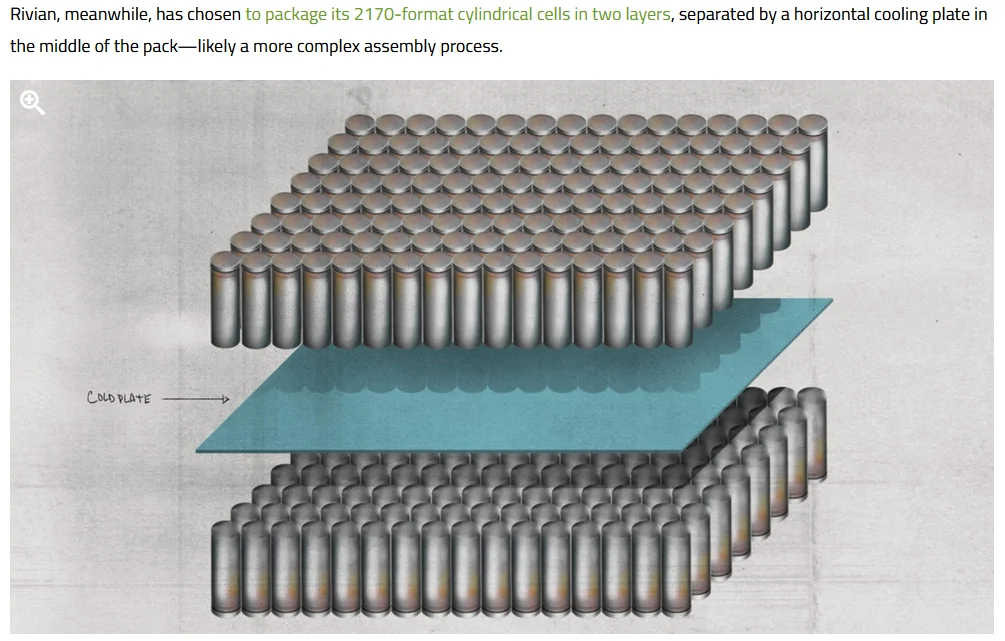
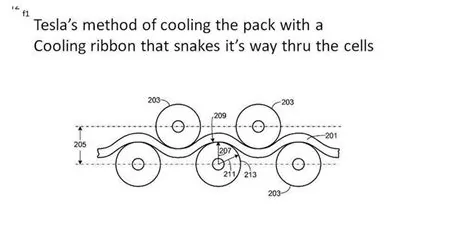
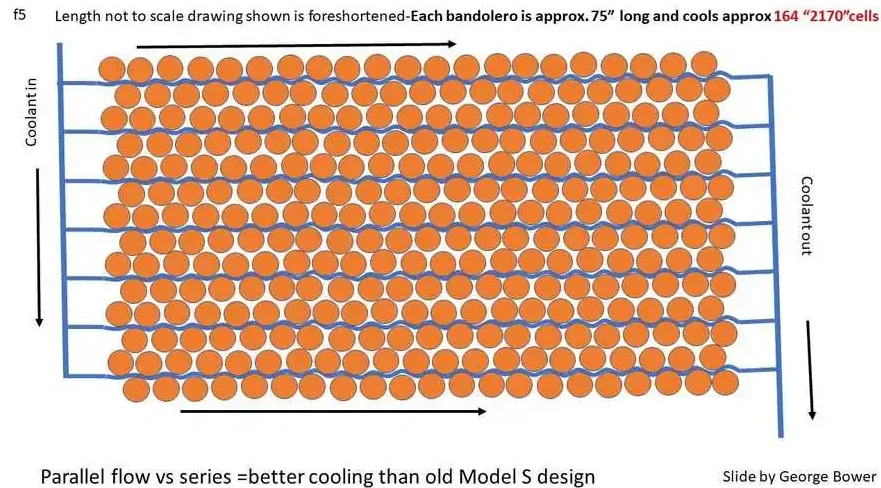

I would assume that, all things being equal, Rivian would stick with what they’re familiar with.Well, Rivian uses that thermal management method in R1... Do we know for sure it's the same with R2?

My understanding is that the 4695 cells are a single stack instead of a double stack like the 2170 cells. Not sure if that changes the cooling mechanism.I would assume that, all things being equal, Rivian would stick with what they’re familiar with.
The BMW estimate includes AWD and is more aerodynamic. No manufacturer subtracts range for cold etc. that is a known factor to take into account for buyers.I think you have to take all range estimates with a grain of salt. BMW i3 has a 108 kw (useable) battery and claims it will achieve a 400 mile EPA range (3.7 mi/k). The i3 form is not THAT different from R2. I would guess claimed efficiency will be 3.5. Then subtract for tires, cold, AWD, etc. i3 doesn't subtract those items either.


