
mkg3
Well-Known Member
- Thread starter
- #1
From Automotive News Europe:
https://www.autonews.com/ev/ane-ev-solid-state-batteries-factorial-0210/
By Lois Jones
February 10, 2026 05:37 AM EST
The solid-state battery race is intensifying as two key players reached big milestones as the industry sprints toward commercial launch.
On Feb 4, Volkswagen Group-backed QuantumScape inaugurated the Eagle Line, a highly automated pilot production facility in San Jose, Calif.
A day later, Karma Automotive revealed an agreement with Factorial Energy to launch the first U.S. solid-state battery production program for passenger vehicles. The battery will debut in the full-electric Karma Kaveya super coupe scheduled to arrive in late 2027.
Factorial, a U.S. startup, has a wide range of partners, including Mercedes-Benz, Stellantis and Hyundai/Kia, alongside its production deal with Karma.
In September, Mercedes, which has invested “high double-digit millions” in Factorial, announced that a modified EQS test vehicle, with lithium metal solid-state batteries, had completed a 1,205 km (749 mile) journey from Stuttgart to Malmo, Sweden, on a single charge.
Factorial aims to start mass production of its battery cells as soon as 2029, CEO Siyu Huang has said.

Stellantis will launch a demonstration fleet of Dodge Charger Daytonas powered by Factorial’s solid-state batteries in 2026. (FACTORIAL ENERGY) Where automakers stand
Several automakers have targeted 2027 as the year they will start equipping their production vehicles with solid-state batteries. Some are tentatively deploying semi-solid or “quasi-solid” batteries first, which are easier to manufacture and act as a bridge to full solid-state technology. These include Chinese automakers SAIC Motor and Nio.
Others are moving straight ahead.
Mercedes said solid-state battery packs are thinner and lighter, and offer better energy density, and thus longer range. (MERCEDES-BENZ)
“This means there is now an ‘arms race’ to see who gets SSBs to market the fastest and most successfully,” Gartner Vice President of Research Pedro Pacheco told Automotive News Europe.
But being first isn’t all that counts, Pacheco said. “Even the first movers should only sell limited volumes of SSBs this decade due to the high costs and limitations in production ramp-up. Only at the beginning of the next decade should we see the first automakers achieving higher production volumes of SSBs. Manufacturing technology and economies of scale will be crucial in bringing down the cost.”
High density but expensive
Industry analysts expect limited initial volumes — around 50,000 vehicles per large automaker before 2030 — because of these high production costs. This positions early solid-state batteries in premium and luxury segments while manufacturers work toward economies of scale.
Other weak points include charging and durability (the number of cycles). Finding stable and efficient solid electrolyte materials remains another big challenge. Ceramics and perovskite materials seem to be the most promising for mass production, Robert Fisher, senior consulting manager at SBD Automotive, said in an email.
That said, solid-state batteries offer advantages, including high energy density that should allow some BEVs to reach or even surpass a driving range of 1,000 km under WLTP test standards. “This means you can have a battery in a small city car with high energy density or in a bigger vehicle with major driving range,” Pacheco said.
Solid-state batteries are also safer, as their solid electrolytes are less prone to fires. And they offer more effective cooling performance, faster charging and improved reliability, experts say.
Next milestones to watch
Going forward, silicon anodes might be a less expensive alternative for solid-state battery anodes than lithium iron phosphate. “In the future, silicon anode SSBs may play the same role that LFP does today, providing a lower-cost and more sustainable solution for non-premium vehicles,” Fisher predicted.
Pacheco envisages a future where solid-state batteries take the upper end of the market, lithium batteries move to the mid-range of the market and sodium ion dominates the lower end. The market share for lithium ion batteries with nickel manganese cobalt chemistry, which dominate the BEV market, will progressively shrink. “In five years, we will already be seeing something which is very different from where we are today,” he said.
Fisher could even see liquid electrolyte lithium ion batteries becoming obsolete as solid-state batteries become the standard for automotive batteries.
As more production lines are set up and supply chains mature, prices should begin to fall and demand will increase, Fisher said.
“After 2030, I would expect to see much more mature SSB technology and more appetite from automakers to start integrating SSBs into their high-end lineups. Closer to 2035, I’d expect to see real competition between the ‘wet’ and ‘dry’ cells as traditional cells will no longer be competitive from a range and weight perspective,” he said. “I then expect to see SSBs trickling down from high-end vehicles to mass market as time goes on.”
https://www.autonews.com/ev/ane-ev-solid-state-batteries-factorial-0210/
By Lois Jones
February 10, 2026 05:37 AM EST
The solid-state battery race is intensifying as two key players reached big milestones as the industry sprints toward commercial launch.
On Feb 4, Volkswagen Group-backed QuantumScape inaugurated the Eagle Line, a highly automated pilot production facility in San Jose, Calif.
A day later, Karma Automotive revealed an agreement with Factorial Energy to launch the first U.S. solid-state battery production program for passenger vehicles. The battery will debut in the full-electric Karma Kaveya super coupe scheduled to arrive in late 2027.
Factorial, a U.S. startup, has a wide range of partners, including Mercedes-Benz, Stellantis and Hyundai/Kia, alongside its production deal with Karma.
In September, Mercedes, which has invested “high double-digit millions” in Factorial, announced that a modified EQS test vehicle, with lithium metal solid-state batteries, had completed a 1,205 km (749 mile) journey from Stuttgart to Malmo, Sweden, on a single charge.
Factorial aims to start mass production of its battery cells as soon as 2029, CEO Siyu Huang has said.
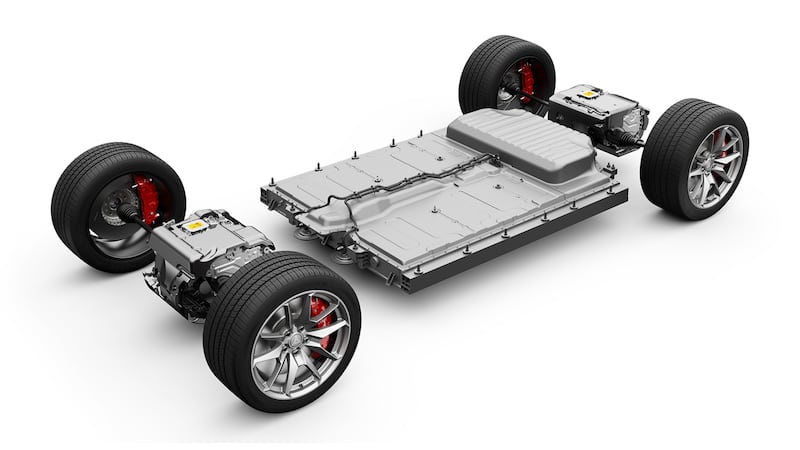
Stellantis will launch a demonstration fleet of Dodge Charger Daytonas powered by Factorial’s solid-state batteries in 2026. (FACTORIAL ENERGY) Where automakers stand
Several automakers have targeted 2027 as the year they will start equipping their production vehicles with solid-state batteries. Some are tentatively deploying semi-solid or “quasi-solid” batteries first, which are easier to manufacture and act as a bridge to full solid-state technology. These include Chinese automakers SAIC Motor and Nio.
Others are moving straight ahead.
- Stellantis this year will launch a demonstration fleet of vehicles with Factorial’s solid-state batteries.
- Chery Automobile plans to begin pilot testing and vehicle verification this year.
- Toyota plans to launch its first EVs with solid-state batteries between 2027 and 2028.
- BYD will begin serial production for its premium models in 2027 with mass-market availability across its broader vehicle lineup set for 2030.
- Nissan is building a pilot production plant in Yokohama for a 2028 commercial launch.
- Honda is focusing on a dedicated demonstration line for the late 2020s.
- BMW has been conducting real-world road tests with 17 prototypes and targets a commercial introduction in the early 2030s.
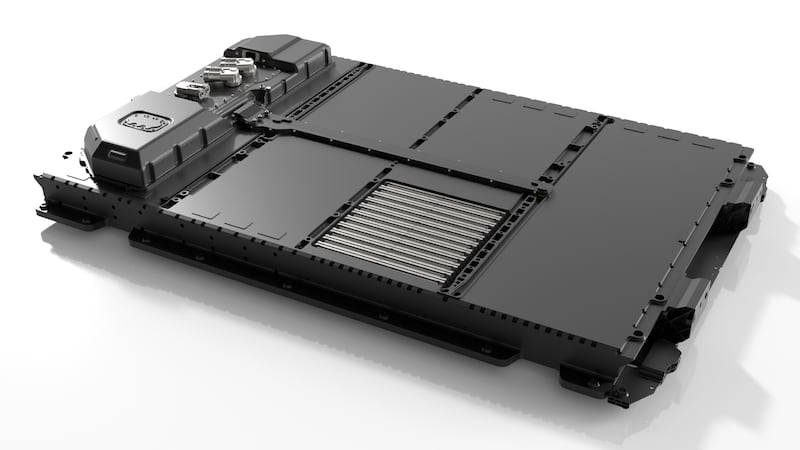
Mercedes said solid-state battery packs are thinner and lighter, and offer better energy density, and thus longer range. (MERCEDES-BENZ)
“This means there is now an ‘arms race’ to see who gets SSBs to market the fastest and most successfully,” Gartner Vice President of Research Pedro Pacheco told Automotive News Europe.
But being first isn’t all that counts, Pacheco said. “Even the first movers should only sell limited volumes of SSBs this decade due to the high costs and limitations in production ramp-up. Only at the beginning of the next decade should we see the first automakers achieving higher production volumes of SSBs. Manufacturing technology and economies of scale will be crucial in bringing down the cost.”
High density but expensive
Industry analysts expect limited initial volumes — around 50,000 vehicles per large automaker before 2030 — because of these high production costs. This positions early solid-state batteries in premium and luxury segments while manufacturers work toward economies of scale.
Other weak points include charging and durability (the number of cycles). Finding stable and efficient solid electrolyte materials remains another big challenge. Ceramics and perovskite materials seem to be the most promising for mass production, Robert Fisher, senior consulting manager at SBD Automotive, said in an email.
That said, solid-state batteries offer advantages, including high energy density that should allow some BEVs to reach or even surpass a driving range of 1,000 km under WLTP test standards. “This means you can have a battery in a small city car with high energy density or in a bigger vehicle with major driving range,” Pacheco said.
Solid-state batteries are also safer, as their solid electrolytes are less prone to fires. And they offer more effective cooling performance, faster charging and improved reliability, experts say.
Next milestones to watch
Going forward, silicon anodes might be a less expensive alternative for solid-state battery anodes than lithium iron phosphate. “In the future, silicon anode SSBs may play the same role that LFP does today, providing a lower-cost and more sustainable solution for non-premium vehicles,” Fisher predicted.
Pacheco envisages a future where solid-state batteries take the upper end of the market, lithium batteries move to the mid-range of the market and sodium ion dominates the lower end. The market share for lithium ion batteries with nickel manganese cobalt chemistry, which dominate the BEV market, will progressively shrink. “In five years, we will already be seeing something which is very different from where we are today,” he said.
Fisher could even see liquid electrolyte lithium ion batteries becoming obsolete as solid-state batteries become the standard for automotive batteries.
As more production lines are set up and supply chains mature, prices should begin to fall and demand will increase, Fisher said.
“After 2030, I would expect to see much more mature SSB technology and more appetite from automakers to start integrating SSBs into their high-end lineups. Closer to 2035, I’d expect to see real competition between the ‘wet’ and ‘dry’ cells as traditional cells will no longer be competitive from a range and weight perspective,” he said. “I then expect to see SSBs trickling down from high-end vehicles to mass market as time goes on.”
Sponsored