Sponsored

Katsudon

Well-Known Member
First Name
Tim
Joined
Feb 20, 2019
Threads
137
Messages
228
Reaction score
1,349
Location
NY
Vehicles
2022 R1T, Macan
https://electrek.co/2026/07/13/california-ev-rebate-rivian-lucid-tesla/

California’s new $3,500 EV rebate favors Rivian and Lucid over Tesla

July 13, 2026

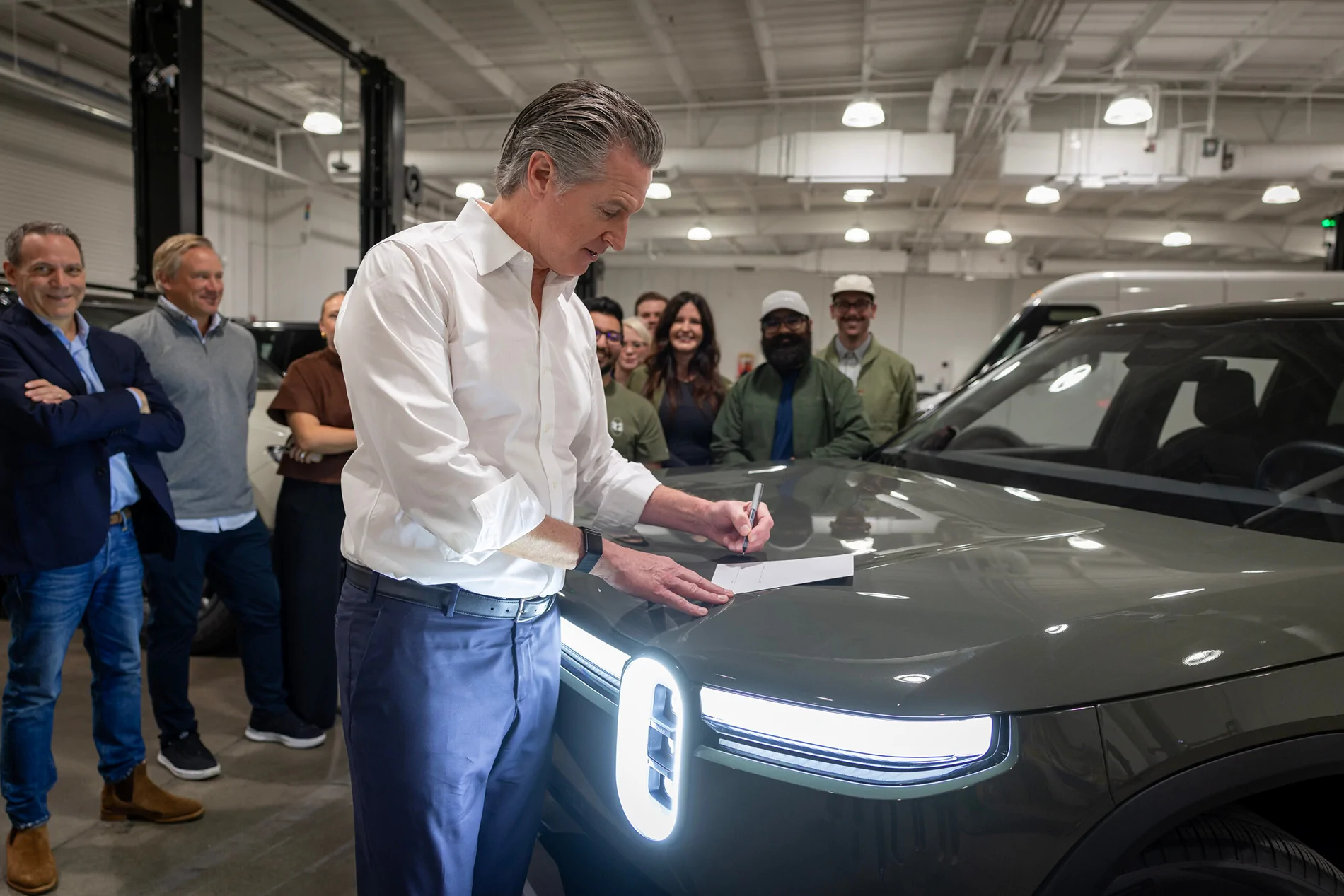
California Governor Gavin Newsom signed SB 168 today, creating a new “MyFirstEV” program that gives first-time electric vehicle buyers a $3,500 instant rebate at the dealership starting later this summer.

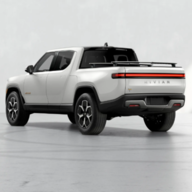
The point-of-sale discount is backed by $135.5 million in state funding, matched dollar-for-dollar by participating automakers — and a California-headquarters rule makes Rivian and Lucid the biggest winners, while Tesla qualifies only on its cheapest models.

How the $3,500 instant rebate works
Unlike the old application-based Clean Vehicle Rebate Project, MyFirstEV is an instant point-of-sale discount. Eligible buyers walk into a participating dealership and drive out with the money already off the price — no paperwork, no waiting for a check.

Here are the core rules of the program:

  • $3,500 off new EVs with an MSRP up to $50,000
  • $1,750 off used EVs sold for up to $25,000
  • First-time ZEV buyers only — confirmed by buyer attestation
  • No income cap — eligibility is gated by vehicle price, not household income
  • Curb weight limit of 8,500 pounds, restricting it to light-duty passenger vehicles
  • California residents only
The $135.5 million in state money is matched by the automakers themselves, who must opt in and cover half of each rebate. That brings the combined pool to roughly $270 million in point-of-sale savings, according to the governor’s office. The California Air Resources Board (CARB) is still finalizing agreements with automakers and dealerships, and says full details will come next month, with the program launching in the coming weeks.

The no-income-cap structure is a notable shift. California’s previous rebate programs were increasingly means-tested, reserving the biggest incentives for lower-income buyers. MyFirstEV instead uses price caps as the gatekeeper — a simpler design, but one that hands an unusual advantage to two specific automakers.

The catch: a California-headquarters loophole
Here’s where it gets interesting. The $50,000 price cap is waived entirely for EVs built by California-headquartered, EV-only automakers — companies whose corporate management and staff are based in the state as of January 1, 2026.

That carve-out was written to protect California-based manufacturers and their workers. In practice, it benefits two companies: Rivian, its engineering headquarters in Irvine apparently counts, and Lucid, based in the San Francisco Bay Area. Their cheapest models, around $58,000 for Rivian and $71,000 for Lucid, sit well above the $50,000 cap that applies to everyone else, yet they still qualify for the full $3,500.

Tesla does not. The company moved its headquarters from California to Austin, Texas, in 2021, so it no longer counts as a California-based automaker under the new rules. That means the price-cap exemption doesn’t apply to Tesla, and only its sub-$50,000 configurations of the Model 3 and Model Y qualify. The Cybertruck is out.

The framing is hard to miss given the ongoing feud between Newsom and Tesla CEO Elon Musk. The exemption rewards where a company plants its headquarters flag, not where it builds its cars — and Tesla still assembles hundreds of thousands of vehicles a year at its Fremont, California, factory.

What qualifies — and the bigger $600 million package
Plenty of mainstream EVs land under the $50,000 cap. GM has three: the Chevy Blazer EV, Equinox EV, and the Bolt, which starts under $30,000. Toyota’s bZ and C-HR crossovers start under $40,000, Hyundai’s Ioniq 5 starts around $35,000, and Ford’s Mustang Mach-E starts around $38,000.

The instant rebate is the centerpiece of a broader $600 million zero-emission vehicle package in the 2026-27 state budget, funded through Cap-and-Invest revenue and smog-abatement fees. The rest includes $150 million for the Community Air Protection Program, $135.5 million for the Clean Truck and Bus Voucher Incentive Project (HVIP), $130 million to replace polluting heavy-duty engines through the Carl Moyer Program, $35 million for clean off-road equipment, and $19.8 million for lower-income buyers through Clean Cars 4 All.

California is moving because the market needs it. After Congress repealed the $7,500 federal EV tax credit, which ended last September, US EV sales are down at least 20% in the first half of 2026. California’s own EV market share fell from nearly a quarter of new car sales a year ago to just 15.7% in the first quarter, far below the state’s 35% target for this year. The state has been signaling a backstop like this since 2024, and it now joins a patchwork of state-level EV incentives filling the gap left by Washington.
Sponsored

 

mkennedy009

Well-Known Member
First Name
Michael
Joined
Mar 11, 2026
Threads
1
Messages
65
Reaction score
88
Location
Scappoose, OR
Vehicles
2012 Triumph Bonneville T100 110th Anniversary
Occupation
Database developer
I guess the EV just got $3500 more expensive.
Cali is looking revive CARB now that smog checks are no longer legal in Cali. Can't wait for the new Tire rules. It will be a boom for Manufactures and may cost a lot of EVs. Say good bye to after market tires. Then the new rules for break dust. You will have to buy CARB approved break pads.
 

Sponsored

rvnxyz001

Well-Known Member
First Name
Ryan
Joined
Jun 30, 2026
Threads
1
Messages
123
Reaction score
123
Location
USA
Vehicles
subaru
Smog Check is not gone. California is still running the program and still requires inspections for covered vehicles. The federal fight was over California’s authority to set certain emissions and EV rules for new vehicles, not inspections of cars already on the road. Those are two completely different issues, so saying "smog checks are now illegal" is simply false.
 

mkennedy009

Well-Known Member
First Name
Michael
Joined
Mar 11, 2026
Threads
1
Messages
65
Reaction score
88
Location
Scappoose, OR
Vehicles
2012 Triumph Bonneville T100 110th Anniversary
Occupation
Database developer
Sorry. The Feds are suing CARB:
The litigation is part of a broader legal and political dispute over:
  • California's authority under the Clean Air Act.
  • EPA waivers granted to California.
  • California's 2035 zero-emission vehicle mandate.
  • Heavy-duty truck emissions and fleet requirements.
  • Whether federal law preempts state emissions regulations.
CARB lost the Waiver and because they lost the waiver they cannot restrict emissions beyond EPA guidelines. I cannot go into the details between the Waiver and the EPA guidelines, I am not that smart. I understand, CARB was way more strict than EPA and now they have to follow EPA. The waiver was to clean up Los Angeles in 1970 and they started expanding it in 2009, 2013,2022,2023 and 2024.

CARB has been a real job killer in the golden state, from my perspective.
 

UnsungZero_OldTimeAdMan

Well-Known Member
First Name
Barnum
Joined
Mar 20, 2023
Threads
69
Messages
9,039
Reaction score
12,476
Location
SoCal
Vehicles
'23 GW Quad-Large R1T "Ghost"
Occupation
Advertising Circus
Sorry. The Feds are suing CARB:
The litigation is part of a broader legal and political dispute over:
  • California's authority under the Clean Air Act.
  • EPA waivers granted to California.
  • California's 2035 zero-emission vehicle mandate.
  • Heavy-duty truck emissions and fleet requirements.
  • Whether federal law preempts state emissions regulations.
CARB lost the Waiver and because they lost the waiver they cannot restrict emissions beyond EPA guidelines. I cannot go into the details between the Waiver and the EPA guidelines, I am not that smart. I understand, CARB was way more strict than EPA and now they have to follow EPA. The waiver was to clean up Los Angeles in 1970 and they started expanding it in 2009, 2013,2022,2023 and 2024.

CARB has been a real job killer in the golden state, from my perspective.
Eh. Even if the state loses, and that’s a big if, it will install some other law to regulate emissions. This doesn’t make much real world difference.
 

Snakedoc

Member
First Name
Danny
Joined
Mar 11, 2025
Threads
0
Messages
20
Reaction score
19
Location
El Dorado Hills, Ca
Vehicles
2006 Porsche Boxster S, 2019 Hyundai Santa Fe
Occupation
Retired
This rebate favors Tesla also. Without the Model S and X, You can get a Model 3 and Y for under $50k
 

derekmw

Well-Known Member
First Name
Derek
Joined
Jul 26, 2022
Threads
10
Messages
407
Reaction score
607
Location
San Diego, CA
Vehicles
2022 R1T
Occupation
Engineer
I got my step to start the purchase/financing as the vehicle nears completion at factory but now I'm trying to stall because of this. $3500 is a good chunk to lose, possibly by weeks if I jump forward now. We are going to register it under my wife since she hasn't purchased an EV before. Just got confirmation from Rivian support that they can do this for me but they are also in a holding pattern waiting to see how this rebate will work.
 

Sponsored

NeverFollow

Well-Known Member
Joined
Aug 5, 2020
Threads
0
Messages
77
Reaction score
48
Location
A Galaxy Far Far Away
Vehicles
リビアン
We are going to register it under my wife since she hasn't purchased an EV before.
This is not clear to me.

I previously bought a Tesla and paid everything, including insurance and DMV.
But added my wife under my Tesla account, DMV, and my insurance as co-driver.

Also at the time, in 2018, CA was offering a $3,500 rebate for Clean Vehicle Rebate Project (CVRP).
And I declared my Fed and State IRS taxes under a joint household, not separate tax declaration.

Under California law, I believe that a couple share ownership, or community property,
like if you decide to get separated everything own during the marriage get split.

So can the wife of a California married couple whose husband previously bought an EV,
could take advantage of this new “MyFirstEV” program ?
 

NeverFollow

Well-Known Member
Joined
Aug 5, 2020
Threads
0
Messages
77
Reaction score
48
Location
A Galaxy Far Far Away
Vehicles
リビアン
California’s new $3,500 EV rebate favors Rivian and Lucid over Tesla
The requirement included in the bill, that a company must be headquartered in California, can be considered highly politically biased, IMO, given that Tesla is the only automaker with a factory in the state.

In contrast, Rivian manufactures vehicles in Normal, Illinois, and is currently building a plant in Georgia, while Lucid assembles its vehicles in Casa Grande, Arizona.

Encouraging the state's taxpayers to invest in those out of state EVs, rather than in in state production, does not appear to be an effective way to revitalize California's economy...

But at least those factories are located in US.


Note: It is interesting to note that California taxpayers once effectively subsidized China's steel industry by outsourcing the construction work to replace the eastern span of the Bay Bridge, a project that dragged on for over a decade.

The project faced fierce criticism not only for exceeding its budget by approximately $5 billion but also for suffering from structural issues, such as defective welding and rust.

This decision was highly controversial, particularly given the backdrop of the time: the U.S. steel industry was grappling with severe unemployment and factory shutdowns, forcing the payment of jobless benefits to thousands of workers.

It later emerged that the Chinese company lacked the capacity to execute the project, to the point where it had to build a new factory specifically for the job.

Had the work been carried out domestically, the project could have benefited the economies of the communities that sustain U.S. steel production.
 

UnsungZero_OldTimeAdMan

Well-Known Member
First Name
Barnum
Joined
Mar 20, 2023
Threads
69
Messages
9,039
Reaction score
12,476
Location
SoCal
Vehicles
'23 GW Quad-Large R1T "Ghost"
Occupation
Advertising Circus
The requirement included in the bill, that a company must be headquartered in California, can be considered highly politically biased, IMO, given that Tesla is the only automaker with a factory in the state.

In contrast, Rivian manufactures vehicles in Normal, Illinois, and is currently building a plant in Georgia, while Lucid assembles its vehicles in Casa Grande, Arizona.

Encouraging the state's taxpayers to invest in those out of state EVs, rather than in in state production, does not appear to be an effective way to revitalize California's economy...

But at least those factories are located in US.


Note: It is interesting to note that California taxpayers once effectively subsidized China's steel industry by outsourcing the construction work to replace the eastern span of the Bay Bridge, a project that dragged on for over a decade.

The project faced fierce criticism not only for exceeding its budget by approximately $5 billion but also for suffering from structural issues, such as defective welding and rust.

This decision was highly controversial, particularly given the backdrop of the time: the U.S. steel industry was grappling with severe unemployment and factory shutdowns, forcing the payment of jobless benefits to thousands of workers.

It later emerged that the Chinese company lacked the capacity to execute the project, to the point where it had to build a new factory specifically for the job.

Had the work been carried out domestically, the project could have benefited the economies of the communities that sustain U.S. steel production.
Cherry pick much?

They are HQ’ed in CA and have multiple campuses in CA. They employ thousands of CA residents, who are also CA tax payers.

And Tesla received plenty of assistance and breaks from the state in the past. Who cried unfair then? You?

On another note Lucid stock was halted yesterday after dropping 40% on rumors of discussions on filing for bankruptcy.

I’d much prefer the state spend tax dollars on this than another penny to that 0 mph high speed rail.
 
Last edited:

NeverFollow

Well-Known Member
Joined
Aug 5, 2020
Threads
0
Messages
77
Reaction score
48
Location
A Galaxy Far Far Away
Vehicles
リビアン
I’d much prefer the state spend tax dollars on this than another penny to that 0 mph high speed rail.
One reason the California High-Speed Rail (CA HSR) project is moving forward is the practical impossibility of building new airports or expanding existing ones in major California cities like Los Angeles, San Francisco, and San Diego.

As part of efforts to reduce CO2 emissions, some EU member states in Europe have begun moving to ban flights on routes where the rail travel time is less than two and a half hours. Consequently, high-speed rail stations are increasingly being established on or immediately adjacent to the premises of major airports.

By connecting Central Valley communities to coastal job centers with 220 mph trains, the California High-Speed Rail (CAHSR) project aims to reduce supercommutes and mitigate urban sprawl. This strategy targets transit-oriented development (TOD) to concentrate new growth near stations rather than endlessly expanding existing city footprints.

A key point of contention surrounding the CA HSR is the cost escalation often associated with large-scale projects. This cost issue is a major concern, particularly given that land acquisition has not yet been completed.

Furthermore, the modernization and expansion of the viaduct network represent an essential—albeit costly, undertaking. As California’s population continues to grow despite the absence of large rivers, this infrastructure development has become an increasingly critical priority.
 

UnsungZero_OldTimeAdMan

Well-Known Member
First Name
Barnum
Joined
Mar 20, 2023
Threads
69
Messages
9,039
Reaction score
12,476
Location
SoCal
Vehicles
'23 GW Quad-Large R1T "Ghost"
Occupation
Advertising Circus
One reason the California High-Speed Rail (CA HSR) project is moving forward is the practical impossibility of building new airports or expanding existing ones in major California cities like Los Angeles, San Francisco, and San Diego.

As part of efforts to reduce CO2 emissions, some EU member states in Europe have begun moving to ban flights on routes where the rail travel time is less than two and a half hours. Consequently, high-speed rail stations are increasingly being established on or immediately adjacent to the premises of major airports.

By connecting Central Valley communities to coastal job centers with 220 mph trains, the California High-Speed Rail (CAHSR) project aims to reduce supercommutes and mitigate urban sprawl. This strategy targets transit-oriented development (TOD) to concentrate new growth near stations rather than endlessly expanding existing city footprints.

A key point of contention surrounding the CA HSR is the cost escalation often associated with large-scale projects. This cost issue is a major concern, particularly given that land acquisition has not yet been completed.

Furthermore, the modernization and expansion of the viaduct network represent an essential—albeit costly, undertaking. As California’s population continues to grow despite the absence of large rivers, this infrastructure development has become an increasingly critical priority.
Yah? And how well is that working out?
Sponsored


Top