
Deleted member 30372
Guest
These phantom range figures didn’t just appear out of nowhere. Rivian has been testing the R2 for over a year, yet they opted to stick with the 330-mile range. This is concerning.
Sponsored
Yup...trust is the central issue at hand.These phantom range figures didn’t just appear out of nowhere. Rivian has been testing the R2 for over a year, yet they opted to stick with the 330-mile range. This is concerning.

You're 100% right. Do a comparison of the R2 and a Model Y on cross country trips. I did one from Los Angeles to Texas and the total travel time was off by 15 minutes. FIFTEEN MINUTES.When I'm on the highway going 70 MPH there will be plenty of high speed chargers available so a range of 250 miles is fine.
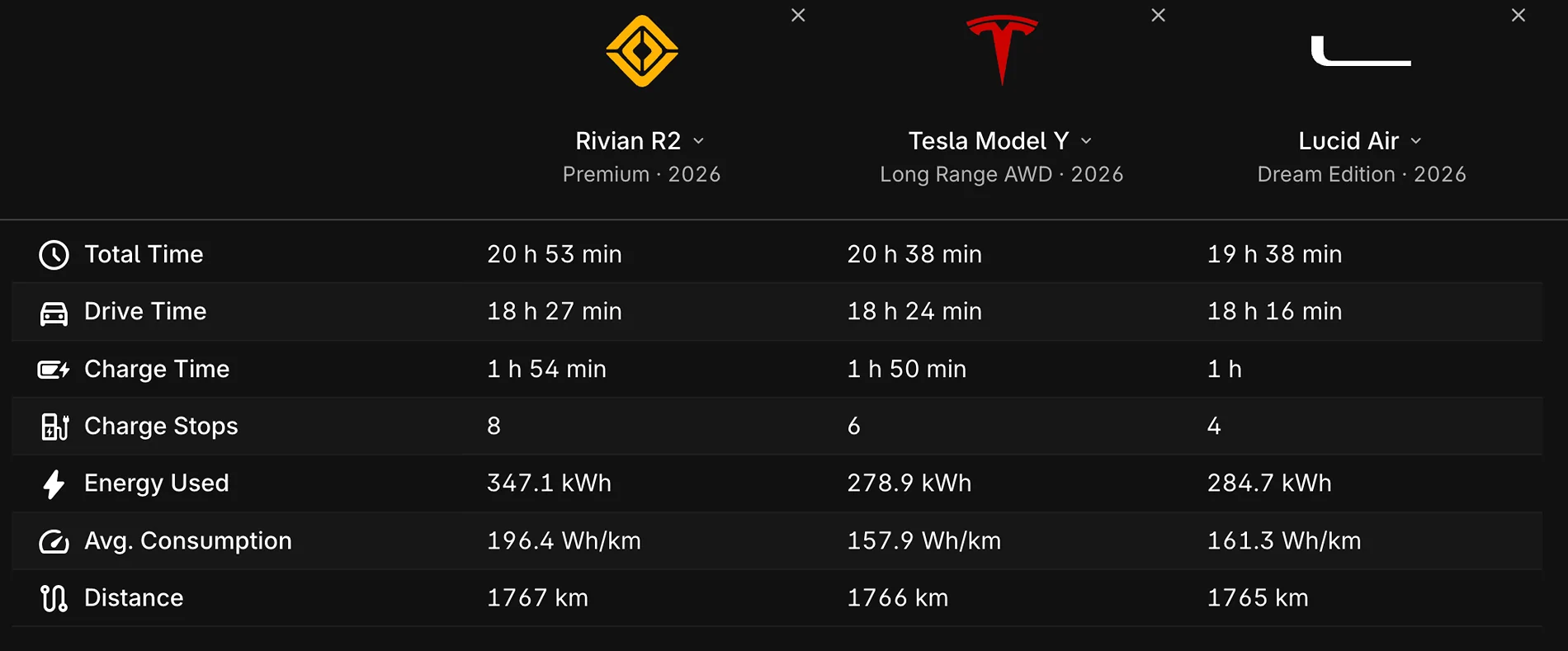
ABRP is wrong because it uses the wrong efficiencyYou're 100% right. Do a comparison of the R2 and a Model Y on cross country trips. I did one from Los Angeles to Texas and the total travel time was off by 15 minutes. FIFTEEN MINUTES.
ABRP's comparison tool was what I used.
A range of 250-300 will make you stop at basically the same chargers when on long distance trips. You'd need a car that can actually hit 400+ miles to start skipping chargers in a meaningful way and making better times. I added a Lucid Air to the mix for fun and it only beat the Y by an hour, the R2 by 1 hour and 20 minutes. That's it.
The R2's better charging curve helps it make up time against the Model Y's better efficiency. On any "range test" type long distance trip I compare the 2 against each other, there is hardly any difference in total travel time. I'm talking minutes apart for thousands of miles.


ABRP is wrong because it uses the wrong efficiency
Secondly, the navigation on ABRP is wrong.
Just simply map phoenix to las vegas
It incorrectly routes through Quartzsite instead of going straight through wickenburg.
That means the difference is 43 miles and more than 1 hr difference with rivian's real efficiency
If you map Los angeles to dallas texas, you get around 24.5 hrs using tesla trip planner and ABRP. I'm using RWD because tesla allows you to have the premium interior and sound system in all models
The currently available rivian trims only give premium sound system (even tesla standard sound system is probably better) in AWD models. ABRP says 28 hrs if you change efficiency to what out of spec reports. This would affect range
The difference is 3.5 hrs, and you get access to more tesla stations (no tesla access only 60%).
The cost difference of the vehicles is huge. RWD model Y premium has 0.99% financing. The cost difference between premium AWD R2 is about $17K
 - reference consumption has been auto-set for a SF to SD trip of 500 miles. Drive time is 7.7 hours (65 mph). 150 kWh consumed (3.33 MPK), however the default consumption is 245 wh/mi (4.08 MPK).
What is the Avg. Consumption for R2 in ABRP based on?The R2's better charging curve helps it make up time against the Model Y's better efficiency. On any "range test" type long distance trip I compare the 2 against each other, there is hardly any difference in total travel time. I'm talking minutes apart for thousands of miles.
The avg consumption seems to be based on the top line EPA numbers.. 3.55mile/kw gets one to ~ 330 miles.What is the Avg. Consumption for R2 in ABRP based on?
You're right. The reference consumption is based on.....fantasy? LOLWhat is the Avg. Consumption for R2 in ABRP based on?
I wish OoS and RivianTrackr showed the Energy Monitor/Usage screen like StateOfCharge did when he got ~260miles on 20" AllTerrains in a mostly 70mph test. Yes it was in CO, yes it had regen, yes it was at 70F with a higher climate control... but I would have loved to seen the breakdown of how much energy was spent/wasted on propulsion, hvac, a255/55R21ind compute.As others have said, for ppl on this forum and early reservations holders it’s probably not going to be that big of a deal. Not what was expected (I NEVER expected 330 miles of 70 mph highway, but I DID sort of expect 285-300 miles of 70 mph highway range).
for anyone here with an R1S, or maybe even R1T, it’s a bit more of a disappointment because they know what those larger battery Rivian can do, ~ 300-320 highway miles sometimes, and they figured smaller vehicle, TWO THOUSAND POUNDS LESS WEIGHT!, 3-4 YEARS of additional engineering evolution if not revolution should be possible.. so It’s certainly plausible that they should be able to mirror they USE CASE experience of their current vehicle (R1S or maybe R1T) and travel the same way, same stops, same speeds, etc..
But, alas it’s not going to be same same.
But, for a new buyer to EV (which Rivian is 100% counting on to make target sales figures of 200-300K PER YEAR for this vehicle) their number one issue for new buyers is RANGE ANXIETY.. (ok, it could be price, but price aside just a bit).
They don’t know what it’s like to drive an EV, stop maybe more frequently than with an ICE vehicle. How good charging CAN be in most of the country highways, etc..
They look at 330 and think “that’s pretty acceptable, I can make the jump”: but when it’s 20-25% LESS Than that they might just reconsider a different vehicle altogether.
So I’m not totally surprised, but it’s arguably less than I realistically expected.. and Im really just MORE surprised that my 8+ year old TM3LR, can do at least this range, and certainly better efficiency at LEAST 3.5M/kw, if not most of the time 4-4.2m/kw even when highway driving.
I sort of thought that we really would get a bigger evolutionary leap for overall EV engineering.
400 is way too high, it’s likely between ~300 and 350 or so…333 being 3.0 MPK at 65 MPH…You're right. The reference consumption is based on.....fantasy? LOL
I changed it to 400Wh/mi and, well, the time gap increased between it and a Model Y. That being said, the "5 minute" stops would likely be longer in both cars, as I would need to pee and walk the pup, so that does help a bit.
Still, 400Wh/mi is really high for a car with 88kWh of usable battery. I drive large 150 mile stretches of Texas highway at 75mph when I go on trips - and that seems to be quite a challange for R2, and it's not even winter yet.
My scenario is:400 is way too high, it’s likely between ~300 and 350 or so…333 being 3.0 MPK at 65 MPH…

I was also using something near 400 Wh/mi for low ambient temp near freezing. The other thing I noticed there is an option in ABRP in the side panel at the bottom of the "Routing" section where you can change the temperature from seasonal to manual so I've been experimenting with that too. Not sure if there's a difference, but I was trying to see how that changes versus adjusting the consumption.You're right. The reference consumption is based on.....fantasy? LOL
I changed it to 400Wh/mi and, well, the time gap increased between it and a Model Y. That being said, the "5 minute" stops would likely be longer in both cars, as I would need to pee and walk the pup, so that does help a bit.
Still, 400Wh/mi is really high for a car with 88kWh of usable battery. I drive large 150 mile stretches of Texas highway at 75mph when I go on trips - and that seems to be quite a challange for R2, and it's not even winter yet.
I dont think sensors will have any impact on the energy usage...compared to AC/motors this is a very low energy drainers...I do agree we should know where is room for improvement or if this is already the best They can do (which is very bad since the EPA sets a totally different expectation) I planned to replace my Lyriq by the R2 but since it does 315miles on road I'll probably cancel my R2 reservation and keep my car. Too much difference to ignore.I wish OoS and RivianTrackr showed the Energy Monitor/Usage screen like StateOfCharge did when he got ~260miles on 20" AllTerrains in a mostly 70mph test. Yes it was in CO, yes it had regen, yes it was at 70F with a higher climate control... but I would have loved to seen the breakdown of how much energy was spent/wasted on propulsion, hvac, a255/55R21ind compute.
I'm not saying either test had issues... i just wanted to see the cost of hvac and highway assist which software/hardware optimizations may be able to improve... or in the case of LIDAR/RAP, possibly degrade to running more sensors.


