Sponsored

Charging R1T at 30amp RV site Question

VSG

Well-Known Member
Joined
Oct 3, 2022
Threads
4
Messages
3,417
Reaction score
6,532
Location
WA
Vehicles
R1T LE/RB/OC/20
Can you charge with an adapter, yes.

Should you charge with an adapter, I wouldn't.

The reason being is some of those campsite light posts were installed decades ago and who knows what state those wires and connections are in and if they will be able to handle 30amps continuous load? As such, ask any RV owner if the plug directly into one of those posts without a surge protector (a good one will set you back $200) and many will say no. I'm an RV owner and I've plugged into more than one of those posts in the past year that has tripped my surge protector and had to move sites. For that reason, it's not worth hosing the $$$ electronics in your Rivian.
Oh come on, what does that have to do with using an adapter? The wiring in an RV park is going to be suspect whether you use an adapter or not. And all the electricity goes through your portable charger first before it gets to the vehicle. If anything is going to be damaged, it's the portable charger. And I highly doubt that will be a problem, but if it bothers you then use the same surge protector you would use for an RV.

And remember the problem with RVs is typically things like A/C units which have huge inrush/startup currents, and the RVs themselves which tend to have inexpensive and minimal electronic control of the input power. With the portable charger, it controls the amount of current flowing and has a effective soft-start built-in as well. You're not going to see an overvoltage or an overcurrent at the vehicle.

I've been charging my R1T at campgrounds and RV parks for four years. Mostly off the 50A, because that's the most common plug, but often off a TT-30 outlet using an adapter. I've never had a problem, even when the outlets were beat up and would barely hold the plug in place.
Sponsored

 

SwampNut

Well-Known Member
First Name
Carlos
Joined
Apr 22, 2024
Threads
55
Messages
3,797
Reaction score
4,034
Location
Peoria AZ
Vehicles
2022 R1T Launch Edition
Occupation
Geek
Clubs
 
I've been regularly camping since childhood and am 61. I/we plugged into hundreds or potentially thousands of random, usually shitty electrical posts since I grew up poor-ish. Never owned a protector, never had anything blow up. It's apparently snake oil.

On top of that, the switching power supplies that make up our chargers can handle absolute garbage power at mostly any voltage between 100 and 250, with some J spec chargers able to do 90-277. Dirty power? Who cares. Voltage ripples? Who cares.
 

ElGuano

Well-Known Member
Joined
Oct 9, 2024
Threads
51
Messages
893
Reaction score
1,263
Location
Cali
Vehicles
R1T Trimax - Storm Blue, Driftwood, Sport Dark
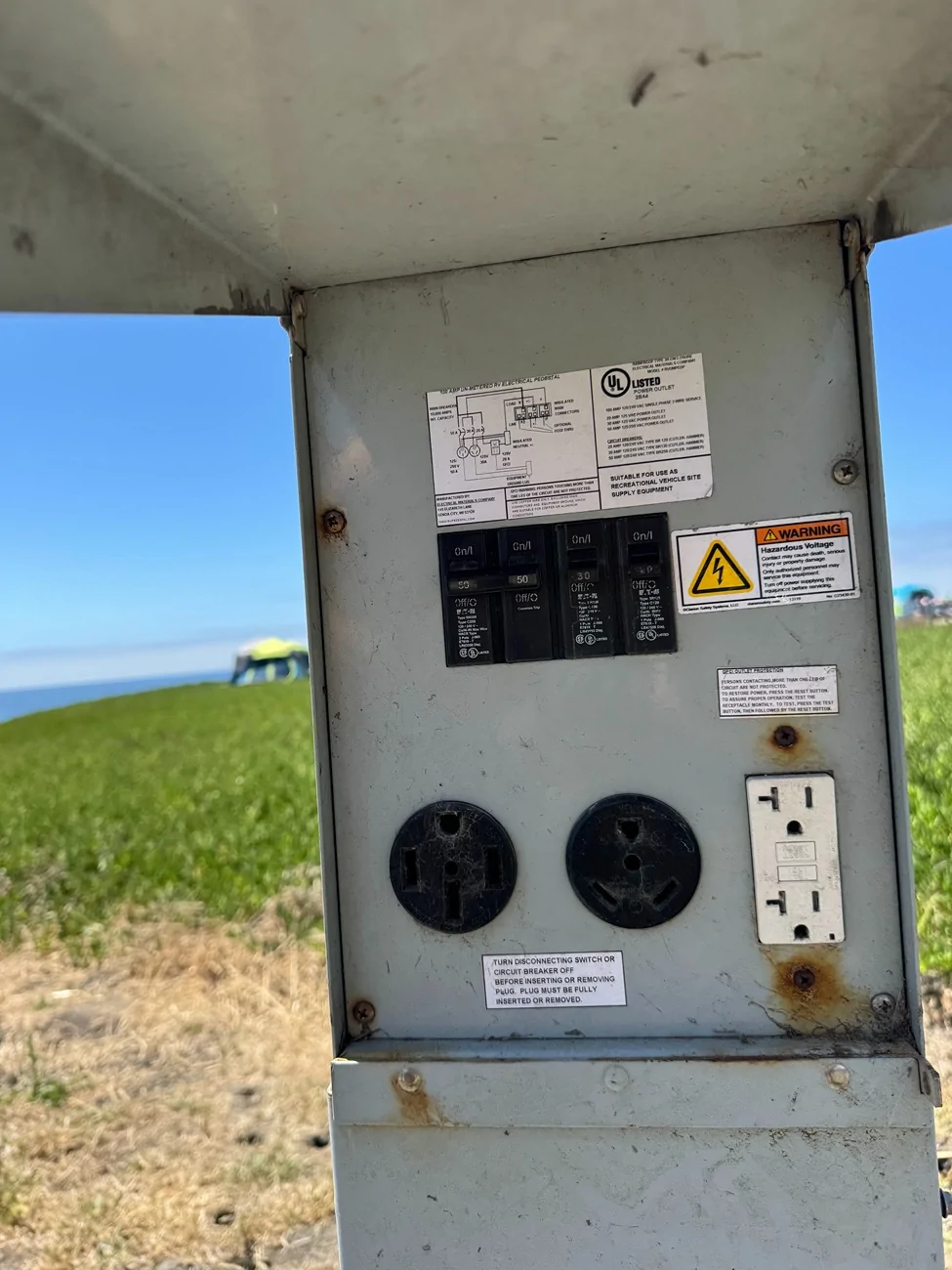
Just got back from a nice camping trip btw, here's the pedestal they had - 20/30/50 amp supported.
Rivian R1T R1S Charging R1T at 30amp RV site Question IMG_6091

No fee for charging, no prohibition against EVs. It made me think, at what point could a campsite reservation be cheap enough to justify booking a night just to charge your car?
 

VSG

Well-Known Member
Joined
Oct 3, 2022
Threads
4
Messages
3,417
Reaction score
6,532
Location
WA
Vehicles
R1T LE/RB/OC/20
Varies wildly of course, but a lot of campgounds (mostly state parks) where I stay on road trips charge about $30/night, with a 50A hookup where I can charge from 10% to 100% overnight. Totally worth it.
 

babock

Well-Known Member
First Name
Bruce
Joined
Dec 6, 2024
Threads
5
Messages
146
Reaction score
112
Location
Los Angeles and South Lake Tahoe
Vehicles
2025 Rivian R1T, 2024 GMC Denali 2500HD, 2022 Hyundai SantaFe PHEV
Occupation
Retired Electrical Engineer
You need an adapter. It's an unusual adapter. It's sort of dangerous. Here's why: The 50 amp connector is wired for 240 V between the the line terminals--there is no neutral conductor--the 3rd pin is safety ground. The 30 A connector at the RV site likely has 120 V between each of the line terminals and the neutral pin. Here's the catch--the voltsge between the line terminals is zero! The supply is not split phase as it is in most wiring. This i because RVs have no 240 V appliances. Their load center is wired differently. You need s special adapter that connects one of the 50 A connectors pins to one of line conductors on the 30 A plug. The other pin to on the 50 A pin connector is connected is connected to neutral on the 30 A side. The remaining connector on the 30 A connector. If you use such an adapter on a 240 V appliance, such as a dryer, it could cause damage. The adapter should be labeled NOT for RV use and for charger use only and a maximum of 24 A. You can achieve a maximum of 2.8 KW charge rate.
BTW, the Tesla L1 charger has available adapters for several kinds of plugs. They also automatically set the current limit.
This is not correct. Maybe you found a campground that had it wired this way but that is not the norm. Many RVs have 240V appliances...dryers are one example. Inductive cooktops are another.

In addition, if it was actually wired this way, the neutral would have to be twice the size of the two hotlines...I highly doubt that.

BTW..the 30A adapter only uses one of the lines anyway so it doesn't matter if they already fed the same line to both hot legs
 
Last edited:

Sponsored

babock

Well-Known Member
First Name
Bruce
Joined
Dec 6, 2024
Threads
5
Messages
146
Reaction score
112
Location
Los Angeles and South Lake Tahoe
Vehicles
2025 Rivian R1T, 2024 GMC Denali 2500HD, 2022 Hyundai SantaFe PHEV
Occupation
Retired Electrical Engineer
Can you charge with an adapter, yes.

Should you charge with an adapter, I wouldn't.

The reason being is some of those campsite light posts were installed decades ago and who knows what state those wires and connections are in and if they will be able to handle 30amps continuous load? As such, ask any RV owner if the plug directly into one of those posts without a surge protector (a good one will set you back $200) and many will say no. I'm an RV owner and I've plugged into more than one of those posts in the past year that has tripped my surge protector and had to move sites. For that reason, it's not worth hosing the $$$ electronics in your Rivian.
A 30A outlet should not be charged at 30A continuous...you use a 80% derate factor so you use 24A.
 

Mathme

Well-Known Member
First Name
Matt
Joined
Jul 25, 2022
Threads
3
Messages
1,384
Reaction score
1,819
Location
Los Altos, CA
Vehicles
R1T: El Cap, OC, 20AT, Off road package
Occupation
High Tech
A 30A outlet should not be charged at 30A continuous...you use a 80% derate factor so you use 24A.
correct they should be at 80%. I’d still be leery of those rickety old posts in a campground. I’m even nervous with my RV that’s not pulling constant current.
 

Dark-Fx

Well-Known Member
First Name
Brian
Joined
Jul 15, 2020
Threads
155
Messages
13,894
Reaction score
28,282
Location
Michigan
Vehicles
R1S, Livewire One, Sierra EV, R1S, R2
Occupation
Engineering, Dog Petting, Tesla Shill Spotter
Clubs
 
Many campground's power is marginal at best even before EVs came around. That's why I have an EMS in my trailer that cuts my power in the case of low voltage which is common at campgrounds when its warm out and everyone is running AC.
For campgrounds that only have TT-30s, I set my camper up with an inverter that can boost voltage off battery power and passthrough my camper to my EV.

It also reduces those questions about plugging the EV in to charge... I can completely disconnect my camper from the campground power and the EV will keep charging for a few hours off the battery system in the camper. More if it's a heavy solar day.

An added benefit is I can charge a little faster than the 24A circuit provides because of the solar boost and battery storage. If we're planning on going somewhere during the day, I pull extra energy out of the camper battery and the camper battery will get recovered from solar and the campground power when we're gone, so we aren't "missing out" on the energy from that time period.
 

Weck

Well-Known Member
Joined
May 9, 2025
Threads
1
Messages
117
Reaction score
87
Location
MKE
Vehicles
2025 R1T
This is not correct. Maybe you found a campground that had it wired this way but that is not the norm. Many RVs have 240V appliances...dryers are one example. Inductive cooktops are another.

In addition, if it was actually wired this way, the neutral would have to be twice the size of the two hotlines...I highly doubt that.

BTW..the 30A adapter only uses one of the lines anyway so it doesn't matter if they already fed the same line to both hot legs
Um yeah... Without even ever wiring a 14-50 outlet yourself, the mere fact there are FOUR pins alone should have been a clue...

Two hots and a neutral at 6AWG, the ground can be 10AWG iirc, copper. If wired correctly of course...
 

JacobAZ

Well-Known Member
Joined
May 13, 2025
Threads
1
Messages
128
Reaction score
152
Location
Heber, AZ
Vehicles
2025 R1T dual large
You need an adapter. It's an unusual adapter. It's sort of dangerous. Here's why: The 50 amp connector is wired for 240 V between the the line terminals--there is no neutral conductor--the 3rd pin is safety ground. The 30 A connector at the RV site likely has 120 V between each of the line terminals and the neutral pin. Here's the catch--the voltsge between the line terminals is zero! The supply is not split phase as it is in most wiring. This i because RVs have no 240 V appliances. Their load center is wired differently. You need s special adapter that connects one of the 50 A connectors pins to one of line conductors on the 30 A plug. The other pin to on the 50 A pin connector is connected is connected to neutral on the 30 A side. The remaining connector on the 30 A connector. If you use such an adapter on a 240 V appliance, such as a dryer, it could cause damage. The adapter should be labeled NOT for RV use and for charger use only and a maximum of 24 A. You can achieve a maximum of 2.8 KW charge rate.
BTW, the Tesla L1 charger has available adapters for several kinds of plugs. They also automatically set the current limit.
The above is not totally correct. Short explanation, The EV adapter connects one of the 14-50 pins to the TT30 Neutral pin. Details ... A 14-50 has two hots, a neutral and a ground pin. A campground TT30 has one hot, one neutral, and a ground. The adapter is needed to make a complete circuit. The campground TT30 completes a circuit from the hot pin to the neutral pin. However, the EVSE with the 14-50 pigtail plugged in ignores it's neutral pin and expects to complete the circuit via the two hot pins (240 volt circuits are two 120 volt lines acting as a complete circuit). So the EV tt30 adapter internally wires one of the 14-50 hot pins to the neutral pin on the TT30 side of the adapter. With this configuration the campground TT30 delivers 120v to one of the 14-50 hot pins and to the EVSE. The EVSE is happy with just the 120 volts coming in on one pin of the 14-50 end and can complete the circuit sending current out the other hot pin on the 14-50 end which connects to the neutral on the TT30 end. This wiring is safe. Nothing dangerous. As others have said, in the Rivian limit the amps to 24 max or you may pop the campground breaker.
 

SwampNut

Well-Known Member
First Name
Carlos
Joined
Apr 22, 2024
Threads
55
Messages
3,797
Reaction score
4,034
Location
Peoria AZ
Vehicles
2022 R1T Launch Edition
Occupation
Geek
Clubs
 
The above is not totally correct. Short explanation, The EV adapter connects one of the 14-50 pins to the TT30 Neutral pin. Details ... A 14-50 has two hots, a neutral and a ground pin. A campground TT30 has one hot, one neutral, and a ground. The adapter is needed to make a complete circuit. The campground TT30 completes a circuit from the hot pin to the neutral pin. However, the EVSE with the 14-50 pigtail plugged in ignores it's neutral pin and expects to complete the circuit via the two hot pins (240 volt circuits are two 120 volt lines acting as a complete circuit). So the EV tt30 adapter internally wires one of the 14-50 hot pins to the neutral pin on the TT30 side of the adapter. With this configuration the campground TT30 delivers 120v to one of the 14-50 hot pins and to the EVSE. The EVSE is happy with just the 120 volts coming in on one pin of the 14-50 end and can complete the circuit sending current out the other hot pin on the 14-50 end which connects to the neutral on the TT30 end. This wiring is safe. Nothing dangerous. As others have said, in the Rivian limit the amps to 24 max or you may pop the campground breaker.
100% accurate. This is easy to test on the adapter (I have). It is easy to replicate this for custom applications like a generator (I have). I've also tested running the EVSE on 100-150-ish volts using a variable autotransformer--it doesn't care. Everyone other-thinking this and calling it dangerous is just completely wrong.

RVs have vastly more sensitive parts, such as motors that may be damaged by under-voltage.
Sponsored


Top